
On this page
Start here
Quick answer
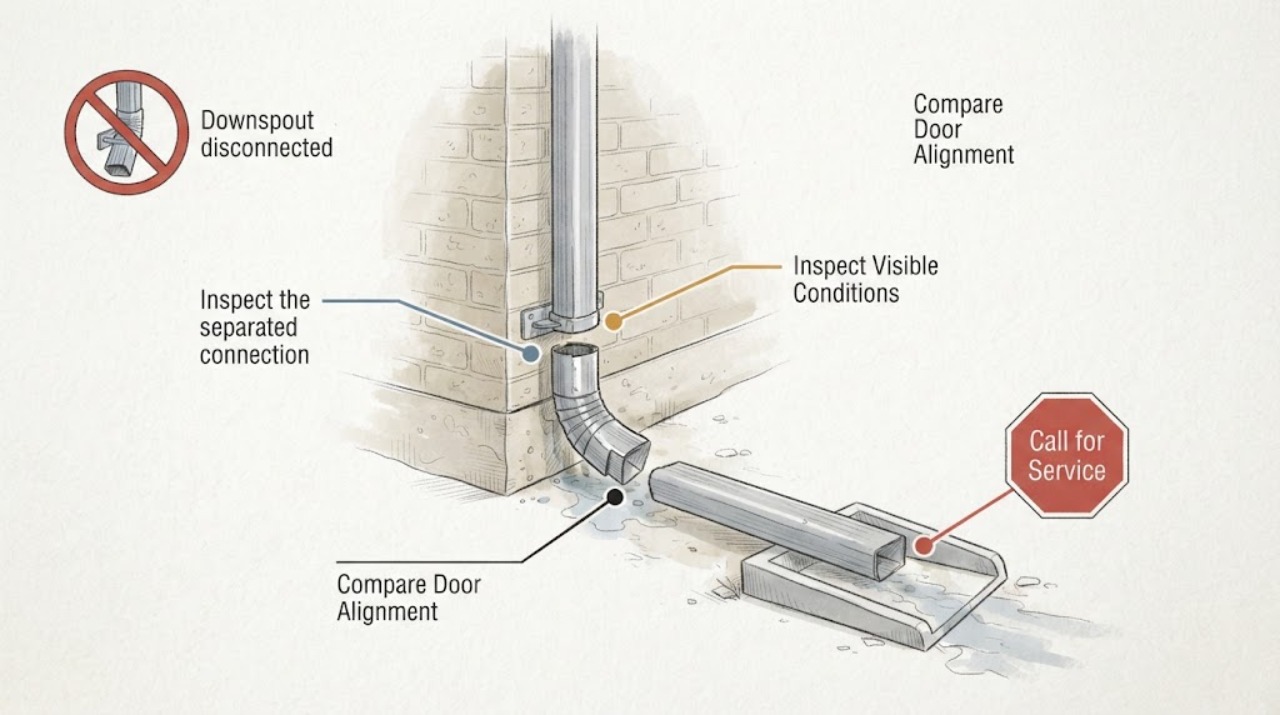
A disconnected downspout can send roof runoff beside the foundation, onto a walkway, or into an area that erodes or floods. From ground level, photograph the separated connection, the discharge direction, wall attachments, and any pooling or foundation impact. Keep clear of unstable pieces and postpone inspection during lightning, high wind, or active flooding. Do not climb to the roof, use a ladder, dig for a buried outlet, or redirect water into a neighbor's property or an unknown drain. A gutter professional can confirm the connection, support, extension, and locally appropriate discharge path.
Work through in order
Diagnostic checks
Use only checks that match the exact appliance or system and its official guide.
-
Inspect the separated connection from the ground
From stable ground, photograph the lower connection and any visible elbow, seam, collar, or extension. Note whether the parts are fully separated, partially overlapped, crushed, corroded, blocked, or simply no longer aligned. Do not pull on the downspout or reach above shoulder height.
Expected result: A clean separation with intact parts suggests a connector or fastener issue; crushed, split, corroded, or missing parts suggest replacement or a wider inspection. Water escaping at a seam during rain identifies a discharge point, not necessarily the original failure.
Next step: Save a close-up and a wide photo showing the wall, grade, walkway, and receiving area. Keep loose sections undisturbed until service, especially if a piece could fall or obstruct a path.
Stop if: Stop if the section is hanging, sharp, unstable, near power lines, or only reachable with a ladder, roof access, climbing, or force. Call a gutter professional.
Why this matters
Why: The observed connection and damage determine whether a professional can plan a localized connector repair or needs to inspect the gutter run and supports for movement or overload.
-
Check visible wall support and alignment
Walk only on stable ground and view the downspout vertically from the side and front. Note missing or pulled-out straps, a bowed or leaning run, gaps at joints, dents, loose siding attachments, and whether the lower section still points toward its intended outlet. Do not climb, remove siding, or inspect the roof edge.
Expected result: A straight run with one failed support differs from a sagging run with several separated seams; the latter can indicate movement or loading that will make a single connector repair unreliable. A damaged wall attachment may require a professional to protect the cladding before securing the pipe.
Next step: Photograph each visible support and write down whether separation appeared after wind, impact, ice, or a recent gutter cleaning. Give that history to the service professional rather than testing the pipe by pulling or hanging anything from it.
Stop if: Stop if support is above safe ground-level reach, the gutter or fascia is moving, there are overhead lines, or wind makes the section unstable. Do not use a ladder or roof access.
Why this matters
Why: Alignment and support affect whether water reaches the outlet and whether a replacement connector or strap is compatible with the existing system. They also show whether the problem may extend above the visible ground-level section.
-
Trace the discharge and look for ground-level damage
From the perimeter, observe where rainwater leaves the downspout and where it flows during or shortly after safe, light rain. Note pooling beside the foundation, splash marks, soil erosion, washout, a wet basement or crawlspace edge, slippery pavement, or water crossing a walkway. Do not dig for a buried pipe, enter floodwater, or inspect during a storm.
Expected result: Water ending beside the foundation, on a walkway, or in an eroding low spot indicates that the outlet path needs attention in addition to the disconnected joint. A buried outlet that appears blocked or backs up cannot be safely diagnosed by probing from above.
Next step: Photograph the water path, affected soil or surfaces, and any interior dampness visible without opening finishes. Keep the receiving area clear and ask the professional to confirm a locally permitted, stable discharge destination.
Stop if: Stop for moving or deep water, electrical hazards, active lightning or high wind, a sinkhole-like depression, unstable soil, suspected buried utilities, or any need to excavate or enter a flooded area.
Why this matters
Why: EPA moisture guidance connects roof drainage and site grading with keeping water away from the foundation. The discharge observation helps a professional evaluate the extension, outlet, grade, and any secondary building damage.
-
Decide whether the situation needs urgent service
Answer yes or no from the ground: is water entering the building, is the foundation or soil visibly washing out, is the loose gutter or downspout a falling hazard, is a walkway becoming unsafe, or did the separation occur with roof or fascia damage after a storm?
Expected result: Yes means keep people away and request prompt gutter, drainage, or building-water service; no means schedule a routine repair while continuing to monitor the outlet and foundation from safe ground.
Next step: Share wide and close-up photos, storm timing, the discharge destination, visible support damage, and any interior dampness with the service professional. Do not improvise an above-ground or buried reroute.
Stop if: Stop all inspection for falling components, roof or fascia movement, flooding, power-line proximity, structural movement, or unsafe storm conditions.
Why this matters
Why: A disconnected downspout can be a small fitting failure or a symptom of storm damage and drainage failure. The urgency depends on the safety and water impact, not on the size of the visible gap alone.
Use your observations
Decision map
Find the observation that best matches what you see, then follow the next safe action.
-
PATH 01Safety boundary
What you see
Parts are stable and reachable from the ground, the wall support is intact, and there is no foundation or walkway damage.
Do this next
Arrange a gutter repair or use a compatible connector, strap, or extension only after the discharge path and local requirements are confirmed. Preserve the photos and do not force parts together.
Why this path and its safety boundary
Safety stop: Do not climb, use a ladder, drill into unknown surfaces, or redirect water to an unapproved or unsafe location.
-
PATH 02Safety boundary
What you see
Several seams are separated, straps are missing, the run is bowed, the fascia or gutter edge is damaged, or the problem followed wind, ice, impact, or roof work.
Do this next
Request professional gutter and exterior inspection. Keep clear of the hanging or moving section and provide ground-level photos; do not access the roof to investigate.
Why this path and its safety boundary
Safety stop: Stop for unstable components, overhead lines, high wind, roof access, or any need for ladder work.
-
PATH 03Safety boundary
What you see
Runoff pools at the foundation, crosses a walkway, erodes soil, enters a basement or crawlspace, or appears to back up from a buried outlet.
Do this next
Request prompt gutter and drainage assessment and report the full water path. Keep people out of floodwater and away from unstable soil; a water-damage professional may be needed if interior materials are wet.
Why this path and its safety boundary
Safety stop: Do not excavate, probe buried drainage, enter floodwater, or inspect during unsafe storm conditions.
Helpful context
Understand the symptom
Start at ground level
The visible separation may be a slipped connector, a failed fastener, impact damage, a clogged or overloaded section, or movement in a buried outlet. You can document the pattern from the ground, but the photo cannot prove whether the upper gutter or roof edge is also damaged.
The outlet matters as much as the joint
EPA guidance explains that downspouts and leaders should carry roof water away from the building and that redirecting runoff is not appropriate in every location. The receiving area, local rules, slope, buried utilities, and neighboring properties all matter; a replacement piece is not automatically a safe drainage design.
Protect the building while arranging service
Keep foot traffic away from a loose section, avoid walking through runoff, and record whether the foundation, siding, basement, crawlspace, or walkway is becoming wet. If water is entering the building, the soil is washing out, or the discharge cannot be safely observed, request prompt gutter and drainage service.
Only after diagnosis
Potential parts
- downspout connector
Only consider a connector when ground-level observations show an otherwise intact, compatible downspout separated at a visible joint and the discharge path is safe.
Confirm the existing downspout shape, dimensions, material, and joint orientation before ordering; final fit must be checked on site. - wall strap
A strap is relevant only when the downspout is otherwise serviceable but a visible support is missing or failed; it does not repair damaged fascia, siding, or unstable structure.
Confirm the wall surface, fastener requirements, pipe profile, and local installation constraints before selecting a strap. - downspout extension
An extension may be relevant when the connection is restored but the current outlet releases water beside the building or onto a walkway; it must not create a new property, erosion, or code problem.
Confirm the receiving grade, outlet destination, local rules, and connection size; do not assume a buried or flexible extension is suitable without site review.
When checks do not resolve it
Need a professional?
Call a gutter professional promptly when the run sags, multiple joints separate, the fascia or roof edge may be damaged, a component could fall, or runoff is reaching the foundation, walkway, basement, crawlspace, or a neighboring property. Use water-damage or structural help when building materials or soil are affected.
Have this ready
- Provide ground-level overview and close-up photos, connection and support locations, the discharge destination, pooling or erosion, storm or impact timing, visible interior dampness, and any overhead-line or access constraint.
Common questions
FAQ
Can I climb up and reconnect the downspout myself?
Do not use a ladder or roof access for this inspection. Photograph what is reachable from the ground and arrange gutter service if the connection, support, or upper system cannot be safely assessed.
Can I send the disconnected downspout into a buried pipe?
Do not assume that is safe or permitted. The destination, slope, buried utilities, local rules, foundation, and neighboring property all need to be considered before a buried reroute.
Why does a small downspout gap matter?
The gap can release concentrated roof runoff beside the foundation, across a walkway, or into an eroding low spot. Record the water path and arrange repair if those impacts appear.
When is a disconnected downspout urgent?
Request prompt service when a component can fall, water enters the building, soil washes out, a walkway becomes unsafe, several joints separate, or the issue follows roof or fascia storm damage.
Read the exact guide
Official sources
- Soak Up the Rain: Disconnect / Redirect DownspoutsU.S. Environmental Protection Agency · downspout runoff direction, discharge context, and local-condition cautions
- Moisture Control Guidance for Building Design, Construction and MaintenanceU.S. Environmental Protection Agency · roof drainage, downspout leaders, foundation moisture control, and site drainage
Community feedback
Share a repair observation
Share a plain-text repair observation. Accepted observations are published automatically; this page may take a moment to update.