
On this page
Start here
Quick answer
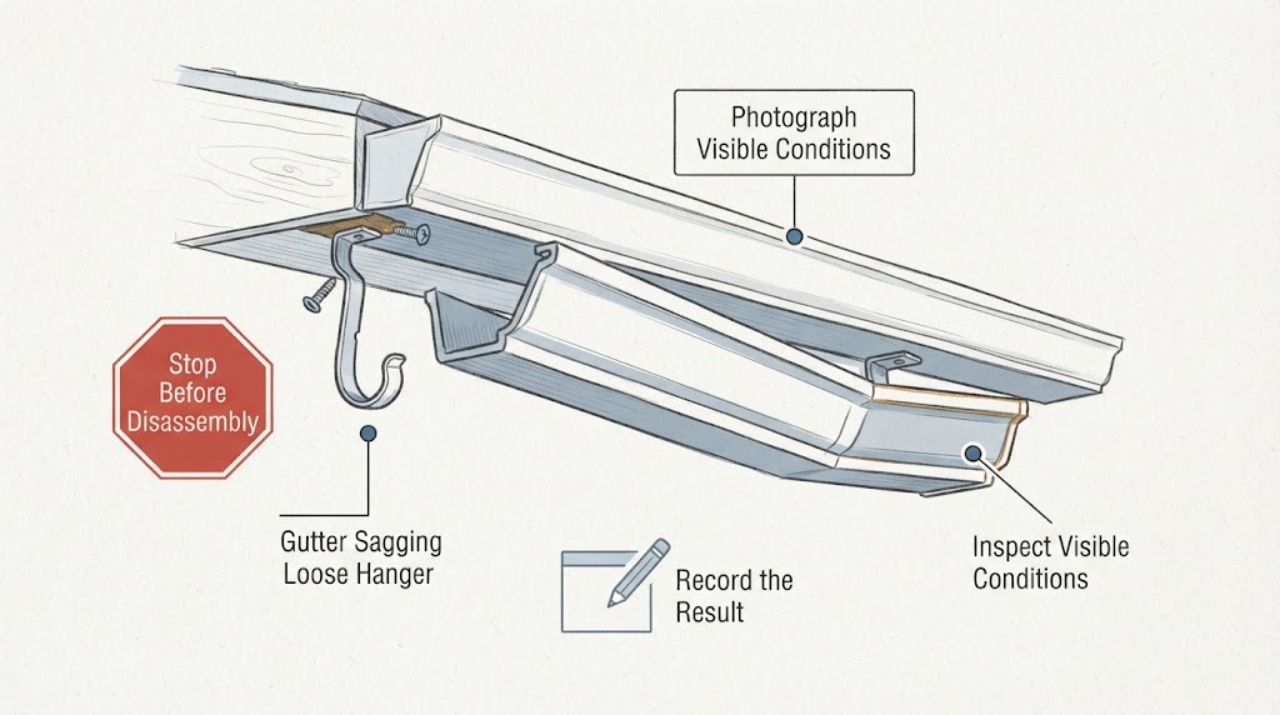
A loose hanger can let a gutter drop out of its designed fall, so water may pool at the low spot, spill over the front or back, or pull the gutter and its fasteners farther from the fascia. Start from a safe ground-level position: photograph the full run, compare the low point with nearby supports, and observe the water path during light rain if that can be done without climbing or touching the gutter. Manufacturer installation guides use regular, product-specific hanger or strap spacing and a deliberate fall toward the downspout, so do not assume that tightening one visible fastener is the complete repair. Stop and arrange qualified gutter or roofing service if the gutter is pulling away, the fascia is split or soft, more than one support is loose, water is entering near a wall or door, or inspection would require a ladder, roof-edge access, lifting the gutter, or fastening into uncertain material.
Before you begin
Safety first
- Do not climb onto the roof, use the gutter as a handhold, lean a ladder against it, reach beyond a stable position, lift a loaded section, drill into uncertain fascia, or apply force to pull the gutter back into line. Leave the area below an unstable section clear and stop for exposed roof-edge materials or active water entry.
Work through in order
Diagnostic checks
Use only checks that match the exact appliance or system and its official guide.
-
Check 1
From the ground or another stable, ordinary viewing position, photograph the entire gutter run and take closer images of the low point, the suspected hanger, both end areas, joints, and the downspout outlet. Do not touch the gutter or use it for support.
Expected result: One support appears loose while the gutter remains straight nearby; several adjacent supports are low or pulled out; the gutter is separating from the fascia; or the fascia itself looks cracked, bowed, or soft.
Next step: Mark the locations in the photographs and arrange service if any support is pulled out, the gutter is separating, or the substrate looks damaged. Do not load the run or attempt a high-level repair to confirm the diagnosis.
Stop if: Stop the inspection if the gutter is unstable, a section is hanging over a walkway or entry, or a closer view would require climbing, a ladder, or leaning on the gutter.
Why this matters
Why: One isolated hanger pattern is more consistent with a localized attachment problem. Several displaced supports or damaged fascia make a simple hanger retightening less likely to be durable and raise a structural attachment concern.
-
Check 2
During or shortly after light rain, observe the water path from the ground without standing beneath a discharge. Note whether water travels toward the downspout, pools at the sag, spills over the front or back, leaks at a joint, or bypasses the outlet.
Expected result: Water reaches the low point and remains there; water moves normally to the outlet but spills at the sag; the outlet has little or no flow; or a joint leaks while the main run drains.
Next step: Record the weather and exact spill locations. Arrange a gutter service assessment when water is pooling, spilling toward a wall or entry, or the outlet does not drain; do not clear a high outlet or dismantle a joint from a ladder.
Why this matters
Why: Pooling or overflow at one low point supports a changed fall or local support issue. Little outlet flow makes a downspout or outlet restriction possible, while a joint-only leak points toward a seam or seal problem rather than proving the hanger is the only fault.
-
Check 3
From a safe viewing position, compare the sagging section with nearby support points and the visible fascia line. Look for a missing or backed-out fastener, a bent or broken hanger, an uneven support interval, an open joint, or a fascia board that has split, bowed, or changed color.
Expected result: The hanger is visibly damaged but the fascia line looks sound; the fastener has pulled from a split or soft-looking board; several support intervals are displaced; or the gutter body and joint are distorted.
Next step: Give the photographs to the service provider and ask them to verify the exact gutter profile, support method, fascia or structural backing, fall, joints, outlet, and downspout as one system. Do not drill, remove fasteners, or choose a replacement by appearance.
Stop if: Stop if the backing cannot be identified safely, the roof edge or flashing is exposed, or any check would require force or elevated access.
Why this matters
Why: A damaged hanger with sound-looking backing may be a component issue, but a fastener pulled from deteriorated backing can make a new hanger fail again. Multiple displaced intervals or a distorted gutter point to a wider run or impact problem.
-
Check 4
Note what changed before the sag appeared: wet leaves or standing water, ice or snow, a heavy guard, a branch or storm impact, recent fascia or roof work, or a recurring overflow. Photograph any debris or visible impact from the ground without reaching into the run.
Expected result: The sag followed a storm or impact; the run carries persistent debris or standing water; a guard or other added load is present; or no unusual load or event is apparent.
Next step: Keep people and property clear of an unstable section and arrange an assessment of the full run, including supports and drainage. Only remove loose material that is reachable without climbing or reaching into an unstable gutter, and follow the product instructions if any ground-level maintenance is attempted.
Why this matters
Why: A recent impact or added load can affect more than the first visibly loose hanger. Persistent debris or standing water can add load and may also indicate an outlet or fall problem; no visible trigger does not rule out hidden fastener or substrate failure.
-
Check 5
Prepare a service handoff with the gutter material and profile if known, approximate run and outlet locations, photos, when the sag began, rain or storm timing, water behavior, fascia observations, and whether there are interior stains or wet areas nearby. Do not order a hanger or gutter section before the attachment and drainage pattern is confirmed.
Expected result: The evidence points to one loose hanger, several failed attachments, damaged backing, a deformed gutter or joint, or an outlet and fall problem.
Next step: Ask a qualified gutter or roofing professional to confirm the cause and the system-specific repair from safe access. Leave the gutter unloaded and stop using the area below it if it is pulling away or leaking toward an entry.
Stop if: Stop using the gutter run and arrange service for visible separation, a loose section over a path, active water entry, exposed roof-edge materials, or any need to climb or apply force.
Why this matters
Why: These patterns lead to different scopes: a system-matched support, backing repair, gutter-section or joint work, or a broader drainage correction. A generic-looking hanger is not proof of fit or of the original cause.
Use your observations
Decision map
Find the observation that best matches what you see, then follow the next safe action.
-
PATH 01Next step
What you see
Only one hanger is visibly loose, the nearby gutter line remains straight, the fascia looks sound, and rain still reaches the downspout without overflow.
Do this next
Have the isolated attachment checked and repaired from safe access; monitor the adjacent supports and water path after the repair rather than assuming the visible fastener is the only issue.
Why this path and its safety boundary
Why it matters: A localized support attachment is more likely than a whole-run drainage failure, but the exact hanger and fastening method still need to match the installed gutter system.
-
PATH 02Next step
What you see
Several neighboring supports are displaced, fasteners have pulled out, or the fascia is split, bowed, or soft-looking.
Do this next
Keep clear of the section and arrange qualified gutter or roofing service to assess the fascia or structural backing and the full support run before any component is selected.
Why this path and its safety boundary
Why it matters: The support surface or a wider attachment line is more likely involved. A new hanger alone may not carry the load, and the gutter may continue to sag or detach.
-
PATH 03Next step
What you see
Water pools at the low point, spills toward the wall or entry, or does not leave through the outlet, especially when the rest of the run appears supported.
Do this next
Stop exposing the wall or entry to overflow and arrange a drainage assessment that includes slope, outlet, downspout, seams, and support. Do not dismantle elevated drainage parts yourself.
Why this path and its safety boundary
Why it matters: Changed fall, a restricted outlet or downspout, or a joint problem may be contributing alongside the sag. A hanger-only fix could leave the water path unresolved.
-
PATH 04Next step
What you see
The sag began after ice, snow, a storm or branch impact, a heavy guard, or a period of wet debris and standing water.
Do this next
Arrange an inspection of the full run and the attachment backing, and keep people away from any section that is separating. Do not add load or try to pull the gutter back into line.
Why this path and its safety boundary
Why it matters: The initiating load or impact may have bent the gutter or affected multiple supports, even if one hanger is the first visible failure.
-
PATH 05Next step
What you see
The gutter is pulling away near a roof edge, flashing appears exposed or displaced, water is entering near a wall or door, or the only view requires a ladder or roof access.
Do this next
Stop the inspection and arrange qualified gutter or roofing service. Keep the area below clear and provide the photographs and water observations instead of attempting an elevated repair.
Why this path and its safety boundary
Why it matters: The problem may extend beyond a hanger into the roof-edge, fascia, flashing, or building-envelope area, and the access itself is a fall hazard.
Helpful context
Understand the symptom
What a loose hanger can explain
A gutter is supported at multiple attachment points and is installed with a slight fall toward an outlet. When one hanger backs out, breaks, or loses its grip in damaged fascia, that section can sag. The visible low point may then be the result of a local support failure, but it can also reveal a wider problem such as several loose supports, softened fascia, a shifted joint, a blocked outlet, or extra load from wet debris, ice, snow, or a heavy guard. The correct repair depends on which pattern is present.
Keep the inspection non-contact and low level
Use photographs and observations from the ground or another ordinary safe position. Do not climb onto a roof, use the gutter as a handhold, lean a ladder against it, reach beyond a stable position, lift a loaded gutter, or tighten hardware where the fascia, roof edge, or attachment cannot be safely identified. If a repair needs elevated access or force, provide the observations to a qualified gutter or roofing professional.
Only after diagnosis
Potential parts
- gutter hanger or support bracket
Consider this category only if inspection confirms an isolated damaged support and the fascia or structural backing is sound; the installed gutter profile and support method must be identified first.
Confirm the exact gutter profile, material, hanger style, fastener type, and attachment substrate from the product documentation or a qualified service provider. Similar appearance does not establish fit. - fascia repair or structural backing material
Consider this category only when a fastener has pulled from split, soft, or otherwise failed backing and the service assessment confirms that the support surface needs repair.
The correct repair depends on the existing fascia, framing, moisture damage, and local construction; do not treat a generic backing material as a confirmed structural repair. - matching gutter section or outlet component
Consider this category only if the gutter body, joint, or outlet is visibly deformed or the confirmed repair requires replacing a section rather than only restoring support.
Confirm the profile, material, dimensions, joint and outlet configuration, and system documentation before ordering; the visible sag alone does not prove that a new section is needed.
When checks do not resolve it
Need a professional?
Stop inspecting and arrange qualified gutter or roofing service for visible separation, multiple loose supports, split or soft fascia, a deformed gutter or joint, pooling or overflow toward a wall or entry, exposed roof-edge materials, active interior water entry, or any need for a ladder, roof access, lifting, drilling, or force. A replacement hanger should follow a system-specific diagnosis rather than a visual guess.
Safety scope: Do not climb onto the roof, use the gutter as a handhold, lean a ladder against it, reach beyond a stable position, lift a loaded section, drill into uncertain fascia, or apply force to pull the gutter back into line. Leave the area below an unstable section clear and stop for exposed roof-edge materials or active water entry.
Common questions
FAQ
Can I just tighten the loose gutter hanger?
Not safely or reliably as a generic first fix. If the fastener pulled from split or soft fascia, another hanger may fail; if the gutter has lost its fall or the outlet is restricted, tightening one support will not correct the water path. Have the support, backing, and drainage pattern identified, and follow the exact product instructions only when the work is safely accessible.
How do I know whether the sag is causing the overflow?
Observe during light rain from the ground. Pooling at the low point or overflow at that section supports a changed fall or local support issue, while little outlet flow suggests that an outlet or downspout restriction may also be involved. A joint-only leak can be a separate seam problem.
How many gutter hangers should the run have?
Use the instructions for the installed gutter system rather than a universal count. The Nordic Steel guide and Hickman's traditional gutter guide show regular support examples at two feet or 24 inches on center, but the hanger style, gutter material, load, fascia, and local installation requirements can change the correct method.
When is a loose gutter hanger a professional-service issue?
Arrange service when more than one support is displaced, the fascia is damaged, the gutter is pulling away, water is entering near a wall or door, the roof edge or flashing is exposed, or any inspection would require a ladder or roof access. A gutter is not a safe support for a person or ladder.
Read the exact guide
Official sources
- Ladder SafetyNational Institute for Occupational Safety and Health, CDC · Safety boundary for elevated gutter inspection and repair
- Installation Guide for Traditional Gutter - Flat Strap TypeHickman Edge Systems · Manufacturer guidance for hanger or strap placement and fastening on traditional gutter systems
- Installation instructions: Gutter Hanger HRNordic Steel Gutters · Manufacturer installation guidance for gutter slope toward the downspout and Gutter Hanger HR support placement
Community feedback
Share a repair observation
Share a plain-text repair observation. Accepted observations are published automatically; this page may take a moment to update.