
On this page
Start here
Quick answer
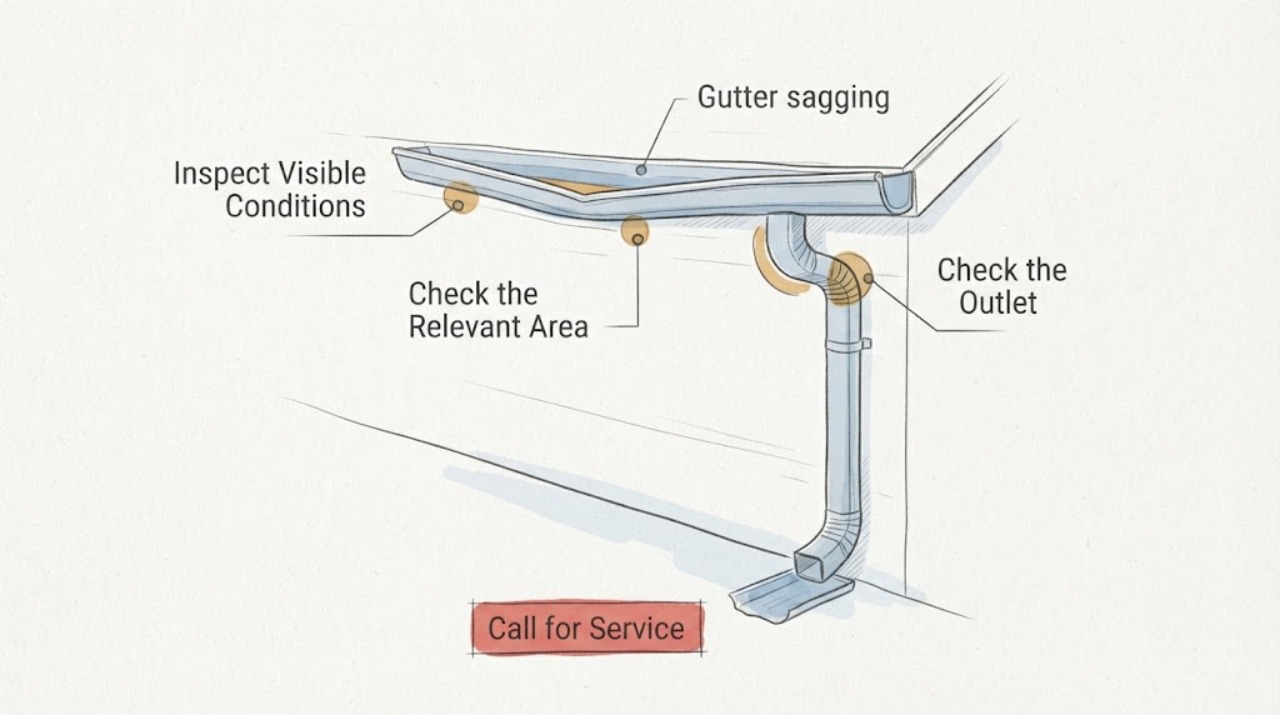
Do not use a ladder, climb onto the roof, touch the gutter, or try to refasten it yourself. From safe ground-level and indoor viewpoints in calm, dry conditions, look for a low span, a changed slope, separation from the fascia, overflowing during a recent rain, detached joints, downspout separation, or water and soil erosion near the foundation. A sag often changes the drainage pitch, but the underlying cause may be debris load, failed hangers, damaged fascia, a loose joint, or a wider drainage problem. Keep people and vehicles out from under loose or falling sections and arrange a qualified gutter or roofing inspection. Escalate immediately for a section pulling away, rotten or collapsing fascia, active water entering the building, or a gutter near electrical lines.
Work through in order
Diagnostic checks
Use only checks that match the exact appliance or system and its official guide.
-
Check 1
From a stable ground-level position, scan the full visible gutter run and compare its line with the roof edge or fascia. Look for a low middle span, a dip near a joint or downspout, a twisted section, or a section that has pulled away; do not touch or reach toward the gutter.
Expected result: The run appears continuous and evenly supported, or one or more sections visibly droop, rotate, separate, or hang lower than adjacent sections.
Next step: Record the location from the ground with a photo or written note and request a gutter inspection. Keep the area below the section clear, especially if it appears loose.
Stop if: Stop and move away if the gutter is hanging, shifting, shedding material, or positioned near a power line or other overhead hazard.
Why this matters
Why: A visible low span can interrupt the intended path to the downspout. Separation or twisting suggests a support, fascia, joint, or impact problem that needs professional assessment rather than a surface adjustment.
-
Check 2
After a previous rain has ended and the ground is safe, observe runoff evidence from a dry location or through a window. Look for overflow at the low span, water marks on the fascia or siding, or a wet trail below the gutter; do not stand under an active overflow or run water into the system.
Expected result: There are no visible overflow or water marks, or water has spilled from the sag, tracked behind the gutter, or collected against the building.
Next step: Document the affected section and the weather context. Ask the professional to check gutter pitch, joints, hangers, fascia, and the downspout path as one system.
Stop if: Stop observing outdoors if rain, wind, lightning, ice, or falling water makes the area unsafe.
Why this matters
Why: A sag with no recorded overflow still deserves inspection because the next storm may expose the problem. Overflow, backflow, or water against the building indicates a drainage and moisture risk, not just an appearance issue.
-
Check 3
Follow each visible downspout from the gutter to its ground-level outlet without touching it. Note whether the downspout is attached, whether an elbow or seam is separated, and whether the outlet directs water away from the foundation, walkway, or driveway.
Expected result: The downspout appears connected and runoff has a clear path, or a joint is open, the outlet is disconnected or crushed, or soil is eroded or wet near the foundation.
Next step: Include the downspout condition and discharge area in the service request. Do not reconnect, redirect, bury, or extend the downspout as a temporary fix when the gutter is sagging or the drainage path is uncertain.
Stop if: Stop if the outlet is near an exposed utility, unstable soil, standing water, or an underground drainage feature that cannot be safely identified.
Why this matters
Why: A sound-looking gutter can still drain poorly when a downspout or outlet is displaced. Erosion, standing water, or dampness near the foundation shows that runoff is not being managed safely at ground level.
-
Check 4
From the ground and from safe interior rooms, inspect visible fascia, soffit, siding, windows, and basement or crawl-space corners for staining, rot-like softness that is already visible, peeling finish, dampness, or water entry below the sagging run; do not probe the structure.
Expected result: No related moisture sign is visible, or the fascia, soffit, wall, ceiling, or foundation area shows staining, dampness, deterioration, or active water entry.
Next step: Photograph visible evidence and arrange a gutter or roofing professional. Keep clear of any ceiling bulge or water near electrical equipment and do not remove finishes to investigate further.
Stop if: Stop immediately for active indoor water, a bulging ceiling, crumbling or collapsing fascia, or moisture contacting electrical equipment.
Why this matters
Why: A dry appearance does not prove that the gutter support is sound. Moisture or deteriorated building material suggests the gutter problem may have already affected the structure and should be assessed with the roof edge and drainage system.
-
Check 5
Review when the sag was first noticed, recent heavy rain or wind, nearby tree or impact events, and any prior gutter work. Compare safe-distance photos over time and note whether the low span is stable or worsening.
Expected result: The sag is new or progressing, follows a storm or impact, recurs after earlier work, or has no known change in timing.
Next step: Send the service provider the timeline, locations, photos, overflow history, downspout observations, and any prior scope or warranty information. Request repair or replacement options after inspection.
Stop if: Stop all self-directed work when diagnosis would require a ladder, roof access, touching the gutter, structural probing, or work during adverse weather.
Why this matters
Why: A new or worsening sag can reflect a failed support or damaged attachment. Repeated sagging points to a cause that needs assessment rather than repeated surface fastening, while an uncertain history is still useful to the professional.
Use your observations
Decision map
Find the observation that best matches what you see, then follow the next safe action.
-
PATH 01Safety boundary
What you see
The gutter is visibly low but still attached, with no active overflow or interior moisture observed.
Do this next
Schedule a professional gutter inspection and provide the low-span location, safe photos, and recent weather or work history. Keep the area below clear until it is assessed.
Why this path and its safety boundary
Safety stop: Do not push the gutter back, add a hanger, drill, seal, or use a ladder to obtain a closer look.
-
PATH 02Safety boundary
What you see
Water spills from the sag, runs behind the gutter, or pools or erodes soil near the foundation.
Do this next
Treat it as an active drainage concern and request prompt gutter or roofing service to assess pitch, joints, fascia, downspout routing, and foundation-side moisture.
Why this path and its safety boundary
Safety stop: Do not run a hose, redirect a connected downspout, or work beneath active runoff to test the system.
-
PATH 03Safety boundary
What you see
The gutter or downspout is pulling away, hanging, cracked, or close to a utility line.
Do this next
Keep people, pets, and vehicles away from the drop area and arrange qualified gutter or roofing service; use the appropriate utility emergency route for a line contact or damaged utility.
Why this path and its safety boundary
Safety stop: Do not touch, pull, brace, refasten, or approach the loose section with a ladder.
-
PATH 04Safety boundary
What you see
Fascia or soffit appears rotten or collapsing, or water is actively entering the building.
Do this next
Stop inspection and request prompt professional assessment of the gutter, roof edge, and affected structure. Keep clear of any unstable overhead material and any wet electrical equipment.
Why this path and its safety boundary
Safety stop: Do not probe, remove, cover, or temporarily repair the structure or gutter yourself.
-
PATH 05Safety boundary
What you see
Wind, rain, ice, lightning, or other adverse weather is present.
Do this next
Wait in a safe location and make only non-contact indoor observations. Arrange inspection after conditions are calm and dry.
Why this path and its safety boundary
Safety stop: Never use a ladder, climb, touch the gutter, or attempt a repair during adverse weather.
Helpful context
Understand the symptom
What a sagging gutter changes
A gutter is meant to collect roof runoff and carry it toward a downspout. When a section drops or pulls away, water can pond in the trough, spill over the edge, or run behind the gutter and wet the fascia and wall. The visible sag is therefore a location clue, not proof that replacing one hanger will solve the whole drainage path.
Keep this inspection observational
A safe inspection stays at ground level or indoors. Use a clear view of the roof edge and lower downspout, but do not reach, push, pull, clean, reseal, drill, or place a ladder against the gutter. If wind, rain, ice, or unstable material is present, wait and keep the area isolated.
Only after diagnosis
Potential parts
- gutter hanger
Only relevant if a qualified professional confirms that the gutter channel and supporting wood are sound and that a hanger replacement is the correct repair.
Confirm gutter material, profile, attachment method, fascia condition, and local installation requirements before selecting a part; do not install it from a ladder. - fascia repair bracket
Only relevant when a professional identifies localized fascia or support damage that can be repaired without replacing a wider roof-edge or structural section.
A professional must confirm the substrate, load path, corrosion exposure, and gutter profile; a bracket is not a substitute for repairing rotten or collapsing structure.
When checks do not resolve it
Need a professional?
Request service when the gutter sags or pulls away, drainage overflows, the downspout path is displaced, or moisture or structural deterioration is visible. Use emergency or utility support when a loose gutter contacts a line or creates an immediate falling hazard.
Have this ready
- Provide the gutter-run location, safe ground-level photos, whether the low point is at a joint or downspout, overflow or water-trail history, downspout outlet condition, nearby foundation moisture, recent weather, and any prior repair information.
Common questions
FAQ
What does a sagging gutter usually indicate?
It indicates that the gutter line or its support is no longer holding its intended path. Debris load, failed hangers, a loose joint, damaged fascia, or another roof-edge issue may be involved. A professional should inspect the full run rather than treating the visible dip as a standalone part.
Can I push a sagging gutter back into place?
No. Do not touch, brace, refasten, or reach toward it, and do not use a ladder. A loose or sagging section can fall, and pushing it may worsen fascia or roof-edge damage. Photograph it from the ground and arrange qualified service.
When is gutter sagging urgent?
Treat it as urgent when water enters the building, the fascia or soffit is collapsing, the gutter is hanging or may fall, water pools at the foundation, or the gutter is near a utility line. Keep the area clear and seek the appropriate professional or emergency support.
Read the exact guide
Official sources
- How to care for a rain garden or other stormwater facility on your propertyCity of Portland Bureau of Environmental Services · The city guidance identifies low or sagging gutter areas, gutter pitch, downspout connections, overflow near foundations, and erosion or settling as maintenance concerns; this article keeps the homeowner actions observational and professional-service oriented.
- Eavestroughs and downspoutsGovernment of Canada · The government page explains that gutters and downspouts direct roof runoff away from foundations, recommends checking for overflow and pooling, and advises seeking help when the work cannot be completed safely.
- Gutters and DownspoutsU.S. Department of Energy Building America Solution Center · The federal building-science guide explains that roof runoff should be carried away from foundations and that moisture near a building can cause interior problems; it supports checking discharge evidence without prescribing homeowner installation work.
Community feedback
Share a repair observation
Share a plain-text repair observation. Accepted observations are published automatically; this page may take a moment to update.