
On this page
Start here
Quick answer
Water pooling in a visibly sagging gutter usually means the run has lost its fall toward the downspout, but a blocked outlet, wet debris, loose hanger, pulled fastener, damaged fascia, or permanently bent section can be the reason. From the ground, photograph the low point and trace the outlet and downspout. Look for standing water, debris, loose supports, gaps behind the gutter, staining, rust, or a crushed discharge path without climbing on the roof or using the gutter as a support. Clear only safely reachable loose debris; do not lift a loaded gutter, add a screw to a failed hole, or re-pitch the run yourself. If water spills behind the gutter, the run is detached or widespread, the fascia is soft, or the sag returns, arrange qualified gutter service before the next heavy rain.
Before you begin
Safety first
- This article supports safe ground-level observation, photography, and removal of loose debris that is safely reachable. It does not authorize roof access, ladder work, re-hanging, pitch adjustment, fascia repair, fastener replacement, metal cutting, or work near power lines.
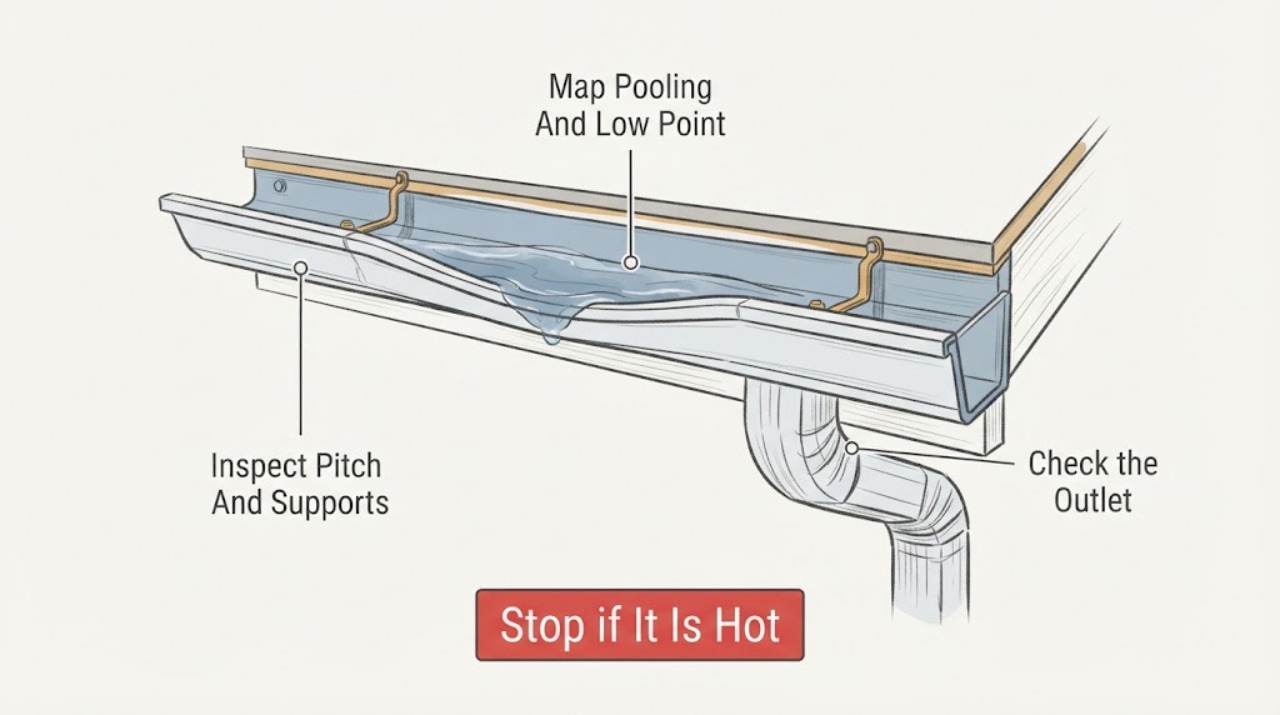
Work through in order
Diagnostic checks
Use only checks that match the exact appliance or system and its official guide.
-
Check 1
From the ground or another secure non-roof position, photograph the full gutter run after rain and identify the deepest pool, the apparent high and low ends, the nearest outlet, and any gap between the back of the gutter and the fascia.
Expected result: Record whether water is pooled only at one dip, spread across a long section, spilling over the front, flowing behind the gutter, or remaining after the rain stops; note any visible tilt, bow, or separation.
Next step: Use the location and extent to choose the debris, outlet, support, or service branch; keep people away from a visibly detached or unstable section.
Stop if: Do not climb onto the roof, stand in the gutter, lean a ladder against it, or inspect beneath a section that could fall.
Why this matters
Why: One pond suggests a local support, blockage, or deformation issue, while broad pooling suggests the run has lost its fall or multiple supports have moved. Water behind the gutter raises concern for the fascia and roof-edge attachment rather than a simple surface clog.
-
Check 2
Without putting weight on the gutter, inspect a safely reachable area for leaves, sediment, ice, or other material and trace the outlet and downspout from the ground; check whether the downspout is attached, crushed, disconnected, or visibly blocked.
Expected result: Record whether wet debris is concentrated at the pool, whether the outlet opening is clear, whether the downspout carries water to its lower end, and whether the discharge is directed away from the building.
Next step: Remove only loose material that can be reached safely without roof or unstable ladder exposure, then observe whether the pool drains; arrange service for inaccessible, crushed, or below-grade blockage.
Stop if: Do not force a hose into a detached run, reach over an edge, work near power lines, or direct discharge toward the foundation, doors, windows, or a neighboring property.
Why this matters
Why: Wet debris and retained water can load the gutter and worsen an existing dip. A blocked or disconnected outlet can create pooling even when the gutter support is sound, while a clear outlet with persistent pooling keeps pitch and support failure in focus.
-
Check 3
Visually compare the gutter’s line with the roof edge and inspect hangers, straps, spikes, screws, joints, corners, and fascia from a safe position; look for a support pulling out, missing hardware, enlarged holes, corrosion, staining, soft wood, or a permanently bent channel.
Expected result: Record whether the low point is between two supports, whether several supports have shifted, whether the gutter pulls away from the fascia, and whether the fascia or gutter material shows damage rather than just wetness.
Next step: Leave the gutter in place and give the repairer the low-point and support photos; a qualified person should determine whether the run needs support, pitch correction, fascia repair, or section replacement.
Stop if: Do not push the gutter upward, remove hangers, loosen fasteners, drill into fascia, straighten metal, or test the attachment by pulling on it.
Why this matters
Why: A support failure can create a local trough, while multiple moved supports, a gap at the fascia, or soft attachment material indicates a broader re-hanging or fascia problem. A bent channel may continue to pond even after a hanger is replaced.
-
Check 4
After safely removable debris is cleared, observe the next rain event or use a small amount of water only from a secure location; watch the pool and the complete route toward the downspout instead of focusing only on the visible sag.
Expected result: Record whether the water moves steadily, drains slowly, remains in the dip, spills over the front, leaks behind or at a joint, or exits a downspout that does not carry it away from the foundation.
Next step: Stop testing when the drainage pattern is clear and arrange gutter service for a persistent pool, leak, or overflow; share the water path and photos rather than attempting to re-pitch the run.
Stop if: Do not test from the roof, during high wind or lightning, beneath a loose section, or with water directed toward the house.
Why this matters
Why: Drainage that improves after clearance supports blockage or debris as a contributor, but slow or absent drainage confirms a pitch, support, deformation, outlet, or downspout problem. Overflow behind the gutter can expose the fascia and wall to ongoing moisture.
-
Check 5
Use the photos and drainage observations to classify the issue as a small stable pool, a recurring local trough, a full-run pitch failure, or a detached or damaged system; check the wall, fascia, and ground below for fresh water marks or erosion from overflow.
Expected result: Record whether water is entering behind the gutter, the fascia is soft or stained, the gutter is pulling away, the problem followed wind, snow, ice, impact, or roof work, or the pool is widespread or worsening.
Next step: Arrange a qualified gutter or exterior-water-management professional for support, pitch, fascia, high-access, storm-damage, or replacement work; keep people clear of a detached section and protect vulnerable interior areas from active water entry.
Stop if: Do not improvise braces, hang from the gutter, perform roof-edge work, or postpone service while a loose run is collecting water before another storm.
Why this matters
Why: A stable local pool may be repairable after its cause is identified, but recurring or widespread pooling, water behind the run, and storm or structural damage raise the risk of fascia, siding, roof-edge, and foundation damage. Those patterns need a complete system assessment.
Use your observations
Decision map
Find the observation that best matches what you see, then follow the next safe action.
-
PATH 01Safety boundary
What you see
The pool is local, wet debris or a visible outlet blockage is present, the supports remain attached, and water drains after safely reachable material is removed.
Do this next
Monitor the next rain, keep the outlet clear with safe routine maintenance, and arrange service if the pool returns or the run remains visibly low.
Why this path and its safety boundary
Why it matters: Debris or outlet blockage was likely adding load or restricting drainage, but the visible sag still warrants rechecking because a low spot can collect debris again.
Safety stop: Do not climb or keep adding water if the gutter is unstable or the blockage is inaccessible.
-
PATH 02Safety boundary
What you see
Water remains at one low point and the nearby hanger, strap, fastener, fascia, outlet, or gutter section is loose, damaged, displaced, or visibly separated.
Do this next
Leave the run unloaded and have a qualified gutter professional inspect the local section and adjacent supports before selecting a hanger, fastener, seal, or replacement section.
Why this path and its safety boundary
Why it matters: A local support, attachment, outlet, or material defect is more likely than a simple blockage; lifting the gutter without correcting that defect can shift the load to adjacent supports.
Safety stop: Do not pry, refasten into the same hole, seal over a moving joint, or straighten the section yourself.
-
PATH 03Safety boundary
What you see
Pooling extends across a long run, several supports have moved, the gutter pulls away from the fascia, the fascia is soft or stained, or the gutter is permanently bent.
Do this next
Arrange a full-run assessment for re-supporting, pitch correction, fascia repair, section replacement, or system replacement as appropriate to the gutter and building.
Why this path and its safety boundary
Why it matters: The system has a pitch, attachment-surface, support-spacing, or material problem that cleaning alone cannot correct and that may allow water behind the roof edge.
Safety stop: Do not attempt a partial screw-and-lift repair, work from an unsafe ladder, or continue operating below a run that is pulling away.
-
PATH 04Safety boundary
What you see
The gutter is detached, falling, twisted after a storm, near power lines, above a high or steep roof edge, or inaccessible without unsafe ladder or roof work.
Do this next
Keep people and vehicles clear, photograph the damage from a safe location, and obtain qualified inspection and stabilization before the next significant rain, snow, or wind event.
Why this path and its safety boundary
Why it matters: The immediate issue is fall, impact, electrical, or structural access risk in addition to drainage failure; homeowner troubleshooting should stop at safe documentation.
Safety stop: Do not climb, brace with improvised materials, touch nearby lines, or use the gutter as an anchor or ladder support.
Helpful context
Understand the symptom
Pooling identifies a drainage symptom, not a single failed part
A gutter needs a consistent fall toward an outlet. A low spot can hold water after a storm, add weight, and deepen the sag. The same symptom can start with leaves in the channel, a blocked downspout, a loose hanger, a pulled fastener, a weakened fascia, a shifted outlet, or a gutter section that has permanently bent. The repair should address why the water is staying, not just hide the pond.
Inspect the whole path from a safe position
Begin at ground level and follow the water path from the roof edge through the gutter, outlet, downspout, and discharge. Gutter edges can be sharp, and a gutter is not a step, handhold, ladder support, or fall-protection anchor. If the low point is high, detached, near power lines, or unsafe to reach, stop at photos and arrange professional inspection.
Do not confuse a clean channel with a corrected pitch
Removing loose debris may reduce the load, but it cannot restore a bent section, failed hanger, soft fascia, or changed fall. Likewise, sealing a joint while water still ponds can leave the underlying drainage failure intact. A qualified repairer may need to inspect supports, attachment material, outlet position, and the full run before deciding whether to clean, re-support, re-pitch, repair, or replace it.
Safety boundary
Stop conditions
- Do not use a gutter or downspout as a step, handhold, ladder support, tie-off point, or structural anchor; gutter edges can be sharp.
- Do not climb onto the roof, work near power lines, or use an unstable ladder to reach a pooled or sagging run.
- Do not lift a water-loaded gutter, remove hangers, drive fasteners into old holes or soft fascia, straighten a bent section, or alter the pitch as an improvised repair.
- Stop for water flowing behind the gutter, a detached or unstable section, widespread sag, storm damage, soft fascia, permanent deformation, or discharge toward the foundation.
- Arrange qualified gutter service when the issue involves re-hanging, pitch correction, fascia or roof-edge work, high access, downspout routing, structural damage, or replacement.
Only after diagnosis
Potential parts
- gutter hanger or support bracket
Consider this category only after inspection confirms that a support has failed while the gutter profile, fascia, attachment method, and adjacent run remain suitable for a supported repair.
Confirm the gutter material, profile, hanger style, fastener requirements, and attachment-surface condition before ordering; a generic hanger cannot compensate for deteriorated fascia or incorrect pitch. - gutter section
Consider a replacement section only if the existing channel is cracked, rusted through, permanently bent, or unable to hold its fall after support and drainage causes are assessed.
Match the existing material, profile, dimensions, joints, outlet layout, and roof-edge system; replacing a section does not correct a failed fascia or support layout by itself. - downspout extension or discharge fitting
Consider this category only when the downspout is intact but its discharge remains too close to the building after the pooling and support problem is corrected.
Confirm the downspout size, connection, local drainage requirements, and discharge route; do not redirect water toward the foundation or a neighboring property.
When checks do not resolve it
Need a professional?
Arrange a qualified gutter professional when water remains pooled after safe debris clearance, the low point returns, the run pulls away from the fascia, supports or fasteners have failed, the fascia is soft or stained, water flows behind the gutter, the downspout is damaged or poorly discharged, the gutter is permanently bent or widespread, or inspection requires a roof, ladder, power-line, or storm-damage assessment.
Safety scope: This article supports safe ground-level observation, photography, and removal of loose debris that is safely reachable. It does not authorize roof access, ladder work, re-hanging, pitch adjustment, fascia repair, fastener replacement, metal cutting, or work near power lines.
Common questions
FAQ
Why is water pooling in my sagging gutter?
The run may have lost its fall toward the downspout, or a blockage, wet debris, loose hanger, pulled fastener, damaged fascia, shifted outlet, or bent section may be creating the low spot. Pooling is evidence of a drainage problem, not proof of one specific failed part.
Will cleaning the gutter stop the pooling?
It may help when wet debris or a blocked outlet is adding weight or restricting flow. If water remains after safely reachable debris is removed, the likely decision changes to checking pitch, supports, fascia, gutter shape, and the downspout rather than repeating cleaning.
Can I re-pitch a gutter that is holding water?
Do not re-pitch a sagging run as a casual homeowner fix. Changing the fall can require removing or repositioning supports and can expose deteriorated fascia or a permanently bent section. Have a qualified person inspect the full run and attachment surface before changing its position.
When is pooling gutter water a water-damage concern?
Treat it as more urgent when water spills behind the gutter, the fascia or wall is stained or soft, the downspout discharges at the foundation, the run is detached, or the pool is widespread or worsening. Stop unsafe access and arrange qualified gutter service before another significant rain event.
Read the exact guide
Official sources
- Homeowners Guide to MaintenanceCity of Shaker Heights, Ohio · Municipal homeowner maintenance guide for common metal gutters and downspouts; local construction and access requirements and the installed system control a specific repair.
- Basic Home Maintenance – Home Occupants’ GuideCanada Mortgage and Housing Corporation · CMHC homeowner guide for common eavestrough systems; exact materials, roof access, and local drainage requirements vary by property.
Community feedback
Share a repair observation
Share a plain-text repair observation. Accepted observations are published automatically; this page may take a moment to update.