
On this page
Start here
Quick answer
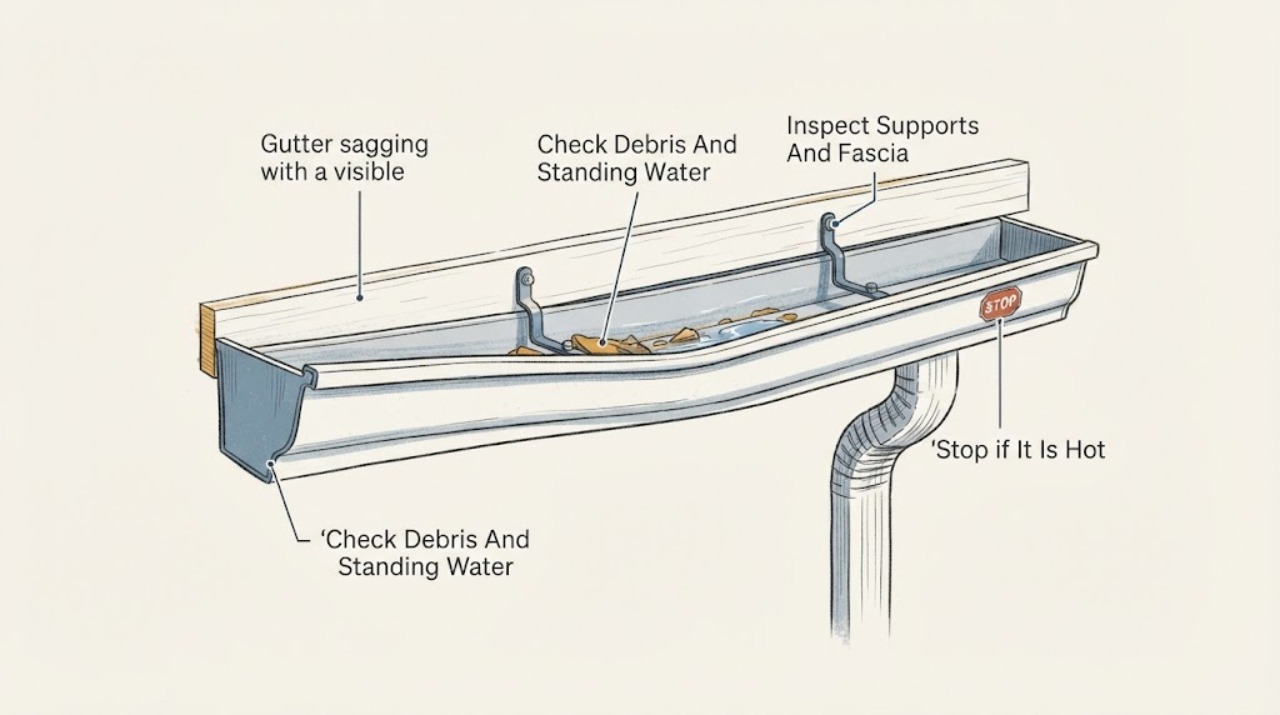
A visible dip means the gutter may have lost support, pitch, or both. From the ground, note whether the sag is between hangers, whether the gutter is pulling away from the fascia, and whether debris or standing water is adding weight. Check the downspout path and look for loose or broken hangers, failed fasteners, rust, a damaged fascia board, or a bent gutter without climbing on or using the gutter as a support. Clear only safely reachable debris if you can do so without roof or ladder exposure; do not push the run back into place or refasten it into deteriorated wood. A short, stable sag may be repairable, but a detached, heavily loaded, leaking, storm-damaged, or widespread sag needs a qualified gutter professional before the next heavy rain.
Before you begin
Safety first
- This article supports safe ground-level observation, photography, and removal of safely reachable loose debris. It does not authorize roof access, ladder work, re-hanging, pitch adjustment, fascia repair, fastener replacement, metal cutting, or work near power lines.
Work through in order
Diagnostic checks
Use only checks that match the exact appliance or system and its official guide.
-
Check 1
From the ground or another secure, non-roof position, photograph the full gutter run and mark the visible low point, any gap behind the gutter, the high and low ends, and the nearest downspout; do not lean on the gutter or place a ladder against it.
Expected result: Record whether the dip is local or extends across most of the run, whether the gutter bows between supports, whether it tilts forward or away from the fascia, and whether water staining appears behind or below it.
Next step: Use the location and extent to select the debris, support, drainage, or professional-service branch; keep the run unloaded if it is visibly detached or distorted.
Stop if: Do not climb onto the roof, stand in the gutter, use it as a handhold, or inspect from an unstable ladder position.
Why this matters
Why: A local dip suggests a nearby hanger or fastener issue, while a long uneven run suggests a pitch, support-spacing, material, or attachment-surface problem. A gap behind the gutter raises concern that fasteners or fascia have failed rather than the gutter merely being dirty.
-
Check 2
Without putting weight on the gutter, inspect any safely reachable opening for leaves, sediment, ice, or visible standing water, and trace the downspout from the outlet to its discharge point using ground-level sight and sound where possible.
Expected result: Record whether the sag contains wet debris or a pond, whether the outlet or downspout appears blocked or disconnected, and whether the lower end directs water away from the building.
Next step: Remove only loose debris that can be reached safely from the ground or a properly positioned access method; do not lift or reshape a loaded run. Arrange service if the outlet is inaccessible, blocked below the surface, or the gutter is too unstable to clean.
Stop if: Do not reach over an edge, work near power lines, use the gutter as a ladder support, or force water into a downspout when the run is detached or the outlet may discharge toward the building.
Why this matters
Why: Wet debris and retained water add load to the support system and can deepen a sag. A blocked or disconnected downspout can make a correctly supported run overflow, while a sag that remains after the drainage path is clear points toward support, pitch, fascia, or material failure.
-
Check 3
Visually inspect the hangers, straps, spikes, screws, end caps, joints, and fascia behind the sag from a safe position; look for a missing or pulled support, enlarged hole, corrosion, cracked material, soft or stained wood, and separation at corners or outlets.
Expected result: Record whether one support has failed, several supports are loose, the fasteners are pulling from sound-looking material, the fascia is deteriorated, or the gutter itself is cracked, rusted, twisted, or permanently bent.
Next step: Leave the run alone and provide the photos and exact support pattern to a qualified gutter professional when damage, repeated failure, fascia deterioration, or detachment is visible; do not drive a new fastener into the same failed hole.
Stop if: Do not pry the gutter up, remove support hardware, drill into fascia, cut metal, or work where the run could fall or where roof-edge access is not secure.
Why this matters
Why: One failed support may create a local dip, but repeated fastener pull-out or soft fascia means a new hanger alone may not hold. A cracked or permanently deformed run may need a section repair or replacement, and damage near an outlet or corner can affect the complete drainage path.
-
Check 4
After any safely removable debris is cleared, observe the gutter during the next rain or use a small amount of water only if the run and access are secure; watch whether water travels toward the downspout or remains at the visible low point, and confirm discharge is away from the foundation.
Expected result: Record whether water drains continuously, ponds at the sag, spills over the front or behind the gutter, leaks at a joint, or exits a downspout that is crushed, disconnected, or too close to the building.
Next step: Stop testing once the drainage pattern is clear and arrange service for a sagging or leaking run; provide the technician the low point, outlet direction, and photos rather than attempting to re-pitch the gutter yourself.
Stop if: Do not test from a roof, during lightning or high wind, near electrical lines, or while standing under a loose section; do not direct water toward doors, windows, or the foundation.
Why this matters
Why: Ponding confirms that the run is not maintaining its intended fall, but the cause may be a loose support, distorted gutter, or blocked outlet. Overflow behind the gutter raises concern for fascia and roof-edge water damage; poor discharge can transfer the drainage problem to the foundation.
-
Check 5
Compare the photos and observations for extent, load, attachment, material, and drainage, then decide whether the safe next step is routine cleaning, a technician inspection, or urgent stabilization before another storm; do not attempt to straighten or rehang a visibly failed run.
Expected result: Record whether the issue is a small stable dip with sound supports, a sag that returns after cleaning, a run pulling away, widespread or permanent deformation, water entering behind the gutter, or damage after wind, snow, ice, or impact.
Next step: Arrange a qualified gutter or exterior-water-management professional for any attachment, pitch, fascia, high-access, storm-damage, or replacement work; keep people clear and avoid operating below an unstable section until it is assessed.
Stop if: Do not improvise support with rope, wire, tape, or a temporary body-weight test, and do not perform roof-edge work without appropriate training and fall protection.
Why this matters
Why: A limited, stable maintenance issue may be serviceable without replacing the whole run, but recurrence, widespread sag, deteriorated fascia, permanent bending, or separation indicates a system-level repair or replacement decision. Detached or unstable gutters can damage the roof edge and wall while also falling.
Use your observations
Decision map
Find the observation that best matches what you see, then follow the next safe action.
-
PATH 01Safety boundary
What you see
The visible dip is limited to one area, the gutter remains attached, no permanent bend or fascia deterioration is visible, and the channel or outlet contains removable debris or standing water.
Do this next
Clear only safely reachable debris, observe drainage, and arrange service if the dip remains, returns, or the support moves.
Why this path and its safety boundary
Why it matters: Added debris or retained water may be loading an otherwise serviceable support point, but the support should still be checked after cleaning because a sag can persist after the weight is removed.
Safety stop: Do not lift a loaded gutter, remove hangers, or rely on cleaning if the run is unstable.
-
PATH 02Safety boundary
What you see
The sag is between supports or the gutter pulls away from the fascia, with loose, missing, corroded, or pulled fasteners, soft wood, water staining, or multiple failed hangers.
Do this next
Keep the area clear and have a qualified gutter professional inspect the full run, attachment surface, pitch, and downspout before selecting hangers, fasteners, or fascia repair.
Why this path and its safety boundary
Why it matters: The attachment system or supporting fascia is more likely to be failing than the gutter needing a simple push upward; refastening into damaged material may not hold.
Safety stop: Do not drive screws into the same holes, pry the gutter into alignment, or use the gutter as a ladder or handhold.
-
PATH 03Safety boundary
What you see
Water remains at the visible low point, spills over the front or behind the gutter, leaks at a joint, or the downspout does not carry water away from the building.
Do this next
Stop the homeowner test and arrange gutter service to clear and inspect the complete path, correct the support or pitch, and verify safe discharge.
Why this path and its safety boundary
Why it matters: The run has a drainage or pitch failure, potentially combined with a blockage, loose support, distorted section, or outlet problem. Continued overflow can wet the fascia, wall, or foundation.
Safety stop: Do not keep adding water, seal a joint without correcting the sag, or redirect discharge toward the foundation.
-
PATH 04Safety boundary
What you see
A long section is detached, visibly twisted or permanently bent, damaged after wind, snow, ice, or impact, near power lines, or unsafe to reach from the ground.
Do this next
Keep people away, do not operate beneath the unstable section, document the damage from a safe location, and obtain qualified inspection and stabilization before the next rain or snow event.
Why this path and its safety boundary
Why it matters: This is a structural, high-access, or storm-damage situation rather than routine gutter cleaning; the run may fall or expose the roof edge to uncontrolled runoff.
Safety stop: Do not climb, brace the gutter with improvised materials, work near power lines, or attempt roof-edge or fascia repair without trained access and equipment.
Helpful context
Understand the symptom
A visible sag is a drainage and attachment problem
A gutter should carry roof runoff toward its outlet rather than hold a pond in the middle. A dip can be the result of a loose hanger, a pulled fastener, debris weight, a blocked downspout, a changed pitch, a bent section, or a weakened fascia. The visible low spot is therefore a symptom: simply lifting it or adding a screw may leave the cause in place and let the sag return.
Inspect from a safe position first
Start with a ground-level view and take photos rather than leaning a ladder against the gutter. Gutter edges can be sharp, and a gutter is not a step, handhold, ladder support, or fall-protection anchor. If the run is high, detached, near power lines, or unsafe to reach, leave the inspection to a trained professional.
Repair depends on what is holding the sag
An isolated loose hanger on sound material is different from rotted fascia, a permanently bent section, a blocked outlet, or a whole run that has lost its fall. The proper repair may involve cleaning, replacing support hardware, correcting the pitch, repairing the attachment surface, or replacing a section. The gutter type and the roof-edge construction determine which fasteners and supports are appropriate.
Safety boundary
Stop conditions
- Do not use a gutter or downspout as a step, handhold, ladder support, tie-off point, or structural anchor; gutter edges and materials can be sharp.
- Do not climb onto a roof, work near power lines, or use an unstable ladder to reach a sagging or detached run.
- Do not push a loaded gutter upward, drive replacement fasteners into deteriorated fascia or old holes, straighten a bent run, or remove support hardware as a casual repair.
- Stop for a gutter pulling away, widespread sag, permanent bend, damaged fascia, storm impact, water entering behind the run, or an unstable section that could fall.
- Arrange qualified gutter service when pitch, hangers, fascia, roof-edge attachment, high access, downspout routing, or replacement is involved; keep people clear until the system is assessed.
Only after diagnosis
Potential parts
- gutter hanger or support bracket
Consider this category only if inspection identifies a failed support and the gutter, fascia, profile, and attachment method are confirmed suitable for a new hanger by a qualified person.
Confirm the gutter material, profile, support style, attachment surface, fastener requirements, and local loading conditions before ordering; do not assume a generic hanger will hold deteriorated fascia. - gutter section
Consider a replacement section only if the existing run is permanently bent, cracked, rusted through, or otherwise unable to hold its shape after the attachment and drainage causes are assessed.
Match the existing material, profile, dimensions, joints, outlet layout, and roof-edge system; a new section does not correct a failed fascia or incorrect pitch by itself. - downspout extension or discharge fitting
Consider this category only when the downspout is intact but its outlet leaves water against the building after the sag and drainage path are corrected.
Confirm the downspout size, connection, local drainage requirements, and discharge route; do not redirect water toward the foundation or a neighboring property.
When checks do not resolve it
Need a professional?
Arrange a qualified gutter professional when the sag persists after safe debris removal, the gutter pulls away from the fascia, supports or fasteners have failed, the fascia is soft or stained, water ponds or spills behind the run, the downspout is damaged or poorly discharged, the run is permanently bent or widespread, or inspection requires roof or ladder exposure. Treat a detached or unstable section as a prompt safety and water-damage concern.
Safety scope: This article supports safe ground-level observation, photography, and removal of safely reachable loose debris. It does not authorize roof access, ladder work, re-hanging, pitch adjustment, fascia repair, fastener replacement, metal cutting, or work near power lines.
Common questions
FAQ
Why is my gutter visibly sagging?
Common contributors include wet debris or standing water, a blocked downspout, loose or broken hangers, pulled fasteners, supports spaced too far apart, an interrupted pitch, deteriorated fascia, or a bent gutter. The visible dip identifies the symptom, not which support or drainage cause needs repair.
Can I just push a sagging gutter back up?
Do not push up a loaded, detached, or unstable gutter. A lasting repair depends on the hangers, fasteners, fascia, pitch, outlet, and gutter material; adding a fastener to a failed attachment surface may not hold. Have a qualified person assess the cause when the run is loose or the sag returns.
How can I tell whether debris is causing the sag?
From a safe position, look for wet leaves, sediment, or water pooled at the low point and check whether the downspout path appears blocked. Debris and retained water can add load, but if the gutter remains low after safe cleaning, inspect the supports and attachment surface rather than repeating cleanup.
When should a professional repair a sagging gutter?
Arrange qualified service for a gutter pulling away from the building, widespread sag, permanent bending, soft or stained fascia, water behind the run, storm damage, an inaccessible or high run, power-line proximity, or any work requiring a ladder, roof access, pitch correction, re-hanging, or fastener replacement.
Read the exact guide
Official sources
- Basic Home Maintenance – Home Occupants’ GuideCanada Mortgage and Housing Corporation · CMHC homeowner guide for common eavestrough systems; exact materials, roof access, and local drainage requirements vary by property.
- Homeowners Guide to MaintenanceCity of Shaker Heights, Ohio · Municipal homeowner maintenance guide for common metal gutters and downspouts; local construction and access requirements and the installed system control a specific repair.
Community feedback
Share a repair observation
Share a plain-text repair observation. Accepted observations are published automatically; this page may take a moment to update.