
On this page
Start here
Quick answer
If a gutter overflows in heavy rain and the water collects at one low section, inadequate fall or a sagging channel is a plausible path, but a blockage, concentrated roof-valley flow, undersized gutter, or limited downspout capacity can look similar. Observe the overflow from a safe position during or just after rain, record exactly where it starts, and on a dry day look for standing water or a visible low point without using a ladder or walking on the roof. Check only safely reachable debris and downspout discharge, then document wet walls, fascia, erosion, or foundation pooling. Do not re-pitch, drill, move, or seal the gutter as a test; arrange qualified gutter or roof-drainage service when the low point persists, the overflow reaches the building, the system is high or inaccessible, or heavy rain overwhelms the whole run.
Before you begin
Safety first
- This article covers ground-based observation, safely reachable loose-debris removal, and documentation only. Do not perform roof access, ladder work in wet conditions, gutter re-pitching, structural attachment changes, flashing work, or buried-drain alterations as a user test.
Work through in order
Diagnostic checks
Use only checks that match the exact appliance or system and its official guide.
-
Check 1
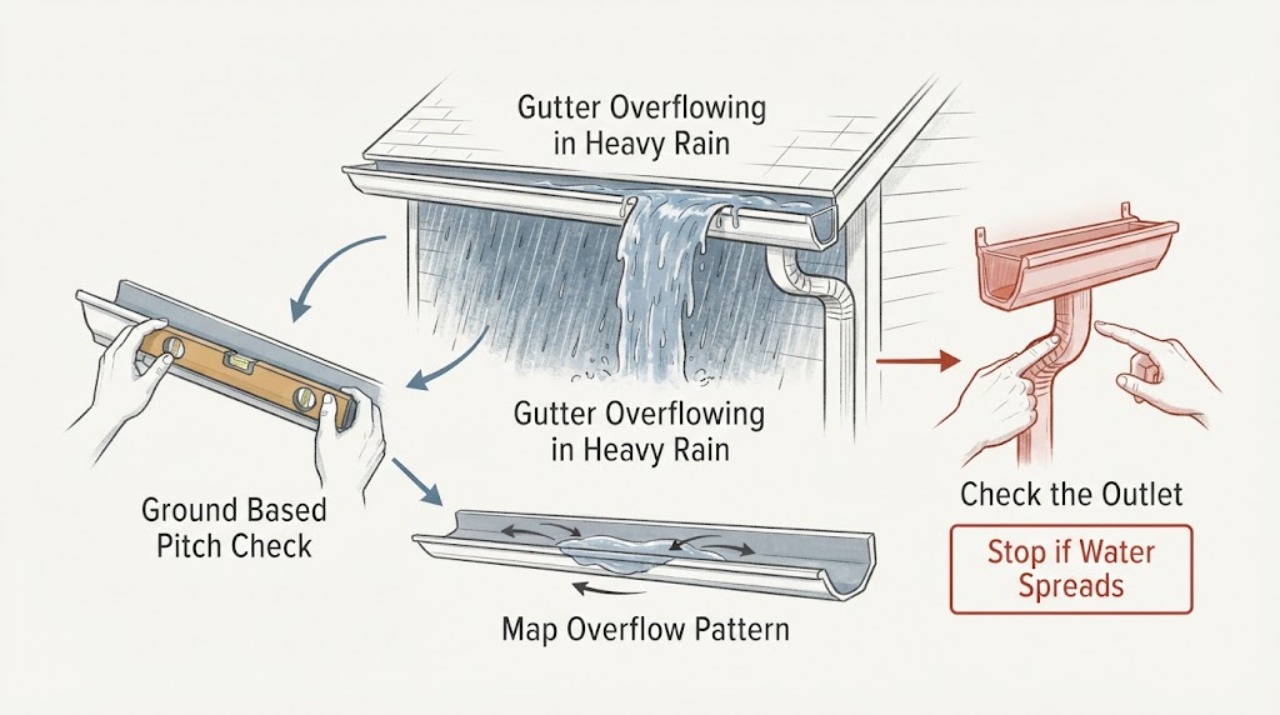
From firm ground or a sheltered interior viewpoint, observe the gutter during safe rainfall or inspect fresh runoff immediately afterward; map the first overflow point, the direction of spill, and the roof edge or downspout serving that section. Do not stand under a heavy waterfall or approach a wet roof.
Expected result: Record one localized low section, overflow at a valley or corner, overflow near an outlet, overflow along the entire run, or no overflow when rainfall is light; photograph from the ground if possible.
Next step: Use the location to guide the dry-day visual check and tell the gutter professional which roof section and rainfall conditions produced the overflow.
Stop if: Stop for lightning, high wind, flooding, slippery ground, falling water or debris, unstable surfaces, or any need to use a ladder or enter the roof.
Why this matters
Why: A repeatable single low point supports an inadequate-pitch, sag, support, or joint assessment. A valley or outlet overflow points toward concentrated inflow or capacity. A whole-run event during intense rain may exceed system capacity rather than prove a pitch defect.
-
Check 2
On a dry, calm day, inspect the gutter line from the ground using ordinary sight or a camera zoom; compare the apparent line from each end toward the downspout and look for a sag, reverse fall, standing-water mark, separated joint, loose support, or displaced end cap. Do not climb, push the gutter, or place a level on an elevated surface.
Expected result: Record a consistent visible fall toward an outlet, a localized dip, a run that falls away from the outlet, water staining at a joint, loose hardware, or a view that is too high or obscured to judge.
Next step: Photograph the full run and the suspected low point, then request a qualified gutter assessment rather than trying to lift or re-pitch the channel.
Stop if: Do not use a ladder, roof access, pole, tool, hose, body weight, or improvised support to measure or alter the gutter.
Why this matters
Why: A visible dip or reverse fall makes inadequate pitch or support a focused professional question, but sight alone cannot establish the required slope or prove the attachment is safe. A consistent line shifts attention toward blockage, capacity, roof inflow, or downstream discharge.
-
Check 3
From safe ground-level reach only, inspect the visible gutter opening, screen, outlet, downspout, and outside discharge for leaves, sediment, ice, a blocked opening, disconnected joint, or water backing up. Remove only loose debris that can be reached without climbing or leaning; do not push debris into the outlet or disconnect the system.
Expected result: Record a clear outlet and free discharge versus a blocked inlet, water backing up behind debris, a downspout that receives little flow, a leaking joint, or discharge directed toward the wall or foundation.
Next step: Photograph the blockage or discharge path, keep water away from openings and the foundation where safely possible, and arrange service if the obstruction is inaccessible, recurring, or connected to a buried or damaged drain.
Stop if: Stop for nests, insects, wildlife, sharp metal, ice, contaminated water, unstable ground, hidden drain connections, or any need to climb or disassemble.
Why this matters
Why: A blocked inlet or outlet can cause overflow that resembles a pitch problem. A clear outlet with a localized high-water mark keeps inadequate fall or capacity in play; discharge at the foundation adds a moisture consequence even if the gutter itself is flowing.
-
Check 4
From the ground and available property drawings or photos, trace which roof planes, valleys, extensions, and upper gutters feed the overflowing run; count visible downspouts and note whether the event occurs only at a concentrated inlet or after the whole roof sheds water. Do not access the roof to inspect valley metal or flashing.
Expected result: Record a small roof section with one outlet, a large or steep catchment feeding one point, a valley or upper roof discharging into the run, multiple downspouts with even flow, or an unknown roof layout.
Next step: Give the roof-catchment map and rainfall conditions to a qualified gutter or roof-drainage professional for sizing, pitch, outlet, overflow, and local-code review.
Stop if: Do not cut the gutter, add a hole, remove flashing, redirect a valley, disconnect a downspout, or enter the roof as a capacity test.
Why this matters
Why: Overflow at a concentrated roof inflow can indicate a capacity or layout issue even when the gutter pitch looks reasonable. Heavy-rain design depends on roof area, roof pitch, rainfall intensity, gutter size, downspout capacity, and spacing; no single visual measurement can select a redesign.
-
Check 5
After the area is dry and from safe ground or interior access, inspect the wall, fascia, soffit, trim, foundation edge, soil, and nearby paths below the overflow without opening finishes or entering a wet cavity.
Expected result: Record clean dry surfaces versus water staining, soft or detached trim, peeling finish, damp interior, pooling near the foundation, soil erosion, ice-related damage, or a blocked route.
Next step: Photograph the affected surfaces, keep contents and people away from unsafe areas, and request prompt service when water reaches the building or the condition is worsening.
Stop if: Stop for electrical contact, ceiling or wall instability, mold or contaminated water, flooding, erosion, or any need to open a wall, fascia, soffit, or roof edge.
Why this matters
Why: Building damage or foundation pooling raises the urgency and may require coordinated gutter, roofing, wall, or drainage assessment. Absence of visible damage does not make a recurring overflow acceptable; it only changes the immediate consequence.
Use your observations
Decision map
Find the observation that best matches what you see, then follow the next safe action.
-
PATH 01Next step
What you see
Overflow repeatedly begins at one section and the dry-day view shows standing-water marks, a dip, reverse fall, loose support, or displaced joint.
Do this next
Arrange qualified gutter service to assess re-hanging, support, joint, outlet, overflow, and local requirements. Do not lift, drill, shim, seal, or re-pitch the gutter as a test.
Why this path and its safety boundary
Why it matters: Inadequate pitch, sagging, support movement, or a joint condition becomes the focused repair question, but the required fall and attachment method still need professional assessment.
-
PATH 02Next step
What you see
The overflow is at a visible blocked inlet, outlet, downspout, screen, joint, or discharge connection, and the obstruction is not safely reachable.
Do this next
Keep clear of the elevated or contaminated area and request qualified gutter or drainage cleaning and inspection. Do not push debris into the outlet or disconnect the downspout.
Why this path and its safety boundary
Why it matters: Restricted flow can produce overflow independently of pitch; inaccessible or recurring blockage may involve the downspout or buried discharge.
-
PATH 03Next step
What you see
Overflow is concentrated below a roof valley, upper roof, corner, or other high-flow inlet while the visible gutter line has no clear low point.
Do this next
Request a roof-drainage assessment that considers catchment area, rainfall intensity, gutter and downspout capacity, overflow provisions, flashing, and local code. Do not alter the valley or cut the gutter.
Why this path and its safety boundary
Why it matters: Roof catchment, valley discharge, outlet placement, or system capacity may be the limiting factor rather than inadequate pitch.
-
PATH 04Next step
What you see
The entire run overflows only during intense rain, with clear visible outlets and no localized low point.
Do this next
Arrange professional capacity and overflow review, especially if water reaches the wall or foundation. Maintain records of rainfall conditions and do not add outlets or enlarge the gutter without design and local-code review.
Why this path and its safety boundary
Why it matters: The event may exceed the design capacity or reflect a roof and rainfall combination for which the existing gutter and downspout layout is insufficient; it does not prove a pitch defect.
-
PATH 05Next step
What you see
Overflow reaches walls, fascia, soffits, windows, electrical equipment, foundation soil, or an unsafe access area, or the cause cannot be observed from ground level.
Do this next
Keep people away from the hazard, document it from a safe position, and request prompt qualified gutter, roofing, and drainage assessment as applicable. Use emergency help for active flooding, electrical danger, or structural instability.
Why this path and its safety boundary
Why it matters: The consequence or access risk is now more important than completing a homeowner diagnosis; multiple building-envelope or drainage systems may be involved.
Helpful context
Understand the symptom
A low point is a pattern to confirm, not a repair instruction
When water ponds in one section before spilling over, the channel may have lost its intended fall, sagged between supports, or shifted at a joint. If the entire run spills during an intense burst, the cause may instead be roof catchment, a valley delivering concentrated flow, blocked outlets, undersized components, or rainfall beyond the design capacity. Published guidance gives examples of positive fall and overflow design, but local code, roof area, rainfall, material, and the existing drainage layout control the repair decision.
Use the overflow location to choose the next check
A single repeatable overflow point with visible standing water or a dip supports a pitch, sag, support, or joint assessment. Overflow at a valley, corner, end cap, or downspout inlet points toward concentrated roof flow or outlet capacity. Water along a wall, behind fascia, or at the foundation makes the consequence more urgent even when the exact gutter fault is not yet known.
Keep storm observation separate from elevated work
Rain, wind, wet roofs, ladders, and flowing water turn a simple gutter check into a fall and access hazard. The checks here are ground-based observation, safe reachable cleaning, and documentation. Re-hanging a gutter, changing its fall, adding an outlet, altering flashing, or opening a roof edge requires the appropriate qualified professional and should not be attempted to prove the diagnosis.
Safety boundary
Stop conditions
- Do not climb onto a roof, use a ladder during rain or wind, lean over an edge, or use a pole or hose to test gutter pitch or flow.
- Do not drill, shim, lift, re-hang, cut, seal, redirect, or detach the gutter, downspout, valley, flashing, or buried discharge as a diagnostic test.
- Stop for lightning, high wind, flooding, falling debris, unstable ground, wildlife, sharp or corroded metal, contaminated water, electrical contact, wall or roof instability, or an inaccessible inspection point.
- Keep people away and obtain prompt qualified assessment when overflow is worsening, reaches the building or foundation, blocks a route, or cannot be controlled from safe ground.
When checks do not resolve it
Need a professional?
Arrange qualified gutter or roof-drainage service when a localized low point or reverse fall persists, overflow recurs after safe debris checks, the roof catchment or outlet capacity is uncertain, the gutter is elevated or inaccessible, or water reaches walls, fascia, soffits, windows, or foundation soil. Request prompt coordinated assessment for active flooding, electrical danger, structural instability, severe erosion, or worsening water intrusion. Provide overflow location, rainfall conditions, roof-catchment map, outlet observations, photos, and visible building impact; do not select a repair method from appearance alone.
Safety scope: This article covers ground-based observation, safely reachable loose-debris removal, and documentation only. Do not perform roof access, ladder work in wet conditions, gutter re-pitching, structural attachment changes, flashing work, or buried-drain alterations as a user test.
Common questions
FAQ
Does gutter overflow in heavy rain prove the gutter pitch is wrong?
No. A localized low point may support an inadequate-pitch or sagging-gutter assessment, but blockages, concentrated roof-valley flow, undersizing, downspout capacity, and unusually intense rain can produce similar overflow.
How can I check gutter pitch safely?
On a dry, calm day, inspect the gutter line from the ground using sight or camera zoom and look for standing-water marks, a dip, reverse fall, loose support, or displaced joint. Do not use a ladder, roof access, pole, hose, or body weight to measure or alter it.
Should I add a downspout or drill a new outlet?
Do not modify the gutter as a test. Roof catchment, rainfall, gutter size, downspout capacity, outlet placement, overflow provisions, flashing, and local requirements need to be reviewed by qualified gutter or roof-drainage service.
When is gutter overflow urgent?
Request prompt assessment when water reaches walls, fascia, soffits, windows, electrical equipment, foundation soil, or an unsafe access area, or when flooding, erosion, structural instability, or worsening intrusion is present. Keep people away and do not inspect from a wet roof or ladder.
Read the exact guide
Official sources
- Part 7.4 Gutters and downpipesAustralian Building Codes Board · Australian National Construction Code housing provision used only as an example that gutter fall and overflow requirements are jurisdiction-specific; it does not prescribe a repair for a property elsewhere.
- Moisture Control Guidance for Building Design, Construction and MaintenanceU.S. Environmental Protection Agency · Official EPA moisture-control guidance used to explain why roof area, roof pitch, rainfall intensity, drainage capacity, and positive discharge affect overflow and building moisture; local code and qualified design control.
- Gutters and DownspoutsPacific Northwest National Laboratory, Building America Solution Center · U.S. Department of Energy Building America residential building-science guidance used for ground-based pattern interpretation and professional drainage assessment; local code and site design control.
- A HOMEOWNER’S GUIDE TO SUSTAINABLE HOME DRAINAGEUSDA Natural Resources Conservation Service · Official USDA residential drainage guidance used for distinguishing undersized or clogged gutter overflow and documenting foundation, erosion, and discharge consequences; it is not a universal gutter installation specification.
Community feedback
Share a repair observation
Share a plain-text repair observation. Accepted observations are published automatically; this page may take a moment to update.