
On this page
Start here
Quick answer
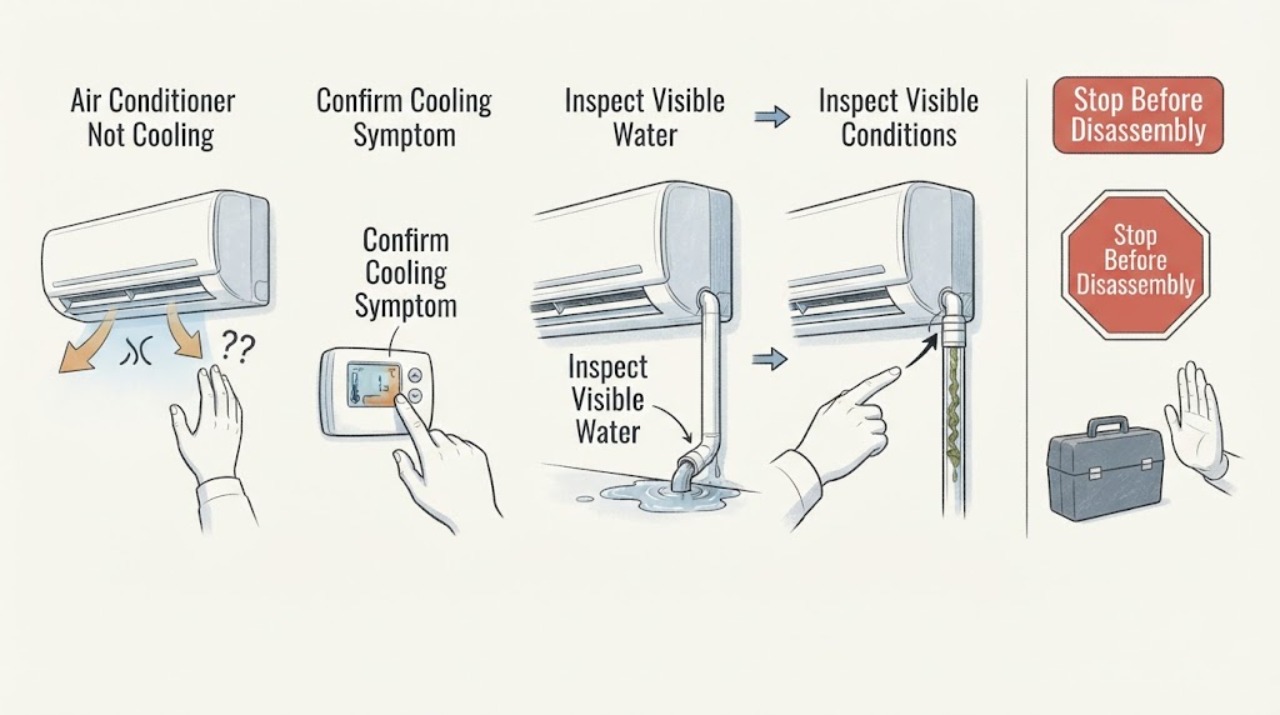
A blocked condensate drain line or pan can make an air conditioner stop cooling because water backs up and a condensate overflow switch may shut down the compressor, outdoor fan, or indoor fan. Look only from safe, ordinary access for standing water, a wet area near the indoor unit, or no water leaving the known drain outlet; also note whether a safety switch has stopped the system. Turn the system off if water is near electricity, and do not pour chemical drain cleaner into the HVAC drain or open the equipment cabinet. A qualified HVAC technician should clear and test the drain line, pan, trap, pump, and overflow switch, then check airflow and cooling. If the line is clear but the system still does not cool, the cause may be a frozen coil, airflow restriction, electrical fault, or refrigerant problem that requires professional service.
Work through in order
Diagnostic checks
Use only checks that match the exact appliance or system and its official guide.
-
Check 1
Read the thermostat and observe the system from a safe distance: record whether there is a cooling call, indoor airflow, outdoor-unit operation, a blank display, or a recent shutdown; do not repeatedly reset a breaker.
Expected result: A cooling call with both indoor and outdoor equipment stopped, especially after the system had been cooling, is consistent with a protective shutdown; no thermostat call points first to controls or settings rather than the drain line.
Next step: Continue to the water and drain observations only if there is no smoke, burning smell, arcing, hot wiring, or immediate electrical danger; otherwise stop and request qualified service.
Why this matters
Why: The operating pattern determines whether to inspect for a condensate safety event or arrange electrical/control service without forcing another start.
-
Check 2
From ordinary safe access, inspect the floor, closet, attic or basement area around the indoor unit and any accessible secondary pan for standing water, a wet surface, staining, or mold-like growth; do not remove an equipment panel.
Expected result: Water near the air handler, a full pan, or water damage supports a condensate backup or overflow; a dry area does not rule out a tripped sensor, hidden pan, trap, or pump issue.
Next step: If water is near a receptacle, wiring, control, ceiling fixture, or other electrical equipment, keep away and shut off power only from a safe, dry location; otherwise keep the system off and arrange HVAC service.
Why this matters
Why: Water evidence raises the priority of stopping cooling to prevent more overflow and having the drain path and safety control tested.
-
Check 3
Without inserting tools or chemicals, observe the known condensate drain termination during a normal cooling call if the system is otherwise safe and accessible; note whether water is flowing, absent, backing up, or discharging somewhere unexpected.
Expected result: No discharge while the indoor coil is producing condensation, backup at the pan, or water appearing at an unexpected joint supports a blocked, kinked, improperly sloped, trapped, or pumped drain path; normal discharge makes a complete blockage less likely but does not clear the pan or sensor.
Next step: Do not force a blockage, blow pressurized air into the line, pour chemical cleaner, or open the air handler. Stop the unit if water is backing up and request HVAC service.
Why this matters
Why: The result tells the technician whether to prioritize the termination, drain line, trap, pan, pump, or overflow switch rather than assuming the compressor has failed.
-
Check 4
Check only the user-accessible air filter and visible supply/return airflow path as the exact equipment instructions allow; look for restricted airflow or visible ice without touching coils, refrigerant lines, or internal components.
Expected result: A heavily loaded filter, weak airflow, or ice that later melts can explain both poor cooling and water, while a clean filter with drain backup keeps the drain system as the leading branch.
Next step: Replace a filter only with the correct manual-approved type and leave the system off if ice or water is present; do not chip ice or restart repeatedly. Arrange HVAC service if cooling does not return after the safe filter step.
Why this matters
Why: Airflow restriction and a frozen coil can create condensate overflow, but refrigerant, coil, electrical, and blower faults are professional diagnostics.
-
Check 5
Record the equipment model, the location and amount of water, the last time the system cooled, whether an overflow switch or pump is visible, the drain outlet result, any ice, and whether a breaker or thermostat message appeared.
Expected result: A repeatable shutdown that follows water accumulation is useful drain-and-safety-switch context; recurrent trips, electrical heat, burning odor, or unexplained shutdowns are not a reason to keep testing.
Next step: Keep the unit out of service when a stop condition occurred and provide the record to a qualified HVAC technician; request a full operational and water-damage check after the drain is serviced.
Why this matters
Why: These details let the technician inspect the drain line, pan, trap, pump, float or sensor, and the rest of the cooling system without unsafe user intervention.
Use your observations
Decision map
Find the observation that best matches what you see, then follow the next safe action.
-
PATH 01Next step
What you see
Water is pooling near the air handler, wiring, a receptacle, a control, a ceiling fixture, or other electrical equipment.
Do this next
Stop the air conditioner and keep clear. Disconnect power only from a safe, dry location and do not touch wet equipment, remove panels, or continue testing; arrange HVAC service and electrical help when water has reached building wiring.
-
PATH 02Next step
What you see
The system stopped during cooling and there is standing water, a full pan, a tripped visible overflow sensor, or no drain discharge.
Do this next
Treat a blocked or backed-up drain path as the priority. Leave the system off and have a qualified HVAC technician inspect and clear the pan, line, trap, pump, and sensor, then verify safe operation.
-
PATH 03Next step
What you see
The drain area is dry but the filter is visibly loaded, airflow is weak, or ice is visible.
Do this next
Use only the exact manual's safe filter-access step, leave the system off while ice melts, and do not chip ice or handle refrigerant. If airflow or cooling remains abnormal, arrange HVAC diagnosis.
-
PATH 04Next step
What you see
Water is leaving the drain outlet normally and there is no pan overflow, but the air conditioner still does not cool.
Do this next
The drain line is less likely to be the sole cause. Check the thermostat setting and accessible filter, then have a technician evaluate airflow, blower, coil, electrical controls, outdoor operation, and refrigerant without opening the system.
-
PATH 05Next step
What you see
A breaker trips again, there is smoke, burning odor, arcing, a hot plug or panel, or suspected refrigerant release.
Do this next
Stop using the system and do not reset, open, measure, or handle internal parts. Request qualified HVAC or electrical service; seek emergency help for fire, smoke, or immediate danger.
Helpful context
Understand the symptom
Why a drain-line problem can look like a cooling failure
Cooling creates condensation at the indoor coil. That water should collect in a pan and leave through a drain line, but debris, biological growth, or an obstruction can stop the flow. An overflow switch may shut down the compressor and fans to prevent a pan overflow, so a suddenly inactive system can have a water-management cause even when the thermostat still calls for cooling. Not every air handler has the same switch or drain arrangement, so treat the visible evidence and the exact equipment instructions as the boundary.
Inspect from ordinary access only
Check the thermostat display, the accessible area around the indoor air handler, and the known drain outlet without removing panels or reaching near wiring. Standing water, a damp ceiling or floor, a wet secondary pan, a pump that is not operating, or no discharge during a cooling call makes the drain path a priority. A clear-looking outlet does not prove that the pan, trap, pump, or overflow sensor is clear.
Keep the repair boundary clear
Turn the system off when water is active or near electrical equipment, protect nearby belongings without touching energized parts, and arrange HVAC service. A technician can isolate power, inspect the pan and drain path, clear the obstruction with suitable equipment, test flow and the safety switch, and then evaluate other causes such as airflow, ice, electrical operation, or the sealed refrigerant system. Do not use a chemical drain product, open a cabinet, or work on refrigerant or electrical components as a homeowner test.
Safety boundary
Stop conditions
- Stop immediately for water near wiring or electrical equipment, active ceiling or floor leakage, smoke, burning odor, arcing, a hot plug or panel, or repeated breaker trips.
- Do not repeatedly reset a breaker or condensate safety switch, restart a system with a full pan, or continue a cooling call while water is backing up.
- Do not pour chemical drain cleaner, use pressurized air or force tools into an HVAC drain, open the cabinet, chip ice, handle refrigerant, or work on electrical components.
- Stop and arrange qualified HVAC service if the drain outlet appears clear but cooling is still poor, if a pump or overflow sensor may be involved, or if the drain path is hidden or inaccessible.
When checks do not resolve it
Need a professional?
Arrange qualified HVAC service when the condensate line or pan appears blocked, water is present, the system has stopped on an overflow control, the drain is hidden or pumped, or cooling remains poor after an allowed filter and thermostat check. Use emergency services for fire, smoke, exposed energized equipment, or immediate electrical danger.
Common questions
FAQ
Can a clogged AC drain line make the air conditioner stop cooling?
Yes. Water backup can trigger an overflow safety switch that stops compressor or fan operation, and a clogged line can also cause pan overflow and water damage.
What can I safely look for around the drain line?
From ordinary access, look for standing water, a wet pan or floor, water damage, or no discharge at the known drain outlet. Do not open the air handler or use chemicals or force in the line.
Should I keep running the AC if the pan is full?
No. Leave it off when water is backing up or near electrical equipment and arrange qualified HVAC service to inspect the pan, drain, pump, and overflow control.
What if the drain outlet is flowing but the AC is still not cooling?
A complete drain blockage is less likely, so a technician may need to evaluate airflow, a frozen coil, blower or outdoor operation, controls, or refrigerant. Do not handle sealed-system or electrical components yourself.
Read the exact guide
Official sources
- Air Conditioner Troubleshooting: Why Your AC Is Not CoolingTrane · Trane residential air-conditioner troubleshooting; thermostat, filter, drain-line, airflow, electrical, and refrigerant decision branches
- Why Is My AC Leaking Water?Carrier · Carrier residential air conditioners; condensate leaks, frozen coils, drain pans, airflow, and professional assessment
- How to Fix a Clogged AC Drain Line | How to Unclog AC Drain LineCarrier · Carrier residential air conditioners; condensate drain-line symptoms, water backup, and qualified service
- HVAC Air Handler Overflow SwitchTrane · Trane residential air handlers, condensate drain pans, drain lines, and overflow switches
Community feedback
Share a repair observation
Share a plain-text repair observation. Accepted observations are published automatically; this page may take a moment to update.