
On this page
Start here
Quick answer
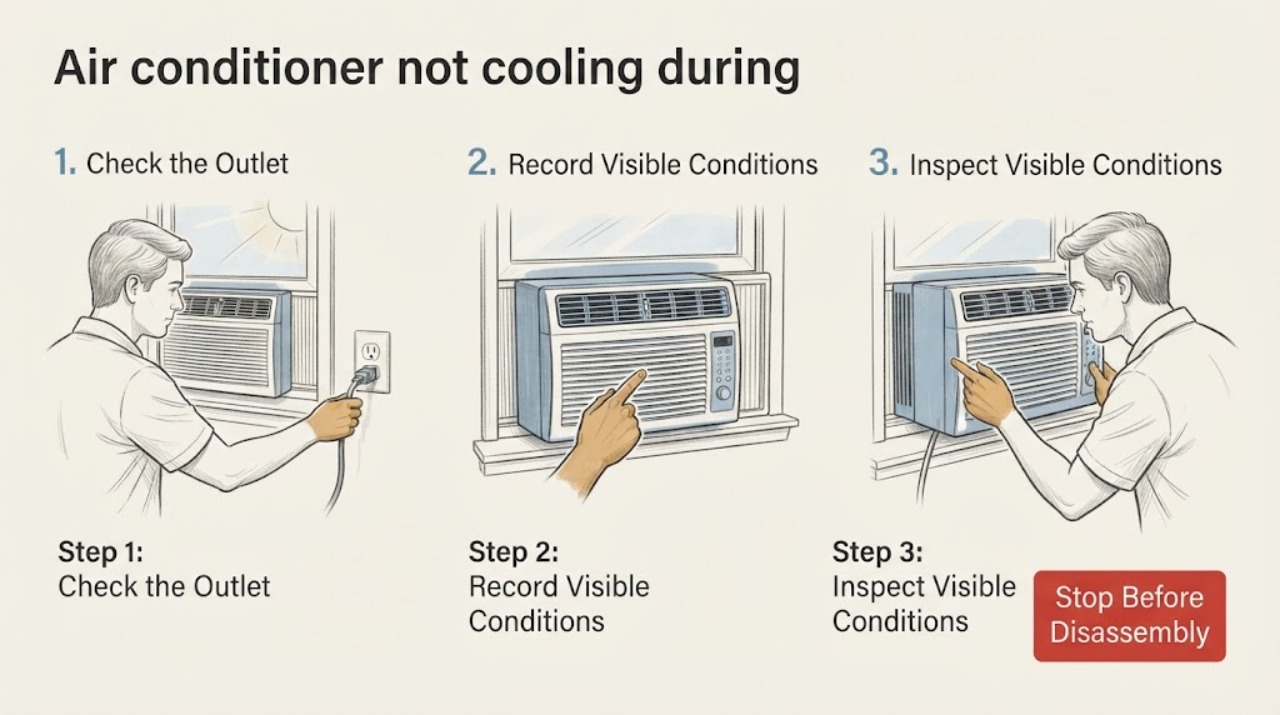
If an air conditioner cools at night but struggles during the day, the added daytime heat load may be exposing a capacity, airflow, outdoor-temperature, or system fault. First confirm that the mode and schedule are calling for cooling, then check the filter and visible indoor and outdoor airflow paths. Close sun-facing blinds and reduce heat sources as a controlled comparison, but do not cover the outdoor unit or open the refrigerant or electrical sections. If ice forms, airflow is weak, water leaks, the compressor does not start, or the unit has a burning smell, smoke, sparks, or a hot plug, stop cooling and arrange HVAC service. A repeatable day-only failure after safe airflow and room checks needs a qualified technician to evaluate charge, coil, fan, compressor, sizing, and duct or installation issues.
Work through in order
Diagnostic checks
Use only checks that match the exact appliance or system and its official guide.
-
Check 1
While the problem is occurring, check from a safe position for smoke, sparks, a burning smell, a hot plug or outlet, water near electrical equipment, unusual noise, or a damaged cord. If any is present, turn the unit off only if safe and stop.
Expected result: A warm room alone can be a load issue; smoke, sparks, burning odor, water at electrical equipment, excessive heat, or damaged wiring is a safety event.
Next step: Keep clear, isolate power only when it can be done without entering a wet or hazardous area, and arrange HVAC or electrical service. Leave and contact emergency help for smoke or fire.
Why this matters
Why: Continuing to run a unit with electrical, fire, or water hazards can cause shock, fire, or property damage.
-
Check 2
Compare the control settings at the same time of day: confirm Cool mode, the intended setpoint, fan mode, timer or sleep schedule, and whether the indoor unit is actually running. Record the indoor temperature, outdoor conditions, and when cooling becomes inadequate.
Expected result: A changed schedule, fan-only or dry mode, high setpoint, or a unit that is off explains an apparent day-only failure. Correct cooling mode with weak cooling only during heat supports a load or performance branch.
Next step: Use the exact manual to correct a setting, then compare one daytime period. Do not force a hidden service menu or repeatedly restart the unit.
Why this matters
Why: Thermostat and timer behavior can make an air conditioner appear faulty, while a repeatable daytime limit under correct settings needs deeper evaluation.
-
Check 3
With the unit off and user-accessible, inspect and clean the filter only as the manual permits. Look for blocked indoor intake or supply vents, a blocked outdoor intake or discharge area, crushed portable exhaust tubing, or furniture and curtains restricting airflow.
Expected result: A visibly dirty filter or blocked path can reduce airflow and cooling. If airflow remains weak after a permitted filter cleaning and obstruction removal, or if the filter ices quickly, the issue is not solved by more cleaning.
Next step: Restore only clear, safe airflow paths and retest after the manual's restart interval. Do not open panels, touch a fan, or clean an energized unit.
Why this matters
Why: Restricted airflow can reduce capacity and may contribute to coil frost or condensate problems; exact filter access and outdoor clearances are model-specific.
-
Check 4
Run a controlled daytime comparison: close blinds or curtains on sun-facing windows, close doors and windows, turn off nearby heat-producing devices, and start cooling before the room is fully hot. Keep the setpoint and fan mode unchanged while noting whether the room and supply air improve.
Expected result: A meaningful improvement after reducing solar and internal heat supports a heat-load, insulation, room-size, or timing limitation. Little or no improvement with a clear room and correct settings points toward equipment, airflow, or installation service.
Next step: Use the result to tell HVAC service whether the problem is load-sensitive. Do not compensate by setting an extreme temperature or leaving the unit running through a safety symptom.
Why this matters
Why: Sunlight, open windows, appliances, and a very hot room add heat faster than a small or impaired unit can remove it; this does not by itself prove a refrigerant fault.
-
Check 5
Look for ice or heavy frost on the accessible indoor coil or tubing, weak airflow, unexpected water, or a drain that is not carrying condensate away. Do not chip ice, pour hot water, use a flame, open the coil cabinet, or touch refrigerant tubing or electrical parts.
Expected result: Ice, weak airflow, or water suggests a frozen coil, blocked filter or drain, fan problem, or refrigerant/system issue. Recurring ice after the unit is off and fully thawed is a professional service branch.
Next step: Turn cooling off and allow safe thawing according to the manual, use fan-only only if the manual permits and no electrical or water hazard exists, then arrange HVAC service if ice, water, or weak airflow returns.
Why this matters
Why: Ice and condensate can reduce cooling and damage the unit or property; the root cause can be beyond a user-cleanable filter.
-
Check 6
Record whether the outdoor section runs during a daytime cooling call, whether the indoor fan runs, whether the unit cycles off early, and whether the night recovery is normal. Leave outdoor electrical, capacitor, and refrigerant work to qualified service; do not remove the outdoor cover or reach through a grille.
Expected result: An indoor fan without expected outdoor operation, repeated short cycles, a compressor that never starts, or a system that cools only after outdoor temperatures fall narrows the service handoff but does not identify a replaceable part.
Next step: Keep the unit off if it makes abnormal sounds, overheats, trips power, or leaks. Otherwise provide the timing and operating observations to a qualified HVAC technician.
Why this matters
Why: Fan, compressor, coil, controls, charge, duct, and sizing issues require equipment-specific testing; the day-only pattern can reveal a marginal system under peak load.
-
Check 7
Prepare a technician handoff with equipment type, model, filter condition, control settings, daytime and nighttime temperatures, weather and sun exposure, airflow symptoms, ice or water, outdoor-unit behavior, error indicators, and all safe checks already completed.
Expected result: A side-by-side day/night record can distinguish heat load from restricted airflow, icing, drainage, controls, fan, compressor, charge, duct, or sizing concerns.
Next step: Arrange HVAC service for a recurring day-only failure. Ask the technician to assess airflow, coils, condensate, controls, outdoor operation, refrigerant circuit, and capacity for the space.
Why this matters
Why: The cause cannot be confirmed by waiting until night or by adding refrigerant; opening sealed or electrical sections is professional work.
Use your observations
Decision map
Find the observation that best matches what you see, then follow the next safe action.
-
PATH 01Next step
What you see
There is smoke, sparks, a burning smell, a hot or damaged plug, water near electrical equipment, or a breaker or safety device trips.
Do this next
Arrange qualified service and follow the exact model guidance.
Why this path and its safety boundary
Why it matters: Stop using the air conditioner and isolate power only if safe. Arrange electrical or HVAC service; leave and contact emergency help for smoke or fire.
-
PATH 02Next step
What you see
The unit produces cold air at night and improves when sunlight, open windows, and nearby heat sources are reduced.
Do this next
Arrange qualified service and follow the exact model guidance.
Why this path and its safety boundary
Why it matters: The symptom is load-sensitive. Keep the room shaded and closed during testing, start cooling earlier, and have HVAC assess capacity, insulation, duct losses, and peak-load performance if comfort remains inadequate.
-
PATH 03Next step
What you see
The filter or a visible indoor or outdoor airflow path is blocked.
Do this next
Arrange qualified service and follow the exact model guidance.
Why this path and its safety boundary
Why it matters: Clean or clear only the user-accessible item allowed by the manual, then retest. If airflow remains weak or the coil freezes, stop cooling and arrange HVAC service.
-
PATH 04Next step
What you see
Ice, repeated frost, water leakage, weak airflow, or a blocked condensate path appears.
Do this next
Arrange qualified service and follow the exact model guidance.
Why this path and its safety boundary
Why it matters: Turn off cooling and allow safe thawing or collection only as the manual permits. Do not chip ice or open the system; arrange HVAC service if the condition recurs.
-
PATH 05Next step
What you see
Correct settings and clear airflow do not restore daytime cooling, or the outdoor section, compressor, or fan behaves abnormally.
Do this next
Arrange qualified service and follow the exact model guidance.
Why this path and its safety boundary
Why it matters: Leave the unit off if abnormal operation or overheating occurs and schedule a qualified HVAC diagnosis. Do not handle refrigerant, capacitors, electrical covers, or sealed components.
Helpful context
Understand the symptom
The day-versus-night pattern is useful evidence, not a diagnosis. During the day, sun and outdoor heat add load to walls, windows, rooms, and the equipment's heat-rejection side. The system may be operating but unable to remove heat as quickly as it enters. A sharp change, weak airflow, ice, water, short cycling, or a hot electrical component points to a fault that should not be hidden by waiting for cooler weather.
Keep the checks specific to the equipment type. A split system, central system, window unit, portable unit, heat pump, and ductless system have different filters, fans, drains, and outdoor sections. Only inspect user-accessible parts described by the exact manual; do not open the refrigerant circuit, remove electrical covers, or add refrigerant yourself.
Safety boundary
Stop conditions
- Stop immediately for smoke, sparks, burning odor, hot or damaged plug or outlet, water near electrical parts, electric shock, fire, repeated trips, abnormal mechanical noise, or excessive heat.
- Do not chip ice, use hot water or flame to thaw a coil, open electrical or refrigerant covers, test live voltage, handle capacitors or refrigerant, bypass safeties, or cover an outdoor unit to create shade.
- Leave cooling off when ice or water returns, airflow is weak, the compressor or fan will not run, the unit short-cycles, or daytime failure persists after safe setting, filter, airflow, and heat-load checks.
Common questions
FAQ
Why does my air conditioner cool at night but not during the day?
Daytime sun and outdoor heat add load, so a correctly operating or marginally sized system may run longer and struggle to reach the setpoint. Dirty filters, blocked airflow, ice, controls, fan, compressor, charge, duct, and capacity problems can produce the same pattern.
Should I cover the outdoor unit to keep it cool?
No. Keep the outdoor intake and discharge clear as the manual requires and do not cover the unit while operating. Shading windows and reducing indoor heat are safer load checks; outdoor-unit service and sealed-system work require a qualified technician.
What if the coil freezes during the day?
Turn cooling off and allow safe thawing according to the manual. Do not chip ice, use hot water or flame, or open the system. If ice, weak airflow, or water returns after the filter and visible airflow path are addressed, arrange HVAC service.
Read the exact guide
Official sources
- Troubleshoot an ACCarrier · Manufacturer context for thermostat schedules and day or night comfort settings
- TroubleshootingDaikin Global · Manufacturer troubleshooting for settings, breakers, filters, blocked airflow, abnormal odor, water leakage, and service
- [LG Air Conditioner for Cooling] Cooling operation fails. No cold airLG USA Support · Manufacturer example for cooling-mode selection, filter care, and model-dependent cooling behavior
- TCL Air Conditioner Not Cooling the RoomTCL Support · Manufacturer troubleshooting for heat load, sunlight, filters, exhaust or outdoor airflow, icing, outdoor temperature, and service boundaries
Community feedback
Share a repair observation
Share a plain-text repair observation. Accepted observations are published automatically; this page may take a moment to update.