
On this page
Start here
Quick answer
A dirty, wet, collapsed, incorrectly sized, or backward-installed air filter can restrict airflow enough to make an air conditioner cool poorly, run longer, or freeze the indoor coil. Check the filter only at the user-accessible location named by the equipment manual, confirm its size and airflow direction, and replace or clean it only as the filter and system instructions allow. If airflow remains weak, ice is visible, water is accumulating, the new filter does not restore cooling, or the equipment has electrical or refrigerant symptoms, turn cooling off and arrange qualified HVAC service. Do not run the system with no filter, force a filter into place, chip ice, open the air handler, or handle refrigerant.
Before you begin
Safety first
- The owner scope ends at a cool, dry, user-accessible filter inspection and a manual-approved clean or replacement. Internal air-handler, blower, coil, electrical, refrigerant, and condensate work belongs to a qualified HVAC professional.
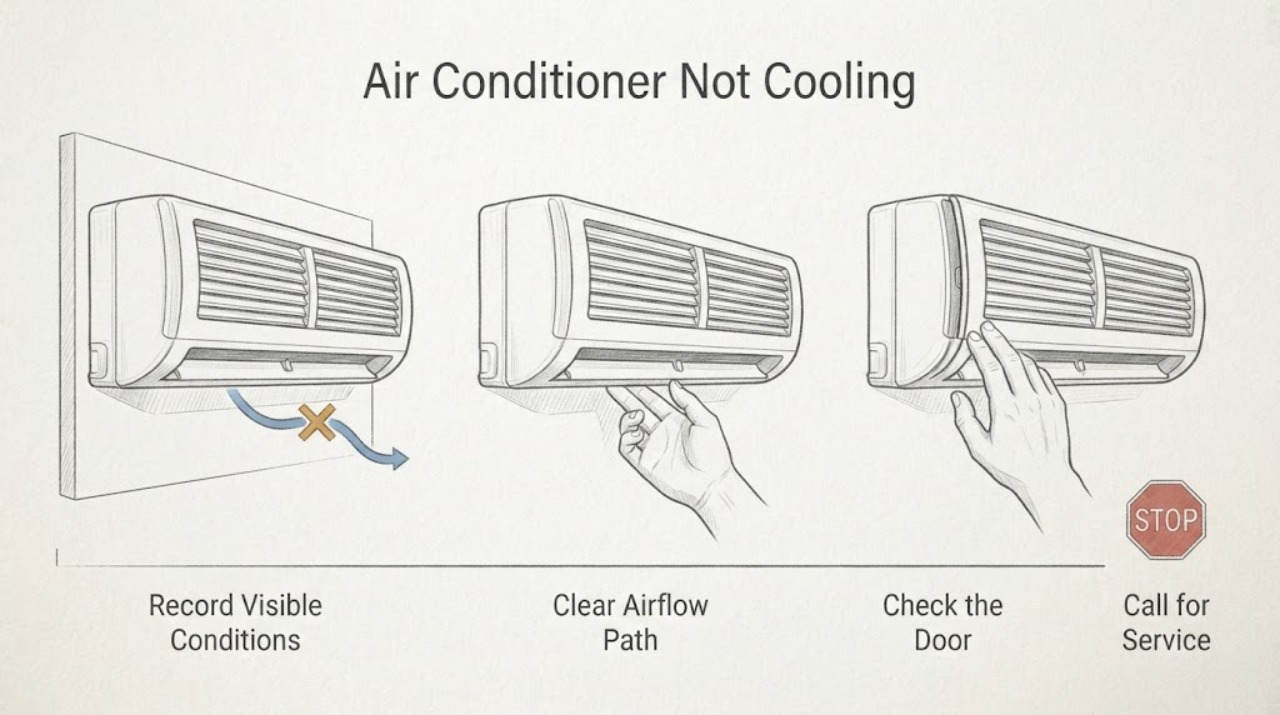
Work through in order
Diagnostic checks
Use only checks that match the exact appliance or system and its official guide.
-
Check 1
Record the equipment type and model, then locate the user-accessible filter at the return grille, air handler, furnace cabinet, or room unit location identified by the manual; do not remove a service cover or enter an unsafe access area.
Expected result: There is one accessible filter with a readable size and airflow marking, several filter locations, no filter, or a filter location that cannot be reached safely.
Next step: Use the exact manual to identify the correct filter and access method. If access requires electrical-panel work, a ladder or attic hazard, or a removed cabinet cover, stop and call HVAC service.
Why this matters
Why: The filter arrangement is model-dependent. Missing or multiple filters can change the airflow path, while an inaccessible location is a service task rather than a reason to improvise.
-
Check 2
Set the thermostat to off and wait for moving parts to stop, then inspect the accessible filter without touching wiring; compare the filter size and airflow arrow with the slot or manual.
Expected result: The media is visibly packed with dust, wet, bowed, torn, collapsed, or installed with the arrow against the intended airflow, or it is clean, dry, intact, and correctly oriented.
Next step: Replace a disposable filter with the exact manual-approved size and type, or clean a reusable filter only as its instructions allow. Do not wash a disposable filter, force a larger filter, or operate without the filter unless the exact service procedure explicitly permits it.
Why this matters
Why: A blocked or damaged filter can restrict airflow and raise the chance of poor cooling or coil frost. A clean, intact, correctly oriented filter makes another airflow or cooling cause more likely.
-
Check 3
After installing the clean or approved replacement filter, confirm that it sits flat, the access grille or door closes normally, and no edge gap or loose media blocks the return path.
Expected result: The filter fits without force and the return path is open, or it is too tight, too loose, bowed, damaged, or difficult to seat.
Next step: Do not trim, stack, tape, or substitute the filter. Confirm the model specification and have HVAC service correct a damaged rack, door, or return assembly.
Why this matters
Why: Correct fit supports the intended airflow; a forced or loose fit can bypass filtration or restrict the return path and may indicate the wrong filter specification or a damaged holder.
-
Check 4
With the filter secured and the system operating only if there are no safety concerns, compare supply airflow at several registers with the normal airflow you remember; keep hands away from fans, belts, coils, and electrical parts.
Expected result: Airflow is stronger and the air becomes cool, or airflow remains weak, uneven, absent, or warm after the filter change.
Next step: If cooling and airflow do not recover, turn cooling off and arrange HVAC diagnosis rather than fitting a thinner filter or opening the air handler.
Why this matters
Why: Improvement supports the filter as a contributor. Persistent low or warm airflow suggests a blocked return or duct, blower issue, frozen coil, thermostat or control problem, or another HVAC fault.
-
Check 5
Look only at visible, safe-to-reach surfaces around the indoor unit and return for frost, ice, dripping water, a rising condensate pan, or damp filter media; do not chip ice or reach into the coil compartment.
Expected result: Ice or frost is present, water is collecting, the filter is wet, or none of those signs are visible.
Next step: Turn cooling off and let the equipment follow its safe defrost or shutdown process. If water is near electrical equipment, isolate power only when it can be done without contact with water; call HVAC service for the cause. Never scrape ice, pour chemicals into a drain, or restart repeatedly.
Why this matters
Why: Restricted airflow can contribute to a frozen evaporator coil, while water can indicate a condensate or drain problem. Either condition can damage the system if cooling continues.
-
Check 6
After the filter is confirmed clean, correctly fitted, and dry, observe whether the thermostat calls for cooling and whether the indoor and outdoor equipment run normally, without opening a panel or touching electrical parts.
Expected result: The system runs with normal airflow but the room stays warm, it short-cycles, the outdoor unit does not run, or the thermostat shows an abnormal state.
Next step: Stop troubleshooting at the filter and call a qualified HVAC professional. Do not test voltage, reset a tripped disconnect repeatedly, open the refrigerant circuit, or adjust charge.
Why this matters
Why: A clean filter with continuing poor cooling points beyond the filter to controls, airflow components, coils, refrigerant, compressor, or electrical supply.
-
Check 7
Prepare a service note with the model, filter size and type, condition and orientation, filter-change date if known, supply-air strength, ice or water observations, thermostat behavior, and whether cooling improved.
Expected result: The note shows the problem changed after the filter was corrected, or the symptom persisted with a clean, correctly fitted filter.
Next step: Give the note to HVAC service and leave any suspect filter, wet area, ice, or electrical symptom out of operation until assessed. Do not keep running a system that is frozen, leaking, overheating, or making unsafe electrical sounds.
Why this matters
Why: A change after filtering supports restricted airflow as a contributor; persistence gives the technician a clear reason to inspect the rest of the HVAC system.
Use your observations
Decision map
Find the observation that best matches what you see, then follow the next safe action.
-
PATH 01Next step
What you see
The filter is visibly clogged, damaged, wet, or installed in the wrong airflow direction, and cooling improves after an approved correction.
Do this next
Keep the correct filter installed and follow the model's inspection schedule. Arrange service if cooling weakens again quickly or the filter becomes wet or damaged.
Why this path and its safety boundary
Why it matters: Restricted return airflow was likely contributing to the poor cooling.
-
PATH 02Next step
What you see
The filter is clean and correctly fitted, but airflow remains weak or the system still does not cool.
Do this next
Turn cooling off if airflow is very low or ice is present and call qualified HVAC service. Do not install a less restrictive filter to mask the symptom.
Why this path and its safety boundary
Why it matters: The filter is unlikely to be the only restriction; duct, blower, coil, thermostat, condensate, refrigerant, or electrical diagnosis may be needed.
-
PATH 03Next step
What you see
Ice or frost appears on the indoor coil or refrigerant tubing after a dirty-filter episode.
Do this next
Stop cooling and let the system defrost safely; have HVAC service identify the cause before normal cooling resumes. Do not chip the ice or handle refrigerant.
Why this path and its safety boundary
Why it matters: Low airflow can be associated with a frozen coil, but the filter may not be the underlying cause.
-
PATH 04Next step
What you see
Water is collecting near the indoor unit, the filter is repeatedly wet, or a condensate safety condition is suspected.
Do this next
Turn cooling off, keep water away from electrical equipment, and call HVAC service. Do not open the drain system or pour an unapproved chemical into it.
Why this path and its safety boundary
Why it matters: A drain or condensate problem can affect operation and create water damage or electrical risk.
-
PATH 05Next step
What you see
Smoke, burning odor, arcing, a hot electrical connection, repeated breaker trips, or damaged wiring is present.
Do this next
Stop using the system and move away from the hazard. Contact appropriate emergency or qualified electrical/HVAC service from a safe location; do not reset repeatedly or open the equipment.
Why this path and its safety boundary
Why it matters: This is an electrical or fire-safety event, not a filter adjustment.
Helpful context
Understand the symptom
What the filter can and cannot explain
The filter protects the return side of a ducted air handler and must allow enough air to cross the cooling coil. Dust, moisture, a collapsed media surface, a filter installed against the airflow arrow, or a filter that does not fit the slot can restrict that path. A restriction may show up as weak supply airflow, longer cycles, warm rooms, or ice at the indoor coil. It cannot prove that the filter is the only cause: the same symptoms can come from a blocked duct, blower problem, condensate protection, frozen coil, refrigerant issue, or electrical fault.
Use the equipment manual for fit and access
Air handlers, furnaces, return grilles, window units, and mini-splits do not all use the same filter location or cleaning method. Use the exact model instructions for the filter size, washable or disposable construction, airflow arrow, access panel, and any reset procedure. Do not climb into an unsafe attic or crawlspace, remove a service panel, or keep the system running while a filter is loose.
Safety boundary
Stop conditions
- Stop cooling for visible ice or frost, severe loss of airflow, water near electrical equipment, a wet or damaged filter, or a condensate pan that is rising or overflowing.
- Stop immediately for smoke, burning or melting odor, sparks, arcing, a hot plug or disconnect, repeated breaker trips, or damaged wiring; do not restart to test the result.
- Do not remove the air-handler cover, touch wiring or moving parts, test live voltage, open a refrigerant circuit, adjust refrigerant charge, or chip ice.
- Do not run the system without its specified filter, force a filter into the slot, stack filters, or substitute a thinner filter to increase airflow.
When checks do not resolve it
Need a professional?
Arrange HVAC diagnosis when the filter check does not resolve the cooling problem or when the symptom involves a frozen coil, drain, blower, coil, refrigerant, controls, or outdoor equipment.
Safety scope: The owner scope ends at a cool, dry, user-accessible filter inspection and a manual-approved clean or replacement. Internal air-handler, blower, coil, electrical, refrigerant, and condensate work belongs to a qualified HVAC professional.
Common questions
FAQ
Can a dirty filter make an air conditioner stop cooling?
Yes. A clogged filter can restrict airflow enough to reduce cooling and, in some systems, contribute to a frozen coil or protective shutdown. Replace or clean it only as the exact equipment instructions allow, then seek HVAC service if cooling does not recover.
How do I know whether my filter is installed backward?
Use the airflow arrow and the filter-slot or model-manual instructions. The filter should sit flat without force, gaps, bows, or a damaged edge. Do not guess from the location alone or run the system with a loose filter.
Should I run the air conditioner without a filter to test cooling?
No. Keep the specified filter installed unless the exact service procedure explicitly directs otherwise. A missing filter allows dust into the air handler and does not safely distinguish a filter issue from a coil, blower, duct, or refrigerant issue.
What if the filter is clean but the air conditioner still is not cooling?
Check for weak airflow, ice, water, short cycling, and abnormal outdoor-unit behavior from a safe position, then turn cooling off and call qualified HVAC service. Refrigerant, blower, coil, drain, control, and electrical work are not filter-level repairs.
Read the exact guide
Official sources
- HVAC Proper Installation of FiltersU.S. Department of Energy Building Science Education · HVAC filter location, airflow, accessibility, and maintenance guidance
- AC Not Blowing Cold AirTrane · Trane residential air-conditioner troubleshooting guidance
- Heat & Cool EfficientlyENERGY STAR · Residential heating and cooling efficiency guidance
- Why Is My AC Not Blowing Cold Air? 7 Common CausesCarrier · Carrier residential air-conditioner troubleshooting guidance
- Maintenance ChecklistENERGY STAR · Residential HVAC maintenance and professional service boundaries
Community feedback
Share a repair observation
Share a plain-text repair observation. Accepted observations are published automatically; this page may take a moment to update.