
On this page
Start here
Quick answer
The assigned condition is “inside post”; this wording is preserved exactly and this article does not infer what it refers to. Start with observable facts instead: confirm the cooling setting, compare indoor airflow, inspect the user-accessible filter, look for visible ice or condensate, and observe the outdoor unit from a safe distance. A dirty filter can restrict airflow and contribute to poor cooling, but a clean filter does not rule out a frozen coil, blocked drain, blower or duct problem, refrigerant issue, or electrical fault. Turn cooling off for ice, water near electrical equipment, smoke, burning odor, or abnormal electrical behavior, and use qualified HVAC service for internal, refrigerant, or electrical work.
Before you begin
Safety first
- The owner scope ends at external observation and model-approved filter care. Internal air-handler, blower, coil, condensate, outdoor electrical, compressor, and refrigerant work belongs to qualified HVAC service.
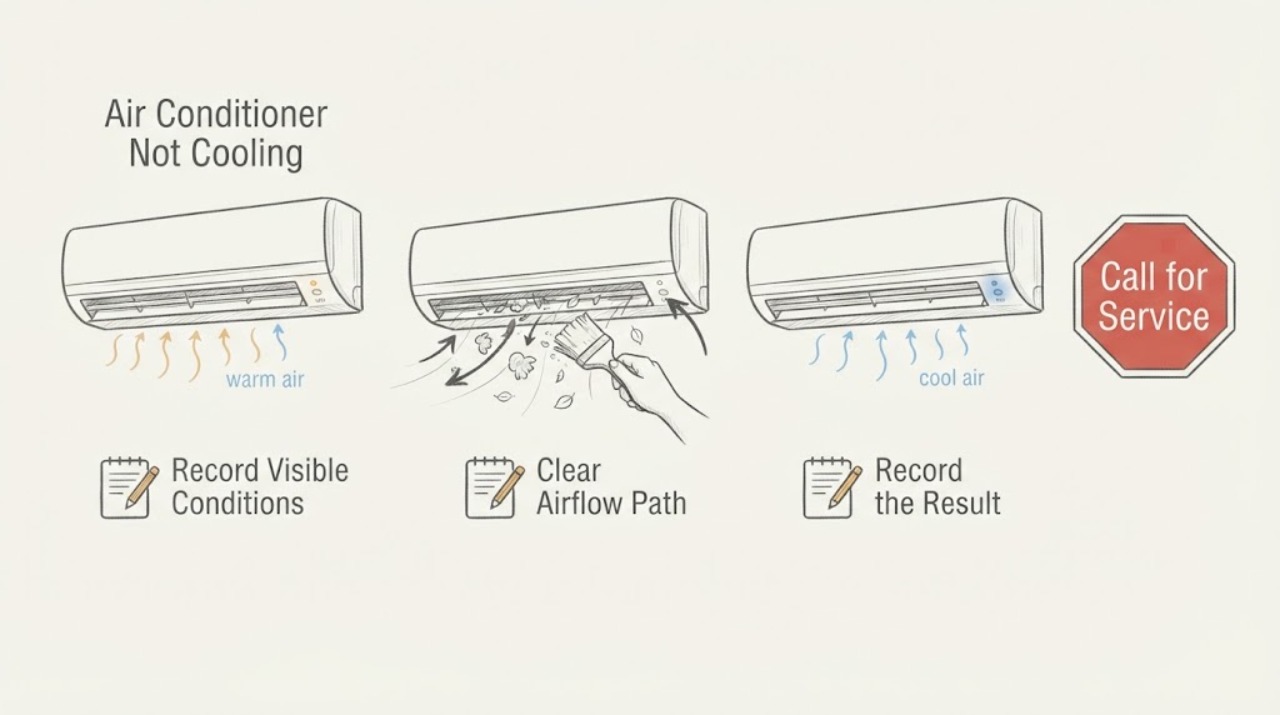
Work through in order
Diagnostic checks
Use only checks that match the exact appliance or system and its official guide.
-
Check 1
Record the exact equipment type and model, then confirm the thermostat is set to cooling with a target below the current indoor temperature; keep the fan setting and the task condition “inside post” exactly as recorded.
Expected result: The thermostat is not calling for cooling, the fan is set to run independently, the display is abnormal, or the system is calling for cooling but the room remains warm.
Next step: Correct only the normal user settings identified by the manual. If the system still does not cool, continue with safe observations; do not open the thermostat, air handler, or electrical panel.
Why this matters
Why: A control setting can make air feel warm without a cooling failure. A valid cooling call with continuing warmth moves the diagnosis to airflow, indoor coil, outdoor unit, condensate, refrigerant, or electrical checks.
-
Check 2
From inside the conditioned space, compare airflow at several supply registers and at the return without moving grilles or reaching into equipment.
Expected result: Airflow is strong but warm, weak at every register, weak only in one area, or absent while the indoor unit appears to run.
Next step: Keep the system off if airflow is severely reduced or ice is visible. Do not remove a blower cover, reach through a grille, or use a thinner filter to mask low airflow.
Why this matters
Why: Strong warm airflow points beyond a simple filter restriction. Weak or absent airflow is consistent with a blocked filter or return, duct issue, blower problem, frozen coil, or a protection control; one-room weakness can be local to a grille or duct.
-
Check 3
Set cooling off before inspecting the user-accessible filter named by the equipment manual, then check the filter for dust loading, moisture, collapse, damage, correct size, and airflow direction.
Expected result: The filter is visibly clogged, wet, damaged, too loose, too tight, or reversed, or it is clean, dry, intact, and correctly seated.
Next step: Clean a reusable filter or replace a disposable filter only as the exact manual allows. Do not run the system without the specified filter, force a fit, or touch wiring behind the access point.
Why this matters
Why: A blocked or damaged filter can reduce airflow and contribute to poor cooling or coil frost. A clean, correctly fitted filter makes another airflow or cooling cause more likely.
-
Check 4
After the filter is secured, check that return grilles and supply registers are not visibly blocked by furniture, coverings, or debris; inspect only from a safe, standing position.
Expected result: The return path or several registers are blocked, or the openings are clear but airflow remains weak.
Next step: Remove only an obvious external obstruction. If airflow remains weak, turn cooling off and arrange HVAC service rather than opening ducts or the air handler.
Why this matters
Why: A blocked air path can reduce delivered cooling. Clear openings with no airflow improvement suggests a duct, blower, coil, filter-rack, or control issue that is not solved by moving one object.
-
Check 5
Look at safe, visible areas around the indoor unit for frost, ice, dripping water, a rising condensate pan, or a wet filter; do not scrape ice or reach into the coil compartment.
Expected result: Ice or frost is present, water is collecting, the filter is wet, or none of these signs is visible.
Next step: Turn cooling off and allow safe defrosting. Keep water away from electrical equipment and call HVAC service for recurring ice, drainage problems, or an inaccessible coil; do not chip ice or add unapproved chemicals.
Why this matters
Why: Restricted airflow can contribute to a frozen evaporator coil, and a blocked condensate drain can cause water damage or a protective shutdown. No visible ice or water does not rule out other causes.
-
Check 6
From a safe distance and without opening an enclosure, observe whether the outdoor unit starts during a cooling call, whether its airflow is unobstructed by obvious external debris, and whether the system stops and restarts unusually often.
Expected result: The outdoor unit does not run, runs for unusually long periods, short-cycles, has visible ice, or appears to run normally while indoor air remains warm.
Next step: Remove only loose debris that is safely outside the unit and permitted by the manual. For no outdoor operation, repeated stopping, ice, or warm air with normal airflow, turn cooling off and call qualified HVAC service.
Why this matters
Why: Outdoor-unit, control, coil, compressor, refrigerant, and electrical issues can produce poor cooling even after the indoor filter is correct. Short cycling or ice is not a reason to keep restarting the equipment.
-
Check 7
Prepare a service note with the model, the literal condition “inside post,” thermostat state, airflow comparison, filter condition and orientation, ice or water location, condensate observations, outdoor-unit behavior, and when cooling changed.
Expected result: Cooling improves after an approved setting or filter correction, or the problem persists despite normal settings, a clean filter, and clear visible airflow paths.
Next step: Give the note to qualified HVAC service and leave the system off for ice, water, electrical symptoms, or repeated short cycling. Do not perform live testing, refrigerant work, or internal repairs.
Why this matters
Why: Improvement supports a user-level airflow or setting contributor. Persistence points toward the coil, blower, drain, controls, outdoor unit, refrigerant, or electrical supply.
Use your observations
Decision map
Find the observation that best matches what you see, then follow the next safe action.
-
PATH 01Next step
What you see
The thermostat was not calling for cooling, or the fan was producing air without a cooling call.
Do this next
Restore the normal cooling setting only as the manual permits. If the system still fails to cool, follow the airflow and ice checks without opening equipment.
Why this path and its safety boundary
Why it matters: The apparent warm air may be a control-mode issue rather than a failed filter or cooling circuit.
-
PATH 02Next step
What you see
The filter is dirty, wet, damaged, or incorrectly fitted and airflow improves after an approved clean or replacement.
Do this next
Keep the correct filter installed and follow the equipment maintenance guidance. Call HVAC service if the filter becomes wet, ices return, or cooling declines again quickly.
Why this path and its safety boundary
Why it matters: Filter restriction or bypass was likely contributing to the symptom.
-
PATH 03Next step
What you see
The filter is clean and correctly fitted, but airflow remains weak or absent.
Do this next
Turn cooling off if airflow is severely reduced or ice is present and arrange qualified HVAC diagnosis. Do not open the air handler or blower compartment.
Why this path and its safety boundary
Why it matters: A return or duct restriction, blower problem, frozen coil, filter rack, or control issue may remain.
-
PATH 04Next step
What you see
Airflow is normal but the air remains warm, the outdoor unit does not run, or the system runs unusually long or short-cycles.
Do this next
Stop at safe observation and call qualified HVAC service. Do not adjust refrigerant, open an enclosure, or perform electrical testing.
Why this path and its safety boundary
Why it matters: The fault is likely beyond the filter and may involve controls, coils, compressor, refrigerant, condensate protection, or electrical supply.
-
PATH 05Next step
What you see
Ice, frost, water near the indoor unit, a rising pan, or a wet filter is visible.
Do this next
Turn cooling off, keep clear of water near electrical parts, and call HVAC service after safe defrosting. Do not chip ice or dismantle the drain or coil.
Why this path and its safety boundary
Why it matters: A frozen coil or condensate problem can damage equipment and cause water damage if cooling continues.
-
PATH 06Next step
What you see
Smoke, burning odor, sparks, arcing, a hot disconnect, damaged wiring, or repeated breaker operation is present.
Do this next
Stop using the equipment and move away from the hazard. Contact appropriate emergency, electrical, or HVAC professionals from a safe location; do not restart to test.
Why this path and its safety boundary
Why it matters: This is an electrical or fire-safety event, not a filter or airflow adjustment.
Helpful context
Understand the symptom
Keep the assigned condition literal
The task condition is recorded as “inside post.” That phrase is intentionally not expanded into a location, installation type, social post, or other meaning here. Use the model label, actual indoor and outdoor observations, and the operating mode to establish what is happening before choosing a repair path.
Separate indoor airflow from cooling production
An indoor unit can move air without producing cooling, and a cooling system can run with very weak airflow. The filter and return path affect how much air crosses the indoor coil; the outdoor unit, refrigerant circuit, condensate path, controls, and electrical supply determine other parts of the cooling process. The checks below stop at safe observation and manual-approved filter care.
Safety boundary
Stop conditions
- Stop cooling for visible ice or frost, severe loss of airflow, water near electrical equipment, a wet filter, or a condensate pan that is rising or overflowing.
- Stop immediately for smoke, burning or melting odor, sparks, arcing, a hot plug or disconnect, damaged wiring, or repeated breaker operation.
- Do not remove an air-handler or outdoor-unit cover, touch wiring or moving parts, perform live electrical testing, open the refrigerant circuit, or adjust refrigerant charge.
- Do not chip ice, force a filter into place, operate without the specified filter, or keep restarting a system that is frozen, leaking, short-cycling, or not cooling.
When checks do not resolve it
Need a professional?
Arrange HVAC diagnosis when the safe indoor and outdoor observations do not identify a user-level setting or filter issue, or when ice, water, cycling, or no cooling persists.
Safety scope: The owner scope ends at external observation and model-approved filter care. Internal air-handler, blower, coil, condensate, outdoor electrical, compressor, and refrigerant work belongs to qualified HVAC service.
Common questions
FAQ
What does the condition “inside post” mean here?
It is preserved exactly as assigned, and this article does not infer its meaning. Confirm the original record or user description, then use the observable indoor, outdoor, setting, airflow, ice, and condensate checks on this page.
Can a filter cause an air conditioner not to cool?
Yes. A dirty or clogged filter can restrict airflow and contribute to poor cooling or a frozen indoor coil. If a correct clean filter does not restore cooling, the cause may be elsewhere in the HVAC system.
What should I do if I see ice on the air conditioner?
Turn cooling off and allow safe defrosting, while keeping water away from electrical equipment. Do not chip the ice or handle refrigerant; recurring ice needs qualified HVAC diagnosis.
When is an air conditioner not cooling problem beyond homeowner checks?
Call HVAC service when airflow stays weak, the outdoor unit does not run, water or ice appears, cycling is abnormal, or cooling remains poor with a clean filter and normal settings. Internal, electrical, coil, blower, drain, and refrigerant work is professional work.
Read the exact guide
Official sources
- Why Is My AC Not Blowing Cold Air? 7 Common CausesCarrier · Carrier residential air-conditioner cooling troubleshooting
- HVAC Proper Installation of FiltersU.S. Department of Energy Building Science Education · HVAC filter placement, airflow, accessibility, and maintenance guidance
- Troubleshoot an Air ConditionerCarrier · Carrier residential air-conditioner system troubleshooting and HVAC service boundaries
- AC Not Blowing Cold AirTrane · Trane residential air-conditioner troubleshooting
- Maintenance ChecklistENERGY STAR · Residential HVAC maintenance, airflow, condensate, coil, refrigerant, and control guidance
- Heat & Cool EfficientlyENERGY STAR · Residential heating and cooling efficiency and filter maintenance guidance
Community feedback
Share a repair observation
Share a plain-text repair observation. Accepted observations are published automatically; this page may take a moment to update.