
On this page
Start here
Quick answer
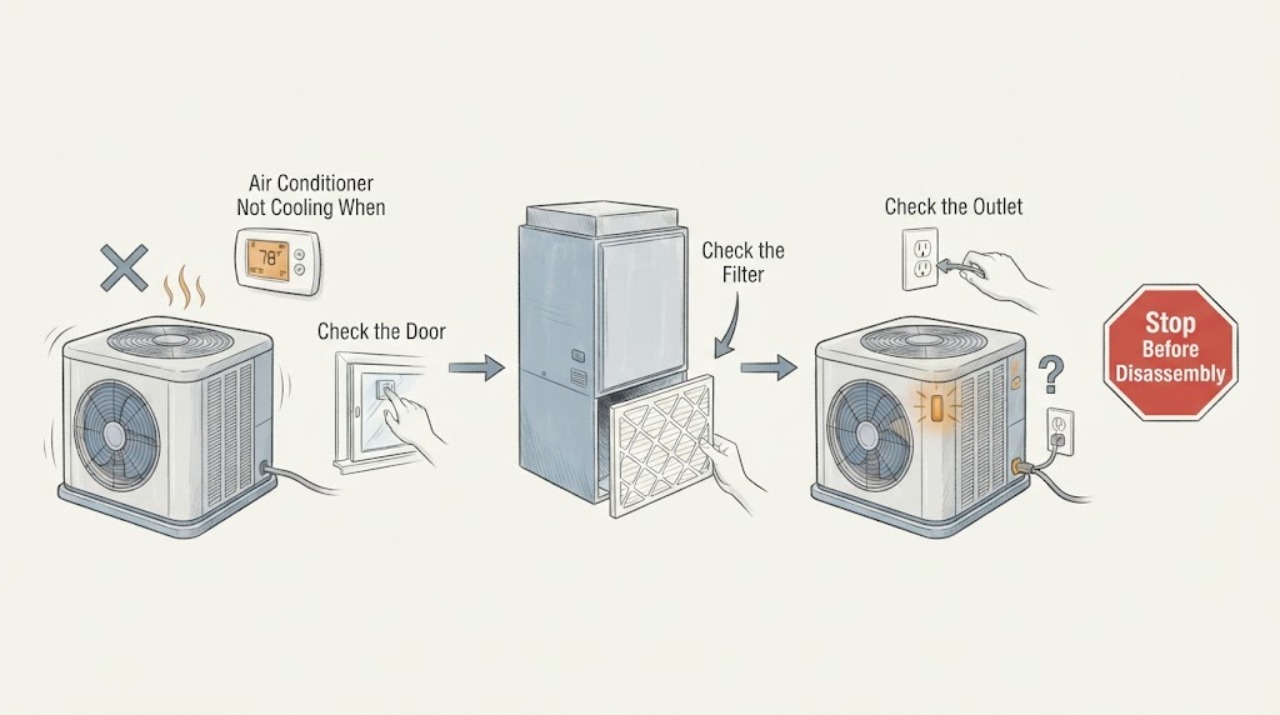
An outdoor unit running does not prove that the indoor blower is moving enough air or that the system is removing heat. Check the thermostat mode, indoor airflow, accessible filter, open registers, visible ice, condensate warning, and clear space around the outdoor unit. If airflow is weak, the coil is iced, cooling is absent after a safe filter check, or the unit only hums, cycles rapidly, or shows electrical or refrigerant symptoms, turn cooling off and arrange HVAC service. Do not open the cabinet, handle refrigerant, test high voltage, or keep running a frozen or damaged system.
Work through in order
Diagnostic checks
Use only checks that match the exact appliance or system and its official guide.
-
Check 1
At the thermostat, confirm the system is set to cooling rather than heating, fan-only, or an energy-saving hold that prevents the expected call. Set a reasonable cooling target and note whether the indoor blower starts. Then compare air at several accessible supply registers with air at the return grille.
Expected result: The indoor blower is silent, airflow is weak at every register, one zone is weak, or air moves normally but is not cooler than the room.
Next step: Continue only with the accessible filter and register check if the area is dry and there are no warning signs. If the blower never starts, leave cooling off and arrange HVAC service rather than opening the air handler.
Why this matters
Why: A silent blower or weak flow across the home points toward indoor power, control, blower, filter, coil, or return-air trouble. Normal flow with little cooling points farther toward the coil, outdoor heat rejection, refrigerant circuit, compressor, or controls. One weak room points toward a register or duct branch rather than the outdoor unit alone.
-
Check 2
With cooling off, inspect the filter at its normal user-accessible location and check that supply registers and the return grille are not blocked by furniture, rugs, or stored items. Replace or clean the filter only according to its type and the equipment instructions; do not substitute an unknown filter or remove a grille that requires tools.
Expected result: The filter is visibly loaded with dust, the return is obstructed, or registers are closed; or the filter and grilles are clear.
Next step: Restore the filter and clear only the accessible airflow path, then make one normal cooling call while watching for steady airflow. If cooling remains absent or airflow remains weak, turn cooling off and arrange HVAC service; do not raise fan speed or alter wiring.
Why this matters
Why: Restricted return or supply airflow can make the indoor coil perform poorly, reduce comfort, and make the system work harder. A clear filter does not rule out a dirty coil, blower fault, crushed duct, or sealed-system problem.
-
Check 3
Look without touching for frost or ice on accessible tubing or coil surfaces, water around the indoor unit or condensate outlet, and a wet or overflowing drain area. Do not scrape ice, pour cleaner into a drain, or remove a panel to reach a coil or drain pan.
Expected result: Ice is present, water is backing up, the drain warning is active, or there is no visible ice or water.
Next step: Turn cooling off if ice or water is present and protect nearby contents from water. Do not keep operating an iced system or handle refrigerant; arrange HVAC service if the condition does not resolve under the equipment instructions or returns.
Why this matters
Why: Ice can follow inadequate airflow or a refrigerant-side problem, and condensate trouble can stop cooling or damage the home. Absence of visible ice does not prove the coil and refrigerant circuit are healthy.
-
Check 4
With the system off, inspect only exposed duct sections, registers, and return connections that can be reached safely from the living area. Look for a disconnected joint, a crushed flexible section, a closed damper or register, or a room that is always warmer than the rest. Do not enter an attic or crawlspace or open a wall to chase a duct leak.
Expected result: Several rooms have weak flow, one branch is weak, a duct is visibly crushed or disconnected, or airflow is even throughout the home.
Next step: Keep the visible path unobstructed and document the affected rooms. Leave concealed, damaged, or inaccessible duct repairs to an HVAC contractor who can evaluate airflow and leakage without unsafe access.
Why this matters
Why: A distribution fault can leave the house warm even while the equipment runs. Leaky or kinked ducts reduce delivered airflow; uniform airflow with no cooling makes an equipment-side or sealed-system assessment more likely.
-
Check 5
From outside the cabinet and with safe clearance, check that leaves, grass, or stored objects are not blocking the outdoor unit's air path. Note whether the outdoor fan runs steadily, whether the unit stops and restarts rapidly, and whether there is unusual humming, grinding, or a strong hot odor. Do not remove the grille or reach into the fan area.
Expected result: The outdoor fan runs but cooling is still absent, the unit only hums, it cycles rapidly, airflow is blocked, or the outdoor area looks clear and sounds normal.
Next step: Clear loose debris from around the unit without opening it. If the unit still does not cool, cycles rapidly, or shows abnormal sound or odor, turn cooling off and arrange HVAC service; do not touch high-voltage parts or refrigerant lines.
Why this matters
Why: Clear outdoor airflow and a running fan are helpful but cannot confirm compressor operation or a correct refrigerant charge. Humming without normal cooling, rapid cycling, or abnormal sound can indicate an electrical, motor, compressor, control, or sealed-system fault that needs professional testing.
-
Check 6
Stop the checks for any smoke, burning smell, visible arc, hot or damaged wiring, repeated breaker trip, water reaching electrical equipment, or a cabinet that is dangerously hot. Keep people away and use only a safe, dry thermostat or disconnect control if it can be operated without approaching exposed parts.
Expected result: No hazard is present, or one of the electrical, water, heat, or fire warning signs appears.
Next step: Leave the system off and arrange qualified HVAC or electrical service. For smoke or fire, leave the building and contact emergency services from a safe location; do not restart the unit to collect more evidence.
Why this matters
Why: A warning sign changes the task from comfort troubleshooting to an electrical or property-safety issue. Repeated operation can damage equipment or create a fire or shock hazard.
Use your observations
Decision map
Find the observation that best matches what you see, then follow the next safe action.
-
PATH 01Next step
What you see
The indoor blower is silent or airflow is weak at every register.
Do this next
Turn cooling off and arrange HVAC service for the indoor blower, controls, filter path, coil, and power checks; do not open the air handler.
Why this path and its safety boundary
Why it matters: The outdoor unit being on does not establish that the indoor air path is operating.
-
PATH 02Next step
What you see
The filter or return path is visibly restricted.
Do this next
Correct only the accessible filter or obstruction according to the equipment instructions, then make one normal cooling call. If flow or cooling does not recover, arrange HVAC service.
Why this path and its safety boundary
Why it matters: The system may be short of airflow, which can reduce cooling and contribute to coil icing.
-
PATH 03Next step
What you see
Ice is visible on the indoor coil or tubing, or condensate is backing up.
Do this next
Turn cooling off, do not chip ice or handle refrigerant, protect the area from water, and arrange HVAC service if the condition persists or returns.
Why this path and its safety boundary
Why it matters: Airflow, drain, or refrigerant-side trouble is possible, and continued cooling can worsen the condition.
-
PATH 04Next step
What you see
Only one or a few rooms have weak airflow or stay warm while other rooms cool.
Do this next
Check only accessible registers and exposed duct sections. Leave concealed or damaged ductwork for a contractor to evaluate and seal.
Why this path and its safety boundary
Why it matters: A register, branch duct, damper, or accessible duct connection may be limiting delivery.
-
PATH 05Next step
What you see
Airflow is steady but the air is not cool, while the outdoor fan runs normally.
Do this next
Do not open the cabinet or test the sealed system. Arrange HVAC service and report the filter result, airflow strength, outdoor behavior, and any ice or water.
Why this path and its safety boundary
Why it matters: A dirty coil, compressor or control problem, incorrect refrigerant charge, or another equipment fault remains possible.
-
PATH 06Next step
What you see
The outdoor unit hums, cycles rapidly, shows abnormal sound or odor, or any electrical or water hazard appears.
Do this next
Leave cooling off and arrange qualified HVAC or electrical service. For smoke or fire, leave and contact emergency services; do not restart the unit.
Why this path and its safety boundary
Why it matters: The unit may have a motor, control, compressor, wiring, or property-safety problem.
Helpful context
Understand the symptom
Why an outdoor unit that is on can still leave the house warm
A central system has indoor and outdoor work to do. The indoor blower must move return air across the indoor coil and through the ducts, while the outdoor section rejects heat. A fan turning outside is useful evidence, but it does not establish adequate indoor airflow, correct refrigerant charge, compressor performance, or intact duct delivery. Start with checks that are visible and reversible, then stop before the diagnosis reaches electrical, refrigerant, or sealed-system work.
Safety boundary
Keep hands out of the indoor and outdoor cabinets. Do not remove access panels, touch capacitors or contactors, measure live voltage, open a refrigerant circuit, or chip ice from a coil. If there is smoke, a burning smell, arcing, a hot wire, water near electrical equipment, or a breaker that trips, switch the system off only from a safe dry control and arrange qualified service.
Safety boundary
Stop conditions
- Do not remove indoor or outdoor cabinet panels, touch capacitors or contactors, test high voltage, open a refrigerant circuit, or handle refrigerant.
- Stop cooling if the coil or tubing is iced, water is backing up, the unit cycles rapidly, or the blower is not moving air; do not chip ice or keep running a damaged system.
- Stop immediately for smoke, burning odor, visible arcing, hot or damaged wiring, repeated breaker trips, or a cabinet that is dangerously hot.
- Do not work in an attic, crawlspace, wet area, near a moving fan, or around exposed electrical parts.
When checks do not resolve it
Need a professional?
Arrange HVAC service when cooling remains absent after safe thermostat, filter, register, and debris checks; when the indoor blower is weak or silent; when ice or condensate returns; when ducts are concealed or damaged; or when the outdoor unit hums, cycles rapidly, or runs without cooling. Use qualified electrical service for wiring, breaker, or power hazards.
Common questions
FAQ
Why is the outside AC unit running if the house is still warm?
The outdoor fan can run while indoor airflow is restricted, ducts leak, the coil is iced or dirty, condensate interferes with operation, or the compressor and refrigerant circuit need professional assessment. Outdoor fan motion alone is not a cooling test.
Should I keep the AC running if I see ice?
No. Turn cooling off and do not chip the ice or handle refrigerant. Restricted airflow and sealed-system problems can both produce icing, so arrange HVAC service if it persists or returns after safe airflow care.
Can a duct problem cause the whole house to stay warm?
Yes. Leaks, holes, poor connections, or kinked sections can reduce delivered airflow, especially when ducts run through unconditioned spaces. Inspect only accessible sections and leave concealed repairs to an HVAC contractor.
Read the exact guide
Official sources
- Maintenance ChecklistENERGY STAR · General central air conditioner, furnace, and heat pump guidance; exact user steps depend on the equipment manual.
- HVAC Quality InstallationENERGY STAR · Residential air conditioners and heat pumps; equipment-specific work belongs to a qualified contractor.
- Heat & Cool EfficientlyENERGY STAR · Residential heating and cooling systems, including central air conditioners and heat pumps.
- Duct SealingENERGY STAR · Forced-air heating and cooling systems with duct distribution.
Community feedback
Share a repair observation
Share a plain-text repair observation. Accepted observations are published automatically; this page may take a moment to update.