
On this page
Start here
Quick answer
The assigned condition is “outside unit,” and this phrase is preserved without adding a meaning that was not provided. From a safe position, confirm the cooling call, compare indoor airflow, observe whether the outdoor fan starts, and look for external debris, unusual sounds, ice, water, or visible oily residue. The outdoor condenser must release heat through its coil and fan, but a failed fan, blocked airflow, refrigerant problem, electrical fault, frozen indoor coil, or condensate issue can all leave the air conditioner not cooling. Turn the system off for ice, water near electrical equipment, smoke, burning odor, arcing, or a damaged outdoor unit. Do not remove the condenser cover, touch the fan or capacitor, open the refrigerant circuit, or perform live electrical tests.
Before you begin
Safety first
- The owner scope ends at safe external observation and manual-approved removal of loose surrounding debris or filter care. Outdoor cabinet, high-voltage, fan, compressor, capacitor, coil, drain, and refrigerant work belongs to qualified HVAC service.
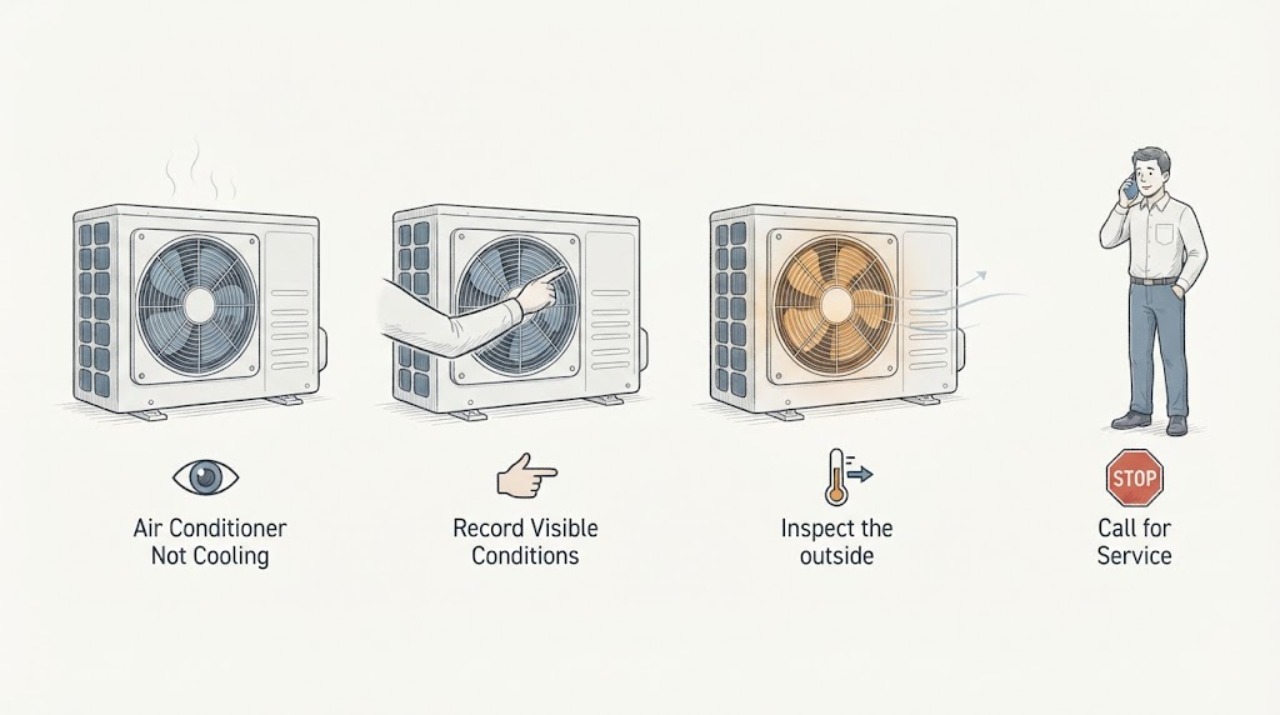
Work through in order
Diagnostic checks
Use only checks that match the exact appliance or system and its official guide.
-
Check 1
Record the exact equipment type and model, keep the condition “outside unit” exactly as assigned, and confirm the thermostat is calling for cooling before comparing indoor and outdoor behavior.
Expected result: There is no cooling call, the indoor blower runs without cooling, or the thermostat calls for cooling while the indoor air stays warm.
Next step: Correct only normal thermostat settings allowed by the manual. If the system still does not cool, continue with safe observations and do not open the thermostat, disconnect, or equipment cabinet.
Why this matters
Why: A control setting can make the outdoor unit appear inactive. A valid cooling call with warm indoor air makes the outdoor unit and the rest of the cooling circuit relevant.
-
Check 2
From a clear, dry position outside the cabinet, observe the condenser fan during a cooling call without reaching through the grille or placing anything on top of the unit.
Expected result: The fan starts and moves air normally, does not start, rotates slowly, stops unexpectedly, or produces rattling, scraping, or another abnormal sound.
Next step: Keep the equipment off for a stopped, slow, damaged, or noisy fan and arrange HVAC service. Do not push the blade, remove the grille, touch a capacitor, or keep restarting it.
Why this matters
Why: Normal fan operation makes the outdoor fan less likely to be the immediate cause, while no rotation or abnormal movement can indicate a fan, motor, control, or electrical issue. The fan and compressor may not behave identically on every model, so do not infer a failed part from one glance.
-
Check 3
Inspect the outside of the condenser for leaves, grass, lint, snow, a temporary cover, a fence or plant obstruction, or visibly bent or heavily fouled coil fins; do not remove panels or brush the coil while energized.
Expected result: Airflow around the cabinet is visibly blocked, the coil face is covered with debris, the fins appear damaged, or the area is open and unobstructed.
Next step: Remove only loose objects that are safely outside the unit and permitted by the manual. Leave internal coil cleaning, bent-fin repair, and any panel work to HVAC service.
Why this matters
Why: Restricted outdoor airflow reduces heat release and can make the unit run longer or cool poorly. Clear surrounding space does not rule out a dirty coil inside the cabinet or a mechanical, refrigerant, or electrical problem.
-
Check 4
From a safe distance, look for ice or frost on the outdoor cabinet or visible refrigerant tubing, water around the indoor unit, and visible oily residue near the outdoor unit; do not touch tubing or attempt to identify or repair a leak.
Expected result: Ice, frost, unusual water, or oily residue is visible, or none of these signs is present.
Next step: Turn cooling off and call qualified HVAC service for ice, water, or oily residue. Do not chip ice, open the refrigerant circuit, add refrigerant, or use a leak-detection flame or chemical.
Why this matters
Why: Ice can accompany low airflow or a frozen coil, water can indicate condensate trouble, and oily residue can be a clue to a refrigerant leak. None of these observations identifies the cause without HVAC testing.
-
Check 5
Compare the indoor register airflow with the outdoor fan observation, and inspect only the user-accessible indoor filter as the manual permits, with the system off before removing it.
Expected result: The indoor airflow is weak or absent while the outdoor fan runs, the airflow is strong but warm, or both indoor airflow and the outdoor fan are abnormal.
Next step: Replace or clean the filter only as the exact manual allows. If airflow remains weak, ice is present, or strong warm airflow persists, stop cooling and arrange HVAC diagnosis rather than opening either unit.
Why this matters
Why: Weak indoor airflow points toward the filter, return, duct, blower, condensate protection, or frozen indoor coil. Strong warm airflow with a running outdoor unit points toward coil, refrigerant, compressor, control, or outdoor heat-release problems.
-
Check 6
Listen from outside the cabinet and note whether the sound is a normal operating hum, a repeated click, a loud buzz, grinding, rattling, or an immediate start-and-stop pattern; do not remove the cover to locate the source.
Expected result: The sound is smooth and stable, or it is harsh, worsening, associated with heat or odor, or followed by a shutdown.
Next step: Stop using the system for an abnormal or worsening sound and call HVAC service. Do not test a capacitor, touch a contactor, or run repeated cycles to reproduce the noise.
Why this matters
Why: A stable operating sound can be consistent with normal operation for the model. Grinding, rattling, loud buzzing, or repeated start-and-stop can indicate a fan, motor, compressor, control, or electrical fault.
-
Check 7
Prepare a service note with the exact model, condition text, mode and thermostat state, indoor airflow, outdoor fan behavior, clearance and debris, sound pattern, ice or water, visible residue, and when the cooling changed.
Expected result: The note shows a clear external obstruction or filter issue, or the outdoor unit remains abnormal or the system remains warm after those safe checks.
Next step: Give the note to qualified HVAC service and leave the system off for ice, water, electrical symptoms, a stopped fan, or abnormal noise. Do not perform live electrical testing or refrigerant work.
Why this matters
Why: An external correction may restore heat release, but persistent poor cooling indicates a system-level fault beyond safe owner maintenance.
Use your observations
Decision map
Find the observation that best matches what you see, then follow the next safe action.
-
PATH 01Next step
What you see
The thermostat is not calling for cooling or the fan is set to move air without a cooling call.
Do this next
Restore normal cooling settings only as the model manual allows. If a valid call still produces warm air, continue with safe indoor and outdoor observations.
Why this path and its safety boundary
Why it matters: The outdoor unit may be correctly inactive for the selected mode.
-
PATH 02Next step
What you see
The outdoor unit is clear, the fan runs normally, indoor airflow is normal, but the air remains warm.
Do this next
Turn cooling off if performance is poor or the system runs continuously and call qualified HVAC service. Do not open the cabinet or handle refrigerant.
Why this path and its safety boundary
Why it matters: The filter and visible outdoor clearance are unlikely to be the complete cause; refrigerant, coil, compressor, controls, or another system fault may remain.
-
PATH 03Next step
What you see
The outdoor fan does not start, rotates slowly, rattles, scrapes, or stops while the system calls for cooling.
Do this next
Keep the system off and arrange HVAC service. Do not push the blade, remove the grille, test or discharge a capacitor, or repeatedly restart the unit.
Why this path and its safety boundary
Why it matters: A fan blade, motor, capacitor, control, or electrical fault is possible.
-
PATH 04Next step
What you see
The outdoor coil area is blocked by debris, plants, a cover, or another external obstruction.
Do this next
Remove only loose external obstructions when safe and manual-approved. If cooling does not recover or the coil is internally fouled, call HVAC service.
Why this path and its safety boundary
Why it matters: Restricted heat-release airflow may be contributing to poor cooling or long run time.
-
PATH 05Next step
What you see
Ice, water near electrical equipment, oily residue, smoke, burning odor, arcing, a hot connection, or repeated breaker operation is visible or reported.
Do this next
Stop using the system and move away from the hazard as needed. Contact qualified HVAC or electrical help from a safe location; do not restart, open the unit, or handle refrigerant.
Why this path and its safety boundary
Why it matters: This is a system safety or professional-diagnosis condition, not an outdoor-clearance adjustment.
Helpful context
Understand the symptom
Keep the condition literal
The task condition is recorded as “outside unit.” It is not expanded into a particular installation, part, or cause. Use the actual model, mode, indoor airflow, outdoor fan behavior, visible unit condition, and timing to establish which branch applies.
What the outside unit tells you
In a typical split system, the indoor coil absorbs heat and the outdoor condenser releases it. The outdoor fan should move air through the condenser coil during a cooling call, although exact fan behavior varies by equipment and operating mode. A quiet, clear outdoor cabinet does not rule out an indoor airflow, condensate, refrigerant, control, or electrical issue, so pair every outdoor observation with what is happening at the indoor registers.
Safety boundary
Stop conditions
- Stop cooling for visible ice or frost, water near electrical equipment, oily residue, a damaged cabinet, or a stopped, slow, or scraping outdoor fan.
- Stop immediately for smoke, burning or melting odor, sparks, arcing, a hot disconnect, damaged wiring, repeated breaker operation, or a loud worsening electrical or mechanical sound.
- Do not remove the outdoor cabinet or grille, touch the fan, capacitor, contactor, compressor, or wiring, perform live electrical testing, open the refrigerant circuit, or add refrigerant.
- Do not chip ice, spray water into an energized unit, place hands or tools through the grille, or keep restarting a system that is not cooling.
When checks do not resolve it
Need a professional?
Arrange HVAC diagnosis for any persistent air conditioner not cooling problem after safe thermostat, airflow, filter, and outside-unit observations, and immediately for ice, water, fan, noise, refrigerant, or electrical signs.
Safety scope: The owner scope ends at safe external observation and manual-approved removal of loose surrounding debris or filter care. Outdoor cabinet, high-voltage, fan, compressor, capacitor, coil, drain, and refrigerant work belongs to qualified HVAC service.
Common questions
FAQ
What does the condition “outside unit” mean here?
It is preserved exactly as assigned and is not expanded into a specific cause or installation. Use the actual model and the safe outdoor observations on this page to establish the relevant branch.
Should the outdoor AC fan always be spinning?
Fan behavior depends on the system and operating state. During a valid cooling call, a fan that does not start, rotates slowly, rattles, or stops abnormally should be left alone and assessed by HVAC service.
Can debris around the outside unit stop cooling?
Yes. Debris or nearby obstructions can reduce airflow through the condenser and impair heat release. Remove only loose external obstructions when safe and allowed by the manual; internal coil cleaning is professional work.
What if the outdoor unit looks normal but the AC still is not cooling?
Compare indoor airflow and check for ice or water from a safe position. If the outdoor unit is clear and running but cooling remains poor, the cause may involve the indoor coil, blower, condensate, controls, refrigerant, compressor, or electrical system; call qualified HVAC service.
Read the exact guide
Official sources
- Understanding Your AC Condenser UnitCarrier · Carrier residential air-conditioner condenser function and troubleshooting guidance
- AC Fan Not Working? Reasons Why It Stopped SpinningTrane · Trane residential air-conditioner indoor and outdoor fan troubleshooting
- Maintenance ChecklistENERGY STAR · Residential HVAC maintenance, condensate, coil, airflow, control, and refrigerant guidance
- Troubleshoot an Air ConditionerCarrier · Carrier residential air-conditioner system troubleshooting and professional repair boundaries
- Air Conditioner MaintenanceTrane · Trane residential air-conditioner maintenance and outdoor airflow guidance
Community feedback
Share a repair observation
Share a plain-text repair observation. Accepted observations are published automatically; this page may take a moment to update.