
On this page
Start here
Quick answer
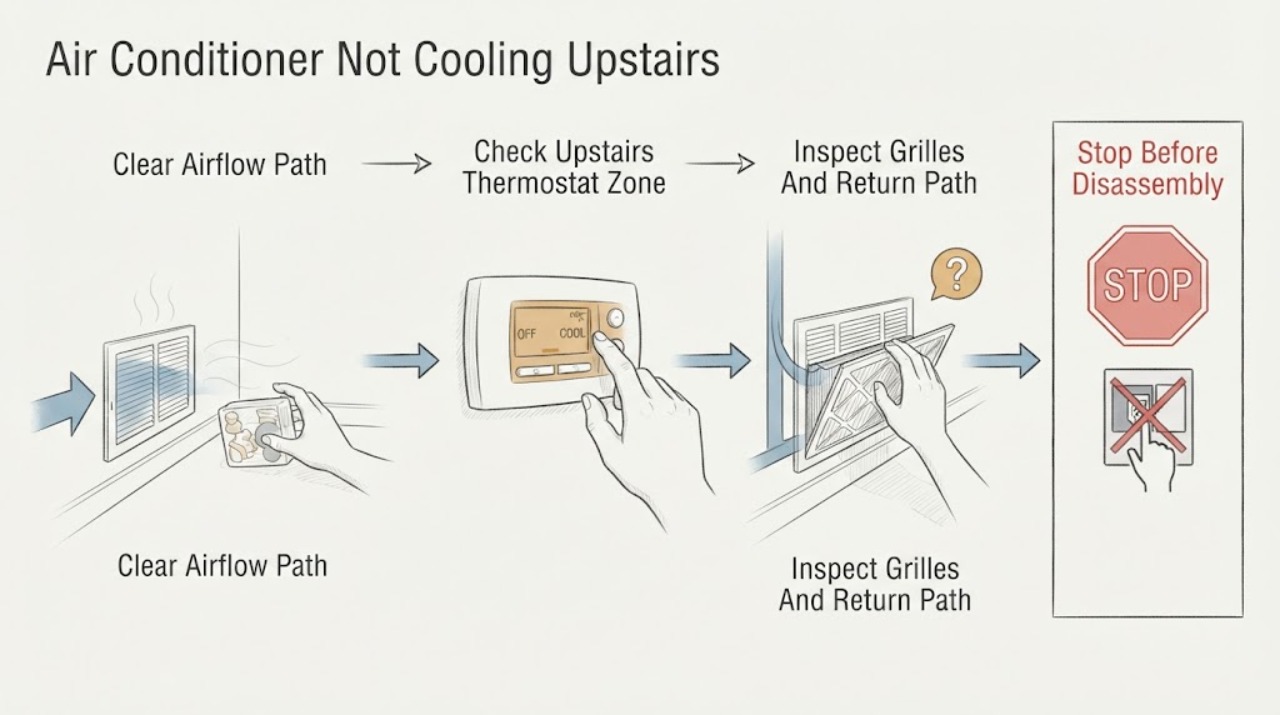
When an air conditioner cools downstairs but the upstairs rooms are not cooling or have little or no air from the vents, first determine whether the problem is airflow to the upstairs zone or whole-system cooling. Check the upstairs thermostat or zone call, keep supply and return grilles unobstructed, inspect the accessible filter, and compare airflow at several upstairs and downstairs registers. If the system has manual or motorized dampers, use only the exact control instructions and do not close downstairs vents to force more air upstairs. A dirty filter, closed or failed damper, blocked return, disconnected or leaking duct in an attic, inadequate return path, or a frozen coil can reduce upstairs comfort; a single-zone home can also have a design or heat-gain imbalance. If there is ice, water, a full drain pan, smoke, burning odor, repeated breaker trips, or exposed electrical equipment, leave the system off and call a qualified HVAC professional. Hidden duct, damper, blower, refrigerant, and zone-control work should be tested and repaired by a technician.
Work through in order
Diagnostic checks
Use only checks that match the exact appliance or system and its official guide.
-
Check 1
With the thermostat calling for cooling in a normal, safe cycle, compare airflow and air temperature at several upstairs supply vents, an upstairs return, and downstairs vents; note whether the indoor blower and outdoor unit appear to run.
Expected result: Little or no upstairs airflow with normal downstairs airflow points toward a zone, return, damper, or upstairs duct branch; airflow everywhere that is warm points toward a whole-system cooling or heat-gain issue.
Next step: Do not close multiple downstairs vents or force a damper. Continue with accessible thermostat, grille, and filter observations, and stop if there is ice, water, smoke, burning odor, or electrical danger.
Why this matters
Why: The distribution pattern determines whether to prioritize the upstairs air path or the central cooling system rather than treating every hot room as a refrigerant problem.
-
Check 2
Read the upstairs thermostat or zone controller from normal access and record its mode, setpoint, schedule, fan setting, displayed temperature, battery or power status, and any zone or equipment message; do not change wiring or remove the thermostat from its base.
Expected result: No cooling call, a schedule override, a locked control, a blank display, or a zone that is not enabled can explain no upstairs response; an active call with no upstairs airflow shifts attention to distribution or equipment.
Next step: Use only ordinary controls and the exact thermostat instructions to select cooling and an appropriate setpoint. If the controller is blank, repeatedly resets, or shows a fault, stop and arrange HVAC service.
Why this matters
Why: A thermostat or zone-control state can prevent a damper or system from responding even when the downstairs area still cools.
-
Check 3
Inspect the visible upstairs supply registers and return grille for closed louvers, furniture, curtains, dust buildup, or a blocked return; check whether a bedroom door being closed changes the symptom, without sealing or altering the grille.
Expected result: One blocked register suggests a local obstruction; weak airflow at every upstairs supply with a blocked return suggests a return-path or pressure issue; a door-related change suggests the room may lack a sufficient return path.
Next step: Remove only an ordinary movable obstruction and keep supply and return grilles open. Do not cover vents, add an unapproved booster, or close downstairs vents to force flow upstairs.
Why this matters
Why: A local grille issue is different from a branch duct, damper, or system-capacity issue and changes what the technician should measure.
-
Check 4
Check the user-accessible filter and visible airflow path as the equipment manual allows, and look from a safe distance for frost or ice on the indoor coil or accessible refrigerant line; do not touch the coil or remove an equipment panel.
Expected result: A loaded filter can reduce airflow to all zones and a frozen coil can later create water; a clean filter with upstairs-only weak airflow keeps the zone or duct branch as the stronger lead.
Next step: Replace a filter only with the correct manual-approved type and leave cooling off if ice or water is present. Do not chip ice or restart repeatedly; arrange HVAC service if the symptom persists.
Why this matters
Why: Airflow restriction and icing can cause poor cooling, but coil, blower, refrigerant, and electrical diagnosis is not a homeowner adjustment.
-
Check 5
From safe, ordinary access only, note whether the home has a zone controller or a clearly labeled manual damper and whether an exposed upstairs duct is visibly disconnected, crushed, badly torn, or sweating; do not enter an attic or crawlspace if access is unsafe.
Expected result: A damper position or zone display that does not match the upstairs cooling call, or visible damage in an accessible duct, supports a distribution fault; no visible defect does not rule out a hidden leak or failed actuator.
Next step: Do not force a damper, tape hidden ducts, disconnect an actuator, or work around a control. Photograph or describe the observation for a qualified HVAC technician.
Why this matters
Why: An upstairs branch can lose conditioned air before it reaches the register, while a damper or actuator can prevent the zone from receiving air.
-
Check 6
Record the upstairs and downstairs temperatures, airflow comparison, thermostat or zone state, filter condition, visible ice or water, damper or duct observations, door position, and whether the problem is new or seasonal.
Expected result: A sudden loss of one zone suggests a damper, actuator, duct, return, or control change; a long-standing upstairs temperature difference suggests distribution design, insulation, heat gain, or system sizing; a whole-home decline suggests central equipment.
Next step: Keep the system off for any stop condition and arrange HVAC service when the upstairs remains without airflow, cooling, or a safe accessible explanation.
Why this matters
Why: A time-and-location history helps the technician choose airflow measurements, duct inspection, zone-control testing, or central cooling diagnosis without unsafe user work.
Use your observations
Decision map
Find the observation that best matches what you see, then follow the next safe action.
-
PATH 01Next step
What you see
Ice, active water, a full pan, water near electrical equipment, smoke, burning odor, a hot component, or repeated breaker trips is present.
Do this next
Stop cooling and keep clear. Isolate power only from a safe, dry location if that can be done without touching the hazard; do not chip ice, touch wet equipment, open panels, or keep restarting. Arrange qualified HVAC or electrical help, and use emergency services for fire or immediate danger.
-
PATH 02Next step
What you see
The upstairs controller is blank, not calling for cooling, in the wrong mode, locked, or not recognizing the zone.
Do this next
Use only the normal, model-approved control steps to restore the intended cooling mode or schedule. If the display remains blank, resets, or shows a fault, arrange HVAC service rather than changing wiring or bypassing the controller.
-
PATH 03Next step
What you see
One upstairs register or return is blocked, closed, or affected by an ordinary movable obstruction.
Do this next
Remove the movable obstruction and keep the supply and return openings open. Do not close multiple downstairs vents, add unapproved equipment, or alter the duct system; reassess the airflow pattern during a normal cycle.
-
PATH 04Next step
What you see
All upstairs vents are weak while downstairs airflow is normal, or an accessible damper, actuator indication, or duct branch appears abnormal.
Do this next
Leave the controls and ductwork intact and arrange HVAC service to measure the zone, return, damper, branch duct, and blower operation. Do not force a damper, enter unsafe attic space, or repair hidden ductwork as a test.
-
PATH 05Next step
What you see
Airflow is present upstairs but is warm, or airflow and temperature are poor throughout the home.
Do this next
Check only the thermostat mode and accessible filter. If the system still does not cool, have a technician evaluate the outdoor unit, indoor coil, blower, electrical controls, refrigerant, and system capacity; do not handle refrigerant or internal electrical parts.
-
PATH 06Next step
What you see
The upstairs difference is long-standing, varies with sun or outdoor heat, and there is no sudden airflow loss or stop condition.
Do this next
Ask an HVAC professional to assess duct sizing and leakage, return paths, attic insulation and heat gain, zoning, and system capacity. A comfort imbalance may need distribution or building-envelope work rather than a replacement filter alone.
Helpful context
Understand the symptom
First separate no airflow from insufficient cooling
If the upstairs registers have little or no air while downstairs airflow is normal, start with the upstairs zone, return path, damper, or duct branch. If air is moving upstairs but it is warm, the whole system may not be producing enough cooling, or heat gain through the attic and envelope may be overwhelming the distribution. If every room is affected, a filter, thermostat, coil, outdoor unit, electrical, or sealed-system issue becomes more likely.
Upstairs is a useful location clue, not a repair instruction
A two-story home can be harder to balance because heat rises, the roof and attic add heat, and a single-zone system controls the home from one sensing point. Zoning systems use thermostats, controllers, and dampers to direct air, but the controls and wiring vary. Do not force a damper, disconnect a zone control, or close many downstairs registers to compensate; restricted airflow can make the system work harder and can contribute to coil icing.
Hidden ducts and returns need a professional boundary
Ducts in attics or other unconditioned spaces can leak or gain heat before air reaches an upstairs register. A closed bedroom door can also leave a room without a sufficient return path, while a disconnected or crushed branch can eliminate supply airflow. Inspect only visible, safely reachable grilles and duct sections. Duct leakage testing, damper diagnosis, coil and blower work, and refrigerant checks require HVAC equipment and training.
Safety boundary
Stop conditions
- Stop immediately for ice with active water, water near electrical equipment, smoke, burning odor, a hot component, exposed wiring, or repeated breaker trips.
- Do not close multiple downstairs vents to force air upstairs; restricted airflow can make the system work harder and contribute to a frozen coil.
- Do not enter an unsafe attic or crawlspace, force dampers, disconnect zone wiring, open equipment panels, chip ice, handle refrigerant, or take live electrical measurements.
- Keep the system off when water or ice is present and arrange qualified HVAC service if the upstairs remains without airflow or cooling after safe thermostat, grille, and filter observations.
When checks do not resolve it
Need a professional?
Arrange qualified HVAC service when every upstairs vent is weak, an accessible damper or duct appears abnormal, the thermostat or zone control does not respond, ice or water appears, or cooling remains poor after the safe filter and control checks. Ask for airflow and return-path measurements, damper and duct inspection, and central cooling diagnosis. Use emergency services for smoke, fire, shock, or immediate danger.
Common questions
FAQ
Why is my upstairs AC not cooling while downstairs is comfortable?
The upstairs may have weak airflow from a blocked return, damper or zone-control problem, leaking or disconnected duct, or a single-zone distribution and heat-gain imbalance. Compare airflow before assuming a refrigerant issue.
Should I close downstairs vents to cool upstairs?
No. Closing multiple vents can restrict system airflow and contribute to coil icing. Keep supply and return openings clear and have zoning or duct distribution assessed.
What if there is no air coming from any upstairs vent?
Check the upstairs thermostat or zone call, visible grille obstructions, the accessible filter, and any clearly labeled control from ordinary access. If all upstairs vents remain weak while downstairs airflow is normal, arrange HVAC inspection of dampers, returns, and duct branches.
When is poor upstairs cooling an emergency?
Turn the system off for ice with water, active leaks, smoke, burning odor, a hot component, exposed electrical equipment, or repeated breaker trips. Use emergency help for fire, shock, or immediate danger.
Read the exact guide
Official sources
- Measure Guideline: Sealing and Insulating of Ducts in Existing HomesU.S. Department of Energy · U.S. Department of Energy guidance on duct distribution, leakage, insulation, return paths, and professional duct testing
- HVAC Duct Terminal SizingU.S. Department of Energy Building Science Education · DOE guidance on supply and return grilles, airflow distribution, register placement, and trained HVAC contractor assessment
- Help! Why Is My House Hot Upstairs and Cold Downstairs?Trane · Trane residential guidance on upstairs comfort, filters, ductwork, single-zone systems, and dampers
- ZoningTrane · Trane residential zoning systems, thermostats, zone sensors, controllers, and motorized duct dampers
- Air Conditioner Troubleshooting: Why Your AC Is Not CoolingTrane · Trane residential air-conditioner troubleshooting for filters, thermostat, airflow, drain line, ice, electrical, and refrigerant service boundaries
Community feedback
Share a repair observation
Share a plain-text repair observation. Accepted observations are published automatically; this page may take a moment to update.