
On this page
Start here
Quick answer
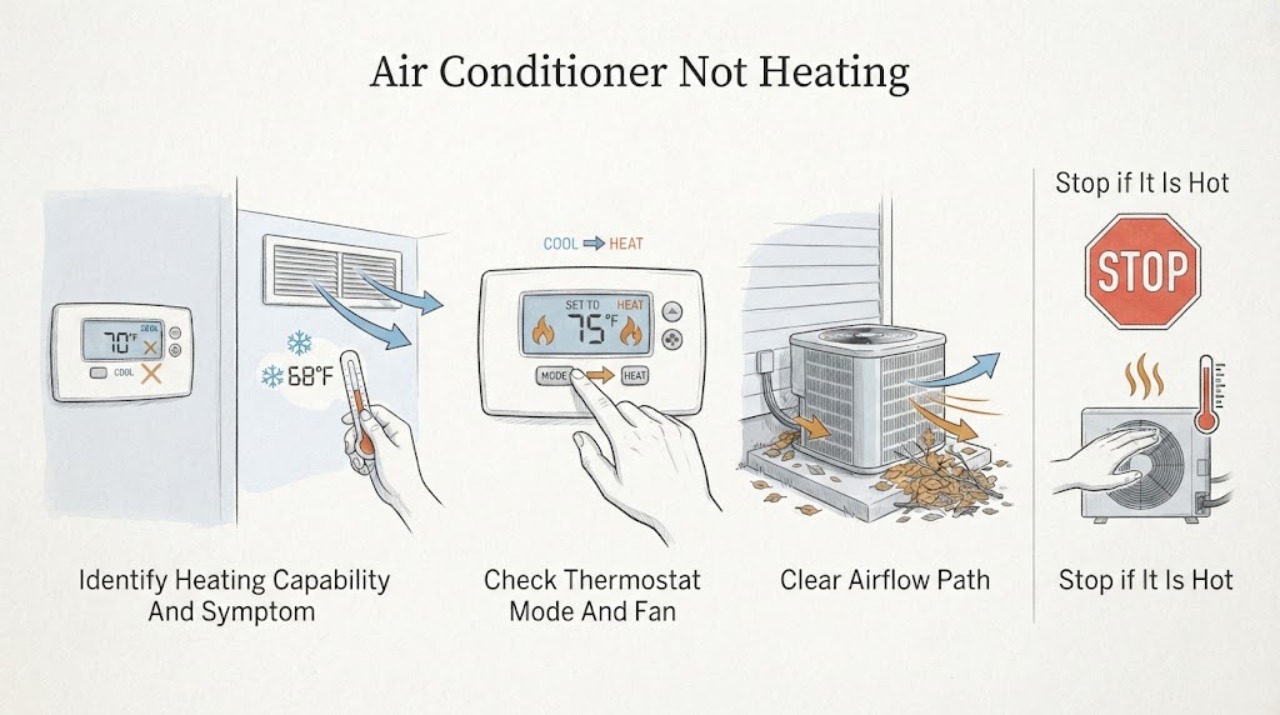
First confirm that your air conditioner is a heat pump or another system designed to provide heat; a cooling-only air conditioner cannot produce heat in winter. If heating is supported, set the thermostat to Heat with the fan on Auto, check the air filter and indoor airflow, verify that the outdoor unit is not blocked, and check the heating-system breaker only if it is safe for you to do so. A heat pump may blow steady warm rather than furnace-hot air and may briefly blow cooler air during a normal defrost cycle. If the system stays cold, repeatedly trips a breaker, remains iced over, or shows signs of a refrigerant, reversing-valve, compressor, or high-voltage fault, turn it off and arrange qualified HVAC service.
Work through in order
Diagnostic checks
Use only checks that match the exact appliance or system and its official guide.
-
Check 1
Confirm from the thermostat, equipment label, and Owner's Manual whether the system is a heat pump, ductless heat pump, or cooling-only air conditioner. Note whether the indoor fan runs, whether the outdoor unit runs, whether the air is mildly warm or truly cold, and whether the thermostat is calling for heat.
Expected result: A heat-pump system has a Heat mode and is designed to provide heating and cooling; a cooling-only system will not have a functioning heat mode. A heat pump that moves air but never warms the room is a different failure pattern from a system with no indoor or outdoor response.
Next step: Record the system type and symptom, then check the thermostat mode and fan setting before inspecting the equipment.
Stop if: Do not open the cabinet or rely on a guessed model-specific function; use the manual for the actual system.
Why this matters
Why: If the equipment is cooling-only, use the home's separate heating system and do not treat missing heat as an air-conditioner component failure. If heating is supported, continue with the thermostat and airflow checks.
-
Check 2
Set the thermostat to Heat rather than Cool or an ambiguous Auto mode, raise the target only enough to create a call for heat, and set the fan to Auto unless the manual specifies another setting. Check that a schedule, hold, lockout, or low thermostat battery is not overriding the request.
Expected result: The indoor unit should respond to a valid heating call. A fan set to On can blow room-temperature or cool air even when the heat pump is not actively heating. During a normal defrost period, the supply air may temporarily feel cooler before heating resumes.
Next step: Leave the thermostat in the correct mode and proceed to airflow and outdoor-unit checks. If the thermostat will not call for heat or displays a fault, record the indication and arrange service rather than bypassing it.
Stop if: Do not jumper thermostat wires, remove the thermostat base, or change installer settings unless the model manual explicitly directs a safe user procedure.
Why this matters
Why: An incorrect mode or fan setting can imitate a failed heat pump. If Heat is selected, the fan is Auto, and the room remains cold after the system has had time to respond, the fault is not explained by the thermostat setting alone.
-
Check 3
Inspect the accessible indoor air filter and replace or clean it only as directed by the equipment manual when it is visibly dirty. Confirm that supply and return registers are open and not blocked by furniture. Look at the outdoor unit from a safe distance and clear loose leaves, debris, or snow from its top and immediate airflow path without opening the unit.
Expected result: A dirty filter or blocked return can produce weak airflow and poor heating performance. Restricted outdoor airflow may make the heat pump struggle to extract heat or may contribute to icing. If airflow is strong and the outdoor unit is clear, a simple restriction is less likely.
Next step: After correcting an accessible filter or obstruction, run one heating call and observe whether airflow and room temperature improve. If not, continue to the power and defrost checks and plan professional diagnosis.
Stop if: Do not reach into the outdoor unit, bend coil fins, wash the unit while it is energized, or continue running a system with heavy ice or a burning smell.
Why this matters
Why: Restoring accessible airflow can resolve a performance problem without changing a refrigerant or electrical component. If airflow stays weak with a clean filter, or the indoor coil or outdoor unit is visibly frozen, continued operation may worsen an underlying fault.
-
Check 4
Check whether the thermostat, indoor unit, and outdoor unit have signs of power and whether the relevant breaker or service disconnect is obviously off. Reset a tripped breaker only if you are comfortable doing so and there is no smoke, heat damage, water, or exposed wiring; make one controlled attempt and then observe the system.
Expected result: A restored breaker may allow the indoor and outdoor units to respond to a heat call. A breaker that trips immediately again, a disconnect that will not stay on, or a system that remains dead despite power at the panel indicates an electrical problem rather than a thermostat setting.
Next step: If the system restarts, allow it to complete a normal heating call and continue monitoring. If it does not restart or trips again, turn it off and arrange qualified HVAC/electrical service.
Stop if: Do not reset a breaker repeatedly, remove the disconnect cover, touch wiring, or operate equipment with burning odor, arcing, or a hot/damaged disconnect.
Why this matters
Why: A single electrical interruption can stop heating, but repeated trips are a safety signal and can involve high-voltage components. The homeowner check ends at the panel; diagnosing the circuit, contactor, capacitor, or compressor requires a professional.
-
Check 5
If the heat pump briefly blows cooler air or the outdoor unit shows a short defrost indication, wait without changing modes and watch whether the system returns to heating. If ice remains on the outdoor coil or indoor refrigerant lines, switch the system off and do not scrape or melt the ice with an improvised heat source.
Expected result: A heat pump can enter defrost mode to remove outdoor frost and then resume normal heating. Persistent cold air, an outdoor unit that stays frozen, hissing near the outdoor unit, liquid pooling, or a frozen indoor coil is not explained by a brief normal defrost cycle.
Next step: If heating resumes after defrost, keep the system in the correct mode and monitor it. If it stays cold or iced, leave it off and arrange prompt HVAC service.
Stop if: Do not chip ice, open the refrigerant circuit, handle leaking refrigerant, or attempt a reversing-valve or defrost-control repair.
Why this matters
Why: A short defrost cycle can be normal. Persistent ice or refrigerant-related signs can indicate restricted airflow, a refrigerant leak, or another system fault, and continued operation can damage the equipment.
Use your observations
Decision map
Find the observation that best matches what you see, then follow the next safe action.
-
PATH 01Next step
What you see
The thermostat and manual show a cooling-only air conditioner with no supported Heat mode.
Do this next
Do not diagnose missing heat as an air-conditioner heating failure; use the home's separate heating equipment.
-
PATH 02Next step
What you see
The system supports heat but the thermostat is in Cool/Auto, the fan is On, or a schedule/lockout prevents a heat call.
Do this next
Correct the mode, fan, schedule, or lockout using the Owner's Manual and allow the system to respond.
-
PATH 03Next step
What you see
The filter is visibly dirty, registers are blocked, or the outdoor unit's airflow is obstructed.
Do this next
Correct only the accessible filter or obstruction according to the manual and keep the unit's airflow path clear.
-
PATH 04Next step
What you see
Cooler supply air occurs briefly while the heat pump indicates or appears to be defrosting, then warm air returns.
Do this next
Treat the brief change as potentially normal heat-pump operation and do not force a mode change during the cycle.
-
PATH 05Safety boundary
What you see
The outdoor unit remains iced, an indoor coil or line is frozen, or there is hissing or liquid near the equipment.
Do this next
Turn the system off and keep clear of the refrigerant circuit; do not scrape ice or attempt a refrigerant repair.
Why this path and its safety boundary
Safety stop: True
-
PATH 06Safety boundary
What you see
The breaker trips again, the disconnect will not remain on, or the indoor/outdoor equipment stays unresponsive after a safe single reset attempt.
Do this next
Leave the system off and stop electrical troubleshooting at the panel.
Why this path and its safety boundary
Safety stop: True
Helpful context
Understand the symptom
Check whether heating is a supported mode
Many people call the outdoor unit an air conditioner even when it is a heat pump. An air-source or ductless heat pump is designed to provide both cooling and heating; a conventional cooling-only air conditioner is not a heating appliance. Look at the thermostat and the equipment label or manual for Heat, Emergency Heat, or a heat-pump designation. If Heat is not a supported mode, the lack of warm air is not a repair symptom for the air conditioner itself; use the home's separate heating system or consult its documentation.
Warm air from a heat pump can feel different
A heat pump does not necessarily blow furnace-hot air. Trane describes a heat pump as delivering a steady stream of warm air, and it may temporarily blow cooler air while it is in a defrost cycle. That is different from air that remains cold throughout a heating call, a thermostat that never reaches its setting, or an outdoor unit that stays covered in ice. Compare the system's behavior with the thermostat call and indoor temperature rather than judging one brief puff of air.
Keep the checks outside the equipment
The safe homeowner boundary is the thermostat, accessible filter, registers, visible outdoor clearance, and a cautious breaker check. Do not remove electrical panels, test capacitors or contactors, open the refrigerant circuit, adjust a reversing valve, or attempt to add refrigerant. Those tasks involve high voltage, pressure, or certified refrigerant handling and need a qualified HVAC professional.
When checks do not resolve it
Need a professional?
Arrange qualified HVAC service when correcting the thermostat, accessible airflow, and safe power conditions does not restore heating; when cold air persists outside a brief defrost cycle; or when the system remains iced, weak, or unable to reach the set temperature.
Common questions
FAQ
Can a regular air conditioner heat a home?
A cooling-only air conditioner is not designed to provide winter heating. Heating from an air-conditioning-style system requires a heat pump or another supported heating system; check the thermostat and Owner's Manual for a Heat mode before troubleshooting the equipment.
Why does my heat pump blow cool air for a short time in Heat mode?
Heat pumps can blow cooler air temporarily during a normal defrost cycle, and they generally deliver steady warm air rather than furnace-hot air. If the air stays cold, the outdoor unit stays iced, or the home temperature continues to fall, the behavior needs professional diagnosis.
Can a dirty filter make an air conditioner stop heating?
On a heat pump, a dirty filter can restrict airflow and make the system struggle to heat. Inspect the accessible filter and clean or replace it only as the manual directs; if airflow or heating remains poor afterward, stop at the homeowner checks and arrange HVAC service.
Should I keep running a heat pump that is covered in ice?
No. A brief defrost cycle can be normal, but persistent ice on the outdoor unit or a frozen indoor coil can indicate an airflow or refrigerant-related fault. Turn the system off, do not chip the ice or open the refrigerant circuit, and arrange qualified service.
Read the exact guide
Official sources
- Ductless Heating & CoolingENERGY STAR · Ductless/mini-split heat-pump heating and outdoor airflow
- Troubleshoot an AC Not WorkingCarrier · Residential air-conditioner power, airflow, ice, high-voltage, and refrigerant safety boundaries
- Troubleshooting Tips for a Heat Pump Not HeatingTrane · Residential heat-pump heating symptoms and homeowner troubleshooting
- Air-Source Heat PumpsENERGY STAR · Air-source heat-pump heating/cooling operation and homeowner use guidance
Community feedback
Share a repair observation
Share a plain-text repair observation. Accepted observations are published automatically; this page may take a moment to update.