
On this page
Start here
Quick answer
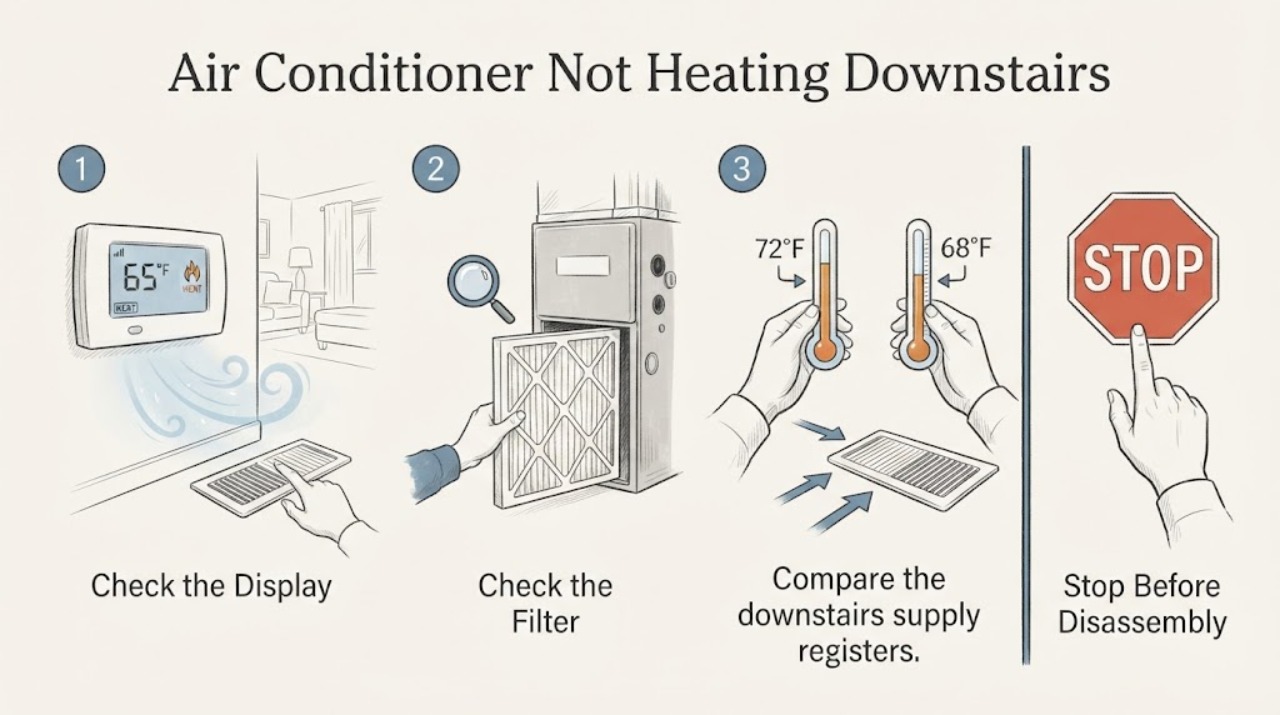
First confirm that the equipment can heat: a cooling-only air conditioner cannot produce heat, while a heat pump or dual-fuel system should have a heating mode. If only downstairs is cold, compare the downstairs thermostat or zone call with the upstairs zone, then check the accessible filter, return, registers, and exposed duct path. Weak downstairs airflow points to a filter, blower, damper, or duct problem; normal airflow that stays cool points toward heat-pump operation, auxiliary heat, controls, or the heating source. Do not open the air handler, touch electrical parts, handle refrigerant, or work on gas equipment; arrange HVAC service for unresolved or unsafe conditions.
Work through in order
Diagnostic checks
Use only checks that match the exact appliance or system and its official guide.
-
Check 1
At the downstairs thermostat, identify whether the system is a cooling-only air conditioner, heat pump, furnace, or dual-fuel setup from the labels and user documentation. Select the documented heating mode, check the schedule or hold, and set a reasonable heating target. Compare the displayed room temperature and heat call with the upstairs control if the home has more than one zone.
Expected result: There is no heating mode; the downstairs thermostat is not calling; the upstairs zone calls normally; or both zones call but only downstairs remains cold.
Next step: Keep the documented mode and schedule, and record which zone calls. If the equipment type or controls are unclear, arrange HVAC service rather than changing wiring or thermostat terminals.
Why this matters
Why: No heating mode means a separate heat source is needed and the outdoor air-conditioning unit cannot solve the symptom. A missing downstairs call points to settings, schedule, sensor, or zone control. A call with a cold downstairs floor points toward airflow, damper, duct delivery, or the shared heating equipment.
-
Check 2
With the system off, inspect the user-accessible filter and the downstairs return grille. Remove furniture, rugs, or stored items blocking the return or supply registers, and open registers that were intentionally closed. Clean or replace the filter only as directed for its type and the equipment; do not remove a grille that requires tools.
Expected result: The filter is visibly dirty, the downstairs return is blocked, several supply registers are closed, or the airflow path is clear.
Next step: Restore the correct filter and clear only accessible obstructions, then make one normal heating call. If downstairs airflow remains weak or the system does not heat, turn it off when appropriate and arrange HVAC service.
Why this matters
Why: Restricted return or supply airflow can leave one floor cold and make the heating equipment work harder. A clear filter and open register do not rule out a dirty coil, blower fault, zone damper, or concealed duct problem.
-
Check 3
Compare the downstairs supply registers with an upstairs register while the heating call is active. Note whether air is strong and warm, strong but cool, weak, or absent; also note whether the downstairs return has clear suction. Do not place hands near a burner, electric element, moving blower, or exposed equipment part.
Expected result: Downstairs airflow is weak or absent while upstairs is normal; both floors have strong but cool airflow; or both floors have weak airflow.
Next step: Document the comparison and leave hidden duct, blower, damper, and heating-source work to an HVAC professional. Do not increase fan speed through wiring changes or open the air handler.
Why this matters
Why: A floor-only airflow difference supports a zone damper, branch duct, return restriction, or disconnected duct path. Strong cool air suggests the system is moving air but not producing heat or is in the wrong mode. Weak airflow everywhere points toward a shared filter, blower, coil, control, or system-level issue.
-
Check 4
If the system is a heat pump, observe the thermostat display and outdoor unit from a safe distance during a normal heat call. Note whether the outdoor unit runs, whether auxiliary or emergency heat is indicated, whether the unit is in a documented defrost cycle, and whether it stops and restarts rapidly. Do not touch the coil, fan, refrigerant tubing, or electrical enclosure.
Expected result: The heat pump runs with cool supply air, auxiliary heat never appears when the documentation says it should, the outdoor unit is silent, or the system cycles rapidly.
Next step: Do not force emergency heat, bypass a control, or open the unit. Record the display and timing and arrange HVAC service, especially if the downstairs temperature continues to fall.
Why this matters
Why: A heat pump can use backup heat in conditions where the outdoor unit cannot meet the load, but the correct controls and model-specific behavior matter. Cool air, no expected backup heat, no outdoor response, or rapid cycling can indicate a control, airflow, compressor, refrigerant, or auxiliary-heat fault.
-
Check 5
From living areas only, inspect exposed downstairs duct sections and registers for a visibly disconnected joint, crushed flexible duct, closed damper, or a large gap where a register meets the floor or wall. Do not enter an attic or crawlspace, open a wall or ceiling, or climb onto an unstable surface.
Expected result: A visible duct or register connection is damaged; only concealed ductwork could be affected; or the exposed path appears intact.
Next step: Leave the visible issue documented and arrange a contractor to evaluate airflow and duct leakage. Do not seal a hot, moving, or inaccessible duct area while the system is operating.
Why this matters
Why: A disconnected or kinked branch can prevent heat from reaching one floor even when the central equipment runs. Concealed duct leaks, poor insulation, or a zone damper still require system-level inspection and airflow measurement.
-
Check 6
Stop and move away if there is a gas odor, carbon-monoxide alarm, smoke, burning smell, visible arc, hot wiring, water near electrical equipment, repeated breaker trip, or an unusually hot cabinet. From a safe location, do not restart the system or remove a cover to collect more evidence.
Expected result: No hazard is present, or one of the fuel, fire, electrical, water, or overheating warnings appears.
Next step: Leave the system off and arrange qualified HVAC or electrical service. For gas odor, smoke, fire, or a carbon-monoxide alarm, leave the building and contact the appropriate emergency service from a safe location.
Why this matters
Why: A warning sign changes the task from zone comfort troubleshooting to an immediate safety issue. Continued operation or an improvised test can worsen a combustion, electrical, or equipment fault.
Use your observations
Decision map
Find the observation that best matches what you see, then follow the next safe action.
-
PATH 01Next step
What you see
The equipment is a cooling-only air conditioner and no separate heat source is operating.
Do this next
Identify the home's heating system and arrange HVAC service if it does not start. Do not change thermostat wiring to force a heating mode.
Why this path and its safety boundary
Why it matters: That equipment cannot heat the downstairs.
-
PATH 02Next step
What you see
The downstairs thermostat does not call for heat while the upstairs zone does.
Do this next
Verify the documented heat mode, schedule, target, and user-accessible zone setting. If the call still does not occur, arrange HVAC service without opening the thermostat or zone panel.
Why this path and its safety boundary
Why it matters: The problem is more consistent with settings, schedule, sensor, thermostat, or zone-control behavior than with the outdoor unit alone.
-
PATH 03Next step
What you see
Downstairs airflow is weak or absent while upstairs airflow is normal.
Do this next
Clear only accessible registers and the filter, then have an HVAC contractor evaluate the damper and duct path. Do not enter concealed spaces or open the air handler.
Why this path and its safety boundary
Why it matters: A downstairs return, supply register, branch duct, zone damper, or duct connection may be restricting delivery.
-
PATH 04Next step
What you see
Downstairs airflow is strong but cool during a valid heat call.
Do this next
Record the thermostat display and equipment type, then arrange HVAC service. Leave refrigerant, electrical, and combustion checks to a qualified professional.
Why this path and its safety boundary
Why it matters: The system is moving air but may be in the wrong mode or have a heat-pump, auxiliary-heat, furnace, control, or sealed-system fault.
-
PATH 05Next step
What you see
Both floors have weak airflow or neither zone heats normally.
Do this next
Check only the accessible filter and registers. If the system still does not heat, arrange HVAC service and do not open the equipment.
Why this path and its safety boundary
Why it matters: A shared filter, blower, coil, control, heating source, or system-level issue is more likely than a downstairs-only duct branch.
-
PATH 06Next step
What you see
A gas odor, carbon-monoxide alarm, smoke, burning smell, arcing, water near electrical equipment, repeated breaker trip, or unsafe heat appears.
Do this next
Leave the system off and get appropriate emergency, utility, electrical, or HVAC help from a safe location. Do not restart or open the equipment.
Why this path and its safety boundary
Why it matters: This is an emergency safety boundary, not a normal zone diagnosis.
Helpful context
Understand the symptom
Confirm what equipment is supposed to heat the downstairs
People often call the outdoor equipment an air conditioner even when the home has a heat pump or a separate furnace. A cooling-only air conditioner does not create heat. A ducted air-source heat pump can heat through the same duct system, and a dual-fuel installation may use a furnace as backup. Before diagnosing a part, read the thermostat mode labels and the equipment nameplate from the outside; do not infer the system type from the outdoor fan alone.
Why only downstairs can be cold
A floor-specific symptom changes the first checks. A separate downstairs thermostat may not be calling for heat, a zone damper may not be opening, or the downstairs return and supply path may have restricted flow. If air reaches the registers normally but remains cool, the fault is farther upstream in the heat-pump, auxiliary-heat, furnace, control, or fuel path. Keep electrical, refrigerant, and combustion work for a qualified HVAC professional.
Safety boundary
Do not remove cabinet panels, touch capacitors or electrical terminals, test live voltage, handle refrigerant, adjust gas pressure, inspect a burner with the cover removed, or defeat a safety control. Stop for a gas odor, carbon-monoxide alarm, smoke, burning smell, arcing, a hot wire, water near electrical equipment, or a breaker trip.
Safety boundary
Stop conditions
- Do not remove HVAC cabinet panels, touch electrical terminals, test live voltage, handle refrigerant, adjust gas pressure, or inspect combustion components with covers removed.
- Stop if the downstairs system has a gas odor, carbon-monoxide alarm, smoke, burning smell, visible arc, hot wiring, water near electrical equipment, repeated breaker trip, or an unusually hot cabinet.
- Do not enter an attic, crawlspace, wet area, or unstable ceiling area to inspect ductwork or dampers.
- Do not force emergency heat, bypass a zone or safety control, or repeatedly restart equipment that is not heating.
When checks do not resolve it
Need a professional?
Arrange HVAC service when the equipment type is unclear, the downstairs thermostat calls but airflow is weak or cool, the zone damper or duct path is concealed, auxiliary heat does not behave as documented, the system cycles rapidly, or downstairs remains cold after safe filter and register checks. Use urgent electrical or emergency help for smoke, arcing, shock, water near electrical equipment, gas odor, or a carbon-monoxide alarm.
Common questions
FAQ
Can an air conditioner heat the downstairs?
A cooling-only air conditioner cannot heat. A heat pump can heat and cool, and a dual-fuel system may use a furnace as backup. Verify the equipment type and thermostat modes before diagnosing a part.
Why is upstairs warm but downstairs cold?
A downstairs zone may not be calling, or its return, filter, damper, register, or duct branch may restrict delivery. Strong cool airflow on the cold floor points farther upstream to the heating mode or heat source.
When should I stop troubleshooting a downstairs heating problem?
Stop for gas odor, a carbon-monoxide alarm, smoke, burning smell, arcing, hot wiring, water near electrical equipment, repeated breaker trips, or unsafe heat. Leave the system off and get qualified HVAC, electrical, utility, or emergency help as appropriate.
Read the exact guide
Official sources
- Air-Source Heat PumpsENERGY STAR · General air-source heat-pump guidance; exact changeover and backup behavior depends on the installed model and controls.
- Duct SealingENERGY STAR · Forced-air systems that distribute heating or cooling through ducts.
- HVAC Quality InstallationENERGY STAR · Residential air conditioners and heat pumps; equipment-specific service belongs to a qualified contractor.
- Maintenance ChecklistENERGY STAR · General residential central air conditioner, furnace, and heat-pump maintenance; exact steps depend on the equipment manual.
Community feedback
Share a repair observation
Share a plain-text repair observation. Accepted observations are published automatically; this page may take a moment to update.