
On this page
Start here
Quick answer
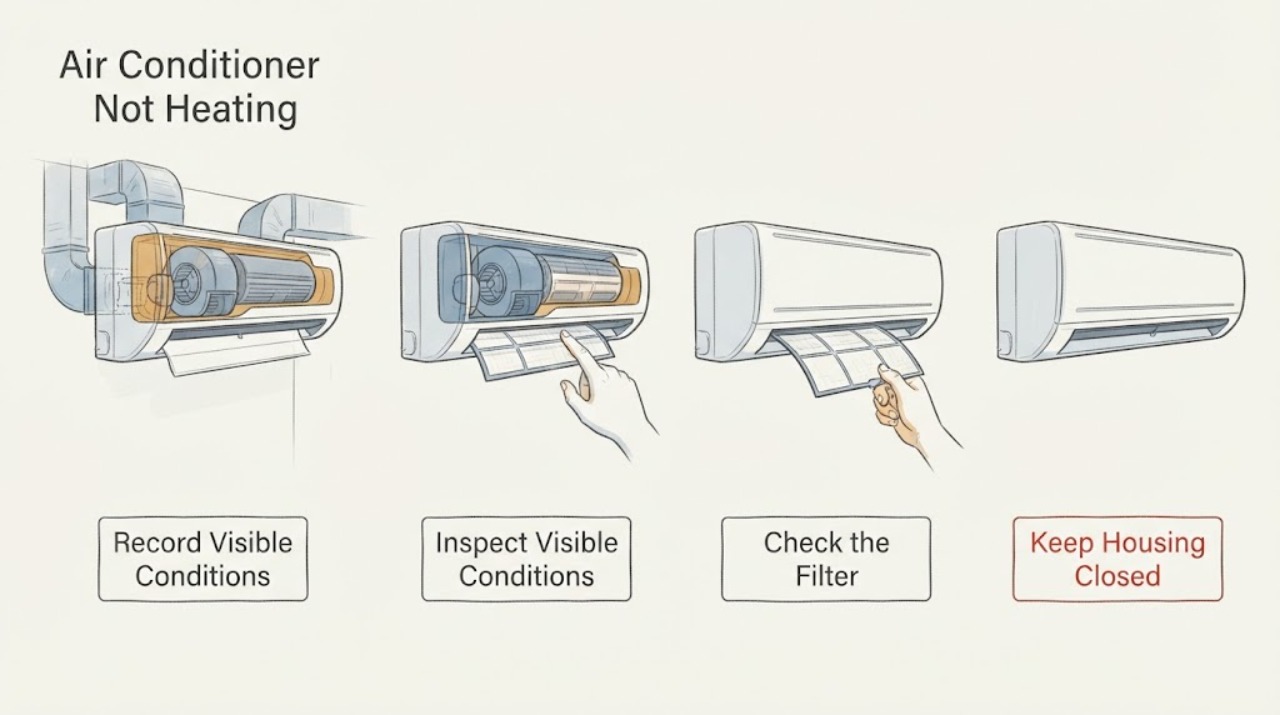
An air conditioner that is not heating may actually be a heat pump in the wrong mode, a normal defrost period, a heating or reversing-valve fault, or a blower-motor and airflow problem. First identify whether the equipment is a heat pump or a cooling-only air conditioner, then record the thermostat mode, indoor airflow, outdoor-unit behavior, filter condition, and any code or alarm. A heat pump can deliver warm rather than furnace-hot air, but there should still be airflow; no air from the registers is a different branch from air that flows but is cool. Check only the thermostat, accessible filter, open registers, and visible outdoor obstructions as the model instructions allow. Do not open the air handler, touch the blower motor or capacitor, inspect energized wiring, handle refrigerant, or bypass a door or safety switch. Stop for smoke, burning odor, arcing, a hot connection, water near electrical equipment, severe noise, repeated breaker trips, or a damaged or frozen unit, and arrange qualified HVAC service.
Before you begin
Safety first
- Keep the system off for smoke, burning or electrical odor, arcing, hot connections, water near electrical equipment, severe noise or vibration, persistent ice, safety alarms, or repeated breaker trips. Do not open panels, touch the motor or capacitor, bypass interlocks, perform energized tests, or handle refrigerant.
Work through in order
Diagnostic checks
Use only checks that match the exact appliance or system and its official guide.
-
Check 1
Read the equipment label or manual from an accessible location and identify whether the system is a heat pump, a cooling-only air conditioner, a furnace paired with an air conditioner, or an unknown configuration. Record the thermostat mode, setpoint, fan mode, display message, and whether the heating call is active; do not remove any cover.
Expected result: The equipment is cooling-only, a heat pump is in Heat or Defrost, a furnace is paired with the air conditioner, or the system type remains unknown.
Next step: Use the exact model instructions to choose Heat, Auto fan, or a documented defrost wait when applicable. If the system type or message is unclear, keep the equipment state unchanged and request HVAC service.
Why this matters
Why: A cooling-only unit cannot provide heat. A heat pump may provide steady warm air or temporarily cool air during defrost, while a paired furnace has a separate heat source. Misidentifying the system can send the diagnosis to the blower motor when the issue is mode or heat generation.
-
Check 2
With the system operating only in a normal, non-hazardous call, place a hand near several open supply registers without touching moving parts and observe whether air is absent, weak, room-temperature, or steadily warm. Check that return grilles are not visibly blocked by furniture, rugs, or stored items.
Expected result: No supply air or very weak air is present, or airflow is normal but the air is cool or only mildly warm.
Next step: Do not open the air handler. For no or weak airflow, stop repeated cycles and arrange HVAC diagnosis. For normal airflow with insufficient heat, follow only model-documented thermostat and defrost guidance, then request service if it persists.
Why this matters
Why: No or weak airflow keeps the blower, filter, return, duct, door interlock, control, and power paths in scope. Normal airflow with cool air shifts attention toward heat-pump mode, defrost, reversing valve, refrigerant, or the separate heat source rather than the blower motor.
-
Check 3
Turn the system off at the thermostat before inspecting an accessible return filter. If the model permits a user filter change or cleaning, compare the filter with a clean one and restore the correct type and fit; do not reach into the blower compartment or remove a blower-door panel.
Expected result: The filter is visibly loaded or wet, the filter is clear, or the filter cannot be reached without opening equipment.
Next step: Correct only the accessible filter issue according to the manual and reassess once. If airflow remains weak, the filter is wet, or access requires a cover removal, leave the system off and call HVAC service.
Why this matters
Why: A restricted filter can reduce airflow and make a heat pump or furnace work harder, but a clean filter does not rule out blocked ductwork, a blower motor, control, or heat-source fault. A wet filter also points to a moisture problem that needs attention.
-
Check 4
Set the thermostat fan to Auto unless the manual says otherwise, then observe from the registers and thermostat whether the blower starts with a heat call, runs continuously without a heat call, starts and stops, or remains silent. Do not remove the thermostat faceplate or air-handler cover to inspect wiring.
Expected result: The blower remains silent, runs continuously with no heat call, cycles abnormally, or runs normally while the system still does not heat.
Next step: Record the fan sequence and request HVAC service for a silent, abnormal, or returning condition. Do not bypass a door switch, manually spin the blower, or perform an electrical test.
Why this matters
Why: A silent or abnormal blower can involve the motor, capacitor, fan control, thermostat, door interlock, power, or a safety lockout. A normal blower with cool air points away from the blower motor and toward the heat-pump or heat-source branch.
-
Check 5
From outside the equipment, look for leaves, snow, ice, or other visible obstruction around the outdoor unit and check for a visible defrost indication or ice buildup without touching the unit. Do not remove panels, chip ice, apply heat, or approach a fan that may start.
Expected result: The outdoor coil or cabinet is blocked, ice is present, the unit appears to be in a documented defrost cycle, or the outdoor unit looks clear.
Next step: Clear only loose material well away from the cabinet if the model instructions allow it. For persistent ice, severe noise, no recovery after the documented cycle, or any damage, turn the system off and arrange HVAC service.
Why this matters
Why: Restricted outdoor airflow or ice can impair heat-pump operation and cause cool supply air, but it does not diagnose the blower motor. Defrost may be normal for a limited model-defined period; persistent ice can indicate airflow, refrigerant, or defrost trouble.
-
Check 6
From a normal standing position, note whether a plainly labeled HVAC breaker or disconnect is off and whether there has been a recent trip, but do not open the panel or touch wiring. If a breaker is repeatedly off or trips again, do not reset it to test the blower or heat call.
Expected result: The protective device is off, the system has a repeated trip, or no power issue is visible.
Next step: Leave the circuit off after a repeated trip and arrange HVAC or qualified electrical service. Do not replace protection, bypass a safety device, or open the enclosure.
Why this matters
Why: A power or protective-device event can stop the blower and heat source, but a repeated trip can indicate an electrical, motor, capacitor, compressor, or wiring fault. It is not evidence that the blower motor alone failed.
-
Check 7
Look from a dry, safe position for water near the indoor unit, a wet filter, smoke, burning odor, arcing, a hot connection, severe motor noise, or a safety alarm. Do not touch wet equipment, continue a hot or noisy cycle, or use a portable object to reach into a register or cabinet.
Expected result: Water is near electrical equipment, smoke or odor is present, a connection is hot, arcing is visible, or the system is noisy or vibrating severely.
Next step: Stop the system, keep clear, and isolate power only from a safe dry location if that can be done without approaching the hazard. Request emergency help for smoke, fire, or active arcing and qualified HVAC/electrical service for other hazards.
Why this matters
Why: This is an electrical, fire, water, or mechanical safety branch and overrides ordinary blower troubleshooting.
-
Check 8
Prepare a service note with the system type, model, thermostat mode and fan setting, supply-air result, filter and register condition, blower sound sequence, outdoor ice or obstruction, display code, breaker events, water, odor, heat, and the time the no-heat problem began. Photograph only closed equipment from a safe, dry position.
Expected result: The no-heat issue remains after the safe setting, filter, register, and visible-obstruction checks, or the blower motor cannot be separated from another system fault.
Next step: Request qualified HVAC service and provide the complete sequence. Ask for a system-level diagnosis before approving a blower motor, capacitor, or other part.
Why this matters
Why: The remaining diagnosis requires controlled HVAC inspection of the blower motor, capacitor, controls, airflow, heat source, reversing valve, compressor, refrigerant, or safety circuits.
Use your observations
Decision map
Find the observation that best matches what you see, then follow the next safe action.
-
PATH 01Next step
What you see
The system is cooling-only rather than a heat pump or paired heating system.
Do this next
Use the home's designated heating system or obtain an HVAC assessment of the installation. Do not alter refrigerant or controls to force a heating mode.
Why this path and its safety boundary
Why it matters: The equipment is not designed to provide household heat, so a blower-motor repair will not create a heating function.
-
PATH 02Next step
What you see
The blower produces no or very weak supply airflow during a heat call.
Do this next
Stop repeated cycles and arrange HVAC service for controlled blower and airflow diagnosis. Do not open the air handler or touch the motor or capacitor.
Why this path and its safety boundary
Why it matters: The blower-motor path is plausible, but a filter, return, duct, door interlock, power, control, capacitor, or safety lockout can produce the same symptom.
-
PATH 03Next step
What you see
Airflow is normal but the supply air remains cool or insufficiently warm in Heat mode.
Do this next
Confirm the thermostat mode and model-documented fan setting once. If the result persists or a code appears, request HVAC service rather than replacing the blower motor.
Why this path and its safety boundary
Why it matters: The blower is less likely to be the primary cause; heat-pump mode, defrost, reversing valve, refrigerant, outdoor unit, or another heat source remains in scope.
-
PATH 04Next step
What you see
The filter or return/register path is visibly restricted and no immediate safety hazard is present.
Do this next
Correct only the accessible filter or obstruction according to the manual and reassess once. If airflow stays weak, call HVAC service.
Why this path and its safety boundary
Why it matters: Restricted airflow can limit heating performance and stress the blower or heat source, but it does not prove a motor fault.
-
PATH 05Next step
What you see
The outdoor unit is iced, blocked, noisy, or does not recover after a documented defrost cycle.
Do this next
Turn the system off for persistent ice, damage, or severe noise and arrange HVAC service. Do not chip ice, apply heat, open the unit, or handle refrigerant.
Why this path and its safety boundary
Why it matters: The heat-pump outdoor coil, airflow, defrost, refrigerant, or compressor path may be involved; the symptom is not isolated to the blower motor.
-
PATH 06Next step
What you see
Smoke, burning odor, arcing, a hot connection, water near electrical equipment, severe vibration, or repeated breaker trips is present.
Do this next
Stop using the system, keep clear, and isolate power only from a safe dry location if possible. Use emergency help for smoke, fire, or active arcing and qualified HVAC or electrical service for other hazards.
Why this path and its safety boundary
Why it matters: This is an immediate electrical, fire, water, or mechanical safety event.
Helpful context
Understand the symptom
First identify what the air conditioner can do
Many people call a heat pump an air conditioner because the same indoor and outdoor equipment provides cooling. A cooling-only air conditioner cannot provide household heat; a heat pump can, and its supply air may feel less hot than furnace air. Confirm the equipment type from the rating label or manual without opening a cabinet. Then separate warm-but-insufficient air from no airflow at all. The blower-motor branch matters most when the indoor fan does not move air or airflow is markedly weak.
Why no airflow does not prove a failed motor
A blower motor can be affected by a dirty filter, blocked return, control signal, door interlock, power condition, capacitor, wiring, or an internal mechanical fault. A heat pump can also stop heating while the blower still operates because of defrost, reversing-valve, refrigerant, or outdoor-unit problems. Use the visible sequence as evidence for service; do not order a motor based on a silent fan or a single cold-air symptom.
Keep blower and high-voltage work professional
The indoor air handler contains electrical parts and moving equipment, and a blower motor or capacitor may be reachable only after covers are removed. Leave the cabinet closed. Do not bypass the blower-door switch, touch terminals, test energized wiring, spin the wheel, or replace a capacitor. A technician can verify the control signal, power path, motor, capacitor, airflow, and heat-pump operation under the correct equipment procedure.
Safety boundary
Stop conditions
- Stop immediately for smoke, burning or electrical odor, visible arcing, a hot connection, a safety alarm, water near electrical equipment, severe vibration, or repeated breaker trips. Keep clear and obtain emergency or qualified service help as appropriate.
- Stop operating the system for persistent ice, a damaged cabinet, a blower that makes severe noise, or a fan that does not run normally. Do not keep restarting it to test the blower motor.
- Do not open the air handler or outdoor cabinet, touch the blower motor or capacitor, bypass a door or safety switch, perform energized electrical tests, handle refrigerant, or alter the reversing valve.
- Do not treat cool air, a silent blower, or one thermostat symptom as proof of a failed blower motor. The complete airflow and heating system must be evaluated.
Only after diagnosis
Potential parts
- blower motor assembly
Consider this only if qualified testing confirms that the blower motor is not operating correctly after filter, duct, control, power, interlock, and capacitor causes are evaluated.
Motor type, speed control, mounting, electrical rating, and equipment model must be confirmed by the HVAC technician; no fit can be inferred from weak airflow alone. - blower motor starting or control component
Consider this only when professional diagnosis identifies a failed starting or control component rather than a failed motor, duct restriction, thermostat, or safety circuit.
Capacitor and control requirements vary by motor and equipment. Do not touch or substitute an electrical component without qualified diagnosis and model-specific information. - thermostat or blower control
Consider this only when controlled testing confirms that the thermostat signal or blower-control path is missing or incorrect while the motor and airflow hardware are otherwise suitable.
Control compatibility depends on heat-pump configuration, wiring, staging, and model requirements. The technician must confirm the correct device.
When checks do not resolve it
Need a professional?
Call after safe equipment-identification, thermostat, filter, register, and visible-obstruction checks fail, or immediately for no airflow with abnormal noise, persistent ice, water, smoke, odor, heat, arcing, a safety alarm, or a breaker event.
Safety scope: Keep the system off for smoke, burning or electrical odor, arcing, hot connections, water near electrical equipment, severe noise or vibration, persistent ice, safety alarms, or repeated breaker trips. Do not open panels, touch the motor or capacitor, bypass interlocks, perform energized tests, or handle refrigerant.
Common questions
FAQ
Does no heat mean the blower motor has failed?
No. If air is moving normally but is cool, look first at heat-pump mode, defrost, reversing-valve, refrigerant, outdoor-unit, or paired heat-source branches. A blower motor is more directly implicated by no or weak airflow, but filters, ducts, controls, power, door interlocks, and capacitors can produce the same symptom.
Can an air conditioner provide heat?
A cooling-only air conditioner cannot heat a home. A heat pump can provide both heating and cooling, and a furnace may share the indoor blower with an air-conditioning system. Confirm the equipment type from the label or manual before applying heat-pump troubleshooting.
What can I safely check for a blower-motor airflow problem?
Check the thermostat mode and fan setting, open supply and return grilles, and an accessible filter if the manual permits user service. Observe whether air is absent, weak, or normal. Do not open the air handler, touch the motor or capacitor, bypass a door switch, or test energized wiring.
Is cool air normal when a heat pump is heating?
A heat pump can deliver warm rather than furnace-hot air, and a documented defrost cycle can temporarily change the supply air. If the air stays cool, the home does not warm, airflow is absent, ice persists, or a code appears, request HVAC service rather than assuming the blower motor is at fault.
When should I stop running the system?
Stop for smoke, burning or electrical odor, arcing, a hot connection, water near electrical equipment, severe noise or vibration, persistent ice, a safety alarm, or repeated breaker trips. Keep the equipment off and obtain emergency, electrical, or HVAC help as the hazard requires.
Read the exact guide
Official sources
- HomeCooling101U.S. Department of Energy · U.S. Department of Energy educational guide; exact equipment and heating configuration vary.
- Maintenance ChecklistENERGY STAR · ENERGY STAR consumer maintenance checklist; manufacturer instructions and qualified service control equipment-specific work.
- Air-Source Heat PumpsENERGY STAR · ENERGY STAR consumer guidance for air-source heat pumps; exact controls and model behavior vary.
- Furnace Blower Not Working: Causes and SolutionsTrane · Trane furnace guidance used for the shared indoor blower concepts of a furnace/air-conditioner or heat-pump system; exact equipment varies.
- Common Reasons for Your Heat Pump Not HeatingTrane · Trane residential guidance; exact model controls and installation instructions take precedence.
- Heat Pump Repair & Service TipsCarrier · Carrier residential guidance; exact equipment and local service instructions vary.
Community feedback
Share a repair observation
Share a plain-text repair observation. Accepted observations are published automatically; this page may take a moment to update.