
On this page
Start here
Quick answer
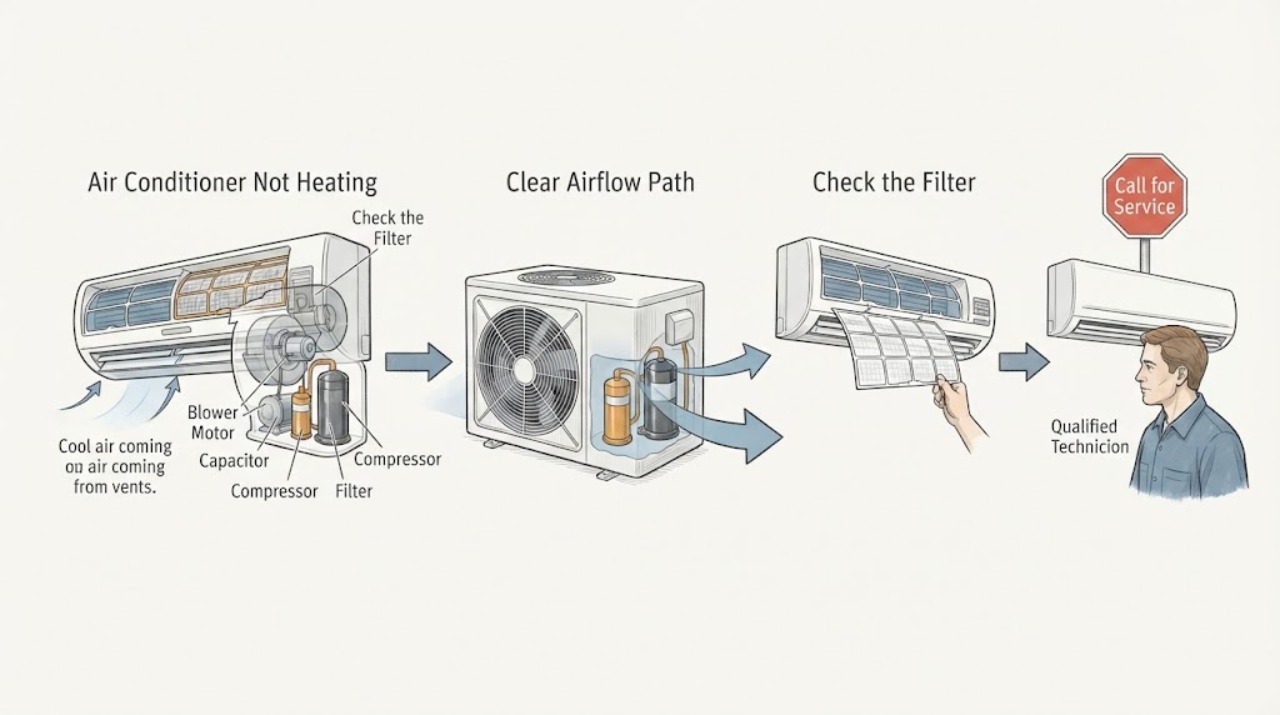
First confirm what equipment you have: a cooling-only air conditioner cannot provide heat, while a heat pump or a dual-fuel system must be in the correct heat mode. For a heat pump, check the thermostat mode and fan, compare indoor airflow, and inspect the user-accessible filter with the system off. A clogged filter can restrict airflow and make the unit deliver lukewarm air, but no indoor airflow, a stopped outdoor fan, repeated clicking or humming, persistent ice, or heating that fails while cooling works can involve the blower motor, capacitor, compressor, reversing valve, controls, or refrigerant circuit. Those components are HVAC service work. Do not open panels, touch a capacitor or compressor, handle refrigerant, or keep operating a system with smoke, burning odor, arcing, severe icing, or repeated breaker trips.
Before you begin
Safety first
- The owner scope ends at identifying the equipment type, checking normal thermostat settings, observing airflow and the outdoor unit from a safe distance, and performing manual-approved filter care. High-voltage, capacitor, compressor, blower-motor, refrigerant, coil, reversing-valve, and wiring work belongs to qualified HVAC service.
Work through in order
Diagnostic checks
Use only checks that match the exact appliance or system and its official guide.
-
Check 1
Record the model and identify whether the equipment is cooling-only, a heat pump, a dual-fuel system, or a separate furnace with an air conditioner; then check that the thermostat is set to heat and is calling for a temperature above the room.
Expected result: The system is cooling-only, the thermostat is in cool or fan-only mode, a backup heat source is selected, or a heat pump is correctly calling for heat but the room remains cold.
Next step: Use only normal thermostat settings and the exact equipment manual. If the system type or mode is uncertain, stop at identification and call HVAC service rather than forcing a mode or changing wiring.
Why this matters
Why: A cooling-only unit cannot heat the home, and a wrong mode can make normal cool airflow seem like a failure. A valid heat call on a heat pump moves the diagnosis to airflow, outdoor operation, defrost, controls, or the refrigeration circuit.
-
Check 2
During a valid heat call, compare airflow at several indoor registers and listen for the indoor blower without removing a panel or reaching near the blower motor.
Expected result: Airflow is strong but cool, weak at every register, absent while the outdoor unit runs, or normal at some registers but not others.
Next step: If airflow is severely reduced or absent, stop heating and arrange HVAC service. Do not open the blower compartment, touch the motor, or use a higher fan setting to mask a fault.
Why this matters
Why: Heat-pump supply air can feel less hot than furnace air, but weak or absent airflow can point to a filter, return, duct, blower motor, frozen coil, or control issue. A local register problem is different from a whole-house loss of airflow.
-
Check 3
With the system off and moving parts stopped, inspect the user-accessible filter named by the exact manual for dust loading, collapse, moisture, damage, and correct fit.
Expected result: The filter is visibly clogged, wet, damaged, or incorrectly seated, or it is clean, dry, intact, and correctly fitted.
Next step: Clean a reusable filter or replace a disposable filter only as the exact manual permits, then secure the access door. Do not run the system without the specified filter or open the air handler.
Why this matters
Why: A restricted filter can reduce airflow and cause lukewarm delivery or protective shutdown. A clean filter makes the blower motor, duct path, indoor coil, controls, or another system issue more likely if airflow remains poor.
-
Check 4
From a safe position outside the outdoor cabinet, observe the fan and the cabinet during a heat call; note smooth operation, no operation, unusual noise, light frost, or a thick ice coating without touching the coil or fan.
Expected result: The fan runs and the unit periodically changes behavior, the fan does not run, the unit is noisy, or ice remains heavy instead of clearing through the model's defrost behavior.
Next step: Keep the system off for a stopped, noisy, or heavily iced unit and call HVAC service. Do not chip ice, push the fan blade, remove the grille, or alter the defrost control.
Why this matters
Why: A little frost and a temporary defrost cycle can be normal for a heat pump. A stopped fan, harsh noise, or persistent ice can involve the fan motor, capacitor, compressor, airflow, refrigerant, defrost control, or another fault.
-
Check 5
Listen from outside the cabinet without opening it and record whether the compressor and fan produce a smooth operating sound, repeated clicks, a loud hum, or a start-then-stop pattern.
Expected result: The outdoor unit clicks or hums without starting, the fan turns but the compressor does not appear to run, or both fan and compressor appear to run while heating remains inadequate.
Next step: Stop at the observation and arrange HVAC service. Do not touch, test, discharge, or replace the capacitor; do not open the compressor or refrigerant system.
Why this matters
Why: Repeated clicking or a loud hum can be associated with a capacitor or starting problem, while a running fan with poor heating can have other causes. The sound alone cannot identify the failed component.
-
Check 6
Compare the same system's cooling behavior only from the thermostat and registers, without switching modes repeatedly: note whether cooling works normally, both modes fail, or the system will not change from one mode to the other.
Expected result: Cooling works but heating does not, neither mode works, or the system changes modes but delivers weak airflow or abnormal temperatures.
Next step: Give the mode comparison to an HVAC professional. Do not manipulate refrigerant valves, thermostat wiring, the reversing valve, or internal controls.
Why this matters
Why: Heating-only failure on a heat pump can point to a reversing valve, heat control, defrost, sensor, or refrigerant issue; failure in both modes raises broader power, blower, compressor, or control concerns.
-
Check 7
Look only at safe, visible areas for smoke, burning odor, arcing, a hot electrical connection, damaged wiring, water near electrical equipment, or a breaker that trips when the system starts.
Expected result: Any warning sign is present, or the equipment is cool, dry, intact, and free of an electrical warning.
Next step: Stop the system immediately for a warning sign, move away as needed, and contact appropriate emergency, electrical, or HVAC service from a safe location. Do not restart to test.
Why this matters
Why: A warning sign changes this from a comfort problem to an electrical, fire, water, or equipment safety issue. A clean exterior does not clear internal HVAC components.
-
Check 8
Prepare a service note with the model, equipment type, four assigned component identities, thermostat mode, indoor airflow, filter condition, outdoor fan and ice behavior, sound timing, cooling comparison, and any warning or display message.
Expected result: The problem changes after a manual-approved setting or filter correction, or heating remains poor after the filter and airflow path are normal.
Next step: Give the note to qualified HVAC service and keep the system off for persistent icing, no airflow, abnormal sound, or electrical symptoms. Do not make an internal repair.
Why this matters
Why: Improvement supports a setting or airflow contributor. Persistence points toward the blower motor, capacitor, compressor, reversing valve, defrost controls, refrigerant circuit, or electrical supply.
Use your observations
Decision map
Find the observation that best matches what you see, then follow the next safe action.
-
PATH 01Next step
What you see
The equipment is a cooling-only air conditioner rather than a heat pump or a system with a separate heat source.
Do this next
Use the home's designated heating equipment or obtain an HVAC assessment of the system type; do not add heating wiring or modify controls as a DIY repair.
Why this path and its safety boundary
Why it matters: The unit is not designed to provide space heating.
-
PATH 02Next step
What you see
The thermostat was in cool, fan-only, or an incorrect dual-fuel mode, and heating works after a normal setting correction.
Do this next
Leave the system in the manual-approved heat mode and monitor normal airflow. Call HVAC service if the setting changes back, the call is ignored, or room temperature does not recover.
Why this path and its safety boundary
Why it matters: The apparent failure was a mode or control-setting issue.
-
PATH 03Next step
What you see
The filter is clogged, damaged, wet, or incorrectly fitted and indoor airflow improves after approved filter care.
Do this next
Keep the correct filter installed and follow the equipment's maintenance instructions. Arrange service if the filter becomes wet, airflow falls again quickly, or the coil ices.
Why this path and its safety boundary
Why it matters: Restricted airflow was likely contributing to lukewarm or insufficient heating.
-
PATH 04Next step
What you see
Indoor airflow is weak or absent while the outdoor unit runs, or the blower does not start.
Do this next
Stop heating and call HVAC service. Do not open the blower compartment, touch the motor, or bypass a safety control.
Why this path and its safety boundary
Why it matters: A filter, return, duct, blower motor, indoor coil, or control problem may be preventing heat from reaching the rooms.
-
PATH 05Next step
What you see
The outdoor unit has a stopped fan, repeated clicking or loud hum, heavy persistent ice, or cooling works but heating does not.
Do this next
Keep the system off and arrange qualified HVAC diagnosis. Do not touch high-voltage parts, chip ice, manipulate refrigerant, or repeatedly restart the unit.
Why this path and its safety boundary
Why it matters: A capacitor, compressor, fan motor, defrost control, reversing valve, refrigerant, or related professional fault is possible.
-
PATH 06Next step
What you see
Smoke, burning odor, arcing, a hot electrical connection, water near electrical parts, damaged wiring, or repeated breaker operation is present.
Do this next
Stop using the system and move away from the hazard. Contact appropriate emergency, electrical, or HVAC service from a safe location; do not restart to test.
Why this path and its safety boundary
Why it matters: This is an immediate electrical, fire, water, or equipment safety concern.
Helpful context
Understand the symptom
An air conditioner may not be a heater
A conventional cooling-only air conditioner removes heat but does not add heat. A heat pump is an air-source heating and cooling system that can reverse its heat-transfer direction, and some homes pair a heat pump with a separate backup furnace or electric heat. The first diagnostic decision is therefore the equipment type, not a component replacement.
Keep the four assigned components in their proper boundary
The assigned components are the blower motor, capacitor, compressor, and filter. A filter is a possible user-level airflow check. A weak or absent indoor blower can make a healthy heat pump feel cold because little conditioned air reaches the room. A capacitor, compressor, and their wiring are inside the professional service boundary; clicks, hums, no-start behavior, or burning odor are clues for a technician, not instructions to open the cabinet.
Safety boundary
Stop conditions
- Stop heating for persistent heavy ice, severe loss of indoor airflow, water near electrical equipment, a stopped or damaged outdoor fan, or a breaker that trips again.
- Stop immediately for smoke, burning or melting odor, sparks, arcing, hot electrical connections, damaged wiring, or abnormal compressor or motor noise.
- Do not open the air-handler or outdoor-unit cabinet, touch the blower motor, capacitor, compressor, fan, wiring, or reversing valve, perform live electrical tests, or handle refrigerant.
- Do not chip ice, bypass a safety control, change thermostat wiring, or keep switching modes to reproduce a heating fault.
When checks do not resolve it
Need a professional?
Arrange HVAC diagnosis for persistent air conditioner not heating symptoms after safe mode, airflow, filter, and external outdoor observations, and immediately for capacitor, compressor, blower motor, refrigerant, reversing-valve, heavy-ice, or electrical signs.
Safety scope: The owner scope ends at identifying the equipment type, checking normal thermostat settings, observing airflow and the outdoor unit from a safe distance, and performing manual-approved filter care. High-voltage, capacitor, compressor, blower-motor, refrigerant, coil, reversing-valve, and wiring work belongs to qualified HVAC service.
Common questions
FAQ
Can an air conditioner provide heat?
A cooling-only air conditioner does not heat. A heat pump can heat and cool by reversing heat transfer, and some homes use a separate furnace or backup heat source. Confirm the equipment type and manual before troubleshooting components.
Can a dirty filter make a heat pump blow cool air?
Yes. A clogged filter can restrict airflow and contribute to lukewarm delivery or a frozen coil. Clean or replace it only as the exact manual permits; persistent weak airflow or ice needs HVAC service.
What does clicking or humming from the outdoor unit mean?
Repeated clicks or a loud hum can be associated with a capacitor, compressor, fan, or starting problem, but sound alone cannot identify the cause. Keep the cabinet closed and have a qualified HVAC professional diagnose it.
Can I replace a heat-pump capacitor or blower motor myself?
No. Capacitors and blower-motor wiring can involve stored or high voltage, and compressor or refrigerant work is also professional work. Stop at safe external observations and call qualified HVAC service.
Read the exact guide
Official sources
- Air-Source Heat PumpsENERGY STAR · Air-source heat-pump heating, cooling, mode, fan, and filter guidance
- Heat Pump Troubleshooting GuideCarrier · Carrier residential heat-pump airflow, outdoor coil, defrost, blower motor, and professional service guidance
- Maintenance ChecklistENERGY STAR · Residential HVAC airflow, filter, condensate, coil, control, electrical, and refrigerant maintenance guidance
- All About Heat Pump Capacitors and Signs of TroubleTrane · Trane residential heat-pump capacitor, compressor, and fan safety guidance
- Heat Pump Not Heating? Here’s How to TroubleshootCarrier · Carrier residential heat-pump heating troubleshooting
Community feedback
Share a repair observation
Share a plain-text repair observation. Accepted observations are published automatically; this page may take a moment to update.