
On this page
Start here
Quick answer
Water from an American Standard central air conditioner near the indoor unit commonly points to a backed-up condensate drain, an overflowing or damaged drain pan, a frozen evaporator coil that is thawing, or a leak at a connection. Turn cooling off, keep water away from electrical equipment, and document where the water starts and whether the pan or visible drain outlet is full. Do not open the air handler, pour chemicals into an unknown drain, or force a blockage; arrange qualified HVAC service when water continues, the drain is inaccessible, the coil is frozen, the pan is cracked, or the ceiling or equipment is at risk.
Before you begin
Safety first
- This article covers turning cooling off, protecting the area, tracing visible water, observing an accessible outlet, checking normal user filters, and documenting frost or pan conditions. It does not authorize air-handler or coil-panel removal, drain-line disconnection, chemical or compressed-air clearing, live electrical work, refrigerant work, overflow-switch bypass, or internal part replacement.
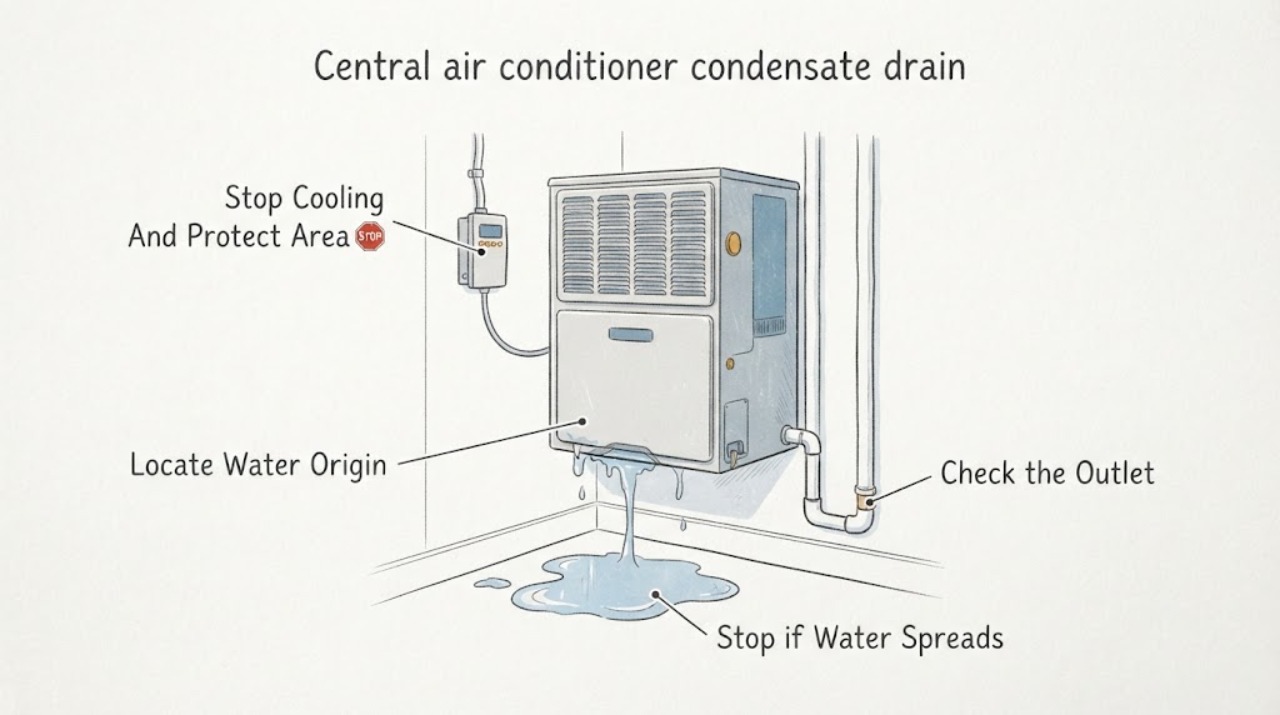
Work through in order
Diagnostic checks
Use only checks that match the exact appliance or system and its official guide.
-
Check 1
Set cooling to off at the thermostat and keep people away from standing water near the indoor air handler, electrical equipment, or ceiling. Place a container or absorbent material below the drip only if it can be done without touching wiring or opening the unit.
Expected result: Water continues to rise or drip after cooling stops, the leak is near electrical parts, the ceiling is sagging, or the flow stops and the area is safe.
Next step: Keep the system off for ongoing flow or any electrical or structural concern and arrange HVAC or appropriate emergency service. If the area is stable, continue only with visible, non-invasive checks.
Stop if: Stop immediately for sparks, burning odor, water in an electrical panel, a sagging ceiling, or an air handler that cannot be reached safely.
Why this matters
Why: Continued flow can be stored condensate or another plumbing leak rather than active cooling alone. Water near electrical parts or building materials is a damage and safety event, not a drain-cleaning experiment.
-
Check 2
From outside the cabinet, trace the visible water path: indoor unit base, auxiliary pan, accessible drain connection, ceiling or wall, or a nearby unrelated pipe. Note whether the air conditioner was running, whether the water is clear or has a musty odor, and whether the visible pan appears to be holding water.
Expected result: Water is at the indoor pan or unit base, at a drain connection, from a ceiling or wall, or not connected to the air conditioner at all.
Next step: Photograph the origin and keep cooling off if the source is the air handler or unclear. Do not remove access panels or disconnect drain piping to trace a concealed leak.
Why this matters
Why: A pan or unit-base leak makes condensate drainage, pan condition, frozen-coil thaw, or air-handler issues more likely. A remote wall or ceiling stain may be downstream drain piping or building damage; a separate pipe requires a different service path.
-
Check 3
If the primary condensate outlet is clearly visible and safe to observe, check whether water is leaving during a recent cooling period and whether the outlet is blocked by dirt, insects, or landscaping. Do not insert tools, blow into the pipe, pour cleaner, or disconnect a line.
Expected result: The outlet is dry while the indoor pan is rising, the outlet is visibly obstructed, water flows normally, or the drain outlet cannot be located.
Next step: Clear only an obvious external obstruction that does not require tools or pipe removal, then keep monitoring with cooling off. For no flow, an inaccessible line, or any recurrence, arrange qualified service to inspect and test the drain path.
Stop if: Do not use compressed air, a chemical drain product, a garden hose, or a snake on an unknown condensate line.
Why this matters
Why: A rising pan with no outlet flow supports a drain restriction or disconnected path, but a normal outlet does not rule out a partial blockage, pan crack, pump, trap, slope, or secondary drain issue. An inaccessible outlet requires professional tracing.
-
Check 4
Look only through normal user-access areas for heavy frost or ice on visible coil surfaces or nearby tubing, and check whether the return-air filter is visibly loaded according to the system's normal maintenance instructions. Do not remove coil panels or touch refrigerant tubing.
Expected result: Heavy frost is present, the filter is visibly loaded, the airflow was weak, or there is no visible frost and airflow seems normal.
Next step: Keep cooling off and let a qualified technician diagnose a frozen coil, airflow, refrigerant, or pan condition. Replace a user-access filter only if the exact system instructions allow it; do not restart cooling to force a frozen coil to thaw.
Stop if: Stop for ice around electrical parts, damaged tubing, refrigerant-like odor or oil, or water entering the blower or control area.
Why this matters
Why: A frozen evaporator coil can release a puddle as it thaws, and restricted airflow can contribute to coil icing. No visible frost does not exclude a pan, drain, pump, or refrigerant problem.
-
Check 5
Without opening the air handler, inspect any visible auxiliary pan, overflow sensor indicator, cabinet base, nearby wall, and ceiling for standing water, rust, staining, or mold-like growth. Record whether the leak is damaging drywall, insulation, flooring, or stored items.
Expected result: An auxiliary pan is full, an overflow indicator has stopped the unit, rust or staining is visible, or the surrounding building materials are dry.
Next step: Keep cooling off for a full pan, safety shutdown, or building damage and arrange HVAC service. Do not bypass the overflow switch or clean inside the cabinet without the model instructions and qualified protection.
Why this matters
Why: A full secondary pan or safety shutdown supports condensate overflow; rust, staining, or mold-like growth indicates the leak has persisted or reached materials. Dry surroundings do not prove that the primary pan or drain is sound.
-
Check 6
Record the American Standard model, indoor-unit location, when cooling was running, exact leak origin, pan and outlet observations, frost or filter condition, thermostat state, overflow indication, and any ceiling, wall, floor, odor, or electrical evidence.
Expected result: The leak stops and does not return after the system remains off; water returns when cooling resumes; or the cause remains unclear or inaccessible.
Next step: Leave cooling off until a qualified technician confirms the drain and pan are safe. Provide the record and photographs; do not restart repeatedly to reproduce a leak near electrical or building materials.
Why this matters
Why: A leak that returns with cooling is consistent with a condensate or coil-related problem, while an unclear or concealed source requires tracing. Stopping temporarily does not prove that a blockage or pan defect is resolved.
Use your observations
Decision map
Find the observation that best matches what you see, then follow the next safe action.
-
PATH 01Next step
What you see
The indoor or auxiliary pan is filling while the visible condensate outlet has no flow, and water appears at the air-handler base.
Do this next
Keep cooling off and arrange qualified HVAC service to inspect the pan, drain, trap, pump if fitted, and overflow protection. Do not force air, chemicals, or tools through the line.
Why this path and its safety boundary
Why it matters: A blocked, disconnected, improperly sloped, or otherwise restricted condensate path is more likely than ordinary surface condensation.
-
PATH 02Next step
What you see
Heavy frost or ice is visible, airflow was weak, and water appears as the indoor coil or nearby tubing thaws.
Do this next
Keep cooling off and arrange HVAC service. Do not restart the system to speed thawing, touch refrigerant tubing, or open the coil cabinet.
Why this path and its safety boundary
Why it matters: The leak may be thaw water from a frozen evaporator coil; airflow, filter, refrigerant, blower, or coil conditions need diagnosis in addition to the drain.
-
PATH 03Next step
What you see
Water originates at a cracked or rusted pan, a visible drain connection, or a persistent joint leak while the drain outlet appears open.
Do this next
Keep cooling off and arrange qualified service for pan or drain repair. Do not seal a wet or damaged connection with an unapproved material or disconnect the line.
Why this path and its safety boundary
Why it matters: A damaged pan, connection, slope, trap, or support is more likely than a simple drain blockage.
-
PATH 04Next step
What you see
The source is in a wall, ceiling, crawl space, or inaccessible drain run, or drywall, insulation, flooring, or wiring is wet.
Do this next
Keep cooling off, protect the area without opening the system, and arrange qualified HVAC service plus appropriate building or electrical assessment for affected materials.
Why this path and its safety boundary
Why it matters: The issue has crossed the ordinary-access boundary and may involve concealed drain piping or secondary building damage.
-
PATH 05Next step
What you see
The visible outlet, filter, frost, pan, and closure observations are inconclusive, but water returns when cooling operates or the air conditioner stops on an overflow condition.
Do this next
Leave cooling off and schedule qualified HVAC diagnosis. Provide the exact leak timing, photographs, and any safety-switch or temperature symptoms instead of repeated restart tests.
Why this path and its safety boundary
Why it matters: A partial restriction, pump, overflow switch, coil, airflow, refrigerant, or internal pan problem remains possible and cannot be separated safely from outside the unit.
Helpful context
Understand the symptom
First protect the indoor area
Condensation normally collects at the indoor evaporator coil, falls into a drain pan, and leaves through the condensate drain. A puddle, wet cabinet base, musty smell, or water stain means the path is not safely carrying the condensate away. Turn cooling off before water reaches electrical equipment and use towels or a container only to protect the surrounding area without opening the air handler.
The visible location narrows the cause
Water at the indoor unit or a secondary pan is consistent with a blocked drain, pan overflow, damaged pan, or a frozen coil thawing. Water at a pipe joint may be a connection or slope issue. A drain outlet with no flow during humid cooling conditions does not prove a clog by itself, but when it is paired with a rising pan or indoor leak, the drain path needs attention.
Why the air handler boundary matters
American Standard's maintenance guidance places condensation-pan, drain, wiring, coil, and blower work in a maintenance context and directs homeowners to a dealer for complicated tasks. A central system may also have an overflow safety switch that stops cooling when the pan rises. Do not bypass that protection or assume that restoring cooling proves the drain is clear.
When to stop troubleshooting
If the leak continues after cooling is stopped, the pan is cracked, the evaporator coil is frozen, the drain runs through a wall or ceiling, the air handler is inaccessible, or water has reached wiring or building materials, the next step is qualified HVAC service. Keep the system off and record the leak location, cooling state, visible frost, drain outlet, and any ceiling or wall damage.
Safety boundary
Stop conditions
- Turn cooling off and stop for water near electrical equipment, sparks, burning odor, a sagging ceiling, exposed wiring, refrigerant-like oil or hissing, or an active leak that threatens the building.
- Do not open the air handler, bypass an overflow switch, probe wiring, touch refrigerant tubing, force a drain with compressed air or tools, or pour chemical cleaner into an unknown line.
- If the evaporator coil is frozen, the drain is concealed or inaccessible, or water returns when cooling resumes, leave the system off and arrange qualified HVAC service.
Only after diagnosis
Potential parts
- condensate drain pan
Consider only when service inspection confirms a cracked, corroded, or otherwise damaged pan rather than a blocked drain or thawing coil.
Confirm the exact American Standard model and manufacturer fit information before ordering any pan. - condensate drain pump or overflow switch
Consider only when the system has these components and qualified testing confirms pump failure or an incorrect overflow signal.
Component availability and fit depend on the exact air-handler model and installed drainage arrangement. - condensate drain fitting or trap
Consider only when service diagnosis finds a damaged, disconnected, blocked, or incorrectly configured drain fitting or trap.
Drain geometry is installation-specific; have the technician confirm the correct configuration and compatibility. - evaporator coil or airflow component
Consider only when qualified testing links the leak to a frozen coil, airflow fault, or damaged coil after drain and pan causes are assessed.
Do not order a coil or airflow component from a puddle alone; verify the exact model and diagnosis.
When checks do not resolve it
Need a professional?
Arrange qualified HVAC service when water returns with cooling, the condensate pan is full or damaged, the drain outlet has no flow, the line or air handler is inaccessible, the evaporator coil is frozen, an overflow switch stops the unit, or water has reached drywall, flooring, insulation, wiring, or electrical equipment. Obtain appropriate emergency electrical or building help for immediate hazards.
Safety scope: This article covers turning cooling off, protecting the area, tracing visible water, observing an accessible outlet, checking normal user filters, and documenting frost or pan conditions. It does not authorize air-handler or coil-panel removal, drain-line disconnection, chemical or compressed-air clearing, live electrical work, refrigerant work, overflow-switch bypass, or internal part replacement.
Common questions
FAQ
Why is my American Standard central AC leaking water?
Common possibilities include a blocked or disconnected condensate drain, overflowing or damaged pan, frozen evaporator coil thawing, or a drain connection problem. Turn cooling off and use the visible water location, pan, drain, frost, and airflow clues to prepare for service.
Should I keep running the AC if water is leaking?
No. Official manufacturer guidance recommends turning a leaking central AC off and arranging repair because continued operation can allow pan overflow and building or equipment damage, especially when the source is unclear.
Can a frozen evaporator coil cause water around the indoor unit?
Yes. Ice can thaw into a puddle near the indoor unit. Keep cooling off and arrange HVAC diagnosis for the coil, filter or airflow, refrigerant, drain pan, and condensate path rather than restarting to force the ice to melt.
Can I unclog the American Standard AC condensate drain myself?
Do not force an unknown drain with compressed air, tools, chemicals, or a hose. The line may be concealed, connected to an overflow safety, or under warranty; keep cooling off and have a qualified HVAC technician clear, inspect, and test the drain and pan.
Read the exact guide
Official sources
- Air Handler Maintenance Tips to Improve PerformanceAmerican Standard Heating and Air Conditioning · American Standard air-handler maintenance, condensation drain, pan, filter, wiring, and dealer boundary
- AC Condensate Drain Line Clogged? Learn What You Can DoTrane · Central air-conditioner condensate pan, drain line, overflow, water damage, frozen-coil clues, and professional service boundary
- AC Leaking WaterTrane · Central AC water leaks from drain pans, condensate lines, frozen evaporator coils, and service escalation
Community feedback
Share a repair observation
Share a plain-text repair observation. Accepted observations are published automatically; this page may take a moment to update.