
On this page
Start here
Quick answer
Water from an American Standard central air conditioner usually means condensate is not reaching its drain, a drain pan or line is damaged or blocked, or a frozen evaporator coil is thawing. Turn cooling off if water is pooling, near electrical equipment, or reaching a ceiling or wall; never run a visibly frozen coil. From safe, accessible locations, note where the first wet spot appears, whether water normally exits the condensate line, whether the filter is loaded, and whether ice or weak cooling is present. Replace only an accessible filter specified for the system and do not open panels, handle refrigerant or electrical parts, chip ice, or pour chemicals into a hidden drain. If the leak continues, returns, involves standing water or structural damage, or has an unclear source, arrange qualified HVAC service to inspect the pan, drain, trap or pump, airflow, coil, refrigerant circuit, and any safety switch.
Before you begin
Safety first
- A qualified technician should inspect sealed coils, refrigerant charge or leaks, blower and electrical components, drain pans, traps, condensate pumps, float switches, inaccessible lines, duct insulation, and installation or airflow faults. Homeowner checks should remain limited to thermostat settings, an accessible filter, visible water or ice, safe drain termination observations, and documentation.
Work through in order
Diagnostic checks
Use only checks that match the exact appliance or system and its official guide.
-
Check 1
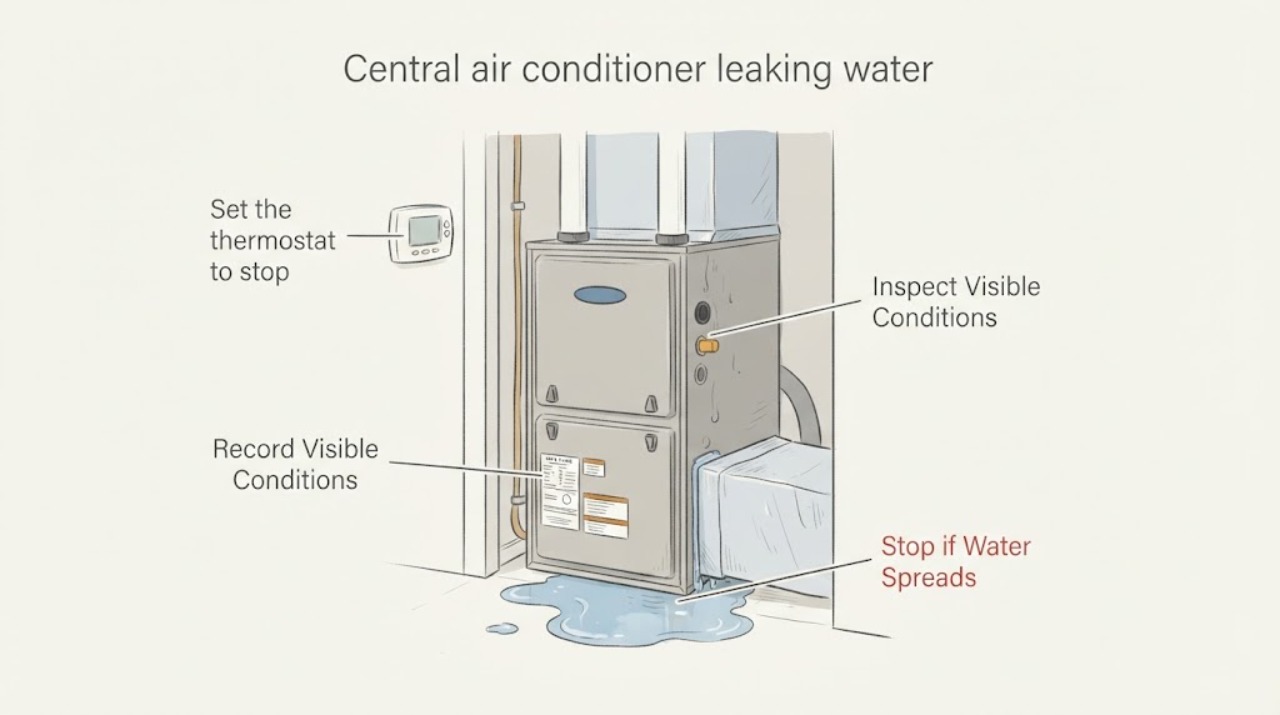
Set the thermostat to stop cooling and keep people away from wet electrical equipment; place absorbent material or a container only below a safe, non-electrical drip point.
Expected result: Water is pooling, reaching a disconnect, outlet, wiring, furnace controls, ceiling, or wall; or the drip is small and isolated away from electrical parts.
Next step: If water is near electrical equipment, do not touch the wet equipment or open a panel; arrange qualified HVAC or electrical help as appropriate. Keep cooling off and continue only with dry, accessible visual checks.
Why this matters
Why: Pooling or electrical and structural exposure can escalate beyond a routine drain observation. A small drip still has an unknown source and should not be tested by repeatedly running the AC.
-
Check 2
Record where the first water appears and when it happens: during a cooling cycle, shortly after shutdown, only after long humid operation, or with no cooling call. Trace visible marks from the indoor unit toward the floor, ceiling, nearby pipes, and ducts without removing covers.
Expected result: The wet point is under the air handler or coil cabinet, appears after shutdown, is on a cold pipe or duct, or is isolated to a ceiling, wall, or unrelated plumbing path.
Next step: Photograph the first wet point and keep cooling off. Give the timing and location to the technician, especially if the visible source is not the condensate system.
Why this matters
Why: Under-unit water supports condensate collection or drainage trouble; post-shutdown water with poor cooling supports thawing ice; surface beads support condensation or insulation trouble; a remote building stain may not be an AC leak.
-
Check 3
From outside the equipment cabinet, look at the accessible condensate drain termination and any clearly visible pump reservoir, alarm, or pan; do not disconnect tubing or open the air handler.
Expected result: The outlet is dry after recent cooling, the indoor area or visible pan contains standing water, a pump alarm or full reservoir is present, or the line is visibly kinked or disconnected.
Next step: Leave cooling off and arrange HVAC service to inspect, clear, and test the condensate route and any safety switch or pump. Do not pour chemicals, force a hose or compressed air through an unknown line, or bypass a float switch.
Why this matters
Why: Standing water with no discharge supports a blocked or poorly draining line, trap, pan, or pump. A kink or disconnection can redirect condensate, but a dry outlet while cooling is off cannot by itself prove a blockage.
-
Check 4
Inspect the return-air filter and visible supply airflow, and look only through a manufacturer-provided viewing area for frost or ice on the accessible coil or refrigerant tubing; do not remove panels or scrape ice.
Expected result: The filter is loaded or missing, airflow is weak, frost or ice is visible, the AC was blowing warm air, or the filter and accessible surfaces look normal.
Next step: If the filter is accessible and the equipment instructions identify its size and type, replace it without opening sealed equipment. With any ice, repeated freezing, weak cooling, or warm air, leave cooling off and arrange professional diagnosis before restarting.
Why this matters
Why: A restricted filter or airflow can freeze the evaporator coil and produce meltwater. Ice, weak cooling, or warm air also keep dirty-coil, blower, refrigerant, and control causes in consideration. A normal-looking filter does not rule out a hidden drain or pan fault.
-
Check 5
Inspect visible insulation, ducts, cabinet surfaces, and nearby cold pipes for beads of condensation, wet spots, rust trails, or damaged insulation, while also checking whether the outdoor unit is the only wet location.
Expected result: Moisture is on an uninsulated or damaged surface, the duct or insulation is wet, a rust trail leads from a pan or pipe, or water is coming from a roof, plumbing line, or outdoor source.
Next step: Keep cooling off, dry what is safely accessible, and have the appropriate HVAC or building professional trace the competing source. Do not conceal wet insulation or damage with sealant or paint.
Why this matters
Why: Surface moisture supports condensation or insulation/duct leakage rather than a simple drain blockage. A rust trail or damaged pan supports a collection failure. A roof or plumbing source needs a different repair and can continue even while the AC is off.
-
Check 6
Collect the system model information, filter condition, leak timing, photos, drain-outlet behavior, ice or airflow observations, and any thermostat or safety-switch message for the service visit.
Expected result: The source remains uncertain, the leak stopped after shutdown, the leak returned after a filter change or drain attempt, or the system has a recurring pattern.
Next step: Give the record to a qualified technician and request diagnosis of the pan, drain, trap or pump, airflow, coil, refrigerant circuit, and safety controls before normal cooling resumes. Do not keep restarting the system to reproduce the leak.
Why this matters
Why: A stopped leak does not prove that the drain is clear; a recurring leak indicates an unresolved drainage, coil, airflow, refrigerant, pump, pan, or moisture-source problem. Photos and timing can distinguish meltwater from an overflow or surface condensation.
-
Check 7
After professional service, verify from safe locations that the intended drain discharges, the accessible area remains dry during a controlled cooling test, and no ice, standing water, or new ceiling or duct moisture returns.
Expected result: Condensate exits normally and the original area stays dry, the pan fills again, water returns after shutdown, the pump or safety switch does not respond, or ice reforms.
Next step: Stop cooling again if water or ice returns and contact the servicing professional with the timing and photos. Do not bypass a safety device or continue operating an overflowing or frozen system.
Why this matters
Why: Normal discharge and a dry original area support a successful repair. Recurrence means the drain, pan, pump, airflow, coil, refrigerant circuit, control, or another moisture source still needs attention.
Use your observations
Decision map
Find the observation that best matches what you see, then follow the next safe action.
-
PATH 01Next step
What you see
Water is under the indoor air handler or coil cabinet, the visible pan has standing water, and the condensate outlet is dry or a pump reservoir/alarm indicates a problem.
Do this next
Keep cooling off and arrange HVAC service to clear and test the complete condensate path. Do not flush an unknown line, use chemicals, or bypass overflow protection.
Why this path and its safety boundary
Why it matters: A blocked or poorly draining condensate line, trap, pan, pump, or safety-switch condition is more likely than normal condensation.
-
PATH 02Next step
What you see
The AC was not cooling well, airflow is weak, frost or ice is visible, or water appears as the system shuts down.
Do this next
Leave cooling off, replace only an accessible documented filter, and arrange qualified diagnosis before restarting. Never chip ice or handle refrigerant.
Why this path and its safety boundary
Why it matters: A frozen evaporator coil from restricted airflow, a dirty coil, blower problem, refrigerant issue, or control fault is more likely than an isolated drain blockage; the meltwater may also overwhelm the pan.
-
PATH 03Next step
What you see
The pan and drain outlet do not show an overflow, but moisture beads on the cabinet, ducts, pipes, or insulation, especially in an attic or other non-conditioned space.
Do this next
Keep cooling off until the source is assessed, dry accessible materials promptly, and have an HVAC professional inspect insulation, ducts, coil cabinet, pan, and drainage without masking the wet area.
Why this path and its safety boundary
Why it matters: External condensation, inadequate insulation or duct sealing, or a hidden pan issue is more likely than a simple blocked drain.
-
PATH 04Next step
What you see
The indoor unit is dry, but a ceiling, wall, roof, plumbing line, or outdoor source is the first wet point.
Do this next
Keep the AC off if its source remains uncertain and arrange the appropriate HVAC, plumbing, or building inspection. Photograph the first wet point before the area dries.
Why this path and its safety boundary
Why it matters: The reported water may be unrelated to the American Standard central AC, or it may be tracking from a concealed HVAC component; clearing the AC drain alone would not correct it.
-
PATH 05Next step
What you see
Water returns after a drain attempt or restart, ice reforms, drywall or insulation is being damaged, electrical parts are wet, or a refrigerant or electrical warning is suspected.
Do this next
Stop cooling, do not open panels or touch wet wiring, and arrange prompt qualified service. Ask the technician to test the drain and overflow protection as well as airflow, coil, refrigerant, and the original leak path.
Why this path and its safety boundary
Why it matters: The fault is recurring or hazardous and cannot be safely separated into a homeowner drain check; continued operation can worsen system or property damage.
Helpful context
Understand the symptom
Why a central AC can leak water
Cooling removes moisture from indoor air at the evaporator coil. That condensate should collect in a pan and leave through a drain. A blocked or poorly draining path can overflow, while a cracked pan, condensate pump problem, or water on a cold cabinet, pipe, duct, or insulation can create a different leak path. A frozen coil can also release an unusually large amount of water as it thaws. A puddle identifies a moisture problem, not a single failed part.
Use timing and location as clues
Water that appears under the indoor unit during cooling, especially with no visible drain discharge, makes a pan, trap, line, or pump problem more likely. A leak that starts after shutdown together with ice, weak airflow, or warm air makes thawing ice more likely. Water beading on a cabinet, pipe, duct, or wet insulation points toward condensation or insulation trouble. A ceiling or wall stain without a matching indoor-unit wet point may be plumbing, roof, or another building leak instead.
Keep homeowner checks outside sealed equipment
The safe checks are visual and limited to the thermostat, an accessible filter, an obvious drain termination, a visible pan or pump alarm, and surrounding surfaces. Do not remove the air-handler cover, enter an energized electrical compartment, scrape ice, add refrigerant, or use a chemical or high-pressure method in an unknown drain. American Standard says leaking or pooling water should be addressed promptly and professional help is appropriate when electrical or refrigerant risks are possible.
Dry the area and confirm the cause was corrected
Protect flooring and furnishings only from a safe dry location, photograph the first wet point, and dry accessible wet materials promptly. EPA recommends prompt repair of leaks and attention to wet insulation, drain pans, coils, and duct moisture. Before normal cooling resumes, the service visit should verify the drain path, pan or pump, coil and airflow condition, and the original leak area rather than assuming that a dry floor after shutdown proves the repair.
Safety boundary
Stop conditions
- Keep cooling off and arrange qualified HVAC help for active pooling, water near electrical equipment, ceiling or wall damage, repeated leaks, a full visible pan, pump or float-switch alarm, or an unknown source.
- If frost or ice is visible, do not run the AC, chip the ice, apply direct heat, open the coil cabinet, or add refrigerant. Let the coil thaw safely and have the cause diagnosed before restarting.
- Do not open the air-handler or electrical-panel covers, test live voltage, handle capacitors or refrigerant, bypass a condensate safety switch, or force water, compressed air, or chemicals through a hidden line.
- If wet insulation, ducts, or suspected mold are involved, dry accessible materials promptly and arrange qualified HVAC or moisture remediation assessment; do not run an HVAC system suspected of spreading contamination.
Only after diagnosis
Potential parts
- air conditioner air filter
Consider this only when the accessible filter is loaded, damaged, missing, or the equipment documentation calls for replacement; a filter cannot repair a pan, drain, refrigerant, or electrical fault.
Confirm the exact American Standard system, filter dimensions, airflow direction, and manufacturer instructions before replacement. - condensate drain pan
Consider this only when a qualified inspection confirms a cracked, corroded, or improperly draining pan after ruling out a blocked line, pump, trap, and frozen-coil meltwater.
Match the exact indoor coil or air-handler model, orientation, drain connections, overflow provisions, and installation instructions. - condensate pump or float safety switch
Consider this only when a technician confirms the pump or overflow control fails after the drain route and power or signal path are tested.
Verify the exact equipment, pump capacity and lift, switch arrangement, wiring, and approved installation method; do not bypass the safety control. - evaporator coil
Consider this only after professional testing confirms a leaking or damaged coil, or a coil that cannot be restored after airflow and refrigerant causes are addressed; a puddle alone does not identify a bad coil.
Confirm the complete indoor and outdoor system, refrigerant requirements, coil orientation, metering device, and manufacturer fit information before any sealed-system replacement.
When checks do not resolve it
Need a professional?
Safety scope: A qualified technician should inspect sealed coils, refrigerant charge or leaks, blower and electrical components, drain pans, traps, condensate pumps, float switches, inaccessible lines, duct insulation, and installation or airflow faults. Homeowner checks should remain limited to thermostat settings, an accessible filter, visible water or ice, safe drain termination observations, and documentation.
Common questions
FAQ
Why is my American Standard central air conditioner leaking water?
The likely paths are a blocked or damaged condensate drain or pan, a condensate pump or safety-switch problem, a frozen evaporator coil that is thawing, or condensation on a cold cabinet, duct, pipe, or insulation. Locate the first wet point and note the timing, but keep cooling off if water is pooling, near electrical parts, or accompanied by ice or weak cooling.
Can I run my American Standard AC while it is leaking?
Do not keep running it to see whether the leak clears. Turn cooling off when water is pooling, near electrical equipment, damaging a ceiling or wall, or accompanied by ice or poor cooling. Running a frozen coil or overflowing condensate system can worsen equipment and property damage.
What should I check first if water is under the indoor AC unit?
First stop cooling and protect the area from a safe, dry location. Then note whether the condensate outlet is discharging, whether a visible pan has standing water, whether a pump alarm or reservoir is full, and whether the filter or accessible coil area shows ice. Do not open the air handler or flush a hidden line; persistent or recurring water needs HVAC diagnosis.
Could a dirty filter cause an American Standard AC leak?
Yes. A loaded filter can restrict airflow, which can contribute to a frozen evaporator coil; meltwater may then reach the pan faster than the drainage system can handle. Replace only an accessible filter that matches the equipment instructions. If ice, weak cooling, warm air, or a repeat leak remains, a technician must check airflow, coil condition, refrigerant, and drainage.
When does a leaking American Standard AC need a technician?
Arrange qualified HVAC service for standing water, a full or damaged pan, a blocked or inaccessible drain, a pump or float-switch alarm, any ice or repeated freezing, weak cooling, a suspected refrigerant leak, wet electrical equipment, recurring water damage, or an uncertain source. Refrigerant, electrical, sealed-coil, blower, and inaccessible drain work are not homeowner troubleshooting tasks.
Read the exact guide
Official sources
- HVAC Maintenance TipsAmerican Standard Heating and Air Conditioning · States that leaking or pooling water should be attended to promptly and the AC turned off to avoid electrical damage; also covers visible airflow and equipment warning signs.
- Why Is My Home AC Not Blowing Cold Air?American Standard Heating and Air Conditioning · Describes condensate formation at the indoor coil, drain-line blockage from debris or standing water, safety-switch shutdown, and frozen-coil possibilities.
- Got a Frozen Evaporator Coil? Don’t Panic, Do This.American Standard Heating and Air Conditioning · Identifies icing, warm air, puddles during thawing, airflow and filter causes, thermostat or refrigerant possibilities, and the instruction to stop cooling and avoid chipping ice.
- Should You Have the Air Ducts in Your Home Cleaned?U.S. Environmental Protection Agency · Advises checking that condensate pans drain, treating substantial standing water or debris as needing immediate attention, checking nearby insulation, and controlling duct condensation and leaks.
- What Is an Evaporator Coil?American Standard Heating and Air Conditioning · Explains that the indoor coil removes heat and moisture, connects dirty airflow and low refrigerant to freezing, and reserves coil cleaning and refrigerant work for trained technicians.
- A Brief Guide to Mold, Moisture and Your HomeU.S. Environmental Protection Agency · Recommends prompt drying and professional assessment where HVAC contamination or contaminated water is suspected, supporting the article’s moisture and stop-use boundaries.
- 8 Common AC Repair Issues for Home SystemsAmerican Standard Heating and Air Conditioning · Directly covers central split-system drain-pan and condensate-line issues, frozen evaporator-coil signs, refrigerant concerns, blower symptoms, and professional repair boundaries.
Community feedback
Share a repair observation
Share a plain-text repair observation. Accepted observations are published automatically; this page may take a moment to update.