
On this page
Start here
Quick answer
A blocked condensate drain can make a central air conditioner leak, but the same water can come from a frozen evaporator coil, damaged drain pan, condensate pump, or condensation on an uninsulated surface. Turn cooling off to limit water damage, keep clear of wet electrical equipment, and note where and when water appears. Look only at accessible areas: the filter, visible pan, drain-line termination, pump alarm or reservoir, and any ice or wet insulation; do not remove panels or pour chemicals into an unknown drain. If the pan is filling, the drain outlet has no flow, ice is present, water is near electrical equipment, the ceiling or drywall is being damaged, or the leak returns, arrange HVAC service. A technician should clear and test the drain, pan, trap, pump, airflow, and refrigerant-related causes before the system is run again.
Before you begin
Safety first
- A qualified HVAC professional should clear and test hidden drains, traps, pans, pumps, coils, airflow, refrigerant circuits, condensate safety switches, and electrical components; building or mold professionals may be needed for wet insulation, ducts, ceilings, or structural damage.
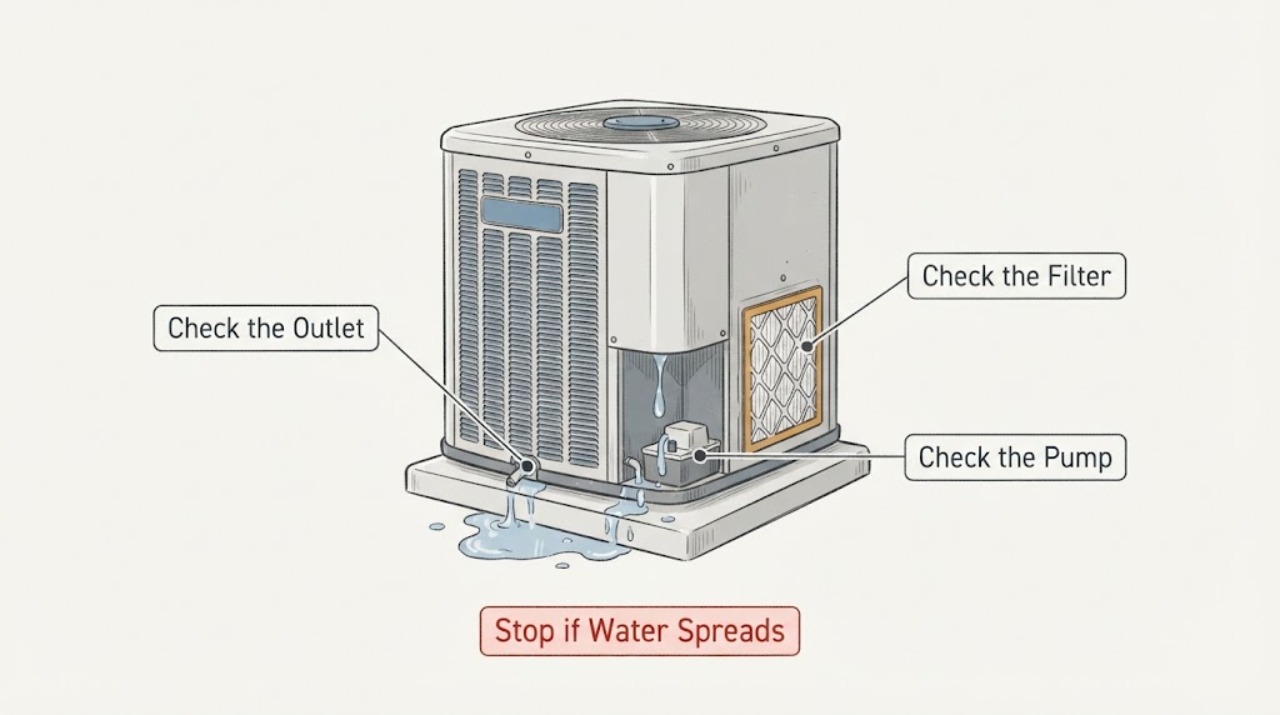
Work through in order
Diagnostic checks
Use only checks that match the exact appliance or system and its official guide.
-
Check 1
Turn cooling off at the thermostat and place a container or absorbent material below a safe, non-electrical drip point; keep away from wet wiring, disconnects, outlets, and equipment panels.
Expected result: Water is actively pooling, reaching electrical equipment, staining a ceiling or wall, or continuing to drip after cooling is off; or the leak is limited to a small accessible area away from electrical parts.
Next step: If water is near electrical equipment or structural damage is occurring, do not touch the wet equipment or restart the system; arrange urgent HVAC or electrical help as appropriate. Otherwise continue with visual checks only while cooling remains off.
Why this matters
Why: Active pooling or structural/electrical exposure can worsen damage and is not a routine drain-line check. A small isolated drip still requires the system to remain off until its source is known.
-
Check 2
From outside or another clearly accessible location, check the condensate drain termination and any visible pump reservoir or alarm without opening the air handler or disconnecting tubing.
Expected result: The drain outlet is dry during a recent cooling period, water is backing up at the indoor unit, a pump alarm or full reservoir is visible, or the line is visibly kinked or disconnected.
Next step: Leave cooling off and arrange HVAC service to inspect and clear the drain system and test its flow. Do not pour chemicals, force a hose or compressed air through an unknown line, or reconnect a fitting that could leak into the structure.
Why this matters
Why: No discharge together with indoor standing water supports a blocked line, trap, pan, or pump problem. A pump alarm or full reservoir supports a pump or drainage problem. A kink or disconnected line can redirect water, but a dry outlet alone cannot prove a blockage because cooling is now off.
-
Check 3
Check the return-air filter and look through any manufacturer-provided viewing opening for frost or ice on the accessible coil area; do not remove panels or scrape ice.
Expected result: The filter is visibly loaded, ice or frost is present, the unit was not cooling normally, or neither filter loading nor ice is visible.
Next step: Keep cooling off and replace the filter only with the size and type specified by the equipment instructions if it is an accessible homeowner task. If ice, poor cooling, or repeat freezing is present, have an HVAC professional diagnose airflow and refrigerant-related causes before restarting.
Why this matters
Why: A dirty filter can restrict airflow and contribute to a frozen coil whose meltwater overwhelms drainage. Ice, poor cooling, or repeated freezing also keeps refrigerant, airflow, and coil faults in consideration. No visible ice does not rule out a drain pan or hidden line problem.
-
Check 4
Trace visible water marks from the indoor unit outward and inspect the accessible drain pan area, cabinet exterior, nearby ducts and pipes, wet insulation, and the ceiling or floor below without opening sealed equipment.
Expected result: Standing water or debris is in the visible pan, the pan appears cracked or corroded, wet insulation or cabinet condensation is present, or water enters from a pipe, roof, or unrelated source.
Next step: Photograph the location and keep cooling off. Arrange the appropriate HVAC or building professional to inspect the pan, trap, line, pump, coil, insulation, and any competing water source; do not patch a pan or seal a duct as a substitute for diagnosis.
Why this matters
Why: Standing water or a pan defect supports a condensate collection or drainage failure. Wet insulation or cabinet/pipe condensation supports a moisture-control or insulation issue. A roof or plumbing source is not fixed by clearing the AC drain.
-
Check 5
After the cause has been professionally corrected, verify that the drain pan stays dry enough to drain, the condensate exits through its intended route, the safety switch or pump operates if fitted, and no new water appears during a controlled cooling test.
Expected result: Water drains normally and the original area remains dry, the pan fills again, the pump or safety switch does not respond, or moisture returns on ducts, insulation, walls, or the ceiling.
Next step: Stop cooling again if water returns or the safety protection does not work, and give the technician the photos and timing log. Do not continue running the system to drain an overflowing pan.
Why this matters
Why: A dry pan and clear discharge support a successful drainage repair, but recurrence indicates a remaining blockage, pan/trap/pump fault, coil or airflow issue, or a separate moisture source. A safety switch that does not operate leaves the property exposed to overflow.
Use your observations
Decision map
Find the observation that best matches what you see, then follow the next safe action.
-
PATH 01Next step
What you see
The indoor pan or area below the air handler is filling with water while the visible drain outlet remains dry, or a pump alarm/full reservoir is present.
Do this next
Keep cooling off and arrange HVAC service to clear and test the condensate system. Do not flush, snake, or chemically treat a hidden line unless the exact equipment instructions explicitly authorize that homeowner action.
Why this path and its safety boundary
Why it matters: A blocked or improperly draining condensate path, trap, pan, or pump is more likely than normal condensation.
-
PATH 02Next step
What you see
Ice or frost is visible, the filter is loaded, cooling is weak, or the leak appears after the system shuts down and the ice melts.
Do this next
Leave the system off, replace only an accessible filter specified by the equipment instructions, and arrange professional diagnosis before restarting; do not scrape ice or handle refrigerant.
Why this path and its safety boundary
Why it matters: Restricted airflow, refrigerant or coil trouble, and a drain that cannot handle meltwater are more likely than an isolated line blockage.
-
PATH 03Next step
What you see
The pan and drain outlet appear normal, but water is condensing on the cabinet, ducts, pipes, wet insulation, or a ceiling/wall source is found.
Do this next
Keep cooling off and have an HVAC or building professional identify and repair the moisture source. Dry wet materials promptly and do not conceal water damage with paint, sealant, or duct treatment.
Why this path and its safety boundary
Why it matters: External condensation, insulation or duct moisture, a damaged pan outside the visible area, or a roof/plumbing source is more likely than a simple blocked drain.
-
PATH 04Next step
What you see
Water is near electrical equipment, actively damaging drywall or ceilings, entering ducts, or returning after a drain clearing and restart.
Do this next
Do not touch wet electrical components or run the AC. Arrange urgent HVAC/building assistance, and request inspection of the pan, drain, pump, coil, airflow, insulation, and affected structure before operation resumes.
Why this path and its safety boundary
Why it matters: The leak presents property, electrical, indoor-air, or recurrence risk beyond a basic homeowner observation.
Helpful context
Understand the symptom
Stop the water before diagnosing the cause
Cooling removes moisture from indoor air and sends it to a drain pan and condensate line. A blocked line can back water up and overflow, but a leak can also follow a frozen coil as ice melts, a cracked pan, a pump problem, or condensation on a cold surface. Turn the system off at the thermostat and protect nearby belongings. Do not touch wet electrical equipment, open the air handler, or restart cooling just to see whether the leak continues.
Use the leak location as a diagnostic clue
A visible wet pan or water at the indoor unit with no discharge at the drain termination supports a drainage problem, while ice on the coil or a very dirty filter points toward restricted airflow or another cooling fault. Water on the outside of a cabinet, duct, or pipe can be condensation rather than pan overflow. These clues narrow the next check but do not prove that the drain alone is blocked.
Limit homeowner checks to accessible, documented points
You can check the filter, visible drain outlet, accessible pump alarm or reservoir, and obvious standing water without removing panels. Do not snake a hidden line, add drain chemicals, force compressed air, pour a hose into the pan, handle refrigerant, or work around a live electrical cabinet unless the exact manufacturer instructions explicitly assign that task to a homeowner. Trane advises that professional service is the safest route for a nonworking or leaking system.
Dry the damage and verify the repair
Dry wet surfaces promptly and document staining, rust, wet insulation, ceiling damage, and the timing of the leak. EPA guidance emphasizes unobstructed condensate drainage and quick moisture control because standing water and wet components can promote mold or damage. After service, the drain, pan, trap or pump, coil, airflow, and the area of the original leak should be tested before normal cooling resumes.
Safety boundary
Stop conditions
- Keep the air conditioner off when water is pooling, the drain pan is filling, a ceiling or wall is being damaged, or the leak reaches electrical equipment; do not touch wet wiring or restart cooling to test it.
- Do not remove sealed panels, handle refrigerant, scrape coil ice, pour drain chemicals, force a hose or compressed air into an unknown line, patch a pan, or alter a safety switch as an ordinary homeowner task.
- Use an HVAC professional for a blocked or hidden condensate line, pump or trap fault, repeated leak, frozen coil, poor cooling, wet insulation or ducts, mold concern, or any leak that cannot be clearly isolated and safely tested.
When checks do not resolve it
Need a professional?
Safety scope: A qualified HVAC professional should clear and test hidden drains, traps, pans, pumps, coils, airflow, refrigerant circuits, condensate safety switches, and electrical components; building or mold professionals may be needed for wet insulation, ducts, ceilings, or structural damage.
Common questions
FAQ
Does water under a central air conditioner always mean the drain is blocked?
No. A clogged condensate line is common, but a frozen evaporator coil, cracked or corroded pan, condensate pump problem, or condensation on a cabinet, duct, pipe, or insulation can look similar. Location, ice, filter condition, drain discharge, and cooling performance help separate the possibilities.
Can I keep running the AC while it is leaking water?
It is safer to turn cooling off. Running a leaking system can overflow a pan, worsen ceiling or drywall damage, and allow a frozen coil to melt into the same drainage problem. Keep it off until the cause is identified and the drain and affected equipment are checked.
What can I safely check before calling an HVAC professional?
With cooling off, document the leak, check the accessible filter, look for visible ice or standing water, and observe the drain termination or pump alarm without opening sealed equipment. Do not pour chemicals, force a hose or compressed air into a hidden line, handle refrigerant, or work around wet electrical parts.
Why does the leak show up after the AC turns off?
Ice on the evaporator coil may melt after shutdown, or a blocked drain may be unable to carry the meltwater away. A dirty filter can restrict airflow and contribute to freezing, but poor cooling or repeated icing also needs professional diagnosis for airflow, coil, and refrigerant causes.
When is a leaking AC an urgent service problem?
Treat it as urgent when water is near electrical equipment, actively damages ceilings, drywall, or floors, enters ducts or insulation, the pan is filling, cooling is failing, or the leak returns after a clearing. Turn the system off and arrange qualified HVAC or building assistance before further operation.
Read the exact guide
Official sources
- Why Is My AC Leaking Water?Carrier · Residential air conditioners; cause and action details remain equipment- and installation-specific
- Should You Have the Air Ducts in Your Home Cleaned?U.S. Environmental Protection Agency · Residential forced-air HVAC systems and components; moisture and insulation handling are system-specific
- AC Condensate Drain Line Clogged? Learn What You Can DoTrane · Central AC and heat-pump condensate systems; exact access and service procedures vary by equipment
- A Brief Guide to Mold, Moisture and Your HomeU.S. Environmental Protection Agency · Residential moisture and mold prevention, including air-conditioning condensate systems
Community feedback
Share a repair observation
Share a plain-text repair observation. Accepted observations are published automatically; this page may take a moment to update.