
On this page
Start here
Quick answer
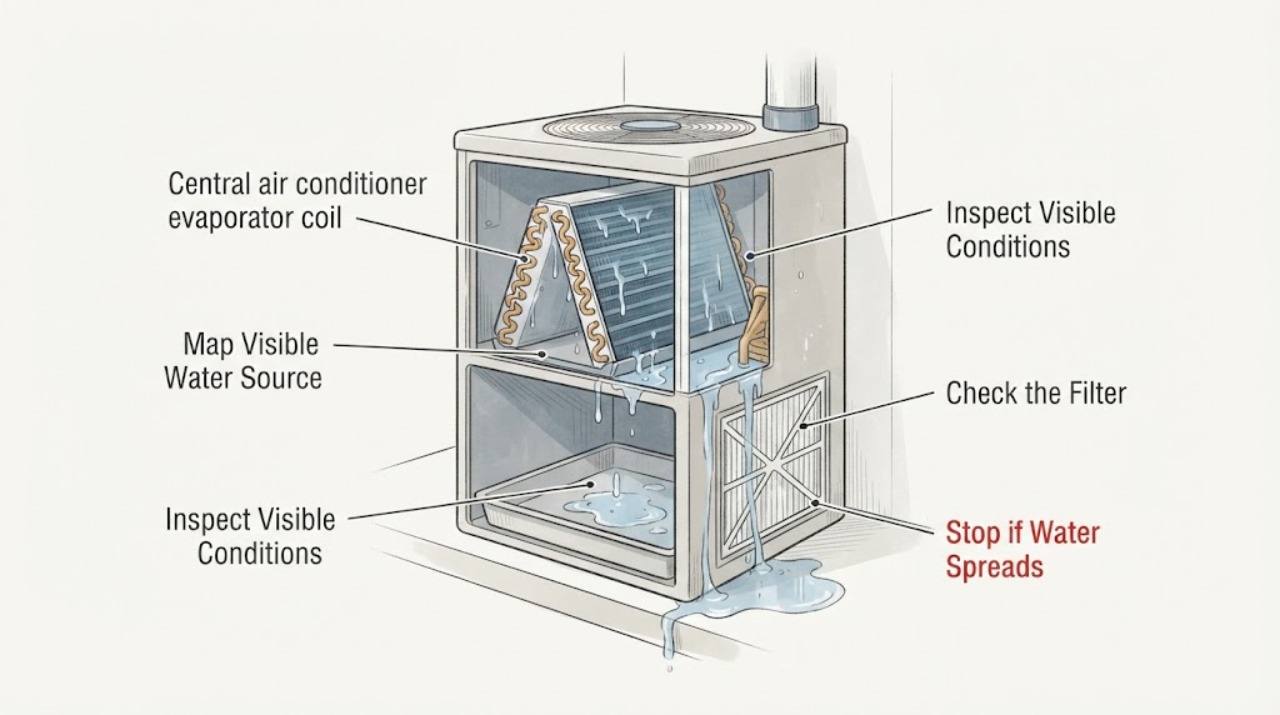
Water attributed to a central air conditioner's evaporator coil is usually a condensate-management or frozen-coil symptom, not a safe coil repair for a homeowner. From a dry, accessible position, note where water appears, whether ice or frost is visible without opening the cabinet, filter condition from its normal access point, drain-outlet behavior, and any water near electrical equipment. If water reaches wiring or electrical parts, turn the system off at the thermostat if that can be done safely, keep clear, and arrange HVAC service. Do not open the air handler, touch the coil or refrigerant circuit, pour chemicals into a drain, or use tools to clear a blockage; a qualified technician must determine whether the cause is drainage, airflow, a drain pan, coil frost, or a refrigerant issue.
Before you begin
Safety first
- The article provides observation-only guidance. The HVAC professional determines whether the cause is drainage, airflow, frost, the pan, the evaporator coil, refrigerant, or another equipment condition.
Work through in order
Diagnostic checks
Use only checks that match the exact appliance or system and its official guide.
-
Check 1
From a dry standing position outside the equipment cabinet, look for puddles, dripping, wet insulation, ceiling or wall staining, rust, or water tracking below the indoor unit; photograph the area without removing a panel or touching the equipment.
Expected result: Water may be absent, limited to a stain, actively dripping, pooling in a pan or floor area, or spreading to nearby building materials.
Next step: Record the exact location, time, equipment mode, and whether the water appears during or after cooling, then arrange qualified HVAC inspection.
Stop if: If water reaches wiring, a disconnect, an outlet, or other electrical equipment, stop approaching the unit, turn the system off at the thermostat only if it is safe, and obtain prompt professional help.
Why this matters
Why: A stain may be an earlier event, while active pooling or building-material wetting indicates ongoing water damage risk. A dry exterior does not prove that the pan or coil area is dry.
-
Check 2
From a normal exterior sight line, look for visible frost or ice on accessible refrigerant tubing or cabinet surfaces and note whether the supply air feels warm; do not open the cabinet, touch ice, or disturb tubing.
Expected result: There may be no ice, a small visible frost area, widespread ice, water after thawing, or warm air without visible frost.
Next step: If frost or ice is visible, stop cooling operation if the thermostat can be used safely, keep the cabinet closed, document the timing, and request HVAC service to diagnose the cause.
Stop if: Stop for hissing, an oily residue, chemical odor, a damaged line, water near electrical parts, or any need to touch tubing, refrigerant, or internal components.
Why this matters
Why: Ice followed by water can be consistent with a frozen coil thawing, while warm air without visible ice has several possible causes. These signs do not identify refrigerant charge, airflow, or coil condition.
-
Check 3
Inspect the filter only from its ordinary, user-accessible slot and note whether it is dry, visibly loaded, damp, collapsed, missing, or not safely reachable; do not open the air handler or reach toward the coil.
Expected result: The filter may look clean and dry, dirty, wet, damaged, missing, or hidden behind a panel that requires service access.
Next step: Record the accessible filter information and provide it to the technician; follow the equipment owner's normal filter-replacement instructions only when the slot is safe and intended for user access.
Stop if: Stop if the filter is wet, there is mold-like material, the slot is damaged, or access requires removing a cover, touching wiring, or reaching into the cabinet.
Why this matters
Why: A loaded or damp filter is an airflow or moisture clue but does not prove it caused coil frost or water. A filter finding cannot rule out a blocked drain, pan issue, or refrigerant problem.
-
Check 4
From a safe exterior location, observe the normal condensate drain termination or outlet while the system is operating normally and note whether water discharges, stops, backs up, or appears at an unexpected location; do not insert anything, disconnect the line, or pour a treatment into it.
Expected result: The outlet may discharge normally, discharge intermittently, show no flow, overflow, or be inaccessible or unidentifiable.
Next step: Record the outlet location, flow pattern, weather, and indoor water symptom, then request HVAC service rather than attempting to clear the line.
Stop if: Stop for overflow, wastewater, a damaged line, water entering a wall, a crawlspace or attic hazard, or any need to climb, open the unit, or work on the drain.
Why this matters
Why: No outlet flow with indoor water can be consistent with a restriction, routing problem, or pan issue, but normal flow does not eliminate a leak at the pan or coil area. An unknown termination should be identified by the technician.
-
Check 5
Compile the system brand and model from an exterior label or existing paperwork, the first and most recent leak times, cooling performance, thermostat mode, visible frost, filter condition, drain-outlet observations, and photos taken without opening the unit.
Expected result: The record may show a one-time thaw, repeated cooling-time leakage, water after shutdown, reduced cooling, or building damage below the unit.
Next step: Keep people and belongings away from wet areas, stop operation when water threatens electrical or building materials, and provide the complete record for an HVAC inspection.
Stop if: Stop all self-directed troubleshooting for active overflow, ceiling damage, smoke or burning odor, exposed wiring, suspected refrigerant release, or any need for internal testing or repair.
Why this matters
Why: Timing helps the technician compare condensate production, thawing, drainage, airflow, and equipment symptoms, but it does not establish a single failed component.
Use your observations
Decision map
Find the observation that best matches what you see, then follow the next safe action.
-
PATH 01Safety boundary
What you see
Is water pooling near wiring, a disconnect, an outlet, control equipment, or other electrical parts, or is it wetting a ceiling or wall?
Do this next
Keep clear, turn the system off at the thermostat only if that control can be reached safely, protect people from the wet area without touching equipment, and arrange prompt HVAC and building-moisture assessment.
Why this path and its safety boundary
Safety stop: Do not touch wet electrical equipment, open panels, reset breakers as a test, or continue operating a unit that is spreading water.
-
PATH 02Safety boundary
What you see
Is visible frost or ice present, or does water appear after the system stops following reduced cooling or warm air?
Do this next
Stop cooling operation safely at the thermostat, keep the cabinet closed, photograph only from a safe position, and request HVAC service to assess airflow, drainage, and refrigerant-related causes.
Why this path and its safety boundary
Safety stop: Do not scrape ice, use heat, handle refrigerant lines, or open the coil enclosure.
-
PATH 03Safety boundary
What you see
Is the accessible filter damp, collapsed, missing, or heavily loaded?
Do this next
Record the finding and request HVAC inspection; use only the equipment's normal filter-access procedure if a replacement is clearly safe, and do not infer that a filter change fixed the leak.
Why this path and its safety boundary
Safety stop: Do not reach beyond the filter slot, clean the coil, or remove a cabinet cover.
-
PATH 04Safety boundary
What you see
Is the indoor unit in an attic, crawlspace, closet, or other location that cannot be reached without a ladder, confined-space entry, or contact with electrical equipment?
Do this next
Do not enter or climb for a closer look; tell the service provider the location and access limitation and provide exterior photos or paperwork if available.
Why this path and its safety boundary
Safety stop: Do not enter a hazardous access area, cross wet flooring near equipment, or move insulation or stored items to expose the unit.
Helpful context
Understand the symptom
The evaporator coil normally creates condensate
Warm indoor air passing over a cold evaporator coil can form water, which should collect in a pan and leave through a condensate route. The U.S. Department of Energy explains that water collected from cooling coils must be drained to prevent equipment or building damage. A leak below the indoor unit therefore points to a drainage, pan, airflow, frost, or related equipment condition; the visible puddle alone does not identify which one.
Use exterior observations to separate urgency from diagnosis
Carrier lists a blocked condensate drain, a frozen evaporator coil, and a damaged drain pan among common causes of an air conditioner water leak. Trane also warns that the evaporator coil is inside the air handler or furnace area and should be accessed only by a trained HVAC professional. Use the checks below to describe symptoms from safe sight lines rather than opening the cabinet or attempting a coil or drain repair.
Refrigerant and electrical work stay with the technician
Frost, an oily residue, warm supply air, or repeated water may accompany an evaporator-coil or refrigerant problem, but none confirms a leak. The EPA states that intentionally venting refrigerants during service or repair is prohibited, and Trane identifies the air conditioner as a high-voltage device. Do not handle refrigerant, test internal electrical components, or remove covers; give the technician the observations and system identification instead.
Only after diagnosis
Potential parts
- HVAC condensate drain pan
Consider this category only if the technician confirms that the pan is cracked, corroded, incorrectly fitted, or otherwise unable to collect condensate.
Confirm the air-handler or furnace model, pan orientation, dimensions, material, auxiliary-pan arrangement, and manufacturer fit information before selecting any replacement. - condensate drain treatment
Consider this category only if a qualified technician identifies an approved maintenance treatment for the specific drain system; it is not a substitute for finding a blockage, pan defect, or water source.
Verify the equipment and drain manufacturer's instructions, safe use conditions, and compatibility before any application; never pour an unknown chemical into the system. - wet dry vacuum
Consider this category only when a qualified technician specifies that this equipment is suitable for the accessible drain termination and service plan.
Confirm the technician's method and the drain configuration before using equipment; user observation guidance does not authorize connecting a vacuum or opening the HVAC system.
When checks do not resolve it
Need a professional?
Arrange qualified HVAC service promptly for recurring water, active pooling, visible frost or ice, warm air with a leak, a damp or damaged filter, unknown drain behavior, reduced cooling, water damage, or any suspected evaporator-coil, drain-pan, refrigerant, or electrical issue.
Safety scope: The article provides observation-only guidance. The HVAC professional determines whether the cause is drainage, airflow, frost, the pan, the evaporator coil, refrigerant, or another equipment condition.
Have this ready
- The equipment brand and model from an exterior label or existing paperwork
- The exact water location and whether it occurs during cooling, after shutdown, or intermittently
- Safe-position photos of water, frost, staining, filter condition, and the drain termination
- Whether water reached wiring, electrical equipment, ceilings, walls, or insulation
- Any warm-air, airflow, odor, sound, or access limitations observed without opening the unit
Common questions
FAQ
Is water near the evaporator coil always a refrigerant leak?
No. Water may involve the condensate drain, drain pan, frozen coil, airflow, or another condition; a refrigerant issue is only one possibility. Frost, warm air, oily residue, or repeated water warrant HVAC diagnosis rather than a homeowner inspection inside the cabinet.
Should I keep running the air conditioner when it is leaking?
If water is pooling, reaching electrical parts, wetting building materials, or accompanied by visible frost, stop cooling operation at the thermostat if safe and arrange prompt service. Do not open the unit or use continued operation as a test.
Can I pour drain treatment into the condensate line?
Not as a first response. Do not pour an unknown treatment into the system or disconnect the drain. A qualified technician should identify the drain configuration and cause, then specify any compatible maintenance product or method.
What should I photograph before HVAC service?
From a safe, dry position, photograph the water location, any visible frost, staining, accessible filter condition, drain termination, nearby building damage, and the exterior equipment label. Add dates, operating mode, and whether the symptom appears during cooling or after shutdown.
Read the exact guide
Official sources
- Why Is My AC Leaking Water?Carrier · Supports common-cause context for water near an air conditioner, including condensate drainage, frozen evaporator coil, and damaged pan; it is not used as model-specific diagnosis.
- Condensate Capture Potential MapU.S. Department of Energy, Federal Energy Management Program · Supports the explanation that cooling coils can produce condensate and that collected water must be drained to prevent equipment or building damage.
- What Is an Evaporator Coil and Why Is Cleaning It Important?Trane · Supports the coil location, condensate, frost, high-voltage, refrigerant, and professional-access boundaries for a central air conditioner.
- Managing Refrigeration and A/C EquipmentU.S. Environmental Protection Agency · Supports the boundary that refrigerant handling and intentional venting are regulated service activities; it is not used to provide repair instructions or legal advice beyond that safety boundary.
Community feedback
Share a repair observation
Share a plain-text repair observation. Accepted observations are published automatically; this page may take a moment to update.