
On this page
Start here
Quick answer
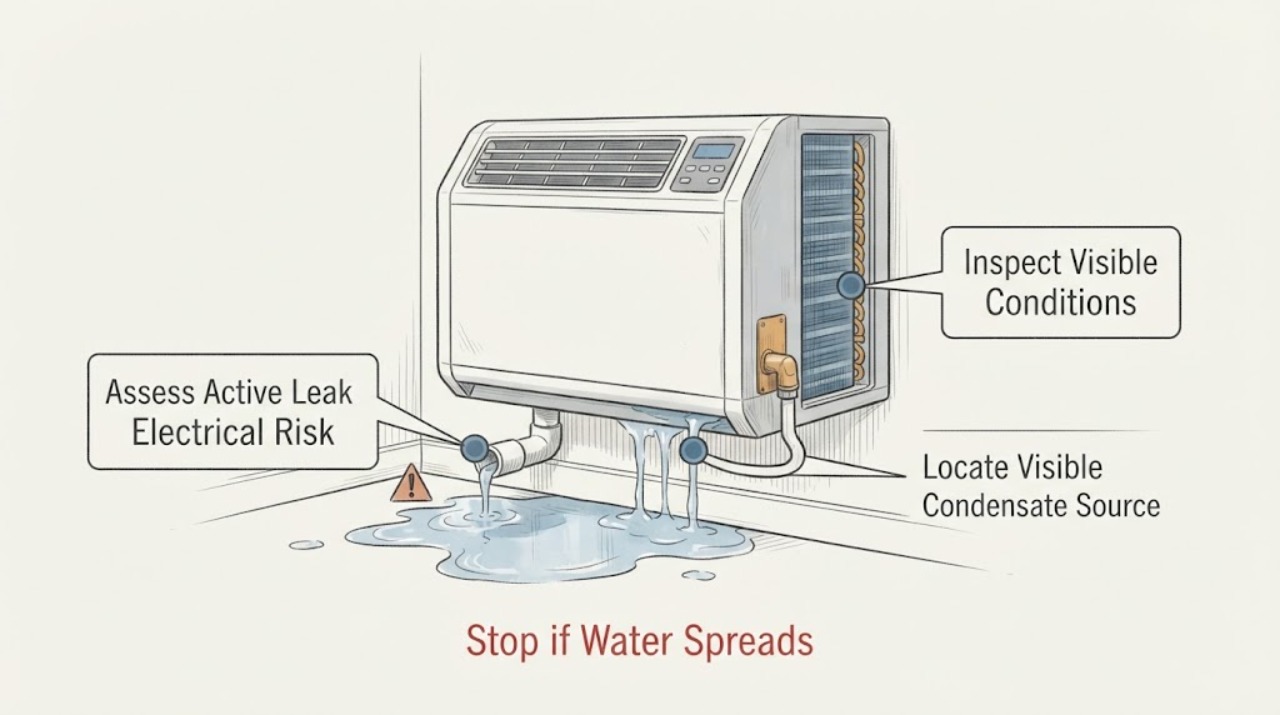
Turn the air conditioner off at the thermostat if water is actively leaking, and keep it off until the source is understood. From a dry, safe position, identify whether water is coming from the indoor unit, a visible drain-pan edge, a condensate-pipe joint, or nearby ceiling or wall; note whether the pan is overflowing, the drain outlet is producing water, or ice is visible. Do not open the equipment panel, clear or disconnect the drain line, access the sealed cooling circuit, or perform electrical testing. If water reaches electrical parts, the leak is active or spreading, the indoor unit is iced, the drain path is hidden, or the cause is not obvious, call an HVAC professional promptly and protect the area from further water damage.
Work through in order
Diagnostic checks
Use only checks that match the exact appliance or system and its official guide.
-
Check 1
From a dry position, observe the amount and direction of water around the indoor unit, drain pan area, floor, ceiling, wall, outlets, wiring, and nearby equipment; if the thermostat is dry and accessible, set cooling to off without approaching wet equipment.
Expected result: Water may be a small isolated drip, an active stream or pooling leak, a ceiling stain below the unit, or water touching an outlet, switch, wiring, furnace, air handler, or other electrical equipment.
Next step: Keep people and pets away, stop cooling only through a dry normal control if safe, and call an HVAC professional promptly. Arrange water mitigation if materials are saturating; do not use powered cleanup equipment in a wet electrical area.
Stop if: Stop immediately for water near electrical parts, smoke, sparking, a burning odor, a hot enclosure, a ceiling that is bulging, or an unsafe route to the equipment.
Why this matters
Why: An active or spreading leak can cause structural damage, while water near electrical parts creates a shock and equipment hazard. The leak is not a safe DIY drain task when its path or electrical exposure is uncertain.
-
Check 2
With cooling off and the unit stationary, look without opening any panel for water at the visible pan edge, condensate-pipe exterior or joint, secondary pan, pump reservoir, floor, wall, or ceiling; do not wipe inside the unit or touch fittings.
Expected result: Water may be visibly overflowing from a pan, appearing at a pipe joint, collecting in a secondary pan, emerging below the unit, or coming from a ceiling or wall with no visible source.
Next step: Photograph the source and mark the safe visible boundary of wet materials. Call an HVAC technician for the pan, drain, pump, and system assessment; do not remove covers, open the drain, or seal a joint as a test.
Stop if: Stop for water inside the cabinet, a wet switch or receptacle, a loose or cracked fitting, a ceiling or wall that is soft or bulging, or any need to open the unit.
Why this matters
Why: Pan overflow is consistent with a drainage or condensate-management problem, while a joint leak, damaged pan, hidden line, or building leak needs a different diagnosis. Water that appears away from the unit may have traveled inside materials.
-
Check 3
From ground level and without disconnecting, flushing, suctioning, probing, or cutting anything, observe the accessible condensate outlet during a normal cooling period if the system is dry and safe to operate; note whether water drips normally, stops, backs up, or is absent while indoor water accumulates.
Expected result: The outlet may discharge water, remain dry, show intermittent flow, or be hidden, submerged, frozen, or inaccessible; indoor water may rise regardless of what is visible outside.
Next step: Record outlet behavior and the indoor water location, then keep the air conditioner off and request HVAC service if the leak persists or flow is abnormal. Do not attempt drain-line clearing or use a wet-dry vacuum yourself.
Stop if: Stop for a wet electrical area, an outlet that requires a ladder or crawlspace, a frozen or buried line, sewage-like water, or any proposed hose, vacuum, chemical, or pipe-disconnection test.
Why this matters
Why: No outlet flow with indoor water supports a possible blocked, disconnected, improperly sloped, or pump-related drain path, but an apparently flowing outlet does not rule out a pan or connection leak. A hidden outlet requires professional tracing.
-
Check 4
With the system off, observe only accessible exterior surfaces for ice or frost at the indoor unit, visible tubing, or nearby coil opening, and look at an existing user-accessible filter without opening the equipment cabinet; do not scrape ice, open the cabinet, or remove a panel.
Expected result: There may be no ice, visible frost or a melting block, a visibly loaded filter, reduced airflow, or no safe access to these clues.
Next step: Photograph the visible condition from outside the equipment and tell the technician whether the leak continued after cooling stopped. Follow only the exact equipment manual for any simple filter observation or replacement; do not enter the cabinet.
Stop if: Stop for exposed coil or wiring, wet electrical parts, damaged sealed-system tubing, a sharp or inaccessible filter area, or any need to thaw, scrape, open, or disassemble the unit.
Why this matters
Why: Ice that later melts can overwhelm a condensate pan, and restricted airflow can be associated with freezing, but ice does not identify the coil, blower, airflow, or condensate cause. A visible clue is a reason to keep cooling off and obtain professional diagnosis, not to access the sealed cooling circuit.
-
Check 5
From a dry position, observe whether a visible secondary pan, condensate pump reservoir, overflow indicator, or safety-switch indicator is present and whether it shows water or a warning; do not lift a float, open the reservoir, reset a switch, or add water.
Expected result: A secondary pan or reservoir may be dry, visibly full, overflowing, or absent; an indicator may be normal, tripped, or not visible.
Next step: Keep cooling off and provide the indicator and water-level observation to an HVAC technician. Do not defeat a safety switch or attempt to empty a pan or pump that is connected to the equipment.
Stop if: Stop for water near electrical controls, a full or overflowing pan, a pump that is humming or hot, a wet switch, or any need to open a reservoir or cabinet.
Why this matters
Why: Water in secondary protection or a tripped overflow indicator suggests the primary drainage route may not be carrying condensate safely. Absence of a visible safety device does not prove that the system lacks protection or that the drain is clear.
Use your observations
Decision map
Find the observation that best matches what you see, then follow the next safe action.
-
PATH 01Next step
What you see
Water is touching electrical parts, the enclosure is wet, or there is smoke, sparking, burning odor, unusual heat, or exposed wiring.
Do this next
Do not touch the equipment, plug, switch, or breaker. Keep people clear and obtain qualified HVAC and electrical help; use only emergency controls that can be reached without entering water or touching a hazard.
-
PATH 02Next step
What you see
Water is actively pooling, spreading into drywall, flooring, ceiling, insulation, or furnishings, or the ceiling or wall is bulging.
Do this next
Keep cooling off through a dry normal control if safe, protect belongings only from a dry area, and call HVAC service plus water mitigation promptly. Do not open the unit or use powered cleanup equipment in the wet area.
-
PATH 03Next step
What you see
A visible primary or secondary pan is holding water, overflowing, or showing a tripped overflow indicator.
Do this next
Leave the air conditioner off and call an HVAC professional. The pan, drain, safety control, and system condition need diagnosis; do not empty, reset, seal, or alter the protection as a DIY test.
-
PATH 04Next step
What you see
The outlet is dry or intermittent while indoor water is present, water returns, or the outlet is hidden, frozen, buried, or inaccessible.
Do this next
Treat the drain route as unresolved and keep cooling off. Arrange HVAC service for the condensate path and pump if present; do not flush, suction, snake, disconnect, cut, or chemically treat the line.
-
PATH 05Next step
What you see
Ice or frost is visible, the system has reduced airflow, or water continues after cooling is stopped.
Do this next
Keep the system off and call an HVAC technician to distinguish airflow, coil, condensate, or other equipment causes. Do not scrape ice or open the cabinet; any sealed-system diagnosis is professional-only.
-
PATH 06Next step
What you see
A visible pipe joint, pan edge, reservoir, or fitting is cracked, loose-looking, leaking, or displaced.
Do this next
Photograph the condition without touching it and keep cooling off. A technician should determine whether the component, drain routing, pan, or pump caused the leak; do not reseal or reconnect it as a test.
-
PATH 07Next step
What you see
The unit is dry externally or the visible outlet appears normal, but water continues to appear at the wall, ceiling, floor, or another concealed location.
Do this next
Keep cooling off and arrange HVAC and, if needed, building-water assessment. Do not assume the leak is harmless or open panels and walls to trace it.
Helpful context
Understand the symptom
Stop the leak from becoming equipment or building damage
Condensation from the indoor cooling coil normally collects in a pan and leaves through a condensate drain. A plugged or damaged drain, a cracked pan, a frozen coil that later melts, or another drainage fault can put water on floors, ceilings, insulation, or electrical components. Do not keep running a leaking system just to see whether it clears. Use only the thermostat or another dry, clearly identified user control to stop cooling; if that control or the surrounding area is wet, stay clear and call for help.
What the visible water can—and cannot—tell you
Water under an indoor air handler, at a pipe joint, or near a secondary pan is a location clue, not a diagnosis. A drain obstruction can cause pan overflow, while a damaged pan, a poor connection, a frozen evaporator coil, airflow restriction, or a condensate pump problem can look similar. A dry-looking outlet does not prove that the hidden drain is clear, and visible ice does not identify a sealed-system fault. Leave internal, drain-line, electrical, and sealed-system work to a qualified HVAC technician.
Drying and mold precautions
Move absorbent items only from a dry, safe area and photograph the leak before cleanup. Drying wet surfaces quickly can reduce secondary damage, but do not run fans, vacuums, or other powered equipment where water may have reached electrical parts. If there is a musty odor, visible mold, contaminated water, or wet insulation or drywall, arrange appropriate water-damage or mold professionals after the HVAC source is controlled.
Safety boundary
Stop conditions
- Do not open HVAC panels, access electrical compartments, test live wiring, access the sealed cooling circuit, or work on the drain line, pan, pump, or fittings; sealed-system service is professional-only.
- Do not clear, flush, suction, snake, cut, disconnect, chemically treat, heat, or reconnect a condensate drain as a homeowner test.
- Stop for water near electrical parts, smoke, sparking, burning odor, exposed wiring, unusual heat, ice, a bulging ceiling or wall, sewage-like water, or unsafe access.
- If cooling is leaking, the source is hidden, or any external observation does not establish a safe cause, keep the system off and call a qualified HVAC professional; add water-mitigation or electrical help when the situation requires it.
Only after diagnosis
Potential parts
- HVAC condensate drain pan
Consider this category only after an HVAC technician confirms that the primary or secondary pan is cracked, corroded, or otherwise the leak source rather than a drain, coil, airflow, or pump issue.
Confirm the exact indoor-unit model, pan orientation, dimensions, drain-port arrangement, materials, and manufacturer fit information before ordering; do not open the cabinet to measure it. - condensate drain treatment
Consider this category only if a qualified HVAC technician identifies recurring biological buildup as an appropriate maintenance concern after the active leak and drain design are corrected.
Use only a product and application approved for the exact system and materials by the technician or manufacturer; treatment does not repair a cracked pan, damaged pipe, pump, electrical fault, or sealed-system problem. - wet dry vacuum
Consider this category only when a qualified HVAC technician recommends a suitable vacuum for a safe, de-energized external service procedure and confirms that the line and outlet can be accessed without opening hazardous equipment.
Confirm the equipment, filtration, water-handling, access, and electrical-safety requirements with the technician; do not use a vacuum near wet electrical parts or substitute it for diagnosis.
When checks do not resolve it
Need a professional?
Call a qualified HVAC professional promptly for any condensate leak that continues after cooling is turned off, a full or overflowing pan, abnormal or absent outlet flow, visible ice, a tripped overflow protection, a damaged pan or fitting, a hidden drain route, or a leak whose source is uncertain. Call urgently for active structural water damage. Do not enter or touch a wet electrical area; obtain qualified electrical help for that hazard. Provide the system brand and model if visible without opening equipment, thermostat state, leak location and rate, pan or reservoir observation, outlet-flow observation, ice or airflow clues, filter visibility, safety-indicator state, and safe photographs. Do not resume cooling until the source has been assessed.
Common questions
FAQ
Should I keep running my central AC if it is leaking water?
No. Turn cooling off through a dry, normal thermostat control if safe and keep it off until the leak is assessed. Continued operation can worsen water damage, and water near electrical parts is hazardous.
What are common reasons an indoor AC leaks water?
Possible causes include a blocked or damaged condensate drain, overflowing or cracked pan, frozen evaporator coil that is melting, airflow restriction, condensate pump trouble, or a concealed leak. The visible water location alone does not identify the cause.
Can I unclog the AC condensate drain myself?
This workflow keeps the check observation-only. Do not clear, flush, suction, snake, disconnect, cut, or chemically treat the drain, and do not open the equipment panel. Call a qualified HVAC technician, especially when water or electrical parts are involved.
What does ice on the indoor AC unit have to do with a water leak?
Ice can melt into the pan faster than the condensate path can carry it, creating a leak. Ice may be associated with airflow, coil, or condensate conditions, so keep cooling off and have an HVAC technician diagnose it; do not scrape the ice or access the sealed cooling circuit.
Can a dirty air filter cause an AC leak?
A restricted filter can contribute to reduced airflow and coil icing on some systems, but a filter clue does not prove the leak cause. Look only at an existing user-accessible filter location without opening the equipment, follow the exact manual for any simple filter maintenance, and call service if water or ice is present.
When is an AC condensate leak an emergency?
Treat it as urgent when water is active or spreading, damaging a ceiling, wall, floor, or insulation, reaching electrical components, or accompanied by smoke, sparks, burning odor, exposed wiring, or a bulging ceiling. Keep clear and call HVAC, electrical, or water-mitigation professionals as appropriate.
Read the exact guide
Official sources
- Maintenance ChecklistENERGY STAR · General central cooling maintenance guidance; it does not authorize homeowner access to electrical, sealed-cooling, panel, or drain-line components.
- Why Is My AC Leaking Water?Carrier · General Carrier residential air-conditioner guidance; exact system design, drain access, and service instructions vary by model.
- A Brief Guide to Mold, Moisture and Your HomeU.S. Environmental Protection Agency · General indoor moisture and mold guidance; it is not a model-specific HVAC repair procedure.
Community feedback
Share a repair observation
Share a plain-text repair observation. Accepted observations are published automatically; this page may take a moment to update.