
On this page
Start here
Quick answer
An American Standard central air conditioner is short cycling when it starts and stops repeatedly without completing a normal cooling cycle. Note the run and off pattern, thermostat setting, indoor airflow, filter condition, ice, outdoor-unit response, and any breaker or odor event. American Standard identifies an oversized system, clogged filter, thermostat problem, or frozen coil as common causes; its repair guidance also lists low refrigerant and capacitor or electrical issues among possibilities. Turn cooling off if the compressor stops and restarts rapidly, ice or water appears, the breaker trips, or there is burning odor, smoke, or sparking. You can check the thermostat, filter, returns, and supplies, but do not open the electrical cabinet, test a capacitor, add refrigerant, or keep resetting protection. Recurrent short cycling needs qualified HVAC diagnosis.
Before you begin
Safety first
- This article supports thermostat observation, filter and visible airflow checks, noting ice or water, and observing the outdoor unit from a safe distance. A qualified person must handle control wiring, electrical testing, capacitors, blower and coil access, refrigerant, compressor, load or duct diagnosis, protection devices, and final startup.
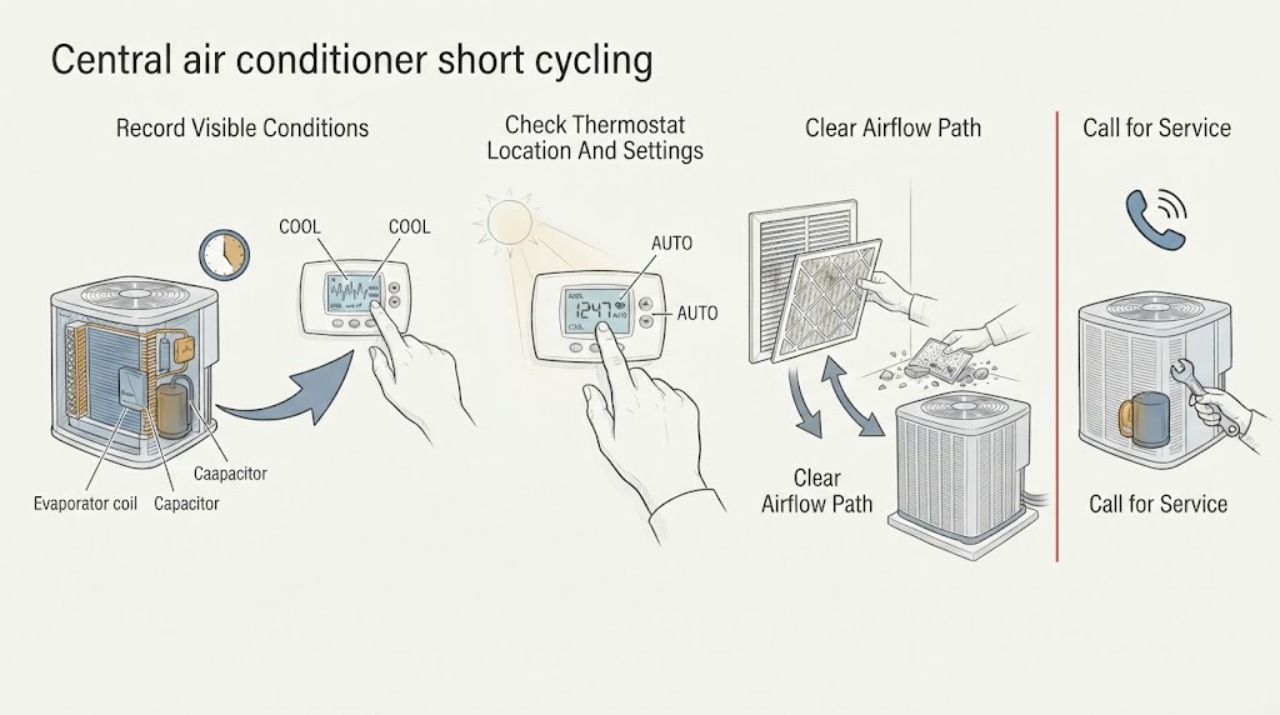
Work through in order
Diagnostic checks
Use only checks that match the exact appliance or system and its official guide.
-
Check 1
Observe one cooling call from a safe distance without changing wiring or opening equipment, and record when the indoor blower and outdoor unit start and stop relative to the thermostat target.
Expected result: Record a normal completed call, several starts and stops in a short period, a compressor or outdoor fan that stops while the blower continues, a thermostat that reaches target unusually quickly, or a unit that stops before the room changes noticeably.
Next step: Keep notes on run time, off time, room comfort, humidity, and weather, then continue with the filter, airflow, thermostat, and visible outdoor checks. Turn cooling off for rapid compressor restarts, abnormal sound, odor, smoke, ice, water, or a breaker trip.
Stop if: Do not force a longer cycle by lowering the setpoint repeatedly, and stop immediately for smoke, burning odor, sparking, exposed wiring, or repeated breaker operation.
Why this matters
Why: Repeated starts before a full cooling cycle support short cycling. Quick target satisfaction makes thermostat location or oversized equipment more plausible; an early stop with no comfort change points toward a protection, airflow, coil, electrical, or control problem.
-
Check 2
Check that the thermostat is in Cool, its target is intentional, and it is not exposed to direct sun, a supply register, a heat-producing appliance, or an unusual draft; do not remove the thermostat cover.
Expected result: Record a stable display and sensible target, a target that is reached almost immediately, a thermostat near a heat or air source, a blank or flickering display, or a call that appears to begin and end without a stable room condition.
Next step: Move only an obvious nearby heat source or obstruction, leave the target at a normal intentional setting, and observe one more call. If the display is unstable, the thermostat is poorly placed, or short cycling persists, arrange qualified HVAC service rather than rewiring or replacing it from symptoms.
Stop if: Do not open the thermostat, change low-voltage wiring, or continue cycling when the display is dead, wiring is exposed, or the system has a burning odor.
Why this matters
Why: A thermostat that senses a distorted local temperature or has a control fault can end or restart a cooling call at the wrong time. Fast target satisfaction also makes an oversized system possible, while a blank or unstable display needs control-power diagnosis.
-
Check 3
With cooling off, inspect the filter at its normal access point and look at return grilles and supply registers for blockage; keep the filter installed and do not open the air handler.
Expected result: Classify the filter as clean, loaded with dust, wet, damaged, or wrong-sized, and note weak airflow, blocked returns, closed supplies, or a room with little air movement.
Next step: Replace a disposable filter only with the exact size and type specified for the equipment, reopen an accidentally closed register, and clear ordinary return obstructions. If short cycling continues or ice appears, keep cooling off and call service.
Stop if: Do not run without a filter, install an unknown restrictive filter, remove the blower panel, or keep cooling when water or ice is present.
Why this matters
Why: American Standard lists a clogged filter as a short-cycling cause because restricted airflow can make the system overheat or protect itself. Weak airflow with a clean correct filter points beyond a simple filter change to duct, blower, coil, or control diagnosis.
-
Check 4
Look only at ordinary-access areas for frost, ice, water, or wet insulation and note whether the cooling call stops as the coil freezes; do not remove the coil panel or chip ice.
Expected result: Record no ice or water, frost on visible tubing, a heavily iced coil area, water after shutdown, a wet filter, or a condensate safety interruption visible without panel access.
Next step: Turn cooling off and let ice melt naturally. Correct only an obvious filter or register obstruction; arrange qualified service for recurring ice, water, wet insulation, or short cycling after thawing.
Stop if: Do not chip ice, use a heat source, bypass a float or safety, add refrigerant, or restart while water is near electrical equipment.
Why this matters
Why: A frozen coil can cause short cycling and later produce meltwater. It may follow restricted airflow, a dirty coil, low refrigerant, or another refrigeration problem, so ice does not identify the filter as the only cause.
-
Check 5
From outside the equipment cabinet, observe the outdoor fan and sound during a normal call without reaching through the grille; remove only loose debris that is clearly outside the cabinet and only with power left off.
Expected result: Record normal fan operation, a fan that stops early, a loud hum, repeated start-stop behavior, vibration, a hot or burning odor, visible coil blockage, or a breaker that trips.
Next step: Leave cooling off for abnormal fan response, hum, vibration, odor, visible damage, or any repeat breaker trip and arrange qualified service. Clear only loose exterior debris when safe; do not open the cabinet.
Stop if: Do not push the fan, touch wiring, open the condenser, spray inside, or reset a breaker repeatedly.
Why this matters
Why: An outdoor fan, capacitor, compressor, electrical control, or refrigerant issue can end a cycle or prevent a normal restart. A breaker trip or hot odor is a protection event, not a reason to try another reset.
-
Check 6
After an obvious filter, register, or nearby thermostat obstruction has been corrected and no ice, water, odor, damage, or protection event is present, make at most one normal cooling call and watch whether the unit completes a stable cycle.
Expected result: Record a completed cycle, the same rapid stop and restart, improved airflow with short run time, renewed ice or water, a thermostat target reached immediately, or outdoor operation that stops abnormally.
Next step: Turn cooling off when the abnormal pattern returns and give the technician the cycle log, thermostat placement, filter condition, airflow, ice or water, outdoor response, and weather. Do not keep cycling to compare results.
Stop if: Stop for rapid compressor restarts, smoke, burning odor, sparking, abnormal sound, heavy vibration, ice, water near electrical equipment, or a repeat breaker trip.
Why this matters
Why: A stable cycle after a visible correction supports that correction as a contributor but does not rule out thermostat fault, equipment sizing, capacitor, low refrigerant, coil, or control problems. Recurrence means the visible check did not resolve the cause.
Use your observations
Decision map
Find the observation that best matches what you see, then follow the next safe action.
-
PATH 01Safety boundary
What you see
The system cools the thermostat area quickly, stops before humidity is reduced, and has short cycles from the start of its service history with no filter, ice, or electrical clue.
Do this next
Have a qualified technician review thermostat location, load calculation, system capacity, duct design, and cycle controls; do not lower or raise the target repeatedly to force a longer run.
Why this path and its safety boundary
Why it matters: An oversized system or thermostat placement is more likely than a sudden filter or capacitor failure. American Standard says an oversized unit can reach the set temperature quickly and repeatedly turn off.
Safety stop: Stop for ice, water, abnormal sound, smoke, burning odor, or a breaker trip even if the room reaches the target quickly.
-
PATH 02Safety boundary
What you see
Short cycling began after a filter became dirty or a return or supply path was blocked, and airflow is weak or uneven without electrical odor.
Do this next
Install the specified filter, reopen blocked registers, clear ordinary return obstructions, and observe only one safe cycle after any ice melts. Call service if the pattern remains or returns.
Why this path and its safety boundary
Why it matters: Restricted airflow is plausible and can cause an early shutdown or contribute to a frozen coil. A clean filter does not rule out dirty coils, duct restriction, blower, or control faults.
Safety stop: Do not run without a filter, open the blower cabinet, or keep cooling with ice or water present.
-
PATH 03Safety boundary
What you see
The system short cycles with frost or ice, weak airflow, a wet filter or insulation, or water after shutdown.
Do this next
Turn cooling off, let ice melt naturally, correct only an obvious filter or register obstruction, and arrange qualified diagnosis if water, ice, or short cycling returns.
Why this path and its safety boundary
Why it matters: A frozen evaporator coil is likely involved, with airflow restriction, dirty coil, low refrigerant, or another fault still unresolved. Meltwater can also trigger a condensate safety or create building damage.
Safety stop: Do not chip ice, heat the coil, add refrigerant, bypass protection, or run to dry the water.
-
PATH 04Safety boundary
What you see
The thermostat display or call is unstable, the system starts and stops without a matching room change, or the indoor and outdoor responses do not follow the expected sequence.
Do this next
Leave the thermostat at an intentional setting, keep panels closed, record the display and equipment response, and arrange qualified HVAC service for control testing.
Why this path and its safety boundary
Why it matters: Thermostat placement, thermostat failure, low-voltage control, sensor, or a protection interruption is more likely than equipment sizing alone. External observation cannot identify a control fault safely.
Safety stop: Do not remove the thermostat cover, change wiring, bypass a safety, or repeatedly reset the system.
-
PATH 05Safety boundary
What you see
The outdoor unit hums, fails to start normally, stops abruptly, trips a breaker, emits a hot or burning odor, or short cycling persists with a clean filter and normal visible airflow.
Do this next
Turn cooling off, do not reset protection, and arrange qualified HVAC diagnosis. Report the sound, timing, breaker behavior, outdoor fan response, airflow, and any ice or water.
Why this path and its safety boundary
Why it matters: Capacitor, fan motor, compressor, wiring, refrigerant, or another electrical or sealed-system fault is more likely. American Standard says capacitors store high voltage and must not be touched or tested by a homeowner.
Safety stop: Do not open the electrical cabinet, test or replace a capacitor, add refrigerant, touch wiring, or operate after smoke, heat, or sparking.
Helpful context
Understand the symptom
Confirm a pattern instead of judging one stop
A cooling call ends when the thermostat reaches its target, so one normal stop does not prove a fault. American Standard describes a regular cycle as commonly taking 10–20 minutes depending on the system, outdoor temperature, and desired indoor temperature, and describes several starts and stops in 10 minutes as short cycling. Record the time from start to stop, how long the unit stays off, and whether the thermostat target has been reached.
Use airflow and coil clues to separate causes
A clogged or restrictive filter can reduce airflow and cause an early shutdown; a frozen evaporator coil can also interrupt cooling and later release water as it thaws. A filter that is clean but paired with weak airflow points toward a duct, blower, coil, or control issue. Normal airflow with quick temperature satisfaction, especially from the day the system was installed, makes capacity or thermostat placement a different path from a sudden filter-related change.
Protect the compressor and keep high-voltage work out of owner checks
Frequent starts increase wear and can leave the home cool but humid. A loud outdoor hum, random shutdown, smoke, burning odor, or a tripped breaker can involve a capacitor, motor, compressor, wiring, or another electrical fault. American Standard says capacitors are high-voltage components and should not be touched, tested, or replaced by a homeowner. Stop the system and arrange qualified service when the pattern is recurrent or accompanied by a safety clue.
Safety boundary
Stop conditions
- Turn cooling off for smoke, burning odor, sparking, exposed or damaged wiring, water near electrical equipment, a breaker that trips again, or an abnormal compressor or fan sound.
- Stop for visible ice, a full or overflowing condensate pan, wet insulation, recurring water, or a safety interruption; let ice melt naturally and do not bypass protection.
- Do not open electrical or refrigerant panels, test or replace a capacitor, add refrigerant, change wiring, alter controls, or run the system with the filter removed.
- Do not keep cycling a unit that stops before cooling, starts and stops rapidly, hums without normal operation, vibrates, or returns to an abnormal condition after a visible correction.
Only after diagnosis
Potential parts
- thermostat or low-voltage control
Consider this category only if qualified testing confirms an unstable thermostat, faulty sensor, wiring, relay, or other low-voltage control problem that matches the cycle record.
Confirm the exact American Standard system, thermostat type, wiring, staging, sensor arrangement, and required configuration before selecting a replacement; timing alone does not prove fit. - air filter
Consider this category only when the installed filter is loaded, wet, damaged, or due for replacement and its exact size and type are confirmed.
Use the specified size and type and keep a filter installed; a filter change does not establish or repair a blower, coil, duct, control, or refrigerant issue. - blower motor or capacitor
Consider this category only after qualified airflow and electrical testing identifies a blower motor or capacitor fault associated with early shutdown or weak airflow.
Confirm the exact air-handler or furnace model, motor characteristics, capacitor rating, mounting, and wiring; capacitors are high-voltage parts and are not owner service items. - compressor, outdoor fan, or refrigerant-circuit component
Consider this category only after qualified measurements confirm an outdoor motor, compressor, charge, metering, or sealed-system fault causing the short cycle.
Confirm exact model, electrical ratings, refrigerant designation, metering arrangement, measured fault, and qualified service procedure; do not select a component from short cycling alone.
When checks do not resolve it
Need a professional?
Arrange qualified American Standard HVAC service when short cycling repeats after the correct filter and visible airflow path are checked, the thermostat display or placement is suspect, ice or water appears, the outdoor fan or compressor hums or stops abnormally, a breaker trips, or the system reaches the target too quickly from its installation history. Thermostat controls, load sizing, airflow measurement, coil and blower work, capacitors, refrigerant, compressor, and electrical protection require equipment-specific diagnosis.
Safety scope: This article supports thermostat observation, filter and visible airflow checks, noting ice or water, and observing the outdoor unit from a safe distance. A qualified person must handle control wiring, electrical testing, capacitors, blower and coil access, refrigerant, compressor, load or duct diagnosis, protection devices, and final startup.
Common questions
FAQ
How do I know if my American Standard AC is short cycling?
Record the time from startup to shutdown and the off time before the next start. American Standard describes short cycling as repeated starts and stops without a completed cooling cycle, such as several cycles in 10 minutes. One normal stop at the target temperature is not enough to diagnose a fault.
Can a dirty filter make an American Standard AC short cycle?
Yes, a clogged filter can restrict airflow and make the system overheat or shut down early. Install only the specified size and type, and reopen blocked returns or supplies. If short cycling continues, or if ice or water appears, turn cooling off and arrange service.
Is an oversized American Standard air conditioner causing the short cycling?
It is more plausible when the system has cycled this way since installation, reaches the thermostat area quickly, and has no filter, ice, control, or electrical clue. A qualified technician should review a load calculation, capacity, thermostat location, and duct design; changing the target does not correct an oversized system.
Can a bad capacitor cause American Standard AC short cycling?
It can be one possibility, especially when short cycling comes with a loud outdoor hum, random shutdown, failure to start normally, or a burning odor. Capacitors store high voltage. Do not touch, test, or replace one yourself; turn the system off and arrange qualified service.
What should I tell the HVAC technician about short cycling?
Provide run and off times, thermostat target and location, filter size and condition, airflow, ice or water, outdoor fan and compressor response, unusual sound or odor, breaker behavior, weather, recent service, and whether the pattern existed from installation. Model and serial details help when they can be read safely without opening panels.
Read the exact guide
Official sources
- Top 10 Signs You Need Air Conditioning RepairAmerican Standard Heating and Air Conditioning · Official American Standard homeowner repair article; symptoms require model-specific diagnosis.
- AC Capacitors: Your Complete GuideAmerican Standard Heating and Air Conditioning · Official American Standard homeowner guidance; capacitor testing and replacement require trained HVAC service.
- Four Reasons Why It's Important to Change Your Air FiltersTrane · Official Trane manufacturer guidance used only for general HVAC filter mechanics; the American Standard unit manual controls exact filter selection.
- What Size AC Unit Do I Need?American Standard Heating and Air Conditioning · Official American Standard sizing article; it supports a service branch and not an owner capacity calculation.
- What Does Cycling Mean for HVAC Systems?American Standard Heating and Air Conditioning · Official American Standard homeowner glossary; exact cycle behavior varies with system, outdoor temperature, and load.
Community feedback
Share a repair observation
Share a plain-text repair observation. Accepted observations are published automatically; this page may take a moment to update.