
On this page
Start here
Quick answer
Short cycling means the central air conditioner starts and stops before the home reaches the thermostat setpoint. Common paths include a restricted filter or airflow, thermostat setting or location, a frozen coil, low refrigerant, an electrical or control fault, an outdoor-unit problem, or an oversized system. Check only the thermostat display and mode, the accessible filter and registers, and visible ice or water; record how the indoor blower and outdoor unit respond. Turn cooling off and arrange qualified HVAC service for ice, abnormal water, a repeated breaker trip, burning odor, smoke, arcing, exposed wiring, or suspected refrigerant or electrical work. Do not open panels, touch moving equipment, add refrigerant, scrape ice, or change wiring. If the symptom has existed since installation, ask the technician to review system sizing and a load calculation.
Before you begin
Safety first
- Owner checks are limited to thermostat settings, ordinary filter and register access, and safe visual or sound observations. A qualified technician must handle cabinet access, electrical testing, moving equipment, refrigerant, coil or compressor work, controls, and load or sizing assessment.
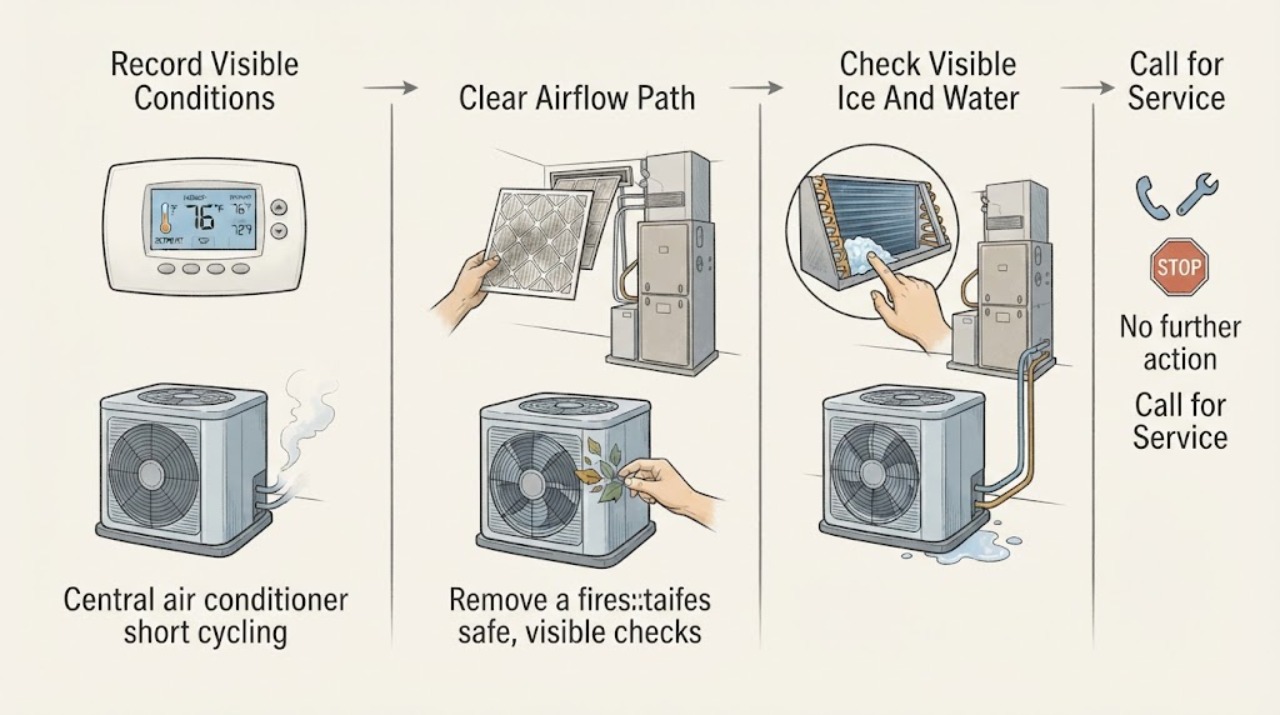
Work through in order
Diagnostic checks
Use only checks that match the exact appliance or system and its official guide.
-
Check 1
Read the thermostat and record the selected mode, setpoint, displayed room temperature, schedule or hold state, and whether the display changes while the system starts and stops. Observe one ordinary cooling call rather than repeatedly changing the setting.
Expected result: Record whether the thermostat is calling for cooling, the room temperature moves toward the setpoint or stalls, and whether the indoor blower and outdoor unit start, stop, or fail to respond together.
Next step: Correct only an obvious thermostat setting, then document the result. If the home still does not approach the setpoint or the equipment starts and stops abnormally, continue with safe observations and arrange HVAC service.
Stop if: Stop for smoke, burning odor, arcing, a hot thermostat or enclosure, water near electrical equipment, or a sudden harsh mechanical sound.
Why this matters
Why: A wrong mode or setting can mimic a cooling problem. A call with weak or absent indoor airflow points toward the filter, frozen coil, blower, safety, or control path; normal airflow with no temperature progress keeps cooling-capacity, outdoor, refrigerant, and sizing paths open. A thermostat call with no equipment response makes power, control, or safety behavior more relevant.
-
Check 2
With cooling stopped, inspect the filter only through its normal user access and confirm supply and return registers are open and not covered by furniture, rugs, or fabric. Do not remove a blower or air-handler cover.
Expected result: Record a clean, dry filter and strong airflow; a visibly loaded filter; a wet filter; blocked registers; weak airflow; or an access point that requires tools.
Next step: Open an accidentally closed register or replace the filter only with the exact type specified by the equipment documentation. If airflow remains weak, the house remains warm, the filter is wet, or access requires tools, leave the equipment alone and request HVAC service.
Stop if: Do not reach into the return, use tools inside the unit, remove a cabinet, or continue cooling when ice or a water hazard is present.
Why this matters
Why: A loaded filter or blocked return can restrict airflow and contribute to poor cooling, freezing, or protective shutdown. A clean filter with normal airflow shifts attention toward capacity, outdoor heat rejection, refrigerant, controls, or sizing. A wet filter or inaccessible equipment is not a homeowner repair diagnosis.
-
Check 3
From a safe position, look for visible ice on accessible refrigerant lines or coil surfaces, water around the indoor unit, and a change in airflow. Do not touch the lines, chip ice, pour water, or remove a panel.
Expected result: Record no ice or water, ice with weak airflow, ice with normal airflow, water that appears during thawing, or active water near electrical equipment.
Next step: Turn cooling off and leave it off while arranging qualified HVAC service for ice or abnormal water. Tell the technician when the ice or water appeared and whether airflow changed.
Stop if: Do not scrape ice, apply heat, add refrigerant, handle refrigerant lines, or operate near wet electrical equipment.
Why this matters
Why: Ice can accompany restricted airflow or a refrigerant problem and continued cooling can harm the compressor. Water can be condensate or thawing ice, but water near electrical equipment is an immediate safety boundary. Visual inspection cannot establish refrigerant charge or a leak location.
-
Check 4
From safe locations, note whether the outdoor condenser fan runs during a cooling call, whether the indoor blower moves air, and whether the short cycle ends with a normal shutdown or an unusual sound. Never reach through a guard or open the outdoor cabinet.
Expected result: Record normal fan movement with warm air, a stationary fan, a hum or high-pitched sound, repeated starts, a rattle or harsh vibration, or an outdoor unit that does not respond to a thermostat call.
Next step: Turn cooling off for a new, loud, persistent, or mechanically harsh sound, a stationary fan, or repeated unsuccessful starts, then request HVAC service with the observation and timing.
Stop if: Do not touch a fan, capacitor, compressor, panel, loose part, or refrigerant line, and do not restart repeatedly to reproduce the symptom.
Why this matters
Why: Normal fan movement does not prove the refrigerant, compressor, or controls are healthy. A stationary fan, unusual sound, repeated starts, or no response can involve electrical, motor, compressor, control, or protective faults that require professional testing.
-
Check 5
From a dry, safe position, record whether the known HVAC circuit appears off or has tripped and whether the symptom followed a power interruption. Do not open electrical covers or repeatedly reset a protective device.
Expected result: Record a normal circuit, one known trip without visible damage, or a repeated trip, buzzing enclosure, scorch mark, warmth, moisture, smoke, or burning odor.
Next step: Leave a repeatedly tripping circuit off and request qualified HVAC or electrical service as appropriate. Provide the event timeline instead of attempting another restart.
Stop if: Do not open a panel, touch exposed conductors, bypass protection, perform live electrical checks, or reset the circuit again after an immediate repeat trip.
Why this matters
Why: A power or safety interruption can leave the thermostat active while cooling or airflow stops. A repeated trip, heat, odor, buzzing, moisture, smoke, or visible damage indicates an unresolved electrical or equipment fault, not a reason to keep running the system.
-
Check 6
Prepare the service request with the equipment model if visible from ordinary access, thermostat readings, the cycle and setpoint timeline, filter and register observations, airflow, ice or water, outdoor response, power events, and whether the problem began after installation or recently.
Expected result: Confirm that the handoff contains external observations only and that no cabinet, fan, wiring, capacitor, compressor, coil, or refrigerant component was disturbed.
Next step: Request qualified HVAC diagnosis and ask the technician to verify airflow, coil and outdoor operation, controls, electrical safety, refrigerant-related causes, and sizing or load calculation as the history warrants.
Stop if: Stop all user troubleshooting when the next step requires cabinet access, electrical measurement, fan or compressor work, refrigerant handling, or operation near moving equipment.
Why this matters
Why: The timeline helps a technician separate a thermostat or control issue from airflow, frozen-coil, outdoor, refrigerant, electrical, or sizing causes. A problem present since installation makes a capacity and load review useful; a recent change calls for fault diagnosis before replacement decisions.
Use your observations
Decision map
Find the observation that best matches what you see, then follow the next safe action.
-
PATH 01Next step
What you see
The thermostat is not calling for cooling or shows a user setting issue, with no ice, water, harsh sound, smoke, burning odor, or electrical warning.
Do this next
Correct the documented user setting and observe one ordinary call. If the equipment still short cycles or the home does not approach the setpoint, arrange HVAC diagnosis rather than repeatedly changing the setting.
-
PATH 02Next step
What you see
The thermostat calls for cooling, but indoor airflow is weak or absent, especially when the outdoor unit runs or an indoor hum is present.
Do this next
Turn cooling off and request HVAC service for the accessible filter result, blower, frozen coil, control, safety, and power paths. Do not open the air handler or touch the blower.
-
PATH 03Next step
What you see
Visible ice, thawing water, abnormal water, or a major airflow change accompanies short cycling and an unmet setpoint.
Do this next
Leave cooling off and request HVAC service. Airflow and refrigerant causes are both possible; do not chip ice, add refrigerant, handle lines, or work near wet electrical equipment.
-
PATH 04Next step
What you see
Airflow is normal but the home remains warm while the outdoor unit runs, with no visible ice and no urgent safety warning.
Do this next
Arrange professional diagnosis of cooling capacity, outdoor heat rejection, refrigerant-related causes, compressor, controls, duct or envelope load, and system sizing. Do not infer a failed part from warm air alone.
-
PATH 05Next step
What you see
The home has failed to reach the setpoint since installation and the system short cycles despite normal external airflow and no visible ice.
Do this next
Ask the technician to review equipment capacity, a room-by-room load calculation, thermostat placement, airflow, and commissioning records before deciding whether a replacement is warranted.
-
PATH 06Next step
What you see
There is smoke, burning odor, arcing, a hot enclosure, exposed wiring, water near electrical equipment, or a repeated breaker trip.
Do this next
Stop using the system, keep clear, and use the appropriate emergency, electrical, or HVAC response from a safe location. Do not restart it to reproduce the symptom.
Helpful context
Understand the symptom
Short cycling and an unmet setpoint point to different diagnostic paths
A short-cycling system starts and stops before the home reaches the requested temperature. That can reduce comfort and humidity removal and add wear, but the pattern does not identify one failed part. If the compressor and outdoor fan stop while the thermostat still calls for cooling, control, power, or a protective shutdown becomes more relevant. If the equipment runs for long periods but the temperature does not move toward the setpoint, restricted airflow, a frozen coil, refrigerant, outdoor heat rejection, duct or envelope load, or system sizing remains possible. Trane notes that thermostat problems and improper sizing are common causes; Carrier lists airflow, refrigerant, thermostat, sizing, and electrical causes.
Use external observations before calling for service
Keep the check limited to ordinary user access. Read the thermostat, inspect the filter without opening an equipment cabinet, confirm supply and return registers are not blocked, and look from a safe position for visible ice or water. Note whether the indoor blower moves air and whether the outdoor unit responds. A clean filter and normal airflow do not rule out refrigerant, compressor, controls, or sizing; a dirty filter, weak airflow, or ice changes the next step toward airflow and professional diagnosis. Carrier specifically warns that ice can damage the compressor and says refrigerant and high-voltage troubleshooting belong with a qualified technician.
The installation history matters
If the house has never reached the setpoint since the system was installed, an incorrect capacity or load assessment is a useful service question; do not infer that replacement is required from cycling alone. If the change is recent, the technician should compare the current airflow, thermostat behavior, coil condition, refrigerant circuit, outdoor operation, controls, and electrical symptoms with the system history. Trane recommends correct sizing when an oversized system is the root cause, while Carrier recommends professional diagnosis for refrigerant, ice, and electrical possibilities.
Safety boundary
Stop conditions
- Do not open HVAC cabinets or electrical panels, perform live electrical tests, touch moving fans, handle capacitors or compressors, change wiring, bypass a safety device, or handle refrigerant.
- Turn cooling off and arrange service for visible ice, abnormal water, weak or absent airflow, a stationary fan, repeated unsuccessful starts, severe vibration, or a new harsh sound.
- Do not scrape ice, apply heat to a coil, add refrigerant, pour water into equipment, or repeatedly reset a breaker after it trips again.
Only after diagnosis
Potential parts
- replacement air filter
Consider a filter only if the existing filter is visibly loaded or the maintenance documentation calls for replacement; a clean filter does not explain every short-cycle symptom.
Match the exact size, depth, airflow rating, and filter type specified by the equipment documentation; do not substitute a restrictive filter without confirming suitability. - compatible thermostat
Consider a thermostat only if testing confirms a faulty sensor, control, placement, or compatibility issue; short cycling alone does not prove the thermostat is bad.
A qualified technician should confirm system wiring, stages, voltage, heat-pump or conventional configuration, and manufacturer compatibility before any replacement or wiring change. - airflow or outdoor-unit service component
A blower, coil, fan, control, compressor, or related component is conditional on measured diagnosis; do not select a part from a symptom or sound alone.
Have a qualified technician identify the failed component and exact model-specific electrical, mechanical, refrigerant, and mounting requirements before sourcing any replacement.
When checks do not resolve it
Need a professional?
Call a qualified HVAC technician when the system repeatedly starts and stops before reaching the setpoint, when airflow or cooling remains abnormal after safe external checks, or when the issue has existed since installation. Turn cooling off and seek prompt service for ice, abnormal water, a stationary outdoor fan, a new harsh sound, suspected refrigerant or electrical fault, or repeated breaker trips. Use emergency or electrical help for smoke, fire, burning odor, arcing, exposed wiring, a hot enclosure, or water at electrical equipment.
Safety scope: Owner checks are limited to thermostat settings, ordinary filter and register access, and safe visual or sound observations. A qualified technician must handle cabinet access, electrical testing, moving equipment, refrigerant, coil or compressor work, controls, and load or sizing assessment.
Have this ready
- Give the technician the thermostat mode and readings, cycle timeline, filter and register observations, airflow, visible ice or water, outdoor response and sound location, breaker history, equipment age or model if safely visible, and whether the symptom began at installation or recently.
Common questions
FAQ
What does AC short cycling mean?
It means the system starts and stops before the home reaches the thermostat setpoint. It can reduce comfort and humidity removal and increase wear, but the pattern alone does not identify a failed part.
Why does the house stay warm if the outdoor unit runs?
The indoor blower or airflow path may be weak, or the system may have ice, a refrigerant-related problem, an outdoor heat-rejection or compressor fault, a control issue, duct or building load, or incorrect sizing. Safe observations can narrow the handoff, but they do not replace service diagnosis.
Can a dirty filter cause short cycling?
Yes. A loaded filter can restrict airflow and contribute to poor cooling, freezing, or a protective shutdown. Inspect the user-accessible filter and use only the exact replacement specified for the system; persistent symptoms need HVAC service.
What should I do if I see ice on the AC?
Turn cooling off and arrange qualified HVAC service. Ice can accompany restricted airflow or a refrigerant problem and continued cooling can harm the compressor. Do not chip the ice, apply heat, touch refrigerant lines, or add refrigerant.
Could the system be too large for the home?
An oversized system can reach the thermostat temperature too quickly and stop before adequate dehumidification. If short cycling has existed since installation, ask a technician to review capacity, thermostat placement, airflow, and a room-by-room load calculation before considering replacement.
When is short cycling an urgent safety issue?
Stop using the system for smoke, burning odor, arcing, a hot enclosure, exposed wiring, water near electrical equipment, a repeated breaker trip, ice, abnormal water, a stationary fan, or a sudden harsh mechanical sound. Keep clear and use appropriate emergency, electrical, or HVAC help from a safe location.
Read the exact guide
Official sources
- Troubleshoot an Air Conditioner: 6 Steps to Fix an AC Not WorkingCarrier · Carrier residential AC troubleshooting guidance used for ordinary external checks and safety escalation, not model-specific repair.
- AC Short Cycling? Learn Why and What to Do - Trane®Trane · Trane residential air-conditioning guidance used for general symptom interpretation and safe escalation, not model-specific repair instructions.
- What Is AC Short Cycling? Causes, Effects, and TroubleshootingCarrier · Carrier residential air-conditioning guidance used for general cause categories and escalation; it does not establish a diagnosis for a particular system.
Community feedback
Share a repair observation
Share a plain-text repair observation. Accepted observations are published automatically; this page may take a moment to update.