
On this page
Start here
Quick answer
A central air conditioner that starts and stops before completing a normal cooling run is short cycling. First document the timing and confirm the thermostat is calling for cooling, the filter and registers allow airflow, and there is no visible ice or water. A dirty filter or blocked airflow can contribute to a freeze-up, while a thermostat/control fault, low refrigerant, outdoor-unit problem, or oversized system needs professional diagnosis. Do not open electrical panels, handle refrigerant, bypass a safety control, or keep running the system when ice, water damage, burning odor, repeated breaker trips, or loud mechanical distress is present.
Before you begin
Safety first
- This article covers ordinary thermostat, filter, grille, and visual observations only. Do not open cabinets or electrical panels, alter wiring, handle refrigerant, bypass a control, remove ice with tools, or diagnose capacitors, compressors, motors, or charge yourself.
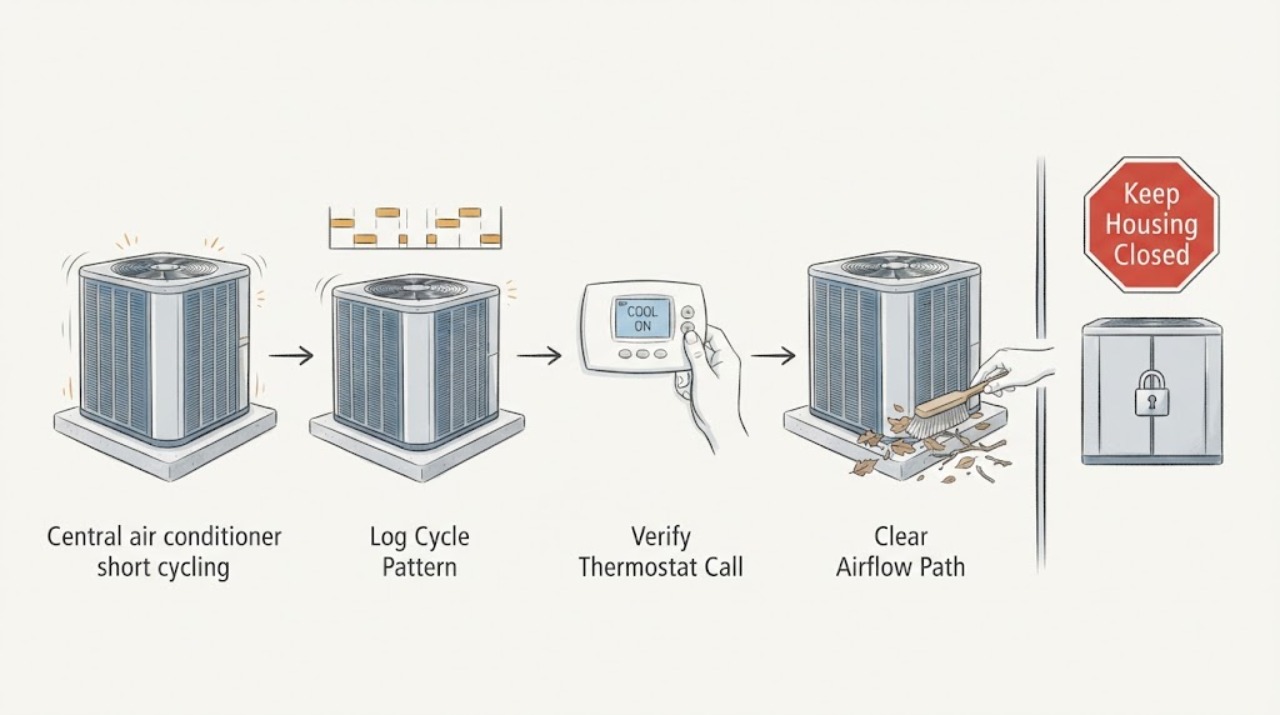
Work through in order
Diagnostic checks
Use only checks that match the exact appliance or system and its official guide.
-
Check 1
For several cooling calls, record when the indoor blower and outdoor unit start, how long they run, when they stop, and how soon they restart; also note the thermostat setting, room temperature, outdoor conditions, and whether the setpoint was reached.
Expected result: Classify the pattern as a normal-looking call that ends at the setpoint, repeated short runs while the home is still warm, a start followed by immediate stop, or a unit that runs continuously without reaching the setting.
Next step: Keep the log and continue with the thermostat and airflow checks only if there is no ice, water damage, burning odor, or electrical distress. Arrange HVAC service when the repeated pattern persists.
Stop if: Stop operating the system and request prompt professional help for smoke, a burning odor, loud mechanical distress, exposed wiring, repeated breaker trips, or water threatening the structure.
Why this matters
Why: A call that ends at the setpoint may be normal control behavior. Repeated premature starts and stops support short cycling, while continuous operation points toward a separate capacity, airflow, or cooling-performance problem; the timing helps a technician distinguish them.
-
Check 2
At the thermostat, verify that the mode is Cool, the fan is Auto unless the equipment instructions say otherwise, the schedule has not been overridden, and any user-replaceable battery or display condition is normal; note whether the thermostat is in direct sun, next to a heat source, or directly in the path of a supply register.
Expected result: After correcting only an obvious setting or schedule issue, observe whether the unit now follows a stable call and ends near the setpoint, or whether it still stops and restarts while the thermostat continues to call for cooling.
Next step: Leave the thermostat at the confirmed cooling settings and add the result to the service log; do not remove the thermostat, alter wiring, or repeatedly power-cycle the system.
Stop if: Stop if the display is damaged, wiring is exposed, the thermostat is hot, or correcting the setting does not prevent unsafe or erratic operation.
Why this matters
Why: A changed setting, schedule, or badly influenced sensor can explain an apparent cycling problem. Continued premature cycling with a persistent cooling call makes a thermostat fault, control problem, airflow issue, or equipment fault more likely than a simple schedule error.
-
Check 3
With the system off and without opening the equipment cabinet, inspect the return-air filter and accessible supply and return grilles; replace a visibly loaded filter with the correct type and size from the equipment instructions, and make sure grilles are not covered by furniture or closed.
Expected result: Record whether the filter is clean or heavily loaded, whether airflow is weak at several registers or only one, and whether airflow improves after an approved filter replacement and unobstructed grilles.
Next step: Run a normal cooling call only long enough to observe the result if no ice or water is present; if short cycling continues or airflow remains weak, schedule professional diagnosis and provide the filter details.
Stop if: Do not remove cabinet panels, reach into the blower or coil, use an oversized or improvised filter, or continue cooling when ice is visible.
Why this matters
Why: A loaded filter or blocked return can restrict airflow and contribute to poor cooling or freeze-up. Weak airflow that remains after the safe filter and grille check points to duct, blower, coil, or other HVAC work rather than another filter change.
-
Check 4
From ordinary safe access, look for frost or ice on visible refrigerant lines or the accessible outdoor unit, unusual water around the indoor unit or drain area, and a wet or overflowing pan; do not remove covers or chip ice.
Expected result: Classify the system as dry and ice-free, visibly iced, wet with possible condensate overflow, or impossible to inspect without opening the equipment.
Next step: Turn cooling off, leave the fan in the setting recommended by the equipment instructions, and arrange qualified HVAC service when ice or excess water is present; document where and when it appeared.
Stop if: Stop immediately for water near electrical equipment, ceiling or wall damage, active overflow, or any need to enter the cabinet or handle refrigerant.
Why this matters
Why: Ice or excess water can accompany restricted airflow, low refrigerant, or a condensate problem and can make short cycling worse; it is not evidence that refrigerant should be added by the homeowner. A dry, ice-free observation lowers the likelihood of an active freeze-up but does not rule out controls, sizing, or other faults.
-
Check 5
During a normal thermostat call and from a safe ground-level position, observe whether the outdoor unit starts, whether its fan runs smoothly, whether air is discharged, and whether there are unusual sounds or visible debris blocking the exterior; do not remove a panel or touch the unit.
Expected result: Record normal fan operation, no outdoor start, an intermittent start, loud or changing noise, or an exterior condition that blocks airflow.
Next step: Clear only loose debris that is safely outside the unit and within ordinary access without tools; otherwise leave it alone and give the technician the timing, sound, and outdoor observation.
Stop if: Do not open the disconnect, service panel, or outdoor cabinet, and stop for smoke, arcing, a burning smell, a damaged cable, or a unit that repeatedly trips protection.
Why this matters
Why: A dead or intermittent outdoor unit, abnormal sound, or fan problem shifts concern toward controls, motors, capacitors, compressor, or condenser airflow. A normal visible fan does not prove refrigerant charge, electrical safety, or compressor health.
-
Check 6
Gather the cycle log, thermostat settings and location, filter size and condition, airflow comparison, ice or water observations, outdoor-unit behavior, installation or repair date, and whether the problem began after a thermostat or equipment change.
Expected result: Look for a persistent pattern since installation, a recent change, a weather-dependent pattern, or a fault that remains after settings and the filter path were checked.
Next step: Request qualified HVAC diagnosis and ask the technician to assess airflow, thermostat/control operation, coil and condensate condition, refrigerant circuit, electrical components, and load-based sizing as applicable.
Stop if: Do not authorize refrigerant charging, electrical component replacement, compressor work, or equipment replacement based only on the cycling symptom; ask for the measured cause and compatible repair path.
Why this matters
Why: A since-installation pattern makes sizing, duct design, and commissioning worth checking; a new or weather-dependent pattern makes a developing control, airflow, coil, refrigerant, condensate, or outdoor-unit issue more plausible. These observations narrow the visit but do not identify a part by themselves.
Use your observations
Decision map
Find the observation that best matches what you see, then follow the next safe action.
-
PATH 01Next step
What you see
The system runs a stable call, the thermostat reaches its setpoint, and the unit stays off until a later call without clammy air or uneven cooling.
Do this next
Continue normal filter and grille maintenance and monitor; arrange service if the pattern changes to premature restarts or comfort worsens.
Why this path and its safety boundary
Why it matters: This pattern is less consistent with short cycling and more consistent with ordinary thermostat control under the current load.
-
PATH 02Next step
What you see
The filter or return path is restricted, airflow is weak at several registers, or ice appears on visible lines while the system starts and stops.
Do this next
Correct only the safe filter or grille issue, turn cooling off for visible ice or excess water, and have an HVAC technician assess airflow, coil, condensate, and refrigerant-related causes.
Why this path and its safety boundary
Why it matters: Restricted airflow or a freeze-related condition is more likely than a sizing-only explanation; low refrigerant and coil or blower problems remain professional diagnoses.
-
PATH 03Next step
What you see
The cycle changes when an obvious schedule, mode, fan setting, or thermostat-location issue is corrected, or the thermostat stops calling despite the home remaining warm.
Do this next
Keep the confirmed settings, document the result, and request thermostat or control diagnosis if premature cycling returns or the call does not match room conditions.
Why this path and its safety boundary
Why it matters: A control, schedule, sensor placement, or thermostat issue is more plausible than an airflow restriction, although the thermostat should not be rewired or replaced by guesswork.
-
PATH 04Next step
What you see
The indoor blower responds to a cooling call but the outdoor unit is silent or intermittent, the fan does not run, or loud or changing outdoor sounds accompany each restart.
Do this next
Stop troubleshooting at the cabinet and arrange qualified HVAC service, reporting the exact timing and sounds. Do not reset a repeatedly tripping breaker or touch high-voltage parts.
Why this path and its safety boundary
Why it matters: An outdoor control, motor, compressor, capacitor, or electrical fault is more likely; a normal-looking thermostat cannot safely distinguish these components.
-
PATH 05Next step
What you see
The unit has short-cycled since installation or replacement, the filter and airflow appear normal, no ice or water is present, and it reaches the setpoint unusually quickly in mild conditions.
Do this next
Ask a qualified technician to verify the home's cooling load, equipment capacity, duct and airflow measurements, refrigerant charge, and commissioning records before considering replacement.
Why this path and its safety boundary
Why it matters: Oversizing or installation and duct design should be investigated. Department of Energy and ENERGY STAR guidance support load-based sizing and adequate airflow rather than a square-footage rule of thumb.
-
PATH 06Safety boundary
What you see
There is smoke, burning odor, arcing, repeated breaker tripping, water near electrical equipment, ceiling or wall damage, or severe mechanical noise.
Do this next
Stop using the system, keep people away from the hazard, and obtain appropriate qualified HVAC or electrical help; address active water damage promptly.
Why this path and its safety boundary
Why it matters: The immediate concern is electrical, mechanical, or water safety, not completing more user troubleshooting.
Safety stop: Do not open panels, reset protection repeatedly, handle refrigerant, or operate the unit to collect more observations.
Helpful context
Understand the symptom
Confirm that the pattern is actually short cycling
A cooling call that ends after the home reaches its set temperature is different from a compressor that repeatedly starts, stops, and restarts before comfort is reached. Note whether the air feels clammy, rooms remain unevenly cooled, or the thermostat temperature is still above its setting. A properly operating system can run for different lengths of time as outdoor conditions and load change, so the repeated pattern and its symptoms matter more than one fixed minute count. Trane and Carrier describe the abnormal pattern as a premature shutdown followed by a quick restart.
Separate homeowner checks from HVAC diagnosis
Thermostat settings, a visibly loaded filter, blocked registers, and an accessible outdoor-unit observation are reasonable information-gathering steps. Refrigerant charge, compressor or fan controls, capacitors, wiring, coil condition, and equipment sizing are not ordinary user adjustments. If ice is visible, stop cooling so the system can be assessed; do not use a tool to remove ice or open a cabinet to investigate the coil.
Why an oversized system is a different repair path
If the system has short-cycled since installation and the filter, airflow, thermostat behavior, and visible condition are normal, ask the technician to verify the cooling load and equipment selection rather than simply replacing it with another unit of the same size. Department of Energy guidance connects rule-of-thumb oversizing with frequent on-and-off cycling, and ENERGY STAR recommends sizing from the home's characteristics and checking airflow, refrigerant, and ducts as part of quality installation.
Safety boundary
Stop conditions
- Do not open indoor or outdoor electrical panels, touch capacitors or wiring, bypass a safety control, or handle refrigerant.
- If ice or excess condensate appears, turn cooling off and arrange qualified HVAC service; do not chip ice or enter the cabinet.
- Stop for smoke, burning odor, arcing, repeated breaker trips, damaged cables, severe mechanical noise, or water near electrical equipment.
- Do not keep restarting a system that short-cycles or operate it solely to test a suspected electrical, refrigerant, compressor, or motor fault.
- Do not approve a replacement based only on frequent starts and stops; request a diagnosis that considers thermostat controls, airflow, refrigerant, condensate, outdoor components, and load-based sizing.
Only after diagnosis
Potential parts
- HVAC air filter
Consider this category only if the existing filter is visibly loaded and the equipment instructions identify it as a user-replaceable filter; a new filter is not a substitute for diagnosing persistent weak airflow or cycling.
Confirm the exact dimensions, airflow rating, installation direction, and equipment instructions before ordering; do not use an improvised or overly restrictive filter. - compatible thermostat
Consider this category only after testing shows the thermostat or sensor is sending an incorrect call or the control is damaged; short cycling alone does not prove the thermostat is the failed part.
A qualified installer should confirm system type, staging, wiring, control requirements, and manufacturer compatibility before replacement; do not alter wiring based on a generic diagram. - condensate safety or drain component
Consider this category only when inspection confirms a condensate overflow, blocked drain, or safety-switch event and a qualified technician identifies the failed component.
Confirm the exact equipment, drain configuration, switch type, and installation requirements with the technician; never bypass a condensate safety control. - outdoor unit control or motor component
Consider this category only after professional testing identifies an intermittent outdoor control, fan motor, capacitor, or compressor-related fault; an outdoor fan observation cannot identify the correct part.
High-voltage component selection and installation require qualified service and exact equipment-model fit confirmation; do not order from the symptom alone.
When checks do not resolve it
Need a professional?
Arrange qualified HVAC service when the unit repeatedly stops and restarts before reaching the setpoint, the issue remains after confirming thermostat settings and the safe filter and grille path, airflow is weak, ice or water appears, the outdoor unit is intermittent or noisy, or the pattern began after installation. Request a diagnosis of controls, airflow, coil and condensate condition, refrigerant circuit, electrical components, and load-based sizing as applicable. Seek prompt help for burning odor, smoke, arcing, repeated breaker trips, severe noise, or water near electrical equipment.
Safety scope: This article covers ordinary thermostat, filter, grille, and visual observations only. Do not open cabinets or electrical panels, alter wiring, handle refrigerant, bypass a control, remove ice with tools, or diagnose capacitors, compressors, motors, or charge yourself.
Common questions
FAQ
What does it mean when a central air conditioner starts and stops often?
If it stops before reaching the thermostat setting and restarts soon afterward, it may be short cycling. Record the timing and check settings, the safe filter and grille path, and visible ice or water. Frequent restarts can also come from controls, low refrigerant, outdoor components, or an oversized system, which need qualified diagnosis.
Can a dirty filter make a central AC short cycle?
Yes. A loaded filter can restrict airflow and is one possible contributor to short cycling or coil freeze-up. Replace it only with the correct user-serviceable filter specified for the equipment, then arrange service if airflow remains weak or the system still cycles prematurely.
Should I keep running the AC if I see ice on a line?
No. Turn cooling off and arrange qualified HVAC service. Ice can accompany restricted airflow or a refrigerant-related problem, and continuing to run the system can worsen damage. Do not chip the ice, open the cabinet, or add refrigerant yourself.
Can an oversized central air conditioner cause short cycling?
Yes. An oversized system can reach the thermostat setting quickly and stop before a complete cooling and dehumidification cycle. If the behavior dates from installation and safe settings and airflow look normal, ask a qualified technician to verify the home's cooling load, equipment capacity, and ducts before considering replacement.
Is short cycling a thermostat problem or an AC problem?
It can be either, and the symptom alone cannot identify the failed component. Confirm mode, fan, schedule, and thermostat location first. If the unit still stops and restarts while the thermostat calls for cooling, have a technician assess controls, airflow, coil and condensate condition, refrigerant, outdoor components, and sizing.
When should I stop troubleshooting a central AC that keeps cycling?
Stop for ice, excess water, smoke, burning odor, arcing, repeated breaker trips, severe noise, damaged wiring, or water near electrical equipment. Do not open panels, handle refrigerant, bypass a safety control, or keep restarting the system; request qualified HVAC or appropriate electrical help.
Read the exact guide
Official sources
- AC Short Cycling? Learn Why and What to DoTrane · Trane residential HVAC troubleshooting guidance; exact equipment instructions and a qualified technician govern component diagnosis.
- What Is AC Short Cycling: Causes, Effects, and TroubleshootingCarrier · Carrier residential air-conditioner guidance; listed causes are possibilities, not a component-level diagnosis for every system.
- HVAC Proper Sizing of HVAC SystemsU.S. Department of Energy, Building Science Education · U.S. Department of Energy educational guidance for HVAC design and sizing; a qualified contractor evaluates a specific home's load and equipment.
- Troubleshoot an Air Conditioner: 6 Steps to Fix an AC Not WorkingCarrier · Carrier residential central-air troubleshooting guidance; high-voltage, compressor, and refrigerant work is reserved for qualified service.
- HVAC Quality InstallationENERGY STAR · ENERGY STAR residential HVAC quality-installation guidance; installation measurements and repairs require a qualified contractor.
Community feedback
Share a repair observation
Share a plain-text repair observation. Accepted observations are published automatically; this page may take a moment to update.