
On this page
Start here
Quick answer
Central AC short cycling means the cooling call ends and restarts repeatedly before the home is comfortable. Start with safe observations: record the thermostat mode and schedule, note how often the system starts and stops, inspect an accessible air filter and supply airflow, and look at the outdoor unit from a safe distance for ice, water, debris, unusual sound, or a fan that is not running. If you see ice, smell burning, hear electrical arcing, find water near electrical equipment, or the breaker trips, turn the system off and call an HVAC professional. Do not open electrical panels, handle refrigerant, access a capacitor, repeatedly reset the system, bypass a safety control, or keep running the AC with ice or a burning smell.
Before you begin
Safety first
- The resident should not access electrical panels, refrigerant lines or gauges, capacitors, compressors, blower or coil cabinets, wiring, or safety controls, and should not repeatedly reset or run a system with ice or burning odor.
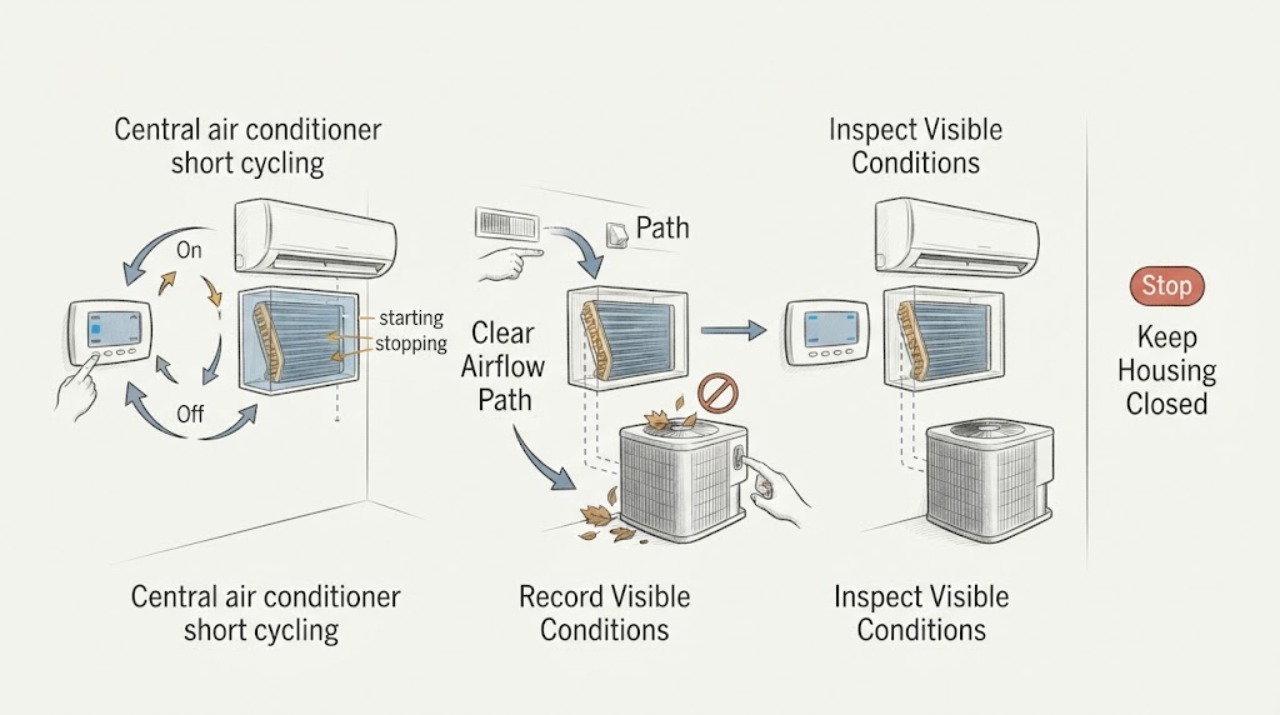
Work through in order
Diagnostic checks
Use only checks that match the exact appliance or system and its official guide.
-
Check 1
At the thermostat, confirm the mode is Cool, note the fan setting, record the setpoint and room reading, and write down the times when a cooling call starts and stops without changing the setting repeatedly.
Expected result: Rapid starts and stops with the setpoint unchanged support a short-cycle symptom; a schedule override, a fan set to run continuously, direct sun or a heat source near the thermostat, or a reading that does not match the room changes the likely path.
Next step: Keep the thermostat at a normal stable setting, capture the display and timing, and provide the log to the HVAC technician. Do not open the thermostat or change wiring.
Stop if: Stop troubleshooting if the thermostat is blank, shows an error that returns, the wall unit is hot, there is a burning smell, or the system starts and stops with a breaker or other electrical symptom.
Why this matters
Why: The thermostat may be ending the call incorrectly, or the system may be stopping for an airflow, coil, safety, sizing, or mechanical reason. The pattern alone cannot identify which one.
-
Check 2
Inspect only the air filter that is accessible through the normal filter slot, without opening an HVAC cabinet or touching electrical equipment; note whether the filter surface is visibly loaded with dust and whether supply airflow feels weaker than usual.
Expected result: A visibly clogged filter together with weak airflow and short cycling supports an airflow restriction; a clean-looking filter or normal airflow does not rule out a blocked coil, duct problem, refrigerant issue, or control fault.
Next step: If the filter can be changed without opening equipment panels, use the exact size and type specified for the system and record the change. If access requires panel removal or the cycle remains abnormal, leave the system for HVAC service.
Stop if: Stop if the filter is wet, frozen, contaminated, inaccessible without tools, or located behind an electrical or equipment panel.
Why this matters
Why: Carrier identifies a dirty filter and weak airflow as possible short-cycle clues, but persistent cycling after a correctly matched filter change needs professional diagnosis.
-
Check 3
From a safe distance, look at accessible supply registers and the return grille while the system is operating normally enough to observe; note weak or uneven airflow, closed registers, unusual noise, or a return grille blocked by furniture.
Expected result: Weak airflow at several registers with a dirty filter supports an airflow restriction; one weak register points more toward a local duct or register issue, while normal airflow with rapid cycling keeps thermostat, sizing, coil, refrigerant, and control causes in play.
Next step: Open only ordinary room registers that are safe to adjust and move furniture away from the return without accessing ductwork; report which rooms are affected. Do not seal, cut, or modify ducts.
Stop if: Stop if airflow carries a burning or chemical odor, water, visible debris, or if the indoor unit is leaking near electrical equipment.
Why this matters
Why: The distribution observation helps the technician decide whether to start with the filter and duct path or investigate the equipment and controls.
-
Check 4
From the ground and without removing any cover, inspect the outdoor unit for visible ice or frost on the copper lines or cabinet, standing water, heavy debris blocking the surrounding airflow, an outdoor fan that is not running when cooling is called, or unusual sounds.
Expected result: Ice, inadequate cooling, water near the indoor unit, a stationary outdoor fan, loud mechanical noise, or repeated rapid starts makes continued operation unsafe or potentially damaging; ordinary loose leaves nearby without ice or noise is a lower-priority maintenance observation.
Next step: If any red flag is present, turn cooling off and request HVAC service. If only loose debris is visible and it can be removed from the ground without reaching into the unit, clear the area and record what you saw.
Stop if: Stop immediately for ice, burning odor, smoke, sparking, water near electrical parts, exposed wiring, a moving or damaged panel, or a fan that is trying to start repeatedly.
Why this matters
Why: Carrier identifies ice, outdoor-unit faults, and refrigerant or electrical problems as professional conditions. A clean-looking exterior does not prove that the coil, compressor, or refrigerant circuit is healthy.
-
Check 5
Compare the short-cycle timing with the home's comfort and recent history: note whether the problem began after a thermostat change, filter change, installation, unusually hot weather, or a repair, and whether the home feels clammy or unevenly cooled.
Expected result: A problem present since installation or a recent replacement can raise a sizing or setup question; a new problem with clammy air, weak cooling, ice, or longer-term deterioration points toward airflow, coil, refrigerant, or equipment service.
Next step: Give the technician the timing log, thermostat settings, filter condition, airflow pattern, outdoor-unit observations, and service history. Do not keep changing setpoints to force a longer cycle.
Stop if: Stop using the system and request urgent service if the condition is worsening, the compressor repeatedly starts, ice appears, water is accumulating, or there is burning odor or electrical noise.
Why this matters
Why: Trane notes that improper sizing and thermostat location can produce short cycling, while Carrier connects restricted airflow, frozen coils, and low refrigerant with related symptoms. A timeline helps the technician test the right branch.
Use your observations
Decision map
Find the observation that best matches what you see, then follow the next safe action.
-
PATH 01Next step
What you see
Ice or frost is visible on refrigerant tubing, the indoor coil area, or the outdoor unit, or there is inadequate cooling with water from melting ice.
Do this next
Turn cooling off and contact an HVAC technician. Do not chip the ice, run the system to melt it, or diagnose refrigerant charge yourself.
-
PATH 02Next step
What you see
There is burning odor, smoke, sparking, exposed wiring, water near electrical equipment, or a breaker trips again.
Do this next
Stop operation, isolate power only if it is safe and accessible, keep clear of the equipment, and request urgent electrical/HVAC service. Do not reset repeatedly.
-
PATH 03Next step
What you see
The thermostat settings are stable, the accessible filter is visibly clogged, airflow is weak, and no ice or electrical warning is present.
Do this next
Replace only an accessible filter with the specified matching filter if that requires no panel access, then monitor the same symptom without repeated resets; call HVAC service if rapid cycling continues.
-
PATH 04Next step
What you see
The thermostat is near direct sunlight or a heat source, the reading appears inconsistent, or the schedule is changing the setpoint.
Do this next
Record the condition and correct only the ordinary setting or schedule if you are authorized to do so. If the thermostat still triggers abnormal cycling, request professional thermostat and system diagnosis.
-
PATH 05Next step
What you see
The issue has existed since installation or replacement, or it persists with a clean filter, normal airflow, and no visible ice.
Do this next
Request an HVAC technician to assess sizing, thermostat placement/calibration, refrigerant circuit, controls, and system operation; do not infer an oversized system from square footage alone.
Helpful context
Understand the symptom
Short cycling is a symptom, not a diagnosis
Trane describes short cycling as abnormal on-and-off operation before a cooling cycle is complete, while Carrier lists thermostat settings, restricted airflow, low refrigerant, frozen coils, and outdoor-unit faults among possible causes. The same symptom can therefore come from a simple accessible filter or setting, a sizing or thermostat problem, or a professional refrigerant/electrical fault. Use observations to narrow the service request rather than trying to identify pressures, wiring, capacitors, or refrigerant charge yourself.
Protect the system while you collect information
A short-cycle log is useful, but repeated forced starts are not a safe test. If ice is visible, stop cooling and leave the system off for professional guidance; do not chip the ice or keep restarting the compressor. Keep the outdoor unit clear of ordinary loose debris only when it can be done from the ground without opening a panel or reaching into the unit. If water is near electrical equipment or the indoor air handler, keep clear and request urgent service.
Only after diagnosis
Potential parts
- HVAC air filter
Consider a replacement filter only when the accessible existing filter is visibly loaded and the system's specified size and type are known; a filter will not correct refrigerant, coil, sizing, or electrical faults.
Match the existing dimensions, airflow direction, equipment requirements, and manufacturer guidance; do not guess a higher restriction or open an equipment panel to install it. - thermostat
Consider a thermostat only after a professional confirms that the control or its placement is causing the cycling; a thermostat should not be used to mask an airflow, refrigerant, or safety shutdown.
Confirm system type, wiring, power requirements, staging, heat-pump or conventional configuration, and manufacturer compatibility before ordering or installing. - condenser coil cleaner
Consider coil-cleaning service only when a technician confirms that accessible outdoor coil contamination contributes to the problem; coil cleaner is not a remedy for ice, refrigerant loss, or electrical faults.
Use only a professional-approved method for the coil and surrounding materials; do not spray chemicals into an energized unit or substitute cleaning for diagnosis.
When checks do not resolve it
Need a professional?
Call an HVAC technician for persistent rapid cycling, a blank or recurring-error thermostat, short cycling after an accessible filter change, cycling since installation, weak cooling, ice, outdoor-unit failure, or any suspected refrigerant, compressor, capacitor, or control fault.
Safety scope: The resident should not access electrical panels, refrigerant lines or gauges, capacitors, compressors, blower or coil cabinets, wiring, or safety controls, and should not repeatedly reset or run a system with ice or burning odor.
Have this ready
- Provide the thermostat mode, fan setting, setpoint and room reading, cycle timing log, filter condition and change date, airflow observations, outdoor-unit status, visible ice or water, sounds or odors, recent work, and model marking if readable without opening equipment.
Common questions
FAQ
How do I know whether my AC is short cycling?
Record when the cooling call starts and stops while the thermostat setting remains stable. Repeated starts and stops before the home is comfortable, especially with clammy air or uneven cooling, support a short-cycle symptom. The timing alone does not identify the cause.
Can a dirty filter cause central AC short cycling?
Yes. A visibly clogged filter can restrict airflow and contribute to weak airflow or short cycling. Inspect only an accessible filter, use the specified replacement if it can be changed safely, and call HVAC service if the symptom continues or the filter is wet, frozen, or inaccessible.
What should I do if I see ice on the AC?
Turn cooling off and call an HVAC professional. Do not chip the ice, keep restarting the compressor, handle refrigerant, or open electrical panels. Ice can accompany airflow or refrigerant problems that require trained diagnosis.
Could the thermostat be causing the short cycling?
It can. Check the mode, fan setting, schedule, reading, and location for obvious sunlight or heat-source influence without opening the thermostat. If the settings are stable and cycling persists, have a technician assess the control and the complete AC system.
Read the exact guide
Official sources
- Troubleshoot an Air ConditionerCarrier · Supports user-visible observations of thermostat settings, filter/airflow, outdoor-unit status, ice, and the boundary against refrigerant/electrical work.
- Troubleshoot an Air Conditioner: 6 Steps to Fix an AC Not WorkingCarrier · Supports checking thermostat, filter, outdoor unit, and ice from accessible areas and stopping operation for ice, electrical faults, or refrigerant concerns.
- AC Short Cycling? Learn Why and What to DoTrane · Supports the definition of short cycling, thermostat/location and sizing branches, humidity symptoms, and professional escalation.
Community feedback
Share a repair observation
Share a plain-text repair observation. Accepted observations are published automatically; this page may take a moment to update.