
On this page
Start here
Quick answer
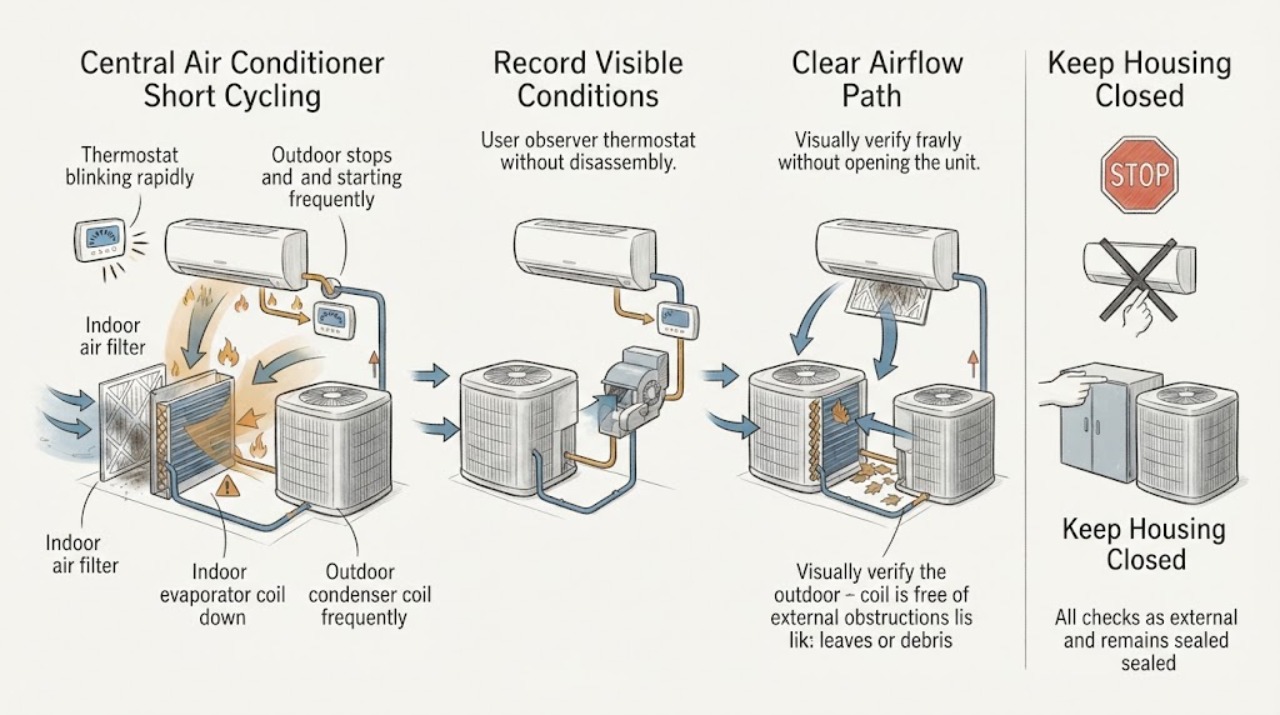
Short cycling means the central AC starts and stops repeatedly before completing a normal cooling cycle. A visibly clogged filter can restrict indoor airflow and contribute to short cycling, but a dirty or frozen evaporator coil, debris on the outdoor condenser coil, low refrigerant, thermostat trouble, or an electrical fault can look similar. First confirm the thermostat is actually calling for cooling and record the run pattern. Then inspect or replace the filter only through its ordinary user access, and look for weak airflow, ice, water, or obvious outdoor debris without opening either cabinet. If the filter is clean but the system still short cycles, if ice or water is present, or if a breaker trips, there is an odor, or cooling is poor, turn the system off at the thermostat and arrange qualified HVAC service. Do not open the air handler, scrub an inaccessible coil, add refrigerant, test electrical parts, or keep restarting the system to see whether it recovers.
Before you begin
Safety first
- Do not open the indoor or outdoor cabinet, clean an inaccessible coil, scrape ice, touch electrical components, connect gauges, add or release refrigerant, bypass controls, wash an electrical unit, or repeatedly reset a breaker. Turn cooling off for ice, water near electrical equipment, burning odor, smoke, arcing, exposed conductors, severe vibration, or recurring trips.
Work through in order
Diagnostic checks
Use only checks that match the exact appliance or system and its official guide.
-
Check 1
Watch one cooling call from a safe location and record the sequence: when the outdoor unit and indoor blower start, when they stop, whether they restart soon afterward, and whether the thermostat still shows a cooling demand. Note whether the home is clammy, the temperature is not falling, or the system is stopping only after reaching the set point. Do not lower the set point repeatedly or keep forcing new calls.
Expected result: The system starts and stops repeatedly before the home reaches the set point; only the indoor fan continues; the thermostat is not calling for cooling; or the cycle appears normal for the current weather and load.
Next step: Correct only an obvious normal thermostat setting issue and observe one subsequent call. If rapid cycling persists with a correct cooling demand, continue with the filter, airflow, ice, water, and outdoor visual checks; do not repeatedly restart an abnormal system.
Why this matters
Why: Frequent restarts before a completed cooling call support short cycling. A fan that continues after compressor shutdown may reflect a normal fan setting rather than a compressor fault. A mode, schedule, or set-point mismatch can imitate a problem, while a normal pattern in unusually mild conditions is not by itself proof of a failure.
-
Check 2
With the system off, inspect the air filter through the ordinary filter slot or user-accessible filter cabinet described by the equipment manual. Note whether it is packed with dust, collapsed, wet, damaged, the wrong size, or seated with gaps. Compare airflow at several supply registers during one safe call. Do not open the air-handler cabinet to reach a coil or blower.
Expected result: The filter is visibly loaded, wet, collapsed, or mis-seated; airflow is weak at many registers; airflow is normal; or only one register is weak.
Next step: If the filter is clearly due for replacement, install only the exact size and type specified for the system through the normal access and observe whether airflow and cycling change. If the filter is wet, airflow remains weak, or short cycling continues with a clean, correctly seated filter, arrange HVAC service rather than opening the unit.
Stop if: Stop the cooling call for water near electrical equipment, a burning or electrical odor, smoke, exposed conductors, or any need to remove an air-handler panel.
Why this matters
Why: A restricted filter plus broad weak airflow makes an airflow-related short-cycle path more likely. A wet filter may be downstream of ice or condensate trouble. Normal airflow makes a filter-only explanation less likely, while one weak register suggests a local grille or duct issue rather than a whole-system filter restriction.
-
Check 3
Look at accessible areas around the indoor unit and refrigerant tubing without touching them. Note visible frost or ice, unusual condensate, water staining, or a wet area near the air handler. Inspect the exterior of the outdoor condenser from outside its grille for leaves, grass, lint, or other obvious blockage. Do not scrape ice, spray the cabinet, remove the top, or reach through the grille.
Expected result: Ice is visible on tubing or near the coil area; water is collecting indoors; the outdoor coil is visibly obstructed; or there is no ice, water, or obvious debris.
Next step: For ice, water damage, or a wet air-handler area, switch the thermostat out of cooling and arrange qualified HVAC service. For a heavily obstructed outdoor coil, photograph the condition and have the service professional determine the safe cleaning method; do not open the cabinet or use a pressure stream. If the view is clear but short cycling persists, use the run history and filter result for service diagnosis.
Stop if: Stop cooling immediately for visible ice, water near electrical equipment, smoke, burning odor, or any damaged or exposed equipment.
Why this matters
Why: Ice can accompany restricted airflow, a dirty or frozen evaporator coil, debris, or low refrigerant, and continuing to run can worsen damage. Water can indicate a frozen coil or condensate problem. Outdoor debris can reduce heat rejection. A clear visual view does not rule out an inaccessible dirty coil, refrigerant issue, control fault, or sizing problem.
-
Check 4
Compare the system behavior before and after the accessible filter check without changing any wiring or electrical controls. Record whether airflow improves, whether the compressor still starts and stops rapidly, whether cooling remains weak, and whether the outdoor unit runs continuously or shuts down. Do not use the filter change as a reason to keep operating through ice or a repeated electrical trip.
Expected result: Cycling improves after a properly fitted filter change; cycling is unchanged with a clean filter; cooling remains weak; or the system stops and restarts with a click, trip, odor, or unusual sound.
Next step: If short cycling remains after the filter is correct, turn cooling off and arrange qualified HVAC diagnosis. Provide the before-and-after timing and airflow observations; do not add refrigerant, test a capacitor, or reset a tripped breaker repeatedly.
Why this matters
Why: Improvement after the correct filter change supports restricted airflow as a contributor, although the system still needs observation if symptoms return. No change with a clean filter makes a dirty-filter-only explanation less likely and raises thermostat, sizing, refrigerant, coil, condenser, compressor, or control possibilities. Electrical or odor symptoms require a higher-priority stop.
-
Check 5
Check the thermostat location and history using only its normal interface. Note whether the thermostat is in direct sun, beside a supply register, near a heat-generating appliance, or showing a schedule or temperature that does not match the room. Record whether short cycling has existed since installation or began recently. Do not open the thermostat or change its wiring.
Expected result: The thermostat is exposed to a local heat source or an unexpected schedule; the problem has been present since installation; or the location and settings seem normal but cycling is new.
Next step: Correct only an obvious schedule or normal setting error and document the thermostat location. If the location cannot be changed safely, the issue dates from installation, or short cycling is new and persists with a clean filter, arrange qualified HVAC service for sizing, controls, airflow, coil, and refrigerant evaluation.
Why this matters
Why: A local temperature bias or schedule can trigger premature calls. Short cycling present from the beginning can make system sizing or installation a consideration, whereas a new symptom with a previously stable system favors a developing airflow, coil, refrigerant, control, or electrical fault.
-
Check 6
Prepare a service handoff from the evidence already collected: list the cycle timing, thermostat setting, filter condition and replacement date, airflow at registers, ice or water, outdoor debris, whether cooling is weak, and any breaker, odor, or sound event. Take safe-distance photos of the filter, ice, water staining, or outdoor obstruction. Do not remove panels to photograph an inaccessible coil or component.
Expected result: The pattern is resolved after the correct filter change; the cause remains uncertain; or a stop condition prevents further observation.
Next step: Keep the system off for ice, water damage, odor, smoke, or repeated trips and arrange qualified service. Give the technician the timeline and photos rather than attempting an internal coil cleaning, refrigerant adjustment, or electrical test.
Why this matters
Why: A filter response helps identify an airflow contributor, while unchanged cycling with a clean filter directs the technician toward coil access, refrigerant, controls, sizing, or electrical testing. A precise timeline is valuable even when the homeowner cannot identify the failed part.
Use your observations
Decision map
Find the observation that best matches what you see, then follow the next safe action.
-
PATH 01Next step
What you see
The filter is visibly loaded, wet, collapsed, or incorrectly seated, and airflow is weak at several registers; cycling improves after the correct filter change.
Do this next
Keep the correctly specified filter installed and monitor normal cooling. If the filter loads unusually fast, is wet, airflow remains weak, or cycling returns, schedule service for blower, evaporator coil, duct, condensate, and control evaluation; do not open the air handler.
Why this path and its safety boundary
Why it matters: Restricted indoor airflow is a credible contributor to the short cycling. The result does not prove the evaporator coil is clean or rule out a second fault if symptoms return.
-
PATH 02Next step
What you see
Ice or frost appears near the indoor coil or refrigerant tubing, water collects near the air handler, or cooling is weak with a restricted filter or visible coil-area contamination.
Do this next
Turn cooling off and arrange qualified HVAC service. Protect nearby contents from water without opening the equipment; do not scrape ice, apply heat, clean an inaccessible coil, or add refrigerant.
Why this path and its safety boundary
Why it matters: A frozen or dirty evaporator coil, restricted airflow, low refrigerant, or condensate issue is more likely. The accessible filter may be part of the chain, but it cannot identify or safely correct an inaccessible coil or sealed-system problem.
-
PATH 03Next step
What you see
The filter is clean and correctly seated, but the outdoor condenser is visibly packed with leaves or debris, cooling is weak, or the system runs abnormally.
Do this next
Keep the area around the equipment accessible and photograph the obstruction. Arrange HVAC service for a safe coil and system inspection; do not remove cabinet panels, bend fins, wash an electrical cabinet, or use a tool inside the unit.
Why this path and its safety boundary
Why it matters: Reduced outdoor heat rejection can contribute to poor performance and abnormal cycling, but visual debris does not establish whether the condenser coil, fan, compressor, or controls are at fault.
-
PATH 04Next step
What you see
The filter is clean and airflow is reasonable, but the system still starts and stops prematurely, especially if the issue began recently or the home remains warm or humid.
Do this next
Turn cooling off if the cycling is rapid, worsening, or paired with poor cooling, and arrange qualified HVAC service. Ask for evaluation of airflow, coil condition, refrigerant, controls, and equipment sizing rather than replacing a filter repeatedly or guessing at a part.
Why this path and its safety boundary
Why it matters: A dirty-filter-only explanation is less likely. Thermostat sensing or wiring, low refrigerant, a dirty or inaccessible coil, compressor or electrical controls, or another operating fault needs qualified diagnosis; if the pattern has existed since installation, sizing also becomes relevant.
-
PATH 05Next step
What you see
Short cycling is accompanied by a breaker that trips again, burning or electrical odor, smoke, arcing, exposed conductors, water near electrical equipment, or a loud abnormal sound.
Do this next
Turn the system off at the thermostat, keep people away from damaged equipment, and arrange prompt qualified HVAC service. Do not reset the breaker repeatedly, touch wiring or capacitors, open cabinets, or use water to clean the unit.
Why this path and its safety boundary
Why it matters: The symptom has crossed from a filter-or-coil observation into an electrical, mechanical, or water-damage safety boundary. Continued starts can increase equipment damage or personal risk.
Helpful context
Understand the symptom
A dirty filter is plausible, not proven
A short-cycling central AC starts, stops, and restarts so quickly or so often that it does not complete a useful cooling cycle. A clogged filter can reduce the air reaching the indoor evaporator coil and make the system run abnormally, but the same pattern can come from a dirty or frozen coil, outdoor heat-rejection trouble, low refrigerant, thermostat signals, electrical controls, or equipment sizing. The filter check is worthwhile because it is accessible; it is not a reason to assume the filter is the only fault.
Separate the indoor airflow side from the coils
The indoor filter and evaporator coil handle air from the home, while the outdoor condenser coil rejects the heat. Weak airflow, a loaded filter, frost on accessible tubing, or water around the indoor unit shifts attention toward the indoor airflow and coil path. A clean filter with a heavily obstructed outdoor unit or persistent short cycling shifts attention toward the condenser, controls, refrigerant, or another professional diagnosis. An inaccessible coil should be treated as a service task, not a deeper do-it-yourself inspection.
Protect the compressor while you collect evidence
Repeated starting and stopping places extra wear on the system and can leave the home humid or uncomfortable. Use the thermostat, normal filter access, registers, and safe visual views only. Do not bypass a control, repeatedly reset power, scrape ice, remove an access panel, wash an electrical cabinet, or add refrigerant. When the equipment is icing, leaking water, tripping power, or producing an electrical odor, turn cooling off and move directly to qualified service.
Only after diagnosis
Potential parts
- replacement air filter
Consider this category only when the accessible filter is visibly dirty, wet, damaged, or due for replacement and airflow or cycling changes after the correct filter is installed.
Confirm the exact dimensions, type, airflow direction, and equipment guidance before ordering. The filter must seat correctly without bypass gaps or excessive restriction. - thermostat or temperature-sensing control
Consider this category only after a qualified technician confirms that thermostat sensing, placement, scheduling, or control output is causing premature cooling calls; a short cycle alone does not identify the thermostat.
Confirm the system type, wiring, control scheme, configuration, and manufacturer requirements before selecting a replacement. Do not open or rewire the thermostat as a user repair. - evaporator or condenser coil component
Consider this category only when qualified inspection confirms a dirty, damaged, leaking, or otherwise failed coil after the filter and visual checks; ice or debris alone cannot identify a replacement coil.
Confirm the complete equipment match, dimensions, metering arrangement, refrigerant design, and manufacturer procedures with a qualified HVAC professional. Do not order a generic coil or open the refrigerant circuit. - compressor protection or electrical control component
Consider this category only after qualified testing identifies a control, relay, capacitor, or compressor-related cause of persistent short cycling with a clean filter and no simple airflow explanation.
Match the equipment model, electrical ratings, control sequence, and manufacturer service information. These are not ordinary-user diagnostic or replacement parts.
When checks do not resolve it
Need a professional?
Stop and arrange qualified HVAC service when rapid starts and stops continue with a clean, correctly fitted filter; when the system remains warm or humid; or when ice, water damage, a wet filter, a dirty or inaccessible coil, repeated breaker trips, burning odor, smoke, exposed conductors, or abnormal sounds are present. Turn cooling off for those warning signs. Do not open equipment, clean an inaccessible coil, scrape ice, add refrigerant, test electrical parts, bypass controls, or keep restarting the system.
Safety scope: Do not open the indoor or outdoor cabinet, clean an inaccessible coil, scrape ice, touch electrical components, connect gauges, add or release refrigerant, bypass controls, wash an electrical unit, or repeatedly reset a breaker. Turn cooling off for ice, water near electrical equipment, burning odor, smoke, arcing, exposed conductors, severe vibration, or recurring trips.
Common questions
FAQ
Can a dirty filter cause a central AC to short cycle?
Yes. A clogged filter can restrict indoor airflow and contribute to rapid starts and stops, especially when airflow is weak at several registers. Inspect it through ordinary access and replace it only with the exact specified size and type if it is due. If cycling does not improve, the filter is wet, or cooling remains poor, arrange HVAC service because coils, refrigerant, controls, sizing, and electrical faults can look similar.
How do I know whether the evaporator coil is dirty?
Homeowners can look for indirect signs such as weak airflow, ice or frost on accessible tubing, water near the air handler, poor cooling, or short cycling. The evaporator coil is often inside the air-handler cabinet and may not be safely accessible. Do not remove the panel or scrub the coil; turn cooling off for ice or water and have a qualified technician inspect it.
Should I keep running the AC after replacing a dirty filter?
If there is no ice, water, odor, smoke, electrical symptom, or abnormal sound, observe one normal call after installing the correctly specified filter. If short cycling remains, cooling is weak, or the filter is wet, turn cooling off and arrange service. Do not keep running the system through ice or repeated electrical trips just to test the filter theory.
What if the filter is clean but the AC still short cycles?
A clean filter makes a filter-only explanation less likely. Possible paths include a dirty or frozen evaporator coil, outdoor condenser restriction, low refrigerant, thermostat or control trouble, electrical components, or equipment sizing. Record the cycle timing, airflow, cooling result, ice or water, and thermostat history, then arrange qualified HVAC diagnosis instead of adding refrigerant or opening the equipment.
Why is short cycling hard on a central air conditioner?
Frequent starts and stops increase wear and can prevent the system from removing humidity effectively. A short-cycle pattern may be caused by airflow, coil, thermostat, refrigerant, electrical, or sizing issues, so it is better to identify the pattern and correct the cause than to repeatedly reset or restart the unit.
Read the exact guide
Official sources
- AC Short CyclingTrane · Manufacturer troubleshooting guidance for distinguishing thermostat, sizing, and maintenance contributors to repeated central AC starts and stops
- What Is AC Short Cycling: Causes, Effects, and TroubleshootingCarrier · Manufacturer homeowner guidance for a central AC that starts and stops frequently before completing a cooling cycle
- Troubleshoot an Air Conditioner | AC TroubleshootingCarrier · Manufacturer troubleshooting guidance for homeowners assessing short cycling, weak airflow, ice, water, and dirty or frozen coils
- Heating and Air Conditioning Repair | HVAC ServicesCarrier · Manufacturer service guidance distinguishing filter maintenance from coil cleaning and repair when an AC starts and stops repeatedly
- Maintenance ChecklistENERGY STAR, U.S. Environmental Protection Agency · Official maintenance checklist distinguishing homeowner filter care from professional central AC maintenance tasks
Community feedback
Share a repair observation
Share a plain-text repair observation. Accepted observations are published automatically; this page may take a moment to update.