
On this page
Start here
Quick answer
A Carrier heat pump that starts and stops repeatedly can be reacting to restricted airflow from a clogged air filter, but a clean filter does not rule out a thermostat, frozen coil, refrigerant, outdoor-airflow, control, or sizing problem. Confirm the pattern, replace or clean the filter with the exact model-approved type, and make sure visible registers and the outdoor unit are not blocked. If the rapid cycling continues, the unit is icing, airflow is weak, or there is a burning smell, exposed wiring, a returning error, or a repeated breaker trip, stop testing and arrange qualified HVAC service.
Before you begin
Safety first
- Do not open panels, handle wiring or the outdoor fan, chip ice, or test refrigerant or energized electrical components. Stop for smoke, burning smell, exposed wiring, arcing, water near electrical parts, or repeated breaker trips.
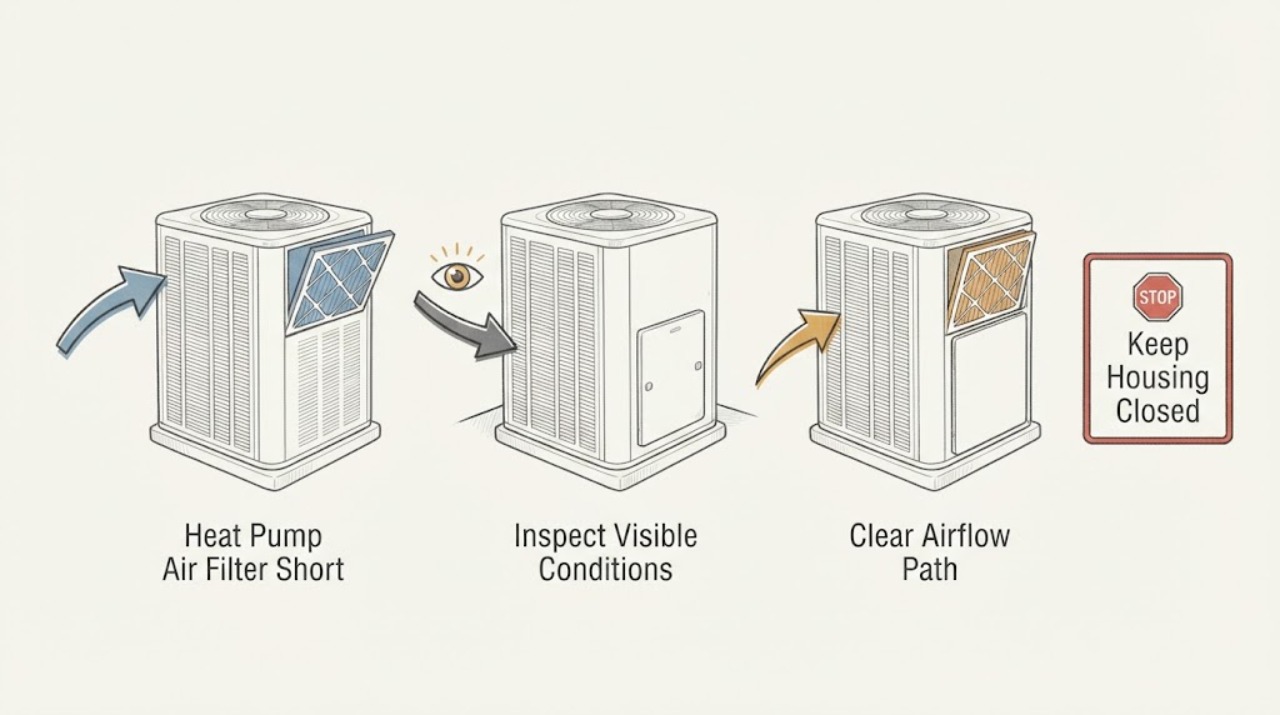
Work through in order
Diagnostic checks
Use only checks that match the exact appliance or system and its official guide.
-
Check 1
Observe one call for heat without repeatedly changing the thermostat. Note whether the heat pump starts, how soon it stops, whether the indoor blower runs, whether the thermostat still calls for heat, the outdoor weather, and whether the change appears to be a defrost event. Stop immediately if there is smoke, a burning smell, exposed wiring, arcing, or a repeated breaker trip.
Expected result: The equipment starts and stops while the thermostat continues calling, the indoor blower is weak or absent, the outdoor coil is heavily iced, or the behavior occurs only during a brief defrost transition.
Next step: If the pattern is persistent, continue only with the external filter, register, thermostat, and clearance checks below. If a safety red flag is present, leave the system off and arrange qualified HVAC service.
Why this matters
Why: A persistent stop-start pattern during an active call is consistent with a fault to investigate; a short defrost transition may be normal heat-pump behavior. Weak airflow or heavy ice makes a simple filter-only explanation less certain.
-
Check 2
Turn the system off at the thermostat and inspect the user-accessible air-filter slot. Compare the filter with the exact size and airflow direction marked on the existing filter or model instructions; replace or clean it only when the filter type permits cleaning, and point its arrow toward the indoor unit or blower.
Expected result: The filter is visibly packed with dust, collapsed, wet, installed backward, or the wrong size; or it is clean, dry, correctly sized, and installed in the marked direction.
Next step: Correct only the filter installation using the exact model-approved size and type, then make one supervised call for heat. If rapid cycling remains, do not keep swapping filters or open the air handler; continue to the airflow and thermostat checks and plan service.
Why this matters
Why: A dirty, damaged, wet, backward, or wrong-size filter can restrict airflow and make cycling or reduced performance more likely. A clean, correctly installed filter makes the filter a less likely sole cause.
-
Check 3
With the system off, check every visible supply register and return grille for furniture, rugs, curtains, or other blockage. Look around the outdoor unit for leaves, snow, or other debris; clear only loose external obstructions without opening panels, touching the fan, washing a coil, or chipping ice.
Expected result: Several indoor openings are blocked, the outdoor unit has a visible loose obstruction, or the registers and outdoor clearance are open. Thick ice remains on the outdoor coil.
Next step: Restore only clear, safe airflow paths and monitor once. If thick ice, weak airflow, a fan problem, water freezing onto the coil, or repeated cycling remains, leave the unit off as appropriate and arrange qualified service; never chip ice or enter the cabinet.
Why this matters
Why: Blocked indoor or outdoor airflow can make the heat pump struggle and can mimic or contribute to cycling problems. Thick ice is not a routine debris issue; Carrier links severe freezing to restricted airflow, refrigerant, water runoff, fan, or defrost problems.
-
Check 4
Review the Carrier thermostat's mode, fan setting, schedule, setpoint, and location. Keep the system in the intended heat mode and fan setting, avoid large repeated setpoint changes, and note whether sunlight, an oven, a draft, or an open nearby door could make the sensor read a different temperature from the room.
Expected result: The mode or fan setting was wrong, the thermostat is exposed to a local heat or draft source, the setpoint is being changed repeatedly, or the settings and location are reasonable but short cycling continues.
Next step: Make the documented setting correction and observe one normal call. Do not remove the thermostat, test low-voltage wiring, or recalibrate internal controls; persistent rapid cycling needs professional diagnosis.
Why this matters
Why: A wrong mode, unusual thermostat location, or erratic control signal can create unnecessary calls. Correct settings that do not change the symptom make a thermostat fault, wiring issue, or equipment problem more likely than the filter alone.
-
Check 5
Inspect only from a safe position for secondary symptoms: weak or no air at registers, frost or thick ice, water around the indoor or outdoor unit, unusual compressor or fan noise, a thermostat error, or a breaker that trips again. Do not remove access panels or measure refrigerant, capacitor, or live electrical values.
Expected result: There is icing, water, weak airflow, a returning error, unusual mechanical noise, or repeated electrical interruption; or none of these signs is visible and the heat pump still short cycles.
Next step: Stop running the system if ice, water near electrical parts, burning odor, exposed wiring, smoke, or repeated trips are present. Otherwise document the pattern and arrange qualified HVAC service when one correct filter and external airflow check does not resolve it.
Why this matters
Why: These patterns can involve a frozen coil, drain or airflow problem, refrigerant, fan, compressor, defrost, control, or electrical fault. A lack of visible clues does not prove a filter diagnosis or a safe user repair.
-
Check 6
Prepare a service record after the safe checks: Carrier model and serial information, filter size and condition, heat or cool mode, thermostat setting, outdoor temperature or weather, approximate start-stop pattern, any ice or water, airflow observations, displayed errors, and what changed after the filter or clearance check.
Expected result: The symptom disappears after correcting a clearly restricted filter or visible obstruction, returns after a short time, or never changes despite correct filter and open airflow paths.
Next step: Give the record to a qualified HVAC technician and request diagnosis of airflow, thermostat/control behavior, coils, defrost operation, refrigerant circuit, compressor, fan, and equipment sizing as indicated by the evidence.
Why this matters
Why: Improvement supports an airflow-related contribution but does not prove that no underlying issue remains. A returning or unchanged symptom needs the system evaluated rather than repeated restarts.
Use your observations
Decision map
Find the observation that best matches what you see, then follow the next safe action.
-
PATH 01Next step
What you see
The filter is visibly clogged, damaged, wet, backward, or the wrong size, and the cycling improves after a model-correct replacement.
Do this next
Keep the correct filter installed and monitor the next normal call. If short cycling returns, arrange HVAC service rather than continuing to run through repeated starts.
Why this path and its safety boundary
Why it matters: Restricted indoor airflow was likely contributing to the stops, although improvement does not rule out another fault.
-
PATH 02Next step
What you see
The filter is clean and correctly installed, registers are open, and the outdoor unit is clear, but the thermostat still calls while the heat pump rapidly stops and restarts.
Do this next
Stop repeated restart tests and arrange qualified HVAC diagnosis. Do not open panels or attempt refrigerant or electrical testing.
Why this path and its safety boundary
Why it matters: The filter is unlikely to be the sole cause. Thermostat or control behavior, a coil or refrigerant issue, compressor or fan protection, or equipment sizing becomes more plausible.
-
PATH 03Next step
What you see
The outdoor coil has thick ice, the indoor airflow is weak, or water is appearing around the unit.
Do this next
Turn the system off in the normal safe way and do not chip ice, touch the fan, or open the cabinet. Arrange qualified service, sooner if water is near electrical components.
Why this path and its safety boundary
Why it matters: A freeze, drain, airflow, refrigerant, fan, water-runoff, or defrost problem is possible; Carrier says severe ice requires attention and refrigerant testing is professional work.
-
PATH 04Next step
What you see
The behavior occurs only during a brief defrost transition, with no persistent loss of heat, ice buildup, or safety symptom.
Do this next
Continue observing without forcing extra cycles. If starts and stops become frequent during ordinary calls or comfort declines, use the filter and external-airflow checks and schedule service if they do not resolve it.
Why this path and its safety boundary
Why it matters: A heat-pump defrost transition may account for that isolated change, rather than the air filter causing a fault.
-
PATH 05Next step
What you see
A wrong thermostat mode, fan setting, schedule, or sensor location is found and correcting it restores a normal call.
Do this next
Leave the documented settings in place and monitor. If the same short cycling returns with reasonable settings, have a technician evaluate the thermostat and heat pump together.
Why this path and its safety boundary
Why it matters: The call pattern was at least partly caused by thermostat configuration or environmental sensing rather than a confirmed filter failure.
-
PATH 06Next step
What you see
A burning smell, smoke, exposed or frayed wiring, arcing, a returning error code, water near electrical parts, or repeated breaker trips occurs.
Do this next
Stop immediately, keep clear, isolate power only from a safe dry location if needed, and arrange qualified HVAC or emergency help. Do not reset repeatedly or restart to test.
Why this path and its safety boundary
Why it matters: This exceeds homeowner maintenance and may involve an electrical, control, water, or equipment safety hazard.
Helpful context
Understand the symptom
What the filter can and cannot explain
A filter sits in the indoor air path, so a heavy dust load can reduce the air moving through the heat pump and make the equipment run inefficiently or trip a protective limit. That makes the filter a sensible first check, not a confirmed diagnosis. A clean, correctly installed filter with continued rapid starts and stops points to a different airflow, thermostat, coil, refrigerant, control, or equipment-sizing question.
Normal heat-pump operation can look different
Record whether the outdoor unit is heating or cooling, the indoor fan behavior, outdoor weather, and whether the stops happen during a defrost event or after a thermostat call. A brief operating change during defrost is different from repeated starts and stops during an ordinary call for heat. Do not use a single timing rule to diagnose every Carrier model; use the repeated pattern and its associated symptoms.
Safety boundary
Stop conditions
- Do not open the air handler or outdoor-unit panels, touch the fan, test energized wiring, measure refrigerant or capacitor values, bypass a limit or control, or chip ice from a coil.
- Stop immediately for smoke, a burning smell, exposed or frayed wiring, arcing, water near electrical parts, a returning critical error, or repeated breaker trips. Keep clear and arrange qualified help.
- If the filter, visible registers, outdoor clearance, and documented thermostat settings are correct but rapid cycling persists, stop repeated restart tests and arrange qualified HVAC diagnosis.
Only after diagnosis
Potential parts
- Carrier-compatible air filter
Consider only when the existing filter is clogged, damaged, wet, or the wrong size and the exact model-approved replacement is confirmed.
Filter dimensions, thickness, airflow rating, and replacement schedule vary by installation. Confirm the exact model and the marked filter requirements before selecting one. - thermostat or temperature-sensing control
Consider only after correct mode, fan, schedule, location, filter, and visible airflow checks fail and qualified diagnosis confirms an inaccurate call or control fault.
Carrier thermostats and communicating controls are model- and system-specific; do not replace one based on appearance or a symptom alone. - airflow, fan, defrost, or refrigerant-system component
Consider only after a qualified technician identifies a confirmed fault such as a failed fan, defrost control, coil-related issue, or refrigerant-circuit problem.
These are system-specific service components and may involve sealed or energized equipment. Confirm diagnosis, exact model, and professional installation requirements first.
When checks do not resolve it
Need a professional?
Arrange qualified HVAC service when the Carrier heat pump keeps short cycling after one correct filter check and visible airflow check, when the filter is clean but the symptom persists, or when there is weak airflow, thick ice, water, unusual mechanical noise, a returning error, or suspected thermostat, refrigerant, fan, compressor, defrost, control, or sizing trouble. Treat burning smell, smoke, exposed wiring, arcing, water near electrical parts, and repeated breaker trips as immediate safety stops.
Safety scope: Do not open panels, handle wiring or the outdoor fan, chip ice, or test refrigerant or energized electrical components. Stop for smoke, burning smell, exposed wiring, arcing, water near electrical parts, or repeated breaker trips.
Common questions
FAQ
Can a dirty air filter make a Carrier heat pump short cycle?
Yes. A clogged filter can restrict airflow and contribute to protective shutdowns or short cycling. Replace or clean it only according to the exact model instructions, with the correct size and airflow direction. If the behavior continues with a clean filter, the filter is not a complete diagnosis.
What should I check before calling about Carrier heat-pump short cycling?
Record the repeated start-stop pattern, check the user-accessible filter, make sure visible registers are open, clear loose debris around the outdoor unit, and verify the thermostat mode, fan setting, schedule, and location. Do not open panels or test wiring, refrigerant, or capacitors.
What if the Carrier heat pump still short cycles after I change the filter?
A clean, correctly installed filter with persistent rapid cycling makes a thermostat or control, coil or airflow, refrigerant, compressor, fan, defrost, or sizing issue more plausible. Stop repeated restart tests and arrange qualified HVAC diagnosis.
Should I run a Carrier heat pump with ice on the outdoor coil?
Do not chip ice or touch the fan. Light frost can occur in winter, but thick ice indicates a problem that may involve airflow, refrigerant, water runoff, fan, or defrost operation. Arrange qualified service, especially if heating is lost or water is near electrical parts.
When is short cycling an HVAC safety stop?
Stop immediately for smoke, a burning smell, exposed or frayed wiring, arcing, water near electrical parts, a persistent error, or repeated breaker trips. Keep clear and arrange qualified help; do not open the equipment or keep resetting it.
Read the exact guide
Official sources
- Common Thermostat Issues and How to TroubleshootCarrier · Carrier thermostat location, filter-related protective cycling, short-cycling triage, error-code, wiring, and burning-smell guidance.
- Heat Pump Troubleshooting Guide | Common Heat Pump Problems & FixesCarrier Residential · Carrier heat-pump thermostat, filter, outdoor blockage, defrost, ice, airflow, and professional-service guidance.
- Heat Pump Service & Maintenance Tips | Carrier ResidentialCarrier Residential · Carrier heat-pump filter, airflow, thermostat, outdoor-clearance, coil, and short-cycling maintenance guidance.
- AC Filter Replacement Guide | How to Replace AC FilterCarrier · Carrier filter location, power-off, airflow-arrow, exact-size, airflow, and short-cycling guidance; use the heat-pump model instructions where they differ.
- What Is AC Short Cycling? Causes & Troubleshooting | CarrierCarrier · Carrier short-cycling explanation for airflow, thermostat, refrigerant, sizing, and electrical causes; applied here to the shared heat-pump air path with model-specific limits.
Community feedback
Share a repair observation
Share a plain-text repair observation. Accepted observations are published automatically; this page may take a moment to update.