
On this page
Start here
Quick answer
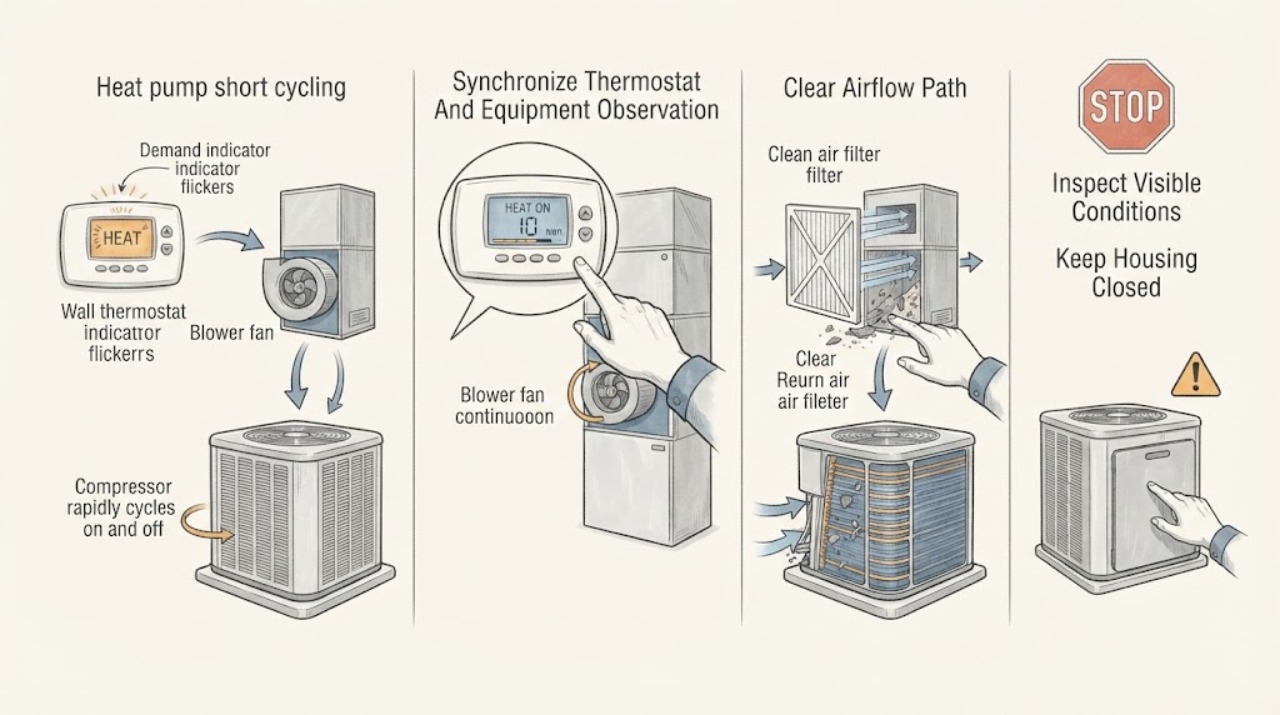
A Goodman heat pump is short cycling when it starts and stops repeatedly before a normal heating or cooling call is complete. The first useful split is whether the thermostat still shows a demand when the outdoor unit stops. A demand that disappears points toward mode, schedule, sensor, staging, or sizing behavior; a continuing demand points more toward airflow, defrost, protection controls, electrical operation, refrigerant, or another equipment fault. Check only the accessible filter, supply and return grilles, thermostat display, outdoor air path, visible ice, and visible water around the air handler. Goodman says a correctly functioning heat pump may pause for automatic defrost, and a light frost can be normal, but heavy ice, a frozen coil, repeated incomplete defrost, weak airflow, a fault indication, burning odor, unusual electrical noise, or rapid restarts requires qualified HVAC service. Do not open panels, change installer settings or wiring, test electricity, adjust refrigerant, bypass a safety, or keep forcing cycles.
Before you begin
Safety first
- Owner checks are limited to thermostat display and mode observation, a steady user-level setpoint, accessible filter replacement, external grille and outdoor-obstruction checks, safely visible identification, and documentation. A qualified professional must handle panels, wiring, electrical tests, refrigerant, pressure measurements, coil or blower disassembly, defrost controls, safety devices, load sizing, duct diagnosis, and equipment commissioning.
Work through in order
Diagnostic checks
Use only checks that match the exact appliance or system and its official guide.
-
Check 1
From the thermostat and a safe position away from the outdoor unit, record whether the Goodman system is in Heat, Cool, Auto, Aux, or Emergency Heat; note the room temperature, setpoint, demand indicator, indoor-blower status, and whether the outdoor unit starts and stops repeatedly. Do not remove the thermostat cover or equipment panels.
Expected result: The demand indicator disappears before the equipment stops; it remains on while the indoor or outdoor unit stops; only one mode is affected; or a fault, lockout, Aux, or Emergency Heat indication appears.
Next step: Keep the mode and user-level setpoint steady, take a photograph of the display, and use the matching branch below. If there is a fault, burning odor, smoke, arcing, loud mechanical noise, or rapid restarting, turn the system off at the thermostat and arrange urgent qualified service.
Stop if: Stop immediately for smoke, burning odor, exposed wiring, loud arcing or grinding, water near electrical equipment, repeated breaker trips, or an unsafe outdoor condition.
Why this matters
Why: A disappearing demand keeps schedule, sensor placement, deadband, staging, and mode behavior in consideration. A continuing demand with an unexpected stop shifts attention toward airflow, a protection or control interruption, electrical operation, defrost, refrigerant, or another equipment problem. An Aux or defrost indication can describe a transition rather than a short-cycle failure.
-
Check 2
With the system off at the thermostat, inspect the accessible return and supply grilles and the installed air filter. Replace a visibly loaded filter only with the size and type allowed by the Goodman equipment documentation, and move a loose object that plainly blocks a grille; do not remove a coil or blower panel and do not close additional vents to test the system.
Expected result: The filter is loaded or collapsed, several returns or supplies are blocked, airflow is weak at many grilles, airflow is normal, or the filter and grilles are clear but short cycling continues.
Next step: After an allowed filter replacement or external obstruction correction, observe one ordinary call without repeated setpoint changes. If airflow stays weak or the Goodman unit still stops while the thermostat calls, leave it off if it is overheating or icing and schedule qualified diagnosis.
Stop if: Stop for a wet or frozen filter, water near electrical equipment, a blower that does not run, contamination requiring remediation, or any need to open the air handler or alter dampers.
Why this matters
Why: A loaded filter or obvious grille blockage can contribute to an air-handler and equipment stress pattern. Weak airflow with a clean filter, or normal external airflow with persistent cycling, leaves the indoor coil, blower, duct balance, controls, or refrigeration system unresolved; it is not evidence for a guessed part.
-
Check 3
From a stable, dry location with the Goodman system not being touched, look around the outdoor unit for leaves, snow, stored items, vegetation, or a cover over the side or top air path. In heating mode, note whether frost is light and clears during a normal defrost pause or becomes heavy and persistent. Remove only loose debris that is plainly safe to reach without tools or contact with the cabinet.
Expected result: The air path is obstructed; the coil has light frost that clears; heavy ice remains; the fan does not run during a demand; or the unit is clear and ice-free.
Next step: Keep the unit uncovered and its external air path clear. If heavy ice remains, the fan is abnormal, or the unit repeatedly enters and exits defrost without restoring comfort, turn the system off and arrange qualified HVAC service rather than restarting it to collect more evidence.
Stop if: Do not scrape or chip ice, pour water on the coil, bend fins, wash the cabinet, remove a guard, touch a moving fan, or open the outdoor unit.
Why this matters
Why: Goodman says the outdoor unit needs to draw air through its sides and exhaust through the top, and that light frost can be handled by automatic defrost. A blocked air path, fan that does not operate, heavy ice, or incomplete defrost makes airflow, fan, defrost control, refrigerant, or another service diagnosis more likely than a homeowner adjustment.
-
Check 4
Using paperwork or a safely visible label, record the Goodman model family and whether the indoor system is described as single-stage, two-stage, variable-speed, or dual-fuel. Note whether short cycling happens mainly in mild weather, after a thermostat or duct change, after installation, or when a small zone is the only demand; record any stage or auxiliary indicator the thermostat normally displays.
Expected result: The symptom began after installation or control work; it occurs mainly at low demand; a variable or two-stage system appears to run at one stage; a dual-fuel system changes to a furnace; or the operating context is unchanged and the problem occurs in all conditions.
Next step: Give the model information and timeline to a licensed HVAC dealer and ask for a system-match, load, airflow, stage, and control-commissioning review. Do not change cycles-per-hour, compressor off-time, deadband, reversing-valve wiring, or auxiliary-heat settings as a trial.
Stop if: Stop if identifying the model requires removing a panel, or if the next check would involve wiring, a meter, refrigerant gauges, a safety reset, or a combustion or electrical compartment.
Why this matters
Why: Goodman explains that reduced-capacity systems may run longer and that heat-pump controls must accommodate the equipment's stages and auxiliary heat. Mild-load cycling or a new-installation onset makes sizing, stage wiring, thermostat compatibility, duct design, or dual-fuel changeover more likely. A context-independent problem keeps equipment, airflow, defrost, electrical, and refrigeration causes in play.
-
Check 5
From ordinary access around the indoor Goodman air handler, look for visible water, a full drain pan, a condensate warning, or water reaching nearby wiring or electrical equipment. Do not remove a panel, clear a concealed drain, pour chemicals into a drain, or touch wet equipment.
Expected result: There is no visible water; there is water or a pan warning while the thermostat is calling; the indoor coil appears frozen; or water is near electrical equipment.
Next step: Turn the system off at the thermostat when water, a frozen coil, or a pan warning is present and arrange qualified HVAC service. Photograph only from a dry, safe position and report whether the symptom occurs in heating, cooling, or both modes.
Stop if: Do not reach into the air handler, reset a float switch, handle wet wiring, or continue operation when water is near electrical parts.
Why this matters
Why: A visible condensate or freeze condition can activate a protection or float control and interrupt the call, but it does not identify whether the underlying cause is airflow, coil temperature, drainage, or controls. Water near electrical equipment is a safety condition, not a reset opportunity.
-
Check 6
Assemble the visible evidence without forcing another cycle: Goodman model and serial information from paperwork or a visible label, thermostat mode and demand state, start/stop timing, indoor temperature, filter and grille condition, outdoor temperature or weather, ice behavior, visible water, fault messages, and any recent installation or control work.
Expected result: The pattern changes after a safe airflow correction; it persists with clear airflow; it is tied to mild load or a recent installation; or it is accompanied by ice, water, a fault, abnormal noise, or loss of heating or cooling.
Next step: Send the record to the Goodman dealer or licensed HVAC professional and request a diagnosis of thermostat demand, airflow, indoor and outdoor operation, defrost, refrigerant circuit, electrical protection, equipment match, and duct conditions. Keep the system off when it is icing, overheating, noisy, leaking, or rapidly restarting.
Stop if: Owner troubleshooting ends when the next step requires a panel, live electrical test, pressure or refrigerant measurement, wiring change, safety bypass, compressor work, or equipment disassembly.
Why this matters
Why: A changed pattern supports the corrected external condition as a contributor, but not necessarily the complete cause. Persistence with clear airflow, a new-installation timeline, or safety and comfort symptoms requires measurements and model-specific procedures to separate sizing, controls, defrost, refrigerant, electrical, motor, compressor, and duct causes.
Use your observations
Decision map
Find the observation that best matches what you see, then follow the next safe action.
-
PATH 01Next step
What you see
The thermostat demand remains appropriate, the Goodman heat pump pauses briefly during heating, light frost clears, auxiliary heat or a defrost indication appears as expected, and comfort returns without repeated rapid starts.
Do this next
Monitor the complete call without covering or forcing the unit. Escalate if the pause becomes prolonged, ice remains, comfort is not restored, or starts and stops become frequent.
Why this path and its safety boundary
Why it matters: This pattern is more consistent with normal defrost or reduced-capacity operation than short cycling. A longer run from a two-stage or variable-speed model is not by itself a failure.
-
PATH 02Next step
What you see
The thermostat demand disappears before the Goodman equipment stops, the displayed room temperature changes abruptly, the symptom follows a schedule or setpoint change, or it occurs mainly with a small or mild load while airflow and ice observations are normal.
Do this next
Hold a user-level setpoint steady, document the display and installation history, and ask a technician to verify thermostat compatibility, stage calls, load sizing, and duct balance. Do not change installer settings or wiring.
Why this path and its safety boundary
Why it matters: Thermostat placement or sensor behavior, mode or schedule, deadband, stage configuration, system sizing, or control compatibility becomes more likely than an immediate compressor failure. Goodman specifically warns that wrong sizing can satisfy the thermostat before the whole home reaches comfort.
-
PATH 03Next step
What you see
The thermostat continues calling while the equipment stops, and the same call has weak airflow, a loaded filter, blocked outdoor air path, heavy ice, a fan that does not run, visible water, or a fault indication.
Do this next
Correct only an obvious permitted filter or loose external obstruction. For persistent weak airflow, heavy ice, visible water, abnormal fan behavior, a fault, or a frozen coil, turn the system off and arrange qualified service; do not keep restarting it.
Why this path and its safety boundary
Why it matters: An airflow restriction, frozen or wet condition, defrost problem, fan or motor issue, protection control, electrical interruption, refrigerant problem, or another equipment fault is more likely. The safe external checks cannot distinguish those causes.
-
PATH 04Next step
What you see
Short cycling began after Goodman installation, thermostat replacement, duct or zoning work, or a dual-fuel/control change, or occurs mainly in mild weather while external airflow and the outdoor coil look normal.
Do this next
Request a commissioning review using the exact model documentation and installation history. Ask the professional to verify load calculations, equipment match, airflow, stage calls, sensor behavior, and changeover logic before any part is ordered.
Why this path and its safety boundary
Why it matters: Load sizing, matched indoor and outdoor equipment, duct balance, stage wiring, thermostat capability, or dual-fuel changeover is more likely than a simple filter obstruction. Normal appearance does not validate the commissioning.
-
PATH 05Next step
What you see
There is smoke, a burning odor, arcing, exposed wiring, repeated breaker operation, water near electrical equipment, loud mechanical noise, heavy ice, or rapid starts that do not stop.
Do this next
Turn the system off at the thermostat and keep clear. If power isolation can be done using a normal labeled control without touching wet equipment or exposed conductors, follow the site's safe procedure; otherwise leave it alone and obtain urgent qualified HVAC or electrical help.
Why this path and its safety boundary
Why it matters: The system may be unsafe or operating with a component or protection fault beyond owner checks.
Helpful context
Understand the symptom
First decide whether the thermostat or the equipment is ending the call
Do not label every pause as a Goodman compressor failure. A single-stage system is designed to run at full capacity and then stop, while two-stage or variable-speed equipment can run at a lower output for longer. A thermostat can also end a call when its sensor reaches the setpoint, even while another room remains uncomfortable. The useful observation is simultaneous: note the thermostat demand indicator, room and set temperatures, indoor blower, and outdoor-unit response at the moment operation stops. Goodman thermostat documentation also shows that cycles-per-hour, compressor off-time, deadband, and heat-pump stage settings exist on some controls. Those settings depend on the installed system and are not a safe trial repair.
Airflow is a system path, not just a filter
A loaded filter or blocked return can reduce the air moving through the Goodman air handler, but a clean filter does not prove that the coil, blower, ductwork, or controls are healthy. Goodman describes the air handler as the indoor part that moves air through supply and return ductwork and says the air supply should be balanced by a licensed dealer. Make only the external correction that is obvious and permitted by the exact equipment instructions; do not compensate for weak airflow by installing an arbitrary high-efficiency filter or closing more vents.
A brief defrost pause is different from persistent ice
In heating mode, frost can form on the outdoor coil and a functioning Goodman system can reverse the refrigeration cycle to defrost it, with auxiliary heat helping indoor comfort during that period. Light frost that clears and a short, repeatable defrost event are different from a coil that becomes a heavy ice block, never clears, or causes repeated starts and stops. Do not scrape the coil, pour hot water on it, cover the unit, or force emergency heat as a workaround.
Installation history changes the likely diagnosis
Goodman says an oversized heat pump can deliver short bursts that satisfy the thermostat before the whole house reaches comfort, while DOE sizing guidance ties excessive on-and-off cycling to an oversized system and calls for load-based selection. A symptom that began after a new Goodman installation, thermostat replacement, duct change, or dual-fuel setup deserves a commissioning and compatibility review. It does not justify buying a larger thermostat or changing stage, deadband, or compressor settings from a generic guide.
Safety boundary
Stop conditions
- Do not open the outdoor unit, air handler, electrical panel, or thermostat, and do not test live wiring, capacitors, compressor terminals, pressures, or refrigerant.
- Stop for smoke, burning odor, arcing, repeated breaker trips, exposed conductors, water near electrical equipment, loud grinding, or unsafe access.
- Do not scrape ice, pour hot water on coils, cover the outdoor unit, bend fins, touch a running fan, bypass a safety, or force a defrost cycle.
- Do not change installer-only cycles-per-hour, deadband, staging, compressor-off, reversing-valve, or thermostat-wiring settings without a qualified diagnosis.
- Call qualified service for persistent short cycling, heavy ice, frozen coils, fault indications, weak airflow after the accessible filter check, suspected refrigerant or electrical trouble, or possible sizing, zoning, or duct problems.
Only after diagnosis
Potential parts
- HVAC air filter
Consider this only when the accessible installed filter is visibly loaded or damaged and the exact size and filter requirements are known; a clean filter does not explain persistent short cycling.
Confirm the filter dimensions and airflow requirements from the Goodman equipment documentation or existing filter. Do not select a higher-resistance filter by rating alone. - heat-pump-compatible thermostat or control
Consider this only after a qualified diagnosis confirms an inaccurate, failing, misconfigured, or incompatible thermostat or control and separates it from sizing, airflow, defrost, and equipment causes.
Verify the exact Goodman system type, compressor and auxiliary stages, dual-fuel or communicating requirements, and wiring from the model documentation before replacement. - defrost sensor or defrost control component
Consider this only when a professional confirms repeated heavy ice or incomplete defrost is caused by a failed model-specific sensing or control component rather than airflow, fan, refrigerant, or coil conditions.
Match the exact Goodman model and control architecture through a qualified technician; frost alone does not justify ordering this part. - outdoor fan motor or fan assembly
Consider this only when professional tests identify an outdoor fan or motor fault after separating an obstruction, defrost behavior, electrical protection, and control command.
Confirm the exact model, motor specification, electrical requirements, and approved assembly before replacement; do not substitute by appearance.
When checks do not resolve it
Need a professional?
Call a licensed HVAC professional when short cycling persists after an obvious, permitted filter or external obstruction correction; when the thermostat demand and equipment behavior disagree; when airflow remains weak; when there is heavy ice, a frozen coil, visible water, a fault or lockout, abnormal fan behavior, or loss of comfort; or when the symptom began after installation or control changes. Call urgently for smoke, burning odor, arcing, exposed wiring, repeated breaker trips, water near electrical equipment, loud mechanical noise, heavy ice, or rapid starts that do not stop.
Safety scope: Owner checks are limited to thermostat display and mode observation, a steady user-level setpoint, accessible filter replacement, external grille and outdoor-obstruction checks, safely visible identification, and documentation. A qualified professional must handle panels, wiring, electrical tests, refrigerant, pressure measurements, coil or blower disassembly, defrost controls, safety devices, load sizing, duct diagnosis, and equipment commissioning.
Common questions
FAQ
What does short cycling mean on a Goodman heat pump?
It means the heat pump starts and stops repeatedly before completing a normal heating or cooling call. Record whether the thermostat still shows a demand when the outdoor unit stops, then check only the accessible filter, grilles, outdoor air path, ice, and visible water.
Is a Goodman heat pump supposed to run for a long time?
A single-stage unit runs at full capacity and stops, while two-stage and variable-speed Goodman systems may run longer at reduced output. A brief automatic defrost pause can also be normal. Repeated rapid starts with lost comfort, heavy ice, faults, or abnormal noise are not normal operation.
Can a dirty filter cause a Goodman heat pump to short cycle?
A loaded filter can reduce airflow and make the system work harder, so it is a reasonable accessible check. Replace it only with the size and type allowed by the exact equipment documentation. If airflow remains weak or cycling continues with a clean filter, arrange service.
Why does the outdoor unit stop while the Goodman thermostat still calls?
That pattern can involve airflow, a protection or control interruption, defrost, fan or motor operation, refrigerant, electrical components, or another equipment fault. Check only the external filter and air path; persistent disagreement between demand and equipment needs qualified diagnosis.
Could the Goodman thermostat be causing short cycling?
It could be a mode, schedule, sensor, deadband, staging, or compatibility issue, especially after a thermostat or control change. Goodman thermostat documentation shows that cycle and stage settings vary by control. Do not change installer settings or wiring as a trial.
Can an oversized Goodman heat pump short cycle?
Yes. Goodman says an oversized heat pump can deliver bursts that satisfy the thermostat before the entire home reaches comfort. Confirming size requires a site-specific load and equipment review; do not choose a replacement or change cycles from the symptom alone.
Is frost on a Goodman heat pump always a problem?
No. Goodman says light frost can form and a functioning unit can defrost automatically, with auxiliary heat helping during the defrost period. Heavy ice that remains, repeated incomplete defrost, or a frozen indoor coil needs service; do not scrape or heat the coil.
Should I switch a Goodman heat pump to emergency heat?
Do not use Emergency Heat as a repair or repeated test. Goodman says auxiliary heat can operate automatically when additional capacity is needed. If the heat pump has a fault, ice, burning odor, rapid cycling, or cannot maintain safe comfort, turn it off and obtain qualified help.
When should I stop troubleshooting a Goodman heat pump?
Stop for smoke, burning odor, arcing, exposed wiring, repeated breaker trips, water near electrical equipment, loud mechanical noise, heavy ice, a frozen coil, or any need to open a panel, test electricity, adjust refrigerant, bypass a safety, or dismantle the equipment.
Read the exact guide
Official sources
- HVAC Learning Center | HVAC 101Goodman Manufacturing · Goodman’s learning-center material provides system mechanics and owner/service boundaries, including the control board’s heating, cooling, and defrost roles; it is general Goodman education, not a model-specific repair procedure.
- HVAC - Cold Climate Heat Pump SizingU.S. Department of Energy, Building Science Education · DOE training material supports the general design principle that load-based sizing helps avoid excessive cycling; it does not diagnose or size this Goodman installation.
- G4272 Residential Air Conditioning & Heating Heat Pump Thermostat Owner's ManualGoodman Thermostats · This is one Goodman thermostat manual, used only to show that some Goodman controls expose cycle, compressor-off, deadband, and heat-pump stage settings; it is not evidence that this thermostat is installed or that a setting should be changed.
- Heat pump common questions and answersGoodman Manufacturing · Goodman’s official FAQ supports the distinction between wrong-size short bursts and other comfort causes, automatic frost/defrost behavior, and escalation for heavy ice; it does not diagnose this installation.
- What type of filter should I use?Goodman Manufacturing · Goodman’s filter FAQ supports matching a filter to blower capacity and avoiding a higher-resistance filter by assumption; it does not establish a universal filter size or replacement interval.
- Customer Support | Warranty | Goodman ManufacturingGoodman Manufacturing · Goodman’s support page supplies the manufacturer support and dealer boundary; it does not diagnose short cycling or authorize a part replacement.
- Seasonal HVAC Maintenance | Heating and Cooling | GoodmanGoodman Manufacturing · Goodman’s maintenance page supports recording the model without opening equipment and routing airflow, coils, refrigerant, electrical, blower, fan, and control checks to a professional; it is not a homeowner repair procedure.
- Variable Speed technology | Air conditioners and Heat PumpGoodman Manufacturing · Goodman’s operation article explains why a variable-speed or two-stage heat pump may run longer than a single-stage system; it does not define a universal acceptable cycle duration.
Community feedback
Share a repair observation
Share a plain-text repair observation. Accepted observations are published automatically; this page may take a moment to update.