
On this page
Start here
Quick answer
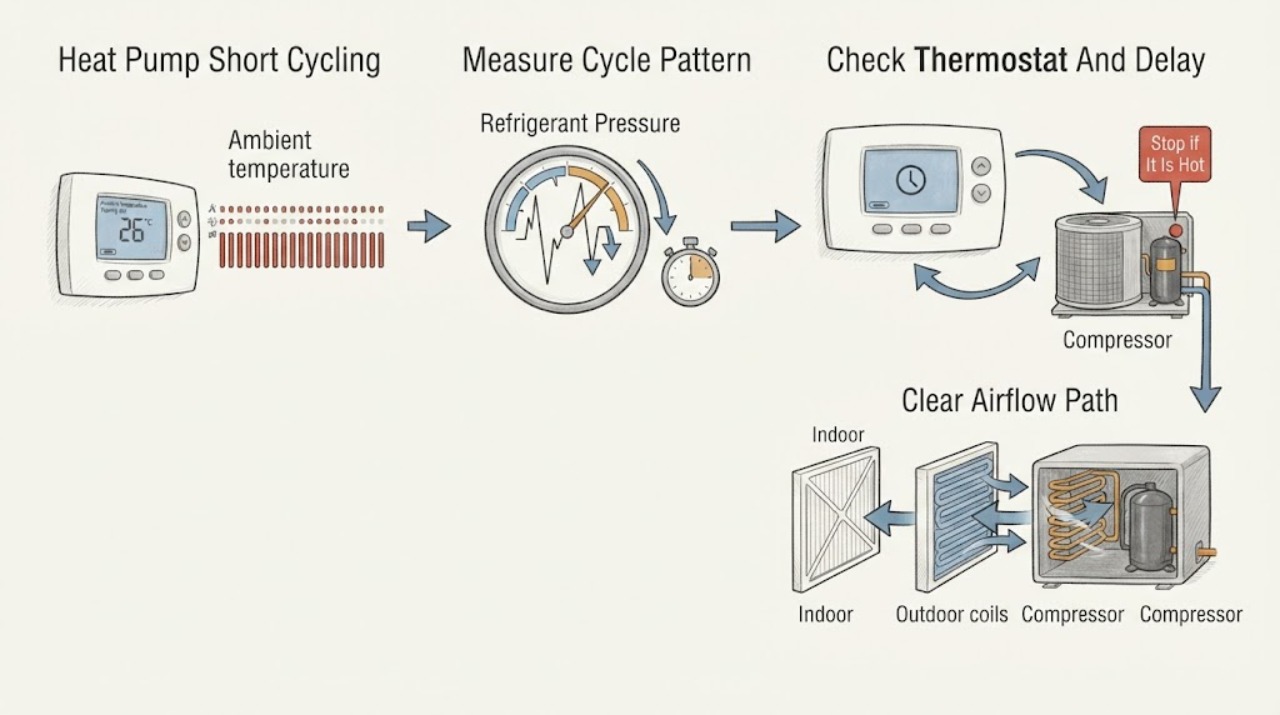
A Carrier heat pump is short cycling when it starts and stops repeatedly before completing a normal heating or cooling cycle. A thermostat time delay after a stop can be normal, but repeated rapid restarts are not a condition to ignore because they can reduce comfort and stress the compressor and motors. First record the mode, cycle timing, room temperature, set point, and whether the indoor blower and outdoor unit stop together. Check the thermostat mode and placement, the accessible air filter, open registers, and visible debris around the outdoor unit. Do not bypass a time delay, safety switch, or thermostat wiring. Carrier identifies clogged filters, refrigerant or airflow problems, thermostat issues, dirty coils, electrical components, and system sizing as possible short-cycling contributors; a cold-weather defrost pause can also be normal if the system resumes afterward. Turn the system off at the thermostat and arrange qualified HVAC service for repeated rapid cycling, a frozen coil, ice that does not clear, a tripped breaker, burning odor, weak airflow, compressor or fan failure, or loss of heating or cooling.
Work through in order
Diagnostic checks
Use only checks that match the exact appliance or system and its official guide.
-
Check 1
For a safe observation period, record the Carrier heat pump mode, thermostat set point and displayed temperature, approximate run duration, stop duration, number of starts, indoor blower behavior, outdoor fan behavior, and whether the system is in a possible defrost event. Do not repeatedly change the set point to force a cycle.
Expected result: The system pauses once and then resumes; it starts and stops repeatedly after short runs; the indoor and outdoor sections stop together; only one section stops; the set point is reached quickly; or comfort is not maintained.
Next step: Keep settings steady and continue only with safe visual checks. Turn the system off at the thermostat and arrange service for repeated rapid starts, lost comfort, or any warning symptom.
Stop if: Stop for a burning smell, smoke, exposed wiring, repeated breaker trips, a frozen coil, hard ice, loud mechanical noise, water near electrical equipment, or no heating or cooling.
Why this matters
Why: A single protective delay may be normal. Repeated incomplete runs indicate short cycling, but the pattern alone cannot separate thermostat, airflow, sizing, safety, refrigerant, or electrical causes. Different indoor and outdoor behavior is useful information for a technician.
-
Check 2
Verify that the thermostat is in the intended heat or cool mode, is not in an unusual schedule or emergency setting, and is not mounted in direct sun, beside a heat source, or in a draft. Note any displayed time-delay message or error. Do not change wiring, remove the thermostat base, or disable a delay.
Expected result: The mode or schedule is wrong; the thermostat is exposed to a local heat or draft source; a delay appears after each stop; the display temperature differs from the room pattern; or settings and placement appear normal.
Next step: Correct only an obvious mode or schedule setting and allow the normal delay to complete. If short cycling continues or the thermostat needs calibration, wiring, or replacement, arrange HVAC service.
Stop if: Stop for exposed or frayed wiring, a persistent error code, burning smell, a blank or unstable display, a tripped breaker, or any need to alter thermostat wiring or controls.
Why this matters
Why: An incorrect mode, local temperature bias, or schedule can create unnecessary calls. A delay message may be a protective control rather than a fault. Normal settings and placement with repeated cycling make airflow, equipment, safety, refrigerant, electrical, or sizing causes more likely.
-
Check 3
Inspect the accessible air filter, supply registers, return grille, and outdoor unit perimeter. Clean or replace the filter only according to the Carrier model instructions, open blocked registers, and clear only loose leaves or snow outside the outdoor cabinet. Do not wash a running unit, remove panels, touch coils, or chip ice.
Expected result: The filter is heavily loaded; several registers or the return are blocked; leaves or snow restrict the outdoor unit; the indoor or outdoor coil is visibly iced; or the air path is clear.
Next step: Restore the accessible airflow path and observe without forcing additional starts. If cycling remains rapid, ice returns, or comfort is poor, turn the system off and arrange professional diagnosis.
Stop if: Stop for a wet or damaged filter, frozen coil, hard ice, water near electrical components, a fan that will not turn, exposed wiring, or any need to open the equipment.
Why this matters
Why: Restricted airflow can make the system work harder and trigger a protective stop or contribute to freezing. Ice, a clear air path with continued short cycling, or a filter that quickly becomes dirty points to a problem beyond a simple filter change.
-
Check 4
Compare the cycling pattern with outdoor conditions and load: mild versus extreme weather, one room versus the whole home, recent insulation or window changes, doors or registers closed, and whether the set point is reached unusually fast. Record whether short cycling occurs in both heating and cooling or only one mode.
Expected result: Short cycling occurs mostly on mild days; only one zone or room is affected; it happens in both modes; it appears after a renovation or control change; it happens with extreme weather; or it is accompanied by humidity, ice, weak airflow, or constant auxiliary heat.
Next step: Provide the pattern to a qualified HVAC professional for measurements and a load or control assessment. Do not retune refrigerant, change wiring, or replace equipment based on runtime alone.
Stop if: Stop for frozen coils, repeated breaker trips, burning odor, refrigerant-line damage, major airflow loss, or a system that cannot maintain a safe indoor temperature.
Why this matters
Why: Mild-weather, quick set-point satisfaction can make low-load or oversizing questions more relevant, while one-zone symptoms can indicate zoning or thermostat sensing. Both-mode symptoms make controls or airflow more plausible; mode-specific symptoms make refrigerant, defrost, reversing, or capacity concerns possible. Extreme-weather cycling with poor comfort is not evidence that the equipment is correctly sized.
-
Check 5
Record the complete Carrier model, thermostat type, mode, set point and displayed temperature, cycle timing, outdoor weather, filter and register state, visible outdoor obstruction or ice, error messages, auxiliary-heat indication, breaker events, noises, odors, and results after safe setting or airflow checks.
Expected result: The system continues to start and stop rapidly; the set point is not reached; a coil is frozen; refrigerant or electrical symptoms are suspected; or safe checks changed nothing.
Next step: Turn the system off at the thermostat when cycling is severe or a warning symptom is present, and arrange qualified HVAC service. Give the technician the recorded timing and symptom pattern rather than trying to identify a part yourself.
Stop if: Do not open panels, test high voltage, inspect or discharge a capacitor, add refrigerant, bypass a safety switch, alter wiring, or repeatedly reset a tripping breaker.
Why this matters
Why: Persistent short cycling may involve low refrigerant, a frozen coil, thermostat or control fault, restricted airflow, incorrect capacity or sizing, compressor or capacitor trouble, a safety switch, or defrost or reversing operation. These causes overlap and require measurements.
Use your observations
Decision map
Find the observation that best matches what you see, then follow the next safe action.
-
PATH 01Next step
What you see
Do this next
Keep the thermostat settings steady and monitor. Arrange service if the pause becomes a repeated incomplete-cycle pattern or new symptoms appear.
Why this path and its safety boundary
Why it matters: A protective thermostat or equipment delay is more likely than short cycling. The delay should not be bypassed.
-
PATH 02Next step
What you see
Do this next
Restore accessible airflow as directed by the model manual and stop if ice or poor comfort persists. Arrange HVAC service for coil, blower, safety-control, or airflow testing.
Why this path and its safety boundary
Why it matters: Restricted airflow or a safety shutdown is more likely than a thermostat-only problem. A filter change may help, but recurring cycling or ice needs diagnosis.
-
PATH 03Next step
What you see
Do this next
Keep settings consistent and request a professional control and load assessment. Do not relocate wiring, recalibrate controls, or select new equipment from runtime alone.
Why this path and its safety boundary
Why it matters: Thermostat sensing, zoning, low load, capacity or sizing, or control configuration is more likely. A level of runtime that seems short does not prove the equipment is oversized.
-
PATH 04Next step
What you see
Do this next
Turn the system off at the thermostat, keep the equipment closed, and arrange qualified HVAC service. Report the mode, timing, ice, odor, breaker, and comfort pattern.
Why this path and its safety boundary
Why it matters: Refrigerant, compressor, capacitor, electrical, defrost, reversing-valve, or control trouble is possible. These are professional diagnostic boundaries and cannot be separated by a homeowner thermostat test.
Helpful context
Understand the symptom
Separate a protective delay from repeated short cycling
A thermostat can wait before restarting after a stop to protect the equipment. That single delay is different from a pattern in which the Carrier heat pump starts, runs briefly, stops, and restarts repeatedly while the space still needs heating or cooling. Count complete starts over a representative period and note whether the outdoor compressor, outdoor fan, and indoor blower follow the same pattern. A control delay alone does not explain repeated incomplete cycles accompanied by poor comfort, ice, or a breaker event.
Start with the air path and thermostat, not internal parts
A clogged filter, blocked register, dirty coil, or outdoor obstruction can change airflow and operating load. Check only accessible items: thermostat mode and placement, filter condition, open registers, and loose debris around the outdoor unit. Carrier's service checklist places refrigerant charge, electrical connections, capacitors, reversing-valve operation, defrost, coils, blowers, and drainage within a service visit. Do not open panels, test voltage, adjust refrigerant, or bypass a safety control.
Sizing is a professional diagnosis, not a homeowner setting
If the system reaches the set point very quickly on mild days and then restarts often, the equipment may be meeting a small load with more capacity than the space needs. The same symptom can also come from a thermostat sensing problem, restricted airflow, low refrigerant, a frozen coil, or a safety shutdown. The remedy depends on measurements and the equipment's design; do not raise or lower the thermostat repeatedly to mask the pattern or assume a larger or smaller replacement is correct without a load evaluation.
Safety boundary
Stop conditions
- Turn the system off at the thermostat for smoke, burning or electrical odor, exposed wiring, repeated breaker trips, a frozen or hard-iced coil, loud mechanical noise, water near electrical equipment, or loss of heating or cooling.
- Do not bypass a thermostat time delay, safety switch, or error; do not repeatedly reset a tripping breaker.
- Do not open HVAC panels, test high voltage, inspect or discharge a capacitor, add refrigerant, alter wiring, adjust a reversing valve, or access a compressor or sealed circuit.
- Do not chip ice, apply heat to coils or lines, hose a running outdoor unit, or force a fan or control component.
- Arrange qualified service when rapid cycling persists after safe checks or when airflow, refrigerant, electrical, defrost, compressor, control, zoning, or sizing work is implicated.
Only after diagnosis
Potential parts
- Carrier air filter, blower, or airflow component
Consider this part class only when accessible airflow checks are complete and qualified diagnosis confirms a restricted, damaged, or incorrectly supported airflow component.
Filter size, blower type, wheel, motor, controls, and air-handler configuration vary by Carrier model; confirm the complete model and diagnosis before selecting a part. - Carrier thermostat, sensor, or control board
Consider this part class only when measured cycling and thermostat checks identify a sensing, communication, or control fault rather than an airflow, load, or refrigerant cause.
Thermostat compatibility, sensors, wiring, firmware, and control boards are system-specific; use the exact Carrier documentation and qualified diagnosis. - Carrier capacitor, compressor, reversing valve, or defrost control
Consider this part class only after a qualified technician links the short-cycling pattern to an electrical, compressor, mode-switching, or defrost fault.
Electrical ratings, refrigerant circuit, controls, and model revisions vary; these components are not safe homeowner replacements based on runtime alone.
When checks do not resolve it
Need a professional?
Arrange service when rapid starts continue after safe thermostat, filter, register, and obstruction checks; the set point is not reached; cycling occurs with ice, weak airflow, abnormal noise, a burning odor, a breaker trip, auxiliary heat, or mode-switching trouble; or diagnosis requires electrical, refrigerant, coil, compressor, defrost, control, or sizing measurements.
Have this ready
- Complete Carrier heat-pump and thermostat models
- Mode, set point, displayed temperature, approximate run and pause durations, and number of starts
- Indoor blower and outdoor-unit behavior during each stop
- Filter, registers, outdoor debris, coil frost, weather, airflow, comfort, and auxiliary-heat observations
- Error messages, breaker events, odors, unusual sounds, recent installation, renovation, zoning, or control changes
Common questions
FAQ
What does short cycling mean on a Carrier heat pump?
Short cycling means the heat pump starts and stops repeatedly before completing a normal heating or cooling cycle. A single protective delay after a completed run can be normal; repeated short runs with poor comfort, ice, weak airflow, or rapid restarts are not. Record the timing and arrange professional diagnosis if the pattern continues.
Can a dirty filter make a Carrier heat pump short cycle?
Yes. A clogged filter restricts airflow and can make the system work harder or trigger a protective stop. Check the accessible filter and replace or clean it as the Carrier model instructions specify. If rapid cycling, weak airflow, or ice remains with a correct filter, turn the system off and arrange service.
Could my Carrier thermostat be causing short cycling?
A thermostat mode, schedule, placement, sensing, wiring, or control problem can contribute, but short cycling can also come from airflow, refrigerant, frozen coils, safety controls, equipment capacity, or other faults. Check only obvious settings and placement, do not bypass a time delay or alter wiring, and seek service if rapid cycling continues.
Is short cycling normal on mild days?
A heat pump may run differently as the load changes, but repeated incomplete starts are still worth documenting. Quick set-point satisfaction on mild days can raise a sizing, zoning, or thermostat question, while the same symptom can result from airflow, refrigerant, frozen-coil, or control problems. A professional load and system assessment is needed before changing equipment.
When should I turn off a short-cycling Carrier heat pump?
Turn it off at the thermostat for a burning odor, smoke, exposed wiring, repeated breaker trips, frozen or hard-iced coils, loud mechanical noise, water near electrical equipment, severe weak airflow, or loss of heating or cooling. Keep the equipment closed and arrange qualified HVAC service rather than resetting or bypassing controls.
Read the exact guide
Official sources
- Heat Pump Service and Maintenance TipsCarrier · Official Carrier heat-pump service guidance used for homeowner-safe maintenance and the service inspection boundary; exact procedures remain model-specific.
- Heat Pump Troubleshooting Guide | Common Heat Pump Problems & FixesCarrier · Official Carrier troubleshooting guidance used for general homeowner checks and symptom combinations; it does not authorize internal electrical, refrigerant, compressor, or control work.
- Common Thermostat Issues and How to TroubleshootCarrier · Official Carrier thermostat guidance used for the definition of short cycling, delay behavior, accessible thermostat and filter checks, and professional boundaries; the page does not diagnose every heat-pump system.
- What Is AC Short Cycling: Causes, Effects, and TroubleshootingCarrier · Official Carrier air-conditioner guidance used for general HVAC short-cycling mechanisms and effects; heat-pump mode and model-specific controls still require the exact documentation.
- HVAC - Cold Climate Heat Pump SizingU.S. Department of Energy Building Science Education · Official DOE building-science training page used to explain why equipment sizing and load calculations matter; it is not an individual home's sizing diagnosis.
Community feedback
Share a repair observation
Share a plain-text repair observation. Accepted observations are published automatically; this page may take a moment to update.