
On this page
Start here
Quick answer
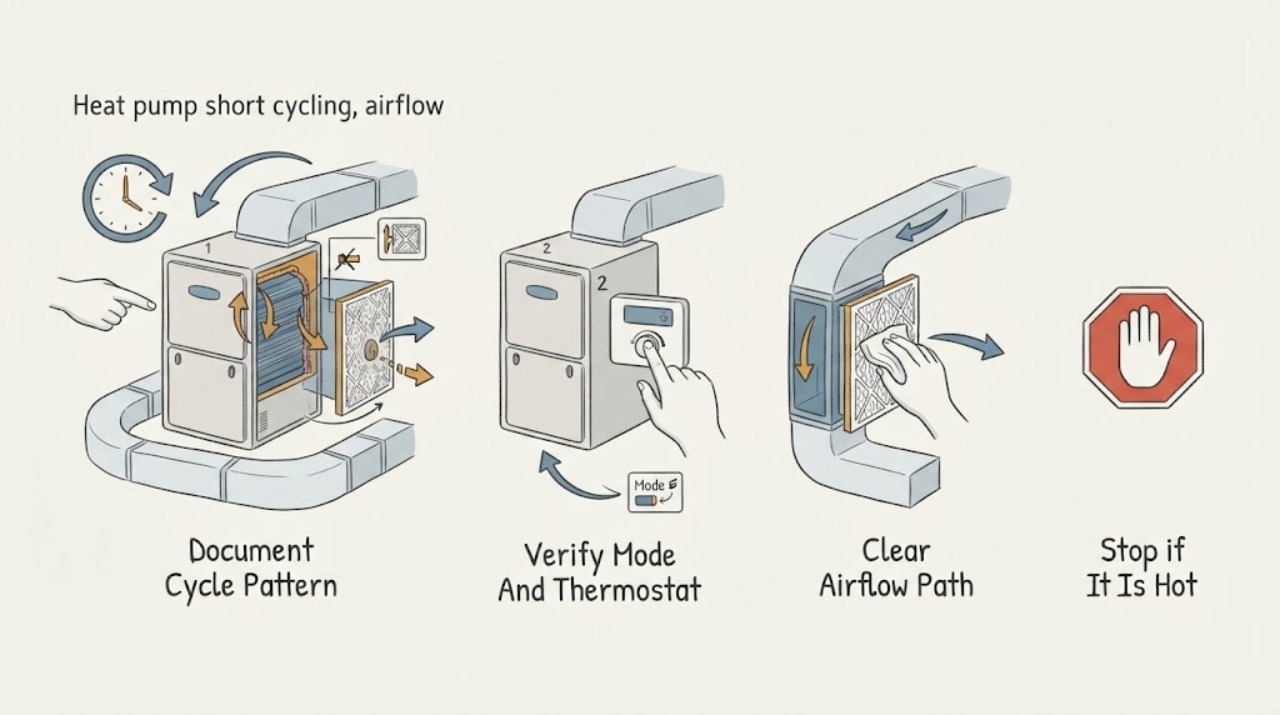
A heat pump that starts and stops before the home is comfortable may have restricted airflow, a thermostat or control issue, an outdoor coil or fan problem, a defrost fault, low refrigerant, or incorrect sizing. Start with observations that do not require opening equipment: confirm the operating mode and setpoint, note whether air is moving at the registers, inspect the user-accessible filter, make sure registers and returns are clear, and look from a safe position for persistent ice, water, or an outdoor unit blocked by debris. A clogged filter can restrict airflow and contribute to overworking or short cycling, while a frozen heat pump can also involve defrost, fan, refrigerant, or blockage problems. Turn the system off and arrange qualified HVAC service for persistent short cycling, ice, abnormal water, weak airflow, a stationary fan, unusual noise, smoke, burning odor, or a repeated breaker trip. Do not open a cabinet, reach into a fan, test live wiring, or handle refrigerant.
Work through in order
Diagnostic checks
Use only checks that match the exact appliance or system and its official guide.
-
Check 1
Without repeatedly changing the setting, observe one normal call and record the mode, thermostat setpoint, room temperature if shown, start time, stop time, off time, and whether the home reaches the setpoint.
Expected result: Record repeated short runs that do not reach the setpoint, a cycle that reaches the setpoint quickly, a brief defrost-related change, or a normal-length cycle with no comfort problem.
Next step: Continue with the airflow and ice checks for repeated incomplete runs. If the system has short-cycled since installation, include that history in a service request for sizing and commissioning review.
Stop if: Stop and leave the system off for smoke, burning odor, arcing, a hot enclosure, active water near electrical equipment, or a repeated breaker trip.
Why this matters
Why: Repeated incomplete runs support a fault or airflow investigation; rapid setpoint satisfaction from the day of installation can support a sizing or thermostat review; a brief defrost event alone is not proof of a failed part.
-
Check 2
Read the thermostat without removing it; confirm the intended Heat or Cool mode, the setpoint, schedule, fan setting, and whether Auto mode is selecting an unexpected mode.
Expected result: Record an obvious wrong mode or schedule change, a stable call in the intended mode, a blank or unstable display, or a thermostat located in direct sun, beside a vent, or near a heat source.
Next step: Correct one obvious setting and observe one cycle. If the display is unstable, the thermostat is hot or damaged, or cycling continues with correct settings, arrange HVAC service.
Stop if: Do not remove the thermostat, open its wiring compartment, bypass controls, or keep resetting it to reproduce the symptom.
Why this matters
Why: A wrong setting or schedule can create apparent cycling, while a display, placement, or control problem can cause false calls. A stable call with correct settings sends attention back to airflow and equipment behavior.
-
Check 3
With the heat pump stopped, inspect the filter only through its normal user access and check that supply registers and return grilles are open and clear of furniture, rugs, and fabric.
Expected result: Record a clean and dry filter with clear grilles, a visibly loaded filter, a wet filter, blocked registers or returns, or an access point that requires tools or cabinet removal.
Next step: Open an accidentally closed grille or replace or clean the filter only as directed for that equipment, then observe the next ordinary cycle. If cycling or weak airflow remains, leave the system off and arrange HVAC service.
Stop if: Do not stack filters, remove a blower or coil cover, reach into the return, or use a tool to clear material inside the equipment.
Why this matters
Why: A loaded filter or blocked grille can restrict airflow and make the heat pump work harder. A clean air path with weak airflow, a wet filter, or inaccessible equipment requires a broader blower, coil, duct, drain, or control diagnosis.
-
Check 4
From a safe position, look for persistent frost or ice on the outdoor coil, ice on accessible lines, water from thawing, and water near electrical equipment; do not touch the lines or remove a panel.
Expected result: Record no ice or water, light frost that clears during a normal defrost event, persistent or heavy ice, active water, or a major change in airflow accompanying the ice.
Next step: Turn the heat pump off and arrange qualified HVAC service for persistent ice, abnormal water, or weak airflow. Provide the timing and operating mode in which the ice appeared.
Stop if: Do not chip ice, pour water on the unit, touch a fan or refrigerant line, add refrigerant, or operate near wet electrical equipment.
Why this matters
Why: Persistent ice can be associated with restricted airflow, a failed defrost cycle, outdoor fan trouble, physical blockage, or refrigerant issues. Water near electrical equipment is a safety issue, and the observation cannot identify the refrigerant or defrost fault by itself.
-
Check 5
From outside the equipment enclosure, note whether the outdoor unit has clear space, whether its fan appears to move air during a call, and whether there is unusual rattling, grinding, or a burning smell; keep clear of guards and moving parts.
Expected result: Record clear surroundings and normal fan movement, leaves or snow obstructing the enclosure, a stationary fan, abnormal noise, smoke, or an odor of overheated material.
Next step: Clear only loose debris or snow that is outside the unit and reachable without tools, then allow one call. For a stationary fan, noise, smoke, odor, or continued cycling, turn the system off and request HVAC service.
Stop if: Do not remove guards or panels, reach into the fan, wash a running unit, touch wiring or capacitors, or restart repeatedly to test a noise.
Why this matters
Why: A blocked unit can reduce heat transfer, while a stationary fan, abnormal sound, smoke, or odor points to an equipment or electrical fault that an external observation cannot safely diagnose.
-
Check 6
Prepare a service note with the model if safely visible, cycle timing, mode and setpoint, filter and grille condition, airflow strength, ice or water, outdoor fan and sound observations, power interruptions, and whether the symptom began after installation or a setting change.
Expected result: Confirm that the note contains observations from ordinary access only and that no cabinet, wiring, fan, coil, compressor, or sealed-system component was disturbed.
Next step: Request qualified HVAC diagnosis and ask the technician to evaluate airflow, indoor and outdoor coils, blower, controls, defrost operation, refrigerant, and sizing as indicated by the record.
Stop if: Stop all user troubleshooting when the next step requires cabinet access, electrical measurements, work near moving equipment, refrigerant handling, or bypassing a safety device.
Why this matters
Why: The pattern helps a technician separate airflow restriction from thermostat or control calls, defrost or outdoor-fan problems, refrigerant concerns, and possible sizing or commissioning issues without asking the owner to make a hazardous diagnosis.
Use your observations
Decision map
Find the observation that best matches what you see, then follow the next safe action.
-
PATH 01Next step
What you see
The heat pump briefly changes sound or mode, then resumes normal airflow and comfort without persistent ice or rapid restarts.
Do this next
Monitor one or two ordinary cycles and keep the timing record. Escalate if the off/on pattern becomes frequent, comfort drops, or ice remains.
Why this path and its safety boundary
Why it matters: A short defrost-related event may be normal operation, but a recurring pattern that leaves the home cold or warm needs service rather than being dismissed as defrost.
-
PATH 02Next step
What you see
Airflow is weak and the filter is visibly loaded, or multiple returns and registers are blocked, with no urgent electrical warning.
Do this next
Restore only the obvious user-accessible airflow path, observe one cycle, and arrange HVAC service if airflow or cycling does not normalize.
Why this path and its safety boundary
Why it matters: An airflow restriction is plausible and can make the heat pump work harder, but continued short cycling after the external correction points to filter fit, duct, blower, coil, or control causes.
-
PATH 03Next step
What you see
Heavy or persistent ice, thawing water, or a significant airflow drop accompanies the short cycling.
Do this next
Leave the system off and request qualified HVAC service. Keep clear of wet electrical equipment and do not chip ice or handle lines.
Why this path and its safety boundary
Why it matters: Restricted airflow, defrost failure, outdoor-fan trouble, blockage, and refrigerant problems are all possible; the visible ice does not identify which one is present.
-
PATH 04Next step
What you see
The thermostat is in the intended mode but the display is unstable, the schedule changes unexpectedly, or the heat pump cycles without a consistent room-temperature reason.
Do this next
Document the display and schedule behavior and arrange HVAC service; do not open thermostat wiring or bypass controls.
Why this path and its safety boundary
Why it matters: The thermostat, its placement, or a control signal becomes more likely than a simple filter restriction, although equipment faults can produce similar timing.
-
PATH 05Next step
What you see
The outdoor fan is stationary, the outdoor unit has unusual noise, or the area is obstructed while the thermostat is calling.
Do this next
Turn the heat pump off and request HVAC service, reporting the outdoor response and whether the indoor blower still moves air.
Why this path and its safety boundary
Why it matters: Outdoor airflow, fan, mechanical, defrost, or electrical problems are possible; a stationary fan or harsh noise can worsen equipment damage if operation continues.
-
PATH 06Safety boundary
What you see
Short cycling began at installation or after a system change, or there is smoke, burning odor, arcing, a hot enclosure, water at electrical equipment, or a repeated breaker trip.
Do this next
For a new-system pattern, request a qualified sizing and commissioning review. For any safety warning, leave the system off, keep clear, and use appropriate emergency, electrical, or HVAC help from a safe location.
Why this path and its safety boundary
Why it matters: The first pattern calls for sizing and commissioning review; the second is an immediate safety boundary and is not a troubleshooting branch for the homeowner.
Safety stop: Do not restart to reproduce the fault, reset a repeatedly tripping breaker, open electrical covers, or continue near smoke, heat, arcing, or water.
Helpful context
Understand the symptom
First decide whether this is true short cycling
Write down when the heat pump starts, when the compressor or outdoor unit stops, how long the off period lasts, and whether the thermostat has actually reached its setpoint. A brief change during a normal defrost operation is different from repeated starts that leave the home cold or warm. Trane describes short cycling as a heat pump or air conditioner turning on and off much more frequently than normal; repeated operation adds wear and can reduce comfort. A cycle that began immediately after installation, or one that reaches the setpoint unusually quickly, makes sizing or thermostat placement worth discussing with a technician rather than assuming the filter is the whole cause.
Airflow checks are the safe first pass
With the system stopped, check the filter through its normal user access and look at supply registers and return grilles. A visibly loaded filter, closed register, covered return, or furniture blocking a grille can reduce delivered airflow. Replace or clean the filter only according to the equipment or filter instructions and use the specified type; do not stack filters or remove an equipment panel. Carrier says a clogged filter restricts airflow and can force a heat pump to work harder, while ENERGY STAR recommends checking filters when visibly dirty or when the filter light indicates service. If the filter is wet, the access is not ordinary user access, or airflow remains weak, stop there and arrange service.
Ice and the outdoor unit change the decision
From a safe position, look for heavy or persistent frost on the outdoor coil, ice on accessible lines, water after thawing, leaves or snow packed around the outdoor unit, and whether the outdoor fan appears to run normally. Some frost can be part of heat-pump operation, but persistent ice or a unit that cannot move air is not a filter-cleaning problem to solve by force. Carrier lists a failed defrost cycle, outdoor fan failure, low refrigerant, physical blockage, and water freezing on the unit among possible reasons for a frozen heat pump. Turn the system off if substantial ice, active water near electrical equipment, or a stationary fan is present; do not chip ice, pour water on the unit, touch a fan, or handle refrigerant lines.
Mode and thermostat behavior can mimic a fault
Confirm whether the thermostat is intentionally calling for heat or cool, whether a schedule is changing the setpoint, and whether Auto mode is switching modes in unusual weather. ENERGY STAR recommends a steady temperature, selecting Heat or Cool instead of Auto when avoiding unwanted mode changes, and using Auto fan or a speed that distributes air adequately. Trane notes that an incorrectly placed or malfunctioning thermostat can call the system at the wrong times. Correct only an obvious user setting and observe one ordinary cycle; a blank, unstable, hot, or physically damaged thermostat needs professional attention rather than repeated resets.
What a technician needs to test
If safe checks do not restore normal cycles, the service request should ask for airflow measurement, filter and indoor-coil inspection, duct and blower evaluation, thermostat and control checks, outdoor coil and fan inspection, defrost operation, refrigerant diagnosis, and verification that the equipment is properly sized for the home. ENERGY STAR says proper heat-pump sizing is essential and points to a Manual J load calculation; a new system that has short-cycled from the first day deserves a commissioning or sizing review. These tests involve electrical, moving, and sealed-system hazards and are not homeowner measurements.
Safety boundary
Stop conditions
- Stop immediately for smoke, fire, burning odor, arcing, a hot enclosure, exposed wiring, water near electrical equipment, or a repeated breaker trip.
- Leave the heat pump off for persistent ice, abnormal water, a stationary outdoor fan, severe vibration, weak or absent airflow, or a loud worsening sound.
- Never open HVAC cabinets, reach through fan guards, touch wiring or capacitors, perform live electrical checks, handle refrigerant, chip ice, or bypass a safety device as a homeowner.
Only after diagnosis
Potential parts
- air filter
A filter is a routine maintenance item only when the installed system's instructions identify it as user-accessible and the existing filter is dirty or damaged; a filter replacement does not repair a continuing short-cycle fault.
Confirm the exact dimensions, airflow rating, access arrangement, and manufacturer instructions before choosing a replacement. - thermostat or heat-pump control component
A thermostat, defrost control, sensor, fan control, or another board should be considered only after qualified testing identifies the failed component; short cycling alone does not identify a part.
A qualified technician must confirm the exact system model, control protocol, wiring, voltage, and approved replacement before sourcing any control component.
When checks do not resolve it
Need a professional?
Call a qualified HVAC technician when short cycling remains after the filter and register check, the system does not reach the setpoint, airflow stays weak, ice or water returns, the outdoor fan does not run, the thermostat call is unstable, or the problem began after installation. Use emergency or electrical help for smoke, burning odor, arcing, a hot enclosure, exposed wiring, water at electrical equipment, or a repeated breaker trip.
Have this ready
- Provide the model if safely visible, cycle timing, mode and setpoint, filter and grille condition, airflow, ice or water observations, outdoor fan and sound behavior, power events, and whether the symptom dates from installation or a setting change.
Common questions
FAQ
Can a dirty heat-pump filter cause short cycling?
It can restrict airflow and make the heat pump work harder, but a dirty filter is only one possible cause. Check the filter and unobstructed registers through normal user access; if cycling continues, airflow stays weak, or ice appears, arrange HVAC service rather than opening the equipment.
Is frost on a heat pump always a problem?
A brief defrost-related change can occur during heat-pump operation, but heavy or persistent ice, reduced airflow, or water near electrical equipment is not a safe do-it-yourself diagnosis. Turn the system off and request qualified HVAC service; do not chip ice or handle refrigerant lines.
Why does the heat pump short-cycle even with a clean filter?
Thermostat placement or control behavior, blocked ducts or coils, an outdoor fan or defrost problem, refrigerant or sealed-system trouble, and incorrect sizing can all remain possible. Record the mode, cycle timing, airflow, ice, outdoor response, and whether the problem began at installation, then have a qualified technician test the system.
Should I keep running a heat pump that starts and stops every few minutes?
Do not keep operating it when short cycling is accompanied by persistent ice, weak airflow, a stationary fan, unusual noise, smoke, burning odor, water near electrical equipment, or a repeated breaker trip. Leave it off and arrange qualified service; repeated starts can add wear and cannot identify the underlying fault safely.
Read the exact guide
Official sources
- HVAC Short Cycling: Causes and SolutionsTrane · Trane residential guidance used for general short-cycling distinctions and likely thermostat or sizing paths, not model-specific repair instructions.
- Maintenance ChecklistENERGY STAR · ENERGY STAR maintenance checklist used for general filter and airflow recommendations and for identifying checks appropriate to a service visit.
- Heat Pump Service and Maintenance TipsCarrier · Carrier residential heat-pump maintenance guidance used for safe homeowner observations and general diagnostic categories; exact model instructions govern access and maintenance.
- Air-Source Heat PumpsENERGY STAR · ENERGY STAR consumer guidance used for general heat-pump controls, airflow-maintenance, and sizing context, not a substitute for the installed equipment manual.
Community feedback
Share a repair observation
Share a plain-text repair observation. Accepted observations are published automatically; this page may take a moment to update.