
On this page
Start here
Quick answer
A heat pump that starts and stops repeatedly without reaching the thermostat setpoint is not behaving like a normal completed cycle. Check the thermostat mode and reading, the accessible air filter, supply and return airflow, and the outdoor unit for obvious leaves, snow, or ice. If the system runs for a long time but the room still misses the setpoint, consider airflow restriction, a dirty coil, extreme outdoor conditions, low refrigerant, a reversing-valve or compressor issue, or an improperly sized system; if it shuts off and restarts unusually often, also consider thermostat location or control settings. Do not add refrigerant, chip ice, bypass controls, alter wiring, or keep resetting a tripping breaker. If the outdoor coil is icing, the compressor or fan makes abnormal noise, the breaker trips, the temperature becomes unsafe, or basic checks do not restore a stable cycle, turn the system off if safe and arrange qualified HVAC service.
Work through in order
Diagnostic checks
Use only checks that match the exact appliance or system and its official guide.
-
Check 1
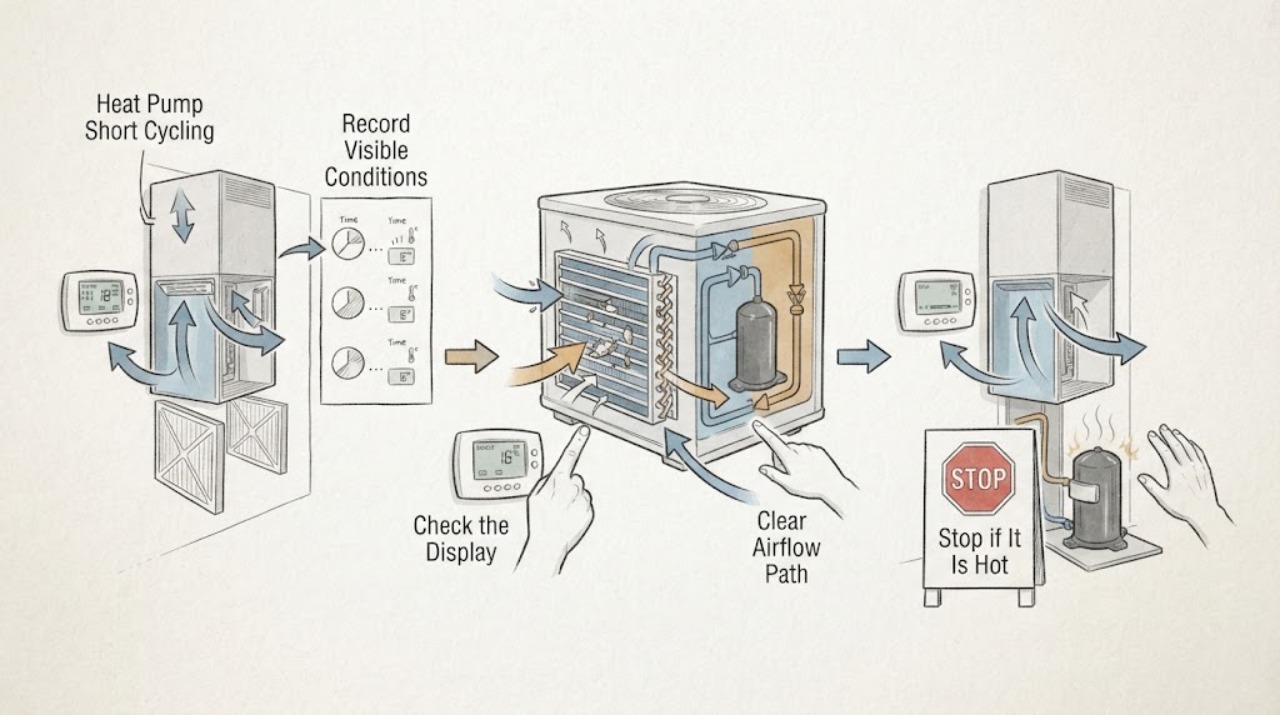
Record several normal calls without changing the thermostat repeatedly: note the mode, setpoint, room temperature, start/stop times, outdoor conditions, and whether the heat pump stops before reaching the setpoint or runs continuously. Keep people away from moving equipment.
Expected result: The unit restarts unusually often, runs for long periods without reaching the setpoint, stops after reaching the setpoint, or the thermostat display does not match a separate thermometer.
Next step: Keep a simple cycle log and continue with thermostat, filter, and airflow checks. If the system short cycles with no obvious setting issue or cannot approach the setpoint, arrange qualified HVAC diagnosis rather than forcing a lower or higher setpoint.
Stop if: Stop using the system for a scalding/unsafe condition, smoke, burning electrical odor, abnormal compressor noise, repeated breaker trip, refrigerant concern, or worsening ice.
Why this matters
Why: Frequent starts suggest short cycling or a control/thermostat issue. Long running without setpoint suggests restricted airflow, dirty coils, extreme load, low refrigerant, component trouble, or undersizing. A normal stop at the setpoint is not short cycling; a mismatched display can make the symptom appear worse than it is.
-
Check 2
Check the thermostat mode, schedule, fan setting, and displayed room temperature. Compare the display with a separate thermometer placed nearby but away from a supply register, sunlight, or heat-producing appliance; do not remove the thermostat faceplate or touch its wiring.
Expected result: The mode is wrong, the setpoint is being changed by a schedule, the thermostat is near a heat source or vent, the display differs materially from the separate thermometer, or the settings and reading appear normal.
Next step: Correct only an obvious mode or schedule setting and monitor one complete call. If the reading or location is suspect, use the exact thermostat instructions or arrange service; do not change anti-short-cycle or staging settings by guesswork.
Stop if: Stop for exposed wiring, a blank or overheating thermostat, a burning odor, unsafe temperature, or any request to jumper terminals or alter live controls.
Why this matters
Why: Incorrect mode, programming, placement, or calibration can produce premature calls or make the setpoint appear unmet. Normal settings and a plausible reading move attention toward airflow, outdoor conditions, system capacity, or an HVAC component.
-
Check 3
Inspect the accessible indoor filter and supply/return grilles, then inspect the outdoor unit from outside for leaves, snow, or other obvious airflow blockage. With power off, clear only loose debris that is not attached to the equipment; do not touch coils, fan blades, wiring, or ice.
Expected result: The filter is clogged, vents or returns are blocked, outdoor airflow is obstructed, the coil is heavily iced, or the visible airflow path is clear.
Next step: Replace the filter according to the unit instructions and open blocked grilles. Remove only safe loose outdoor debris with power off. If ice remains, grows, or returns, turn the system off if safe and call an HVAC professional; never chip the ice.
Stop if: Stop for heavy ice, a damaged fan guard, exposed coil or wiring, water near electrical parts, severe vibration, or any need to enter the cabinet or use tools on the coil.
Why this matters
Why: Restricted indoor or outdoor airflow can reduce capacity, increase run time, and contribute to short cycling or overheating. A coating of ice that does not clear can indicate defrost, airflow, refrigerant, or fan trouble; a clear path does not rule out those internal causes.
-
Check 4
Observe whether the symptom changes with outdoor temperature, mode, defrost, or a second heating stage/backup system, without forcing a mode change. Note any weak airflow, cold air in heat mode, long continuous operation, icing, unusual noise, or a failure to switch modes.
Expected result: The heat pump struggles only in extreme weather, runs constantly in moderate weather, blows cold in heat mode, ices, makes a new noise, or fails to change heating/cooling modes.
Next step: Document the outdoor condition and symptom combination. Keep the system off if there is ice, abnormal noise, or unsafe operation and arrange qualified HVAC diagnosis; do not add refrigerant or adjust the reversing valve.
Stop if: Stop for compressor grinding, loud screeching, burning odor, smoke, refrigerant hissing, repeated electrical trips, or an outdoor coil that stays frozen.
Why this matters
Why: Extreme conditions can increase normal run time, but persistent setpoint loss in moderate weather makes dirty coils, low refrigerant, reversing-valve, compressor, defrost, airflow, or sizing problems more likely. A mode-switch or cold-air symptom points beyond a thermostat setpoint alone.
-
Check 5
If basic thermostat, filter, and visible airflow checks are normal, make one controlled observation of the next cycle and then stop troubleshooting. Gather the model, installation age, cycle log, filter history, outdoor conditions, and any prior service information for the technician.
Expected result: The system still short cycles before setpoint, runs continuously without reaching setpoint, or the issue disappears after a safe setting/filter/debris correction.
Next step: Monitor only if operation returns to a stable normal pattern. Otherwise leave the system in the safest available state and arrange a qualified HVAC technician to test the system rather than repeatedly resetting or changing settings.
Stop if: Stop for any recurring short cycle, unsafe temperature, leak, abnormal odor/noise, ice, breaker trip, or any need to open panels, test live circuits, access refrigerant, or modify controls.
Why this matters
Why: A persistent symptom after external checks points to system sizing, refrigerant, compressor, reversing valve, defrost control, sensor, wiring, or another internal issue. Improvement after a simple correction identifies a likely contributing factor but does not prove the system has no underlying fault.
Use your observations
Decision map
Find the observation that best matches what you see, then follow the next safe action.
-
PATH 01Safety boundary
What you see
Does the heat pump stop and restart unusually often before the room reaches the setpoint, rather than completing a normal call?
Do this next
Treat it as short cycling and continue with thermostat placement/settings, airflow, outdoor conditions, and professional capacity/component diagnosis.
Why this path and its safety boundary
Why it matters: The on/off pattern and setpoint result separate frequent cycling from long, capacity-limited operation.
Safety stop: If it runs for long periods without reaching the setpoint, focus on airflow, coil condition, extreme load, refrigerant/component faults, or possible undersizing rather than a short-cycle control alone.
-
PATH 02Next step
What you see
Is the thermostat setting, schedule, placement, or displayed temperature incorrect or implausible?
Do this next
Correct only an obvious mode/schedule issue and follow the exact thermostat instructions. If the display or placement remains suspect, arrange HVAC/thermostat service without changing wiring or cycle parameters by guesswork.
Why this path and its safety boundary
Why it matters: A thermostat signal or reading can cause premature stops, repeated calls, or a false impression that the setpoint is not reached; direct sunlight, vents, heat sources, dust, or calibration can matter.
-
PATH 03Next step
What you see
Is the filter or airflow restricted, the outdoor coil blocked/iced, or the unit running constantly in weather that is not extreme?
Do this next
Replace the accessible filter and clear only safe loose debris. If ice remains, the unit cannot reach setpoint, or the symptom persists, turn it off if safe and arrange professional diagnosis.
Why this path and its safety boundary
Why it matters: Airflow and coil restrictions can reduce heat transfer and capacity, while persistent long running in moderate conditions can indicate dirty coils, low refrigerant, a reversing-valve/compressor issue, or sizing trouble.
-
PATH 04Next step
What you see
Are there abnormal noises, refrigerant hissing, weak or cold airflow in heat mode, repeated breaker trips, or a mode/defrost failure along with the short cycling?
Do this next
Stop the system if safe, keep clear of the equipment, and arrange qualified HVAC service. Do not add refrigerant, chip ice, bypass controls, or keep resetting the breaker.
Why this path and its safety boundary
Why it matters: The combined pattern may involve compressor, fan, electrical, refrigerant, reversing-valve, defrost, or safety faults and exceeds safe homeowner troubleshooting.
Helpful context
Understand the symptom
Short cycling and long running are different clues
Count the pattern without forcing extra cycles. A heat pump that turns off and back on unusually often is short cycling; a unit that runs for long periods yet cannot reach the setpoint is struggling under the load or has a performance problem. Trane notes that cycling depends on thermostat settings and requested capacity, while an improperly sized system can short cycle when oversized or run long when undersized. The setpoint being missed makes a simple satisfied thermostat less likely.
Start with thermostat and airflow, not refrigerant
Verify that the thermostat is in the intended heating or cooling mode and that its reading is plausible. Replace a dirty accessible filter and clear blocked registers or the outdoor coil area without entering the unit. Carrier identifies incorrect settings, clogged filters, blocked vents, dirty coils, extreme weather, and outdoor obstructions as performance factors; refrigerant, reversing-valve, compressor, and defrost faults need professional diagnosis.
A thermostat can create or misreport a cycling problem
A thermostat in direct sunlight, near a vent, or near a heat-producing appliance can read a different condition from the rest of the home and command the heat pump at the wrong times. A dirty or miscalibrated display can also make the apparent setpoint mismatch misleading. Compare the displayed temperature with a separate known-accurate thermometer from a safe distance and note the thermostat location; do not open wiring or change advanced cycles-per-hour settings without the exact manual.
Safety boundary
Stop conditions
- Stop the system and isolate power if safe for smoke, burning electrical odor, refrigerant hissing, severe vibration/noise, repeated breaker trips, unsafe indoor temperature, or a frozen coil that is not clearing; use emergency guidance for immediate hazards.
- Do not add refrigerant, chip ice, bypass a safety or control, alter wiring, change advanced anti-short-cycle or staging settings, or adjust the reversing valve by guesswork.
- Do not open electrical panels, access the compressor or sealed circuit, or perform live tests without qualified training and the exact service procedure.
- Stop after one controlled cycle observation shows persistent short cycling or continuous setpoint loss after safe thermostat, filter, and visible airflow checks.
Common questions
FAQ
Why does my heat pump short cycle without reaching the setpoint?
Possible contributors include a thermostat setting or placement issue, restricted filter or airflow, dirty coil, extreme outdoor load, low refrigerant, defrost/reversing-valve or compressor trouble, or system sizing. Start with safe thermostat, filter, vent, and visible outdoor checks; persistent short cycling needs professional diagnosis.
How can I tell short cycling from normal heat-pump operation?
Short cycling is unusually frequent starting and stopping before the thermostat's demand is satisfied. A heat pump may also run for long periods in demanding weather; if it cannot reach the setpoint in moderate conditions, focus on capacity, airflow, coil, refrigerant, or component clues rather than assuming the cycle is normal.
Can a dirty filter make a heat pump short cycle?
A clogged filter restricts airflow and can force the system to work harder, run inefficiently, or contribute to overheating and short cycling. Replace it from the accessible filter slot according to the unit instructions. If the cycle problem remains, the filter is not the complete diagnosis.
Can thermostat location cause heat-pump short cycling?
Yes. A thermostat exposed to direct sunlight, a supply vent, or a heat-producing appliance can sense a different condition from the rest of the home and send premature or repeated calls. Compare its reading with a separate thermometer and use the exact thermostat instructions; do not alter wiring or cycle settings by guesswork.
When should I call a professional for a heat pump that cannot reach the setpoint?
Arrange service when safe thermostat, filter, vent, and visible outdoor checks do not help; when the unit runs constantly, short cycles, ices, blows cold in heat mode, makes abnormal noise, trips a breaker, or shows signs of refrigerant, compressor, reversing-valve, or defrost trouble. Do not add refrigerant or chip ice yourself.
Read the exact guide
Official sources
- Thermostat Troubleshooting: Solutions for Common IssuesTrane · Trane thermostat guidance on incorrect display, placement/calibration clues, short cycling/continuous operation troubleshooting, and electrical service boundary
- Heat Pump Troubleshooting | Heat Pump ProblemsCarrier · Carrier heat-pump troubleshooting for thermostat, filters, airflow, outdoor blockage/ice, setpoint loss, reversing valve, refrigerant, compressor, and professional diagnosis
- HVAC Short Cycling: Causes and SolutionsTrane · Trane explanation of normal cycling, abnormal short cycling, comfort/wear effects, thermostat placement, and system sizing
- Is This Normal? HVAC Smells and Sounds, ExplainedTrane · Trane guidance on abnormal heat-pump noises, refrigerant/electrical warning signs, defrost behavior, and shutdown/service boundaries
- Heat Pump Service & Maintenance TipsCarrier Residential · Carrier heat-pump maintenance and service guidance on filters, coils, airflow, short cycling, frozen units, refrigerant, reversing valve, compressor, and professional boundaries
Community feedback
Share a repair observation
Share a plain-text repair observation. Accepted observations are published automatically; this page may take a moment to update.