
On this page
Start here
Quick answer
A Daikin heat pump is short cycling when it starts and stops repeatedly before completing a normal demand, rather than simply turning off after the thermostat is satisfied or briefly changing operation during defrost. First confirm the thermostat mode and schedule, replace or clean an accessible filter according to its instructions, and make sure supply and return vents and the outdoor unit are not blocked. Note whether the thermostat display resets, a breaker trips, the outdoor coil is iced, or the system stops after a similar brief run each time. Do not open the electrical cabinet, jumper controls, or handle refrigerant. If the pattern continues, the unit freezes, airflow is weak, a fault appears, or power protection trips, arrange qualified HVAC service.
Before you begin
Safety first
- The homeowner scope is limited to recording the cycle, checking thermostat settings, servicing an accessible filter as instructed, clearing accessible vents and loose outdoor debris, and observing from a safe distance. Do not open electrical panels, jumper controls, bypass safeties, measure live voltage, adjust refrigerant, remove ice with tools, or replace HVAC components without qualified diagnosis.
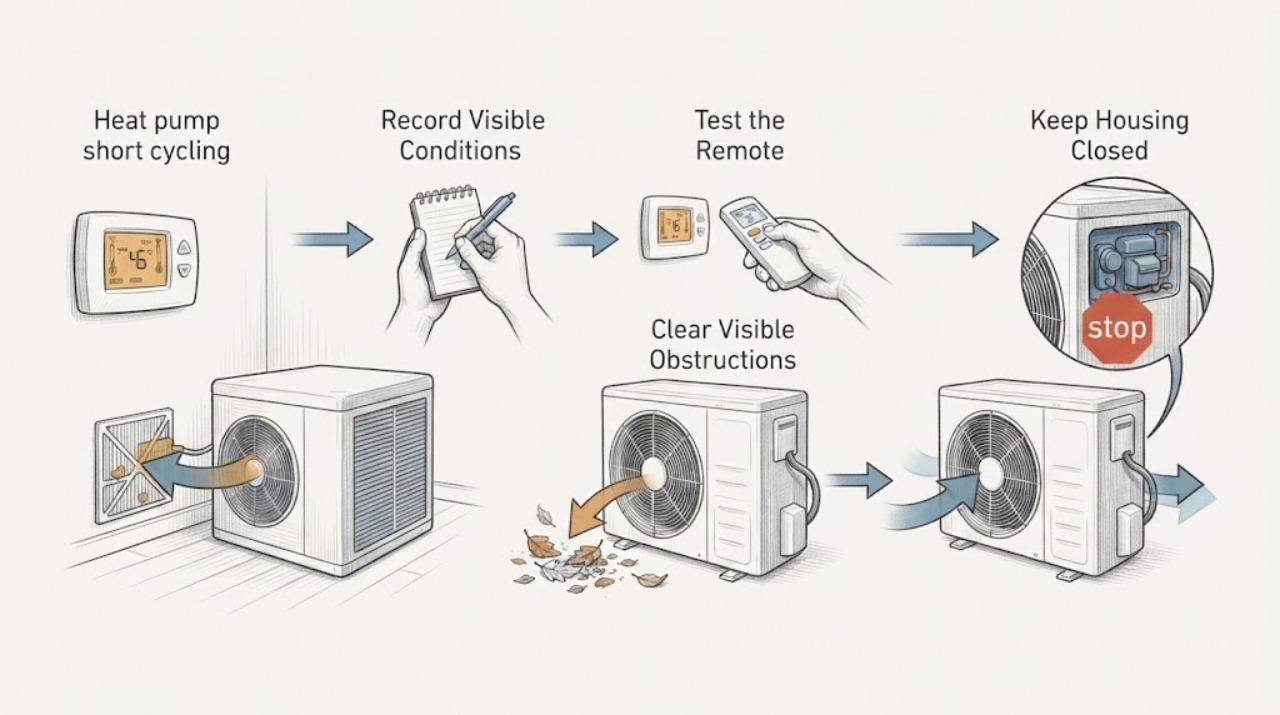
Work through in order
Diagnostic checks
Use only checks that match the exact appliance or system and its official guide.
-
Check 1
Record several consecutive heat-pump cycles without repeatedly changing the thermostat. Note the mode, set point, room temperature, approximate run and off pattern, outdoor temperature, whether the indoor blower runs, and any thermostat or outdoor-unit alert.
Expected result: The system stops after satisfying the set point; changes operation briefly during apparent defrost; starts and stops while the room still misses the set point; or repeats similar short runs with an alert or protection trip.
Next step: Keep the cycle log and continue with settings and airflow checks. Use the exact model manual for any displayed code instead of inferring a component from the sound or timing.
Stop if: Stop operating and arrange service for smoke, burning odor, arcing, refrigerant odor or hissing, severe vibration, an outdoor fan that is stalled, or a breaker that trips again.
Why this matters
Why: A satisfied demand or temporary defrost behavior may be normal. Repeated starts before the demand is met are more consistent with short cycling; an alert or protection trip makes a control, pressure, airflow, or compressor problem more likely.
-
Check 2
Check the thermostat without opening it: verify the intended heat or cool mode, set point, schedule, hold, remote-app command, and battery or display status. Confirm that the display remains stable while the equipment starts and stops.
Expected result: The set point is already satisfied; a schedule or remote command changes the demand; the display is blank or resets; the mode is wrong; or the thermostat remains stable and calls for conditioning.
Next step: Correct only the mode, schedule, or accessible batteries/settings described by the thermostat instructions, then observe a new cycle. Do not jumper terminals or remove the thermostat from its wiring.
Stop if: Stop for burnt wiring, a loose wall connection, a blank display with a burning smell, or any need to test live terminals.
Why this matters
Why: A changing demand, wrong mode, or unstable thermostat can create apparent short cycling. A stable thermostat that continues to call while the unit stops shifts attention to airflow, outdoor conditions, safeties, or equipment controls.
-
Check 3
Inspect the accessible return-air filter and supply and return registers. Replace or clean the filter only with the type and method specified for the installation, and move furniture or curtains that block registers. Check around the outdoor unit for leaves, snow, or other loose obstructions without opening the cabinet.
Expected result: The filter is visibly loaded; registers or returns are blocked; the outdoor coil area is obstructed; or indoor and outdoor airflow paths are already clear.
Next step: Restore only accessible airflow paths, then allow the system to operate and record whether the pattern changes. Leave coil cleaning, blower access, duct measurement, and electrical work to qualified service.
Stop if: Stop if the filter is wet or moldy, the indoor coil or outdoor coil is frozen solid, the outdoor fan is not running when expected, or clearing debris would require removing a guard or panel.
Why this matters
Why: A dirty filter or blocked register can restrict airflow and stress the system. An obstructed outdoor unit can interfere with heat transfer. If airflow is clear but short cycling continues, a filter is unlikely to be the sole cause.
-
Check 4
Look at the outdoor unit from a safe distance during the symptom. Note whether ice covers the coil, whether the fan runs, whether the system briefly changes sound and then resumes, and whether airflow from indoor registers is weak or unusually cold in heat mode.
Expected result: There is no ice and airflow is normal; a temporary frost or defrost event clears; ice remains or returns; the fan is stalled; or indoor airflow is weak while the compressor starts and stops.
Next step: Do not break or melt outdoor ice with tools or chemicals. Keep the area clear as the manual permits, record the pattern, and arrange HVAC service if ice remains, the fan does not run, or short cycling continues.
Stop if: Stop for exposed electrical parts, an ice-covered fan blade, refrigerant-line damage, loud electrical buzzing, smoke, or any need to enter the outdoor cabinet.
Why this matters
Why: A brief defrost event can be part of heat-pump operation. Persistent ice, a stalled fan, or weak airflow can involve restricted airflow, refrigerant, defrost, fan, or control problems and can trigger protective shutdowns.
-
Check 5
After accessible checks, leave the thermostat at a normal setting and observe whether the heat pump completes cycles and maintains the set point. Record whether the short cycle returns immediately, only in one mode, after a particular weather change, or after a power interruption.
Expected result: The system now completes cycles; short cycling persists in heating and cooling; it occurs only in one mode; or it follows a protection trip, power interruption, or repeated fault indication.
Next step: Arrange qualified HVAC diagnosis and provide the cycle log, model and serial information, filter and airflow observations, weather, mode, and any displayed alert. Do not select a relay, capacitor, sensor, or refrigerant service from this pattern alone.
Stop if: Stop running the system if it repeatedly trips power protection, overheats, smells electrical, leaks refrigerant or water, or cannot maintain safe indoor conditions.
Why this matters
Why: Improvement after correcting settings or airflow supports an accessible operating cause. Persistence in one mode can point toward a mode-specific defrost, reversing-valve, pressure, or control path; persistence in both modes makes thermostat, sizing, airflow, or common controls more likely.
Use your observations
Decision map
Find the observation that best matches what you see, then follow the next safe action.
-
PATH 01Safety boundary
What you see
The thermostat reaches the set point or the outdoor unit briefly enters a defrost event, then operation returns normally.
Do this next
Continue observing with the cycle log and verify the system returns to the selected mode; consult the model manual if the behavior becomes prolonged or unusually frequent.
Why this path and its safety boundary
Safety stop: Escalate if the system stops before satisfying demand, remains frozen, or produces a fault indication.
-
PATH 02Safety boundary
What you see
The thermostat mode, schedule, remote command, or display is changing while the unit starts and stops.
Do this next
Correct the user-facing mode or schedule and observe another cycle; arrange service if the display resets, wiring is damaged, or the demand still changes unexpectedly.
Why this path and its safety boundary
Safety stop: Do not open the thermostat or jumper low-voltage terminals.
-
PATH 03Safety boundary
What you see
The filter is dirty or registers and outdoor-unit airflow are obstructed, and the short cycle improves after accessible correction.
Do this next
Keep the filter and airflow path maintained according to the equipment instructions and monitor whether complete cycles continue.
Why this path and its safety boundary
Safety stop: Do not remove coil guards, wash energized equipment, or assume a clean filter proves the blower and duct system are adequate.
-
PATH 04Safety boundary
What you see
The outdoor coil stays iced, the fan does not run, indoor airflow is weak, or short cycling occurs with a pressure or defrost indication.
Do this next
Turn the system off if the manual directs it, keep people away from the outdoor unit, and arrange qualified HVAC diagnosis of airflow, defrost, refrigerant, and fan operation.
Why this path and its safety boundary
Safety stop: Do not chip ice, bypass a safety, handle refrigerant, or enter the outdoor cabinet.
-
PATH 05Safety boundary
What you see
The thermostat is stable and airflow is accessible and clear, but the heat pump repeatedly starts and stops before reaching the set point.
Do this next
Arrange professional diagnosis of thermostat demand, compressor controls, system sizing, refrigerant circuit, and mode-specific controls; provide the recorded pattern.
Why this path and its safety boundary
Safety stop: Do not replace a relay, capacitor, control, sensor, or compressor based only on short cycling.
-
PATH 06Safety boundary
What you see
A breaker trips again, an electrical odor or arcing appears, severe vibration occurs, or the system leaks or cannot maintain safe comfort.
Do this next
Stop the heat pump and arrange qualified HVAC or electrical service as appropriate; preserve the cycle log and any displayed alert.
Why this path and its safety boundary
Safety stop: Do not repeatedly reset the breaker, open electrical compartments, or test energized components.
Helpful context
Understand the symptom
Confirm that the pattern is actually short cycling
A heat pump can stop because the room reached the set point, change operation during a defrost event, or run at a variable speed that sounds different from a single-stage system. Short cycling is the repeated start-stop pattern that does not satisfy the demand normally. Record the thermostat mode, set point, room temperature, run duration, off duration, outdoor temperature, and any displayed alert instead of assuming every frequent sound is a compressor fault.
Start with settings and accessible airflow
Verify that the Daikin thermostat is in the intended heating or cooling mode and is not being changed by a schedule, remote app, or auxiliary setting. Check an accessible return-air filter and replace or clean it only as the equipment instructions permit. Keep supply and return registers open and free of furniture, and clear leaves or debris from around the outdoor unit without opening its cabinet.
Use the symptom pattern to choose the next safe step
A thermostat display that changes or resets, a breaker that trips, and a unit that starts again only after a protection delay point to different paths. Weak airflow with a dirty filter favors an airflow restriction; an iced outdoor coil may involve airflow, refrigerant, or defrost operation; and a clean filter with normal airflow but repeated short runs calls for control, sizing, or refrigeration diagnosis. These observations narrow the service visit but do not identify a part for replacement.
Keep electrical and refrigerant work professional
Daikin service documentation describes short-cycle troubleshooting at the thermostat, low-voltage connections, compressor relay, and control. Those checks involve electrical access and model-specific procedures. Do not remove covers, measure live voltage, jumper thermostat terminals, bypass a pressure or temperature safety, adjust refrigerant, or replace a capacitor or relay as a homeowner experiment.
Only after diagnosis
Potential parts
- air filter
Consider a replacement filter only when the installed filter is loaded or damaged and the equipment instructions identify that filter type as user-replaceable.
Confirm the exact filter dimensions, access location, airflow direction, and manufacturer requirements; a short cycle alone does not establish filter failure. - thermostat or thermostat control
Consider this category only after service testing shows unstable demand, incorrect sensing, or a control incompatibility rather than a simple mode or schedule setting.
Confirm the exact Daikin system, communicating or conventional control scheme, wiring, and approved model compatibility before selection or installation. - defrost sensor, control, relay, or fan motor
Consider these categories only after a qualified technician confirms the corresponding control, defrost, relay, or fan fault under the model's diagnostic procedure.
These components are model-specific and may involve line voltage, refrigerant equipment, or concealed panels; do not choose or replace one from the symptom alone.
When checks do not resolve it
Need a professional?
Escalate for persistent short cycling, recurring fault indications, outdoor icing, weak airflow, thermostat resets, protection trips, abnormal fan or compressor sounds, or any suspected refrigerant, electrical, defrost, or control fault.
Safety scope: The homeowner scope is limited to recording the cycle, checking thermostat settings, servicing an accessible filter as instructed, clearing accessible vents and loose outdoor debris, and observing from a safe distance. Do not open electrical panels, jumper controls, bypass safeties, measure live voltage, adjust refrigerant, remove ice with tools, or replace HVAC components without qualified diagnosis.
Have this ready
- Provide the Daikin model and serial information, operating mode, set point and room temperature, run and off pattern, outdoor weather, filter and register observations, outdoor-unit ice or fan behavior, thermostat changes, and any alert or breaker event.
Common questions
FAQ
What does short cycling mean on a Daikin heat pump?
It is a repeated start-stop pattern that happens before the thermostat demand is normally satisfied. A normal stop after reaching the set point or a brief defrost transition is different. Log the mode, set point, cycle pattern, and any alert before deciding it is a fault.
Can a dirty filter make a heat pump short cycle?
A loaded filter can restrict airflow and stress a heat pump, although it does not prove that the filter is the cause. Check and service an accessible filter only as the Daikin or filter instructions direct, and arrange service if the pattern continues.
Can outdoor ice cause a Daikin heat pump to start and stop?
Persistent outdoor icing can interfere with heat transfer and may involve airflow, refrigerant, fan, or defrost operation. A brief defrost event can be normal. Do not chip ice or open the outdoor unit; arrange HVAC diagnosis if ice remains or cycling continues.
Could the thermostat cause Daikin heat-pump short cycling?
Yes. A wrong mode, changing schedule or remote command, unstable display, inaccurate sensing, or wiring problem can change the demand. Correct only accessible settings, and do not jumper or open the thermostat wiring.
When should I call HVAC service for Daikin short cycling?
Call when short cycling persists after settings and accessible airflow checks, occurs with weak airflow or outdoor icing, follows a fault or breaker trip, or requires cabinet, electrical, refrigerant, defrost, or control work. Stop the system for smoke, electrical odor, arcing, severe vibration, or unsafe temperatures.
Read the exact guide
Official sources
- RSD6200007r17.pmdDaikin · Daikin service documentation for specific outdoor-unit control families; exact model documentation controls the applicable codes and procedures.
- Hot & Cold SpotsDaikin · Daikin homeowner guidance used for general airflow and thermostat observations; installation and model instructions control exact requirements.
- Heat Pump Troubleshooting Guide | Common Heat Pump Problems & FixesCarrier · Carrier homeowner guidance used for general heat-pump diagnostic patterns; Daikin model manuals and qualified service control the installed system.
- Heat Pump Repair Services & Troubleshooting GuideCarrier · Carrier residential guidance used for general symptom branching; it does not establish Daikin part compatibility or model-specific tests.
- HVAC Proper Installation of FiltersU.S. Department of Energy · U.S. Department of Energy building-science guidance used for general filter and airflow context; follow the Daikin installation and operating documentation.
- DH4SEDaikin · Daikin product information used to identify system functions; the installed model's manual controls features and service procedures.
Community feedback
Share a repair observation
Share a plain-text repair observation. Accepted observations are published automatically; this page may take a moment to update.