
On this page
Start here
Quick answer
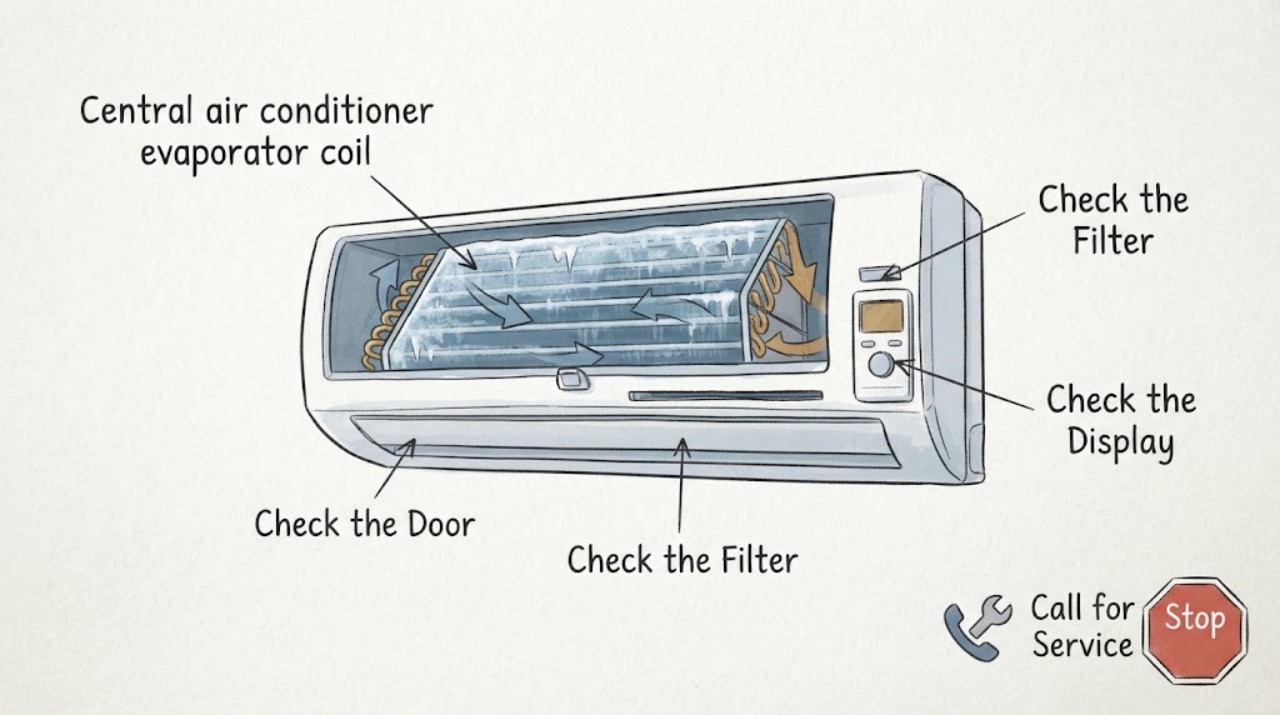
Turn the thermostat's cooling mode to OFF as soon as you see ice on the indoor coil cabinet or refrigerant line, and leave cooling off while you arrange HVAC service. From safe, accessible locations, note the ice or thawing water, filter and return-air condition, thermostat setting, airflow at registers, and condensate signs. A frozen coil can result from restricted airflow, a dirty coil, a thermostat or blower problem, or low refrigerant. Do not run the system with ice, chip or force-thaw the coil, add refrigerant, use coil cleaner, open panels, perform electrical work, or disassemble the unit.
Work through in order
Diagnostic checks
Use only checks that match the exact appliance or system and its official guide.
-
Confirm the visible freeze and stop cooling
Look from a safe, dry position at any visible indoor coil cabinet, exposed refrigerant line, or accessible outdoor line without opening a panel or touching the equipment. If ice or frost is visible, set the thermostat mode to OFF and do not restart cooling while ice remains.
Expected result: Note where the ice is visible, whether it covers a line or cabinet surface, whether the indoor air is warm or weak, and whether thawing water is collecting near the indoor unit.
Next step: Keep cooling OFF, photograph the visible condition from a safe distance, and arrange HVAC service. Protect nearby materials from thawing water without touching the equipment or opening the cabinet.
Stop if: Stop if water reaches electrical equipment, the cabinet is damaged, a refrigerant line is damaged, or any inspection would require opening a panel, touching ice, or using a heat source.
Why this matters
Why: Visible ice, warm air, weak airflow, or thaw water is consistent with a frozen-coil event and needs a cause assessment. The observation cannot distinguish airflow restriction from refrigerant, blower, thermostat, or coil problems by itself.
-
Check the accessible filter and airflow path
With cooling still OFF, inspect only the air filter and return or supply grilles that are designed for ordinary access. Do not open the air-handler cabinet, reach toward the coil, remove a coil cover, or use a brush or cleaner on internal components.
Expected result: Note whether the filter is visibly loaded, collapsed, wet, or missing, and whether return grilles or supply registers are closed or blocked by furniture. Record any unusual dust or water near the accessible filter area.
Next step: Photograph the filter label and condition if accessible and tell the technician which vents were blocked or open. Replace a filter only through the equipment's ordinary user-access procedure and only when it can be done without entering the cabinet or disturbing wet materials.
Stop if: Stop if the filter is wet, the access requires tools or a panel, water is near electrical parts, or the filter area is contaminated or damaged.
Why this matters
Why: A loaded filter or blocked return path can restrict airflow enough to contribute to freezing, but a clean filter does not rule out a dirty hidden coil, blower issue, thermostat problem, or low refrigerant. Do not treat a filter observation as a complete diagnosis.
-
Record thermostat behavior without restarting cooling
Read the thermostat display and settings with cooling OFF. Note the selected mode, fan setting, room temperature reading, schedule or alert, and any visible error message; do not use a temporary setting to force a cooling cycle while ice is present.
Expected result: Record whether the thermostat was calling for cooling continuously, whether the fan setting is ON or AUTO, whether the displayed temperature differs from the room, and whether the thermostat reports a filter or equipment alert.
Next step: Send the thermostat details and a photo of the display to the HVAC technician. Leave cooling OFF and do not open the thermostat or change wiring.
Stop if: Stop if the display is damaged, wiring is exposed, the thermostat is wet, or any next step would require removing its cover or performing electrical work.
Why this matters
Why: A continuous call, unexpected fan behavior, inaccurate reading, or alert can help the technician assess thermostat or control involvement. It does not prove the thermostat caused the freeze, and it is unsafe to test the system under cooling load while ice remains.
-
Observe airflow and thaw-water signs from safe locations
With cooling OFF, observe the accessible supply registers, return grille, floor or drain area near the indoor unit, and any visible condensate line from a dry standing position. Do not start the blower to accelerate thawing, touch the drain, move wet equipment, or inspect inside the cabinet.
Expected result: Note whether airflow had been weak before shutoff, whether water is dripping or pooling as ice thaws, whether the condensate route appears blocked from the outside, and whether the area shows mold-like growth or material damage.
Next step: Keep cooling OFF, place protection near but not against the equipment if safe, and report the water, airflow, and material condition to the HVAC service provider. Do not restart for a test until the technician says the coil is clear and the cause has been addressed.
Stop if: Stop if water approaches electrical components, the floor becomes slippery, the indoor unit leaks heavily, or observing the area would require entering a confined or wet equipment space.
Why this matters
Why: Weak airflow and thaw water give the technician useful context, while pooling water can cause property damage and may indicate a drainage or installation issue. Visible contamination or damaged material should be handled as a professional remediation concern, not with coil cleaner or forced drying.
Use your observations
Decision map
Find the observation that best matches what you see, then follow the next safe action.
-
PATH 01Safety boundary
What you see
Ice is visible on the coil cabinet or refrigerant line, or the coil is thawing with water near the indoor unit.
Do this next
Leave thermostat cooling OFF and arrange HVAC service. Provide photos and the filter, thermostat, airflow, and water observations so the technician can assess airflow, refrigerant, blower, drain, and controls.
Why this path and its safety boundary
Safety stop: Do not run cooling with ice, chip the ice, force thawing, add refrigerant, use coil cleaner, or open the unit.
-
PATH 02Safety boundary
What you see
The filter is visibly clogged or a return/supply path is blocked, but no internal access or wet electrical area is involved.
Do this next
Tell the technician what was observed. If the filter is a normal user-access item and the area is dry, replace it according to the equipment's model-specific user instructions while keeping cooling OFF; still arrange service because the freeze may have another cause.
Why this path and its safety boundary
Safety stop: Do not remove panels, clean the coil, force air through the unit, or restart cooling while ice remains.
-
PATH 03Safety boundary
What you see
The filter is clean or airflow appears normal, but the coil freezes again, the system runs continuously, or refrigerant-line frost returns.
Do this next
Treat this as a professional diagnosis for refrigerant, blower, coil, thermostat, or control problems. Keep cooling OFF and provide the recurrence pattern; do not add refrigerant or adjust electrical components.
Why this path and its safety boundary
Safety stop: Do not perform refrigerant, electrical, panel, or coil work yourself.
-
PATH 04Safety boundary
What you see
Thaw water is reaching electrical equipment, the indoor unit is leaking heavily, the floor is unsafe, or mold-like contamination is visible.
Do this next
Keep away from the affected equipment, protect people and property from the area, and contact HVAC service plus an appropriate water-damage or remediation professional. If there is an immediate electrical or life-safety hazard, use the local emergency channel.
Why this path and its safety boundary
Safety stop: Do not touch wet electrical parts, run the system, use a heat source, or enter a wet or contaminated equipment space.
Helpful context
Understand the symptom
Why the cooling must stop first
Ice on an evaporator coil or the connected refrigerant line means the system is not exchanging heat normally. Continuing to cool can damage the equipment, while thawing can create water around the indoor unit. The visible pattern can help a technician narrow the cause, but refrigerant, electrical, blower, and concealed-coil work require professional tools and training.
Keep the inspection outside the equipment
Use only controls and filters that are designed for ordinary homeowner access and can be reached without opening the air-handler or furnace cabinet. Keep hands, tools, and heat sources away from ice, fins, wiring, and refrigerant lines. Photograph the condition after cooling is off and keep the area protected from thawing water.
Only after diagnosis
Potential parts
- HVAC air filter
Consider this category only if the accessible filter is visibly loaded or damaged and the exact equipment filter size and type are confirmed.
Match the equipment's model-specific filter dimensions and requirements; a filter change does not diagnose low refrigerant, a dirty coil, blower failure, or control problems. - evaporator coil cleaner
Consider this category only as a professional-service material after the technician confirms that a dirty coil is the cause and selects an appropriate method.
Do not apply cleaner to an unidentified or iced coil, and do not open the cabinet or handle chemicals as a homeowner diagnosis; product and coil compatibility must be confirmed by the professional. - thermostat
Consider this category only if a qualified HVAC professional confirms a thermostat or control fault after the coil has thawed and other causes are assessed.
Match the HVAC system type, wiring, heat-pump or conventional configuration, and control features; do not select or wire a thermostat from appearance alone.
When checks do not resolve it
Need a professional?
Arrange high-priority HVAC service for any frozen evaporator coil, recurring ice, weak airflow, continuous cooling call, thaw-water leak, or uncertainty about the cause. Escalate immediately if water reaches electrical equipment, the indoor unit is unsafe, or there is an electrical or property hazard.
Have this ready
- Provide the system brand and model if visible without opening equipment, photos of ice or thaw water, thermostat mode and alerts, filter condition, airflow observations, when the ice started, and whether it returned after prior service. Do not open panels or restart cooling to obtain more information.
Common questions
FAQ
Can I keep running the AC to melt the ice?
No. Turn cooling OFF and leave it off while ice is present. Running a frozen system can damage the equipment; let a qualified HVAC technician determine when it is safe to resume cooling.
Can I add refrigerant when the evaporator coil freezes?
No. Low refrigerant is only one possible cause and can indicate a leak. Refrigerant diagnosis and charging require an HVAC professional with the correct tools; adding it by guesswork can hide the underlying fault.
Is a dirty filter enough to explain a frozen coil?
A loaded filter can restrict airflow, but a clean filter does not rule out a dirty hidden coil, blower, thermostat, drain, or refrigerant problem. Keep cooling OFF and arrange service if ice is present or returns.
Read the exact guide
Official sources
- Help! My AC Evaporator Coil Is FrozenTrane · Supports turning cooling off, not chipping ice, and checking visible filter, vent, thermostat, and airflow contributors while leaving refrigerant and internal work to an HVAC technician.
- Troubleshoot an Air ConditionerCarrier · Supports observing inadequate cooling, ice, condensate, filter and airflow conditions, and referring refrigerant or electrical issues to a professional.
- Maintenance ChecklistENERGY STAR · Supports the distinction between accessible filter observation and professional checks of coils, blower, drain, controls, and refrigerant.
Community feedback
Share a repair observation
Share a plain-text repair observation. Accepted observations are published automatically; this page may take a moment to update.