
On this page
Start here
Quick answer
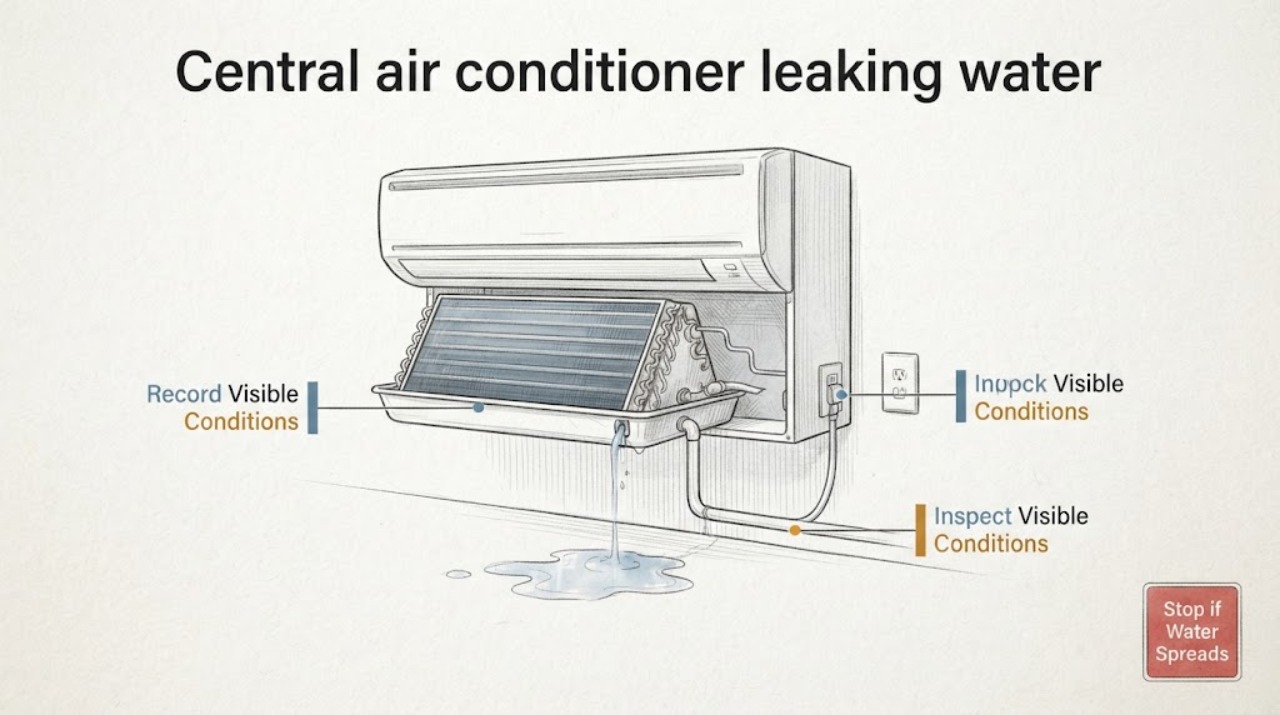
Turn the central AC off when you find indoor water, then identify where and when it appears without opening the equipment. Record whether the water is at the indoor air handler, ceiling, floor, or wall; whether it follows cooling, shutdown, or melting ice; and whether you can see frost, a dirty filter, a full visible pan, or a blocked-looking drain outlet from a safe user-accessible position. Do not open panels, handle refrigerant, disassemble the drain line, perform electrical tests, or keep running a leaking system. Stop immediately for water near electrical parts, ceiling damage, active pooling, or a frozen coil and arrange HVAC service.
Before you begin
Safety first
- Do not open panels, disassemble drain lines, handle refrigerant, perform electrical tests, scrape ice, use chemicals or pressurized methods, or keep operating a leaking system.
Work through in order
Diagnostic checks
Use only checks that match the exact appliance or system and its official guide.
-
Check 1
With the AC switched off, inspect from a safe standing position around the indoor air handler, nearby floor, ceiling, wall, supply plenum exterior, and any visible condensate outlet; do not open panels or enter an attic or crawlspace.
Expected result: Record the first visible water location, its spread, whether it is pooling or only staining, and whether the water is below the unit, at a ceiling, inside a wall, or away from the equipment.
Next step: Photograph the full area and close-up moisture clues and give the HVAC professional the exact location; arrange water-damage assessment too if building materials are wet.
Stop if: Stop if water is near electrical equipment, the ceiling is sagging, water is actively spreading, or the floor is unsafe; keep clear and request prompt service.
Why this matters
Why: Water at the indoor unit can involve a pan or drain path, while a ceiling or wall stain may indicate concealed damage or a line routed through the building. Location alone cannot distinguish a pan, drain, coil, or installation issue.
-
Check 2
Record when the leak occurs relative to cooling operation: while the compressor is running, shortly after shutdown, only on humid days, or when the unit has been off for a while; do not restart the system just to reproduce the leak.
Expected result: Note whether the leak grows during cooling, continues after shutoff, or appears as a later puddle after the system has stopped.
Next step: Keep the AC off and give the timing, indoor temperature impact, and photos to an HVAC technician for a safe coil, pan, drain, and airflow assessment.
Stop if: Stop all testing if the leak is worsening, water reaches a ceiling or electrical area, or the unit cannot be left safely powered down.
Why this matters
Why: A leak during cooling can fit a condensate collection or drainage problem, while water appearing after shutdown can be consistent with melting ice or retained water. Timing is a clue, not a refrigerant or drain diagnosis.
-
Check 3
From outside the equipment and without touching tubing or opening a panel, look for visible frost or ice on accessible coil or line surfaces and note whether the indoor air feels unusually weak or the system is not cooling normally.
Expected result: Record visible frost or ice, dripping during a thaw, unusual airflow, or normal-looking surfaces; do not scrape ice, apply heat, or keep running the unit.
Next step: Leave the system off and request HVAC diagnosis if ice, thaw water, reduced cooling, or repeated freezing is present; do not handle refrigerant or coil components.
Stop if: Stop immediately for heavy ice, a sharp or exposed component, active water near electricity, or any need to open the equipment.
Why this matters
Why: A frozen evaporator coil can release more water as ice melts, and restricted airflow or another HVAC fault can contribute. Absence of visible ice does not rule out a drain-pan or condensate-line problem.
-
Check 4
Check only the normal homeowner-accessible air filter and visible return or supply openings without removing equipment panels or changing system settings beyond leaving the AC off.
Expected result: Record whether the filter is visibly loaded with dust, missing, wet, or damaged, and whether supply or return openings are blocked by furniture or stored items.
Next step: Give the filter condition and system model information to the HVAC professional; replace a filter only with the exact type and size already specified for the system, without opening the air handler.
Stop if: Stop if the filter is wet, there is mold-like growth inside the equipment, access requires a ladder or panel removal, or water is near electrical components.
Why this matters
Why: A restricted filter or airflow path can contribute to coil icing in some systems, but a clean filter does not clear a drain or pan issue and should not be used to justify continued operation during a leak.
-
Check 5
If a condensate outlet is visible from safe ground-level access, observe whether it normally discharges water during a known cooling period without inserting anything, disconnecting the pipe, vacuuming, or pouring treatment into it.
Expected result: Record no visible flow, intermittent flow, an overflow at the indoor unit, a wet area around the outlet, or a drain route that cannot be seen.
Next step: Include the outlet observation and photographs in the HVAC service request; ask the technician to inspect the complete condensate path and pan safely.
Stop if: Stop if reaching the outlet requires climbing, the ground is slippery, the pipe is damaged, or water is backing into the building.
Why this matters
Why: No visible outlet flow during expected cooling can be consistent with a restricted drain, but it can also reflect system design or weather. An indoor overflow or an inaccessible route needs professional inspection rather than a DIY line-clearing attempt.
Use your observations
Decision map
Find the observation that best matches what you see, then follow the next safe action.
-
PATH 01Safety boundary
What you see
There is a small, localized puddle near the indoor unit with no ceiling, wall, or electrical damage and no visible ice.
Do this next
Keep the AC off, document location and timing, and book HVAC service to assess the pan and condensate path before restarting.
Why this path and its safety boundary
Safety stop: Do not open panels or assume a drain treatment will solve the cause.
-
PATH 02Safety boundary
What you see
Frost or ice is visible, or water appears as the system thaws after cooling stops.
Do this next
Leave the system off and request HVAC diagnosis of airflow, coil, refrigerant, and condensate conditions.
Why this path and its safety boundary
Safety stop: Do not scrape ice, apply a heat source, handle refrigerant, or re-run the AC to test thawing.
-
PATH 03Safety boundary
What you see
The visible filter is wet, heavily loaded, missing, or the system has weak airflow and poor cooling.
Do this next
Provide the filter and airflow observations to an HVAC professional; a filter change may be part of service but does not establish the leak source.
Why this path and its safety boundary
Safety stop: Do not operate a leaking unit or enter equipment compartments to inspect the coil.
-
PATH 04Safety boundary
What you see
The indoor drain pan or condensate route appears to overflow, the outlet has no expected flow, or the drain route is inaccessible.
Do this next
Arrange HVAC service to inspect and safely clear or repair the complete condensate system; protect the building from additional water meanwhile.
Why this path and its safety boundary
Safety stop: Do not disconnect the drain line, pour chemicals, use pressurized air, or insert tools.
-
PATH 05Safety boundary
What you see
Water reaches electrical equipment, a ceiling or wall is damaged, or active pooling is spreading.
Do this next
Keep people clear, stop the AC, and use only known safe electrical and water shutoffs; request urgent HVAC and building-water assessment.
Why this path and its safety boundary
Safety stop: Do not touch wet electrical parts, climb to a wet ceiling, or keep energizing the system.
Helpful context
Understand the symptom
Indoor AC water is usually condensate that should collect in a pan and leave through a drain path. A damaged pan, restricted or blocked drain, frozen coil that is melting, or another HVAC fault can move that water into the home. The first useful distinction is location and timing—not a guess at a part.
Keep the system off while you document a leak. Put an absorbent container or towel on a stable dry surface only if doing so does not require touching equipment or standing in water. Do not open the air handler, remove an access panel, pour chemicals into a drain, use refrigerant tools, or remove a drain connection. A wet ceiling, wall, or electrical area needs prompt professional attention.
A clean-looking filter or dry outdoor drain outlet does not prove the system is healthy, and a small amount of water at one location does not identify the source. Carrier and Trane both describe clogged condensate drainage, damaged pans, and frozen evaporator coils as possible causes; the same visible symptom can require different HVAC work.
Dry wet building materials promptly and keep the leak history. EPA guidance says condensate pans should drain properly and substantial standing water or wet insulation needs immediate attention. Do not mask a water stain with paint or sealant before the source and moisture extent are assessed.
Only after diagnosis
Potential parts
- HVAC condensate drain pan
Consider this only if an HVAC professional confirms the existing pan is cracked, corroded, incorrectly fitted, or otherwise unable to collect condensate.
Match the air-handler model, pan orientation, dimensions, and overflow provisions; do not use a pan as a substitute for correcting a blocked drain or frozen coil. - condensate drain treatment
Consider this only when the HVAC professional confirms a compatible maintenance treatment is appropriate for the system and the drain is accessible without unsafe disassembly.
Follow the HVAC manufacturer and treatment label; never pour chemicals into an unknown or blocked line or use treatment to hide an active overflow. - wet dry vacuum
Consider this only if a qualified HVAC professional confirms that the visible drain outlet and system design permit that method and the area is safe to access.
Use only the professional-specified connection and vacuum method; a vacuum cannot repair a pan, coil, refrigerant, wiring, or concealed drain problem.
When checks do not resolve it
Need a professional?
Call an HVAC professional for any indoor AC water, visible ice, a suspected overflow, no visible condensate discharge, weak cooling, or a leak that returns after shutdown.
Safety scope: Do not open panels, disassemble drain lines, handle refrigerant, perform electrical tests, scrape ice, use chemicals or pressurized methods, or keep operating a leaking system.
Have this ready
- Provide photos, first water location, timing relative to cooling and shutdown, filter condition, visible ice or airflow change, condensate outlet observation, model information, and any ceiling, wall, odor, or electrical clues.
Common questions
FAQ
Can I keep running my central AC if it is leaking water?
It is safer to leave it off while the cause is assessed. Continued operation can add water or worsen a drain, pan, airflow, frozen-coil, or other HVAC problem. Arrange service before restarting, especially if water is pooling or reaching building materials.
Why does my AC leak after it turns off?
Water appearing after shutdown can be consistent with ice on the evaporator coil melting or retained condensate overwhelming the drain, but timing alone cannot confirm either cause. Record the timing and leave diagnosis to an HVAC professional.
Should I pour cleaner or vinegar into the AC drain line?
Do not pour chemicals into an unknown, blocked, or inaccessible drain. A professional should confirm the system design, isolate the equipment, and choose a safe clearing or treatment method; a chemical cannot repair a damaged pan, frozen coil, or concealed leak.
Read the exact guide
Official sources
- A Brief Guide to Mold, Moisture and Your HomeU.S. Environmental Protection Agency · Used to support prompt drying and avoiding paint or caulk over wet or moldy surfaces; it does not diagnose the AC equipment.
- Why Is My AC Leaking Water?Carrier · Used for high-level symptom interpretation and the recommendation not to keep operating a leaking system; exact service steps remain professional and model-specific.
- Should You Have the Air Ducts in Your Home Cleaned?U.S. Environmental Protection Agency · Used only for the moisture and standing-water escalation branch, not as a recommendation for duct cleaning.
- AC Leaking Water? Find Out Why and What to DoTrane · Used for the location, timing, ice, drain, and pan branches in a generic split-system context; it is not treated as model-specific diagnosis.
Community feedback
Share a repair observation
Share a plain-text repair observation. Accepted observations are published automatically; this page may take a moment to update.