
On this page
Start here
Quick answer
When an HVAC condenser is not cooling and the assigned clue is blower motor, first separate indoor airflow from outdoor heat rejection. Check the thermostat mode and call, feel for normal airflow at a supply register, and observe the outdoor condenser from a safe distance. A silent or weak indoor blower can freeze the indoor coil and stop cooling even when the outdoor unit responds; a condenser fan that is still, noisy, or slow can prevent heat from leaving outdoors. Look for ice, water, smoke, burning odor, a breaker trip, or a hot cabinet and stop for any of those signs. Do not open the air handler or condenser, touch a capacitor, motor, contactor, wiring, fan blade, compressor, or refrigerant circuit. If one fan runs without the other, cooling is poor, or the system short-cycles, leave it off and arrange qualified HVAC service.
Before you begin
Safety first
- Keep the system off for smoke, odor, heat, arcing, water, ice, residue, severe noise, or repeated protective-device operation. Motor, capacitor, control, high-voltage, compressor, and refrigerant work belongs to qualified HVAC personnel.
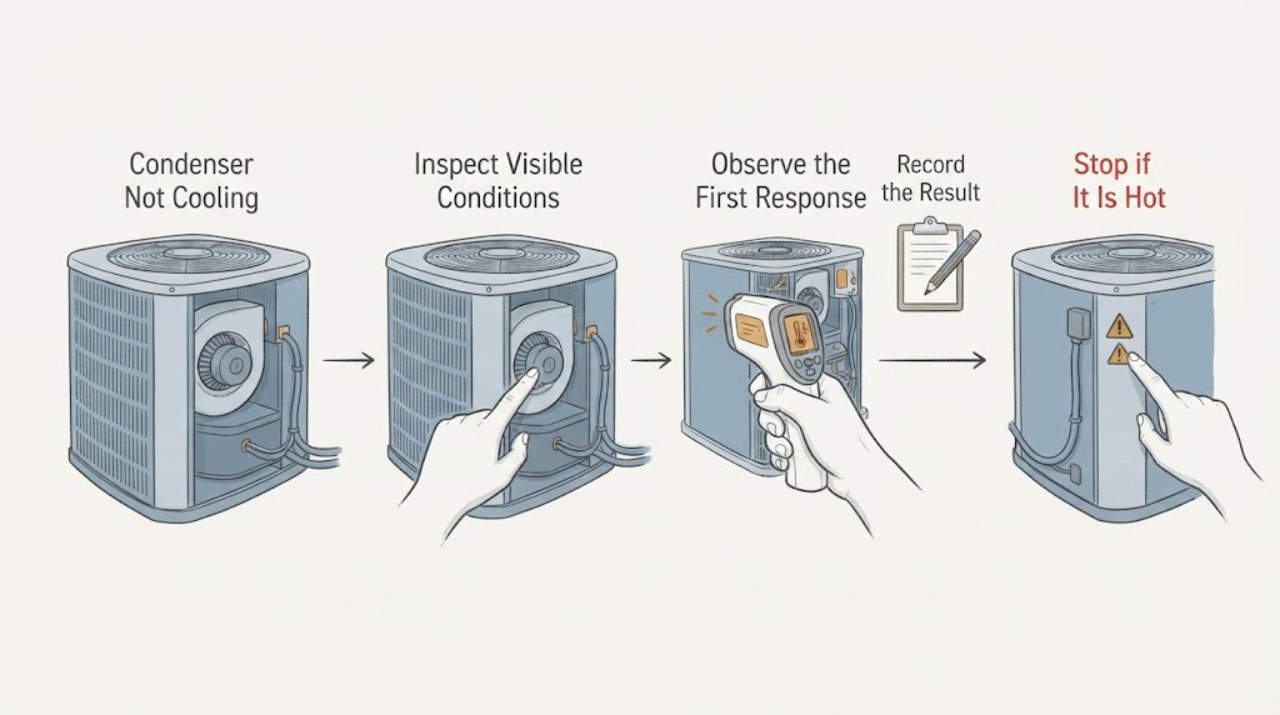
Work through in order
Diagnostic checks
Use only checks that match the exact appliance or system and its official guide.
-
Check 1
From a dry, safe position, observe the air handler and outdoor condenser for smoke, burning or hot-insulation odor, hot surfaces, arcing, exposed wiring, standing water near electrical equipment, visible ice, severe vibration, or a breaker that opens when cooling is called; do not touch either cabinet.
Expected result: A hazard sign, ice, water, heat, smoke, exposed wiring, or repeat protective-device operation is present.
Next step: Stop cooling, keep clear, and arrange urgent HVAC or electrical service. If smoke or fire is present, leave and use the local emergency route from a safe location.
Stop if: Stop immediately for smoke, fire, burning odor, heat, arcing, water at electrical parts, visible ice, exposed wiring, severe vibration, or a repeated trip.
Why this matters
Why: The no-cooling condition may involve an electrical, fire, moisture, freeze, or mechanical hazard rather than a routine filter or setting issue.
-
Check 2
At the thermostat, observe whether the system is in Cool, the target is below the room reading, the fan setting and schedule are intended, and the display shows a delay, lock, alert, or blank screen; use only ordinary documented controls and do not touch thermostat wiring.
Expected result: The thermostat is off, in the wrong mode, not calling, delayed, locked, blank, or calling normally while cooling remains poor.
Next step: Correct only an obvious documented setting and observe one normal call if the system is dry and safe. If cooling remains poor or the alert returns, stop cycling and arrange HVAC service.
Stop if: Stop for a damaged or blank control that would need wiring access, or for smoke, heat, odor, water, ice, or a repeat trip.
Why this matters
Why: A control state can mimic condenser or blower failure. A valid call with poor cooling shifts attention to airflow, power, outdoor response, ice, or professional equipment diagnosis.
-
Check 3
During one ordinary cooling call with no warning sign, hold a hand near a supply register without blocking it and observe whether airflow is normal, weak, absent, or warm; note whether the indoor blower is audible and do not remove an access door.
Expected result: Airflow is normal but warm, weak, absent, or the blower is silent, humming, or stopping.
Next step: Record the airflow pattern. Stop the system for absent airflow, humming, ice, water, heat, or abnormal noise and arrange HVAC diagnosis; do not reach the blower motor or capacitor.
Stop if: Stop for no airflow, a hot or humming blower, ice, water, smoke, odor, or any need to open the air handler.
Why this matters
Why: Normal airflow with warm air points more toward outdoor heat rejection, refrigerant, or control conditions. Weak or absent airflow can involve a filter, blower, indoor coil, door safety, power, or control fault and can lead to ice.
-
Check 4
With the system stopped through its normal thermostat control, inspect only the accessible filter and visible return and supply grilles; if the filter is visibly loaded, use the equipment manual for a matching filter replacement without opening the blower compartment.
Expected result: The filter is loaded, grilles are blocked, the filter is clear, or airflow remains weak after a documented filter change.
Next step: After a safe filter change, observe one ordinary call only if there is no ice, water, odor, heat, or abnormal sound. If the problem persists, keep the cabinet closed and call HVAC.
Stop if: Stop for ice, water, burning odor, smoke, hot equipment, abnormal noise, or any need to open the blower compartment.
Why this matters
Why: Restricted airflow can reduce cooling and contribute to coil icing, but a clear filter does not rule out a blower motor, control, power, or refrigerant fault.
-
Check 5
From well outside the outdoor unit and away from the top grille, observe during the same single call whether the condenser fan turns smoothly, turns slowly, remains still, or makes an unusual sound, and whether the outdoor cabinet responds at all; do not reach through the grille or approach moving parts.
Expected result: The outdoor fan runs normally, is still or slow, wobbles or scrapes, the unit hums without a fan response, or the entire condenser is silent.
Next step: Record the response and stop extra cycles. Arrange qualified HVAC service for a still, noisy, slow, or non-starting condenser; do not open the cabinet or touch the fan, capacitor, contactor, compressor, or wiring.
Stop if: Stop for a wobbling or scraping blade, harsh hum, smoke, odor, heat, arcing, ice, water, or a repeat breaker opening.
Why this matters
Why: A normal outdoor response with weak indoor airflow keeps the blower side in focus. A still, slow, noisy, or silent outdoor unit can involve fan, power, control, capacitor, compressor, or other condenser conditions.
-
Check 6
From outside the equipment, look for ice on visible tubing or coil surfaces, water around the indoor unit, a blocked outdoor air path, heavy debris, or oily residue; do not scrape ice, wash the cabinet, straighten fins, or handle tubing.
Expected result: Ice, water, oily residue, blocked outdoor clearance, or no visible exterior problem is present.
Next step: Stop cooling for ice, water near electrical equipment, oily residue, or worsening performance and arrange HVAC service. Keep stored objects away from the unit without entering it.
Stop if: Stop for ice, standing water near electrical equipment, oily residue, smoke, odor, heat, or any need to open the cabinet.
Why this matters
Why: Ice or water can accompany restricted airflow, condensate, or refrigerant conditions; oily residue can indicate a refrigerant leak. Blocked outdoor airflow can raise heat load. A clear exterior does not rule out an internal blower or condenser fault.
-
Check 7
Prepare a service note with the system and thermostat models, thermostat mode and target, indoor airflow, filter condition, outdoor fan response, sound, cooling result, cycle behavior, ice or water, outdoor clearance, and breaker behavior; leave both cabinets and the disconnect closed.
Expected result: Cooling remains poor, the blower or condenser response is abnormal, the symptom returns, or diagnosis would require access to a motor, capacitor, contactor, compressor, wiring, or refrigerant circuit.
Next step: Arrange qualified HVAC service and keep the system off for abnormal noise, heat, odor, smoke, ice, water, residue, or repeated cycling. Do not choose a motor, capacitor, compressor, or refrigerant service from symptoms alone.
Stop if: Stop user diagnosis whenever a cabinet, disconnect, moving blade, motor, capacitor, contactor, compressor, wiring, or refrigerant circuit would need access.
Why this matters
Why: The remaining possibilities include blower motor or control, filter and airflow, condenser fan or compressor, electrical starting parts, coil icing, condensate, or refrigerant conditions.
Use your observations
Decision map
Find the observation that best matches what you see, then follow the next safe action.
-
PATH 01Next step
What you see
Smoke, burning odor, heat, arcing, exposed wiring, water at electrical equipment, oily residue, severe movement, or a repeat breaker trip is present.
Do this next
Stop the system, keep clear, and arrange urgent HVAC or electrical service; leave and use the local emergency route for smoke or fire.
Why this path and its safety boundary
Why it matters: The no-cooling problem includes an electrical, fire, refrigerant, moisture, or mechanical hazard.
-
PATH 02Next step
What you see
The outdoor unit responds but indoor airflow is weak, absent, warm, or the blower is silent, humming, or stopping.
Do this next
Keep the system off for absent or abnormal airflow and request HVAC diagnosis without opening the air handler.
Why this path and its safety boundary
Why it matters: Filter, indoor airflow, door safety, blower motor, control, power, or frozen-coil conditions are possible.
-
PATH 03Next step
What you see
Indoor airflow is normal but the outdoor fan or condenser is still, slow, noisy, silent, or fails to run while cooling is called.
Do this next
Stop extra cycles and arrange qualified HVAC service; do not enter the condenser cabinet.
Why this path and its safety boundary
Why it matters: Fan, motor, capacitor, contactor, compressor, power, or control conditions may prevent outdoor heat rejection.
-
PATH 04Next step
What you see
Ice, water, oily residue, or a blocked outdoor air path is visible.
Do this next
Turn cooling off and call HVAC; do not scrape ice, add heat, wash inside the unit, or handle refrigerant.
Why this path and its safety boundary
Why it matters: Airflow, condensate, coil, or refrigerant conditions may be affecting cooling and can damage the system if it continues to run.
-
PATH 05Next step
What you see
The thermostat setting is wrong or an accessible filter is loaded while the equipment otherwise shows no warning sign.
Do this next
Correct only the documented setting or filter position and observe one cycle; arrange HVAC service if cooling remains poor or the symptom returns.
Why this path and its safety boundary
Why it matters: A user setting or airflow restriction may be limiting cooling, but a persistent failure needs professional assessment.
Helpful context
Understand the symptom
A condenser problem can start indoors
A split air conditioner has an indoor blower and an outdoor condenser assembly. The blower moves air across the indoor coil; the condenser fan and compressor reject heat outside. If the blower is weak or stopped, airflow can fall and the indoor coil can freeze. If the outdoor assembly is not running, the system cannot reject heat. The word condenser in the topic does not prove that the blower motor is the failed part.
Use the sequence of visible responses
Start with thermostat settings, indoor airflow, and the outdoor fan's visible response. Record whether the indoor blower runs while the outdoor unit is silent, whether the outdoor fan runs while the registers have weak airflow, and whether ice or water appears. This sequence narrows service scope without requiring access to either cabinet.
Filter and ice are clues, not permission to open equipment
A visibly loaded accessible filter can restrict airflow, but a clean filter does not clear the blower, control, motor, or refrigerant system. Visible ice needs the system off and professional diagnosis; do not scrape it, add heat, or handle refrigerant. Water near electrical equipment, smoke, odor, or a repeated protective-device trip is an immediate stop condition.
Safety boundary
Stop conditions
- Stop immediately for smoke, fire, burning or hot-insulation odor, heat, arcing, exposed wiring, water near electrical equipment, oily residue, severe vibration, or repeated protective-device operation.
- Do not open the air-handler or condenser cabinet, disconnect box, or electrical panel; do not touch the blower motor, fan, capacitor, contactor, compressor, wiring, or refrigerant circuit.
- Do not reach through a grille, insert tools, scrape ice, add heat to ice, wash inside the unit, straighten fins, or attempt a refrigerant check or repair.
- Stop repeated thermostat cycles when airflow is absent, a motor hums, a fan is still or scraping, the unit short-cycles, or cooling continues to worsen.
- If smoke or fire is present, leave the area and use the local emergency route from a safe location; do not return to investigate.
Only after diagnosis
Potential parts
- blower motor or blower control
Consider this only if professional diagnosis confirms weak or absent indoor airflow is caused by the blower motor or its control rather than a setting, filter, safety, or coil condition.
Confirm the exact air-handler model and electrical specifications with the HVAC technician before selecting a part. - condenser fan motor or fan blade
Consider this only if professional inspection confirms a still, slow, wobbling, scraping, or electrically failed outdoor fan.
Match the outdoor-unit model and fan specifications only after qualified identification. - run capacitor or contactor
Consider this only if a qualified technician links the failed start, hum, repeated clicking, or fan or compressor symptom to a starting or switching component.
These components have model-specific electrical ratings and must not be selected or handled from sound alone. - compressor or refrigerant-system service
Consider this only after professional diagnosis links normal airflow and abnormal outdoor performance or cooling loss to the compressor or refrigerant system.
Compressor and refrigerant work requires qualified HVAC handling and exact system identification.
When checks do not resolve it
Need a professional?
Indoor airflow is weak or absent, the blower is silent or humming, or the outdoor unit runs without normal airflow inside., The outdoor condenser fan is still, slow, noisy, wobbling, or the unit hums without stable operation., Cooling remains poor after a documented thermostat or accessible-filter check, or the system short-cycles or runs continuously., Ice, water, oily residue, blocked clearance, smoke, odor, heat, arcing, or a repeat breaker opening is present., Diagnosis would require opening a cabinet or disconnect, touching electrical or moving parts, or handling refrigerant.
Safety scope: Keep the system off for smoke, odor, heat, arcing, water, ice, residue, severe noise, or repeated protective-device operation. Motor, capacitor, control, high-voltage, compressor, and refrigerant work belongs to qualified HVAC personnel.
Common questions
FAQ
Can a blower motor cause the condenser not to cool?
Yes. A weak or stopped indoor blower can reduce airflow and contribute to a frozen indoor coil, while the outdoor condenser may still respond. Check indoor airflow and outdoor response separately, then stop for ice or abnormal operation and call HVAC.
What if the outdoor fan runs but the house is still warm?
Normal fan motion does not prove that cooling is healthy. Check the thermostat, airflow, filter, and visible ice or water from safe positions. Poor cooling with normal airflow can involve the coil, refrigerant, compressor, or controls and needs HVAC diagnosis.
Can I check the capacitor or compressor myself?
No. Keep the cabinets closed. Capacitors, compressors, contactors, wiring, and refrigerant circuits are professional service points, and the visible fan or airflow symptom does not identify which part has failed.
Read the exact guide
Official sources
- AC Fan Not Working? Reasons Why It Stopped SpinningTrane · Indoor blower versus outdoor condenser fan identification, fan symptoms, capacitor safety, and HVAC service guidance.
- Understanding Your AC Condenser UnitCarrier · Outdoor condenser components, airflow, noise, compressor, fan, electrical, blocked-clearance, and refrigerant concerns.
- Troubleshoot an Air Conditioner: 6 Steps to Fix an AC Not WorkingCarrier · Air-conditioner thermostat, filter, electrical, ice, condenser, compressor, and professional service guidance.
Community feedback
Share a repair observation
Share a plain-text repair observation. Accepted observations are published automatically; this page may take a moment to update.