
On this page
Start here
Quick answer
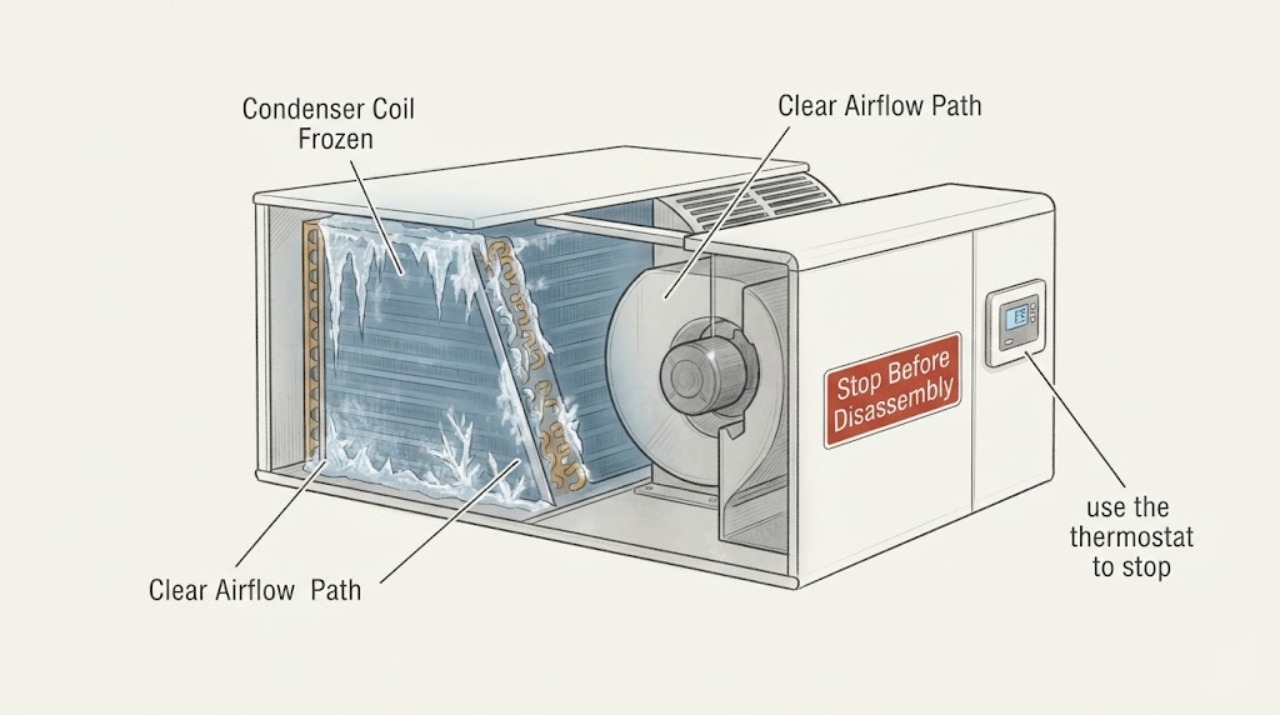
A frozen coil at the outdoor condenser is not automatically a blower-motor failure. In cooling mode, the coil that normally freezes is usually the indoor evaporator; an outdoor condenser coil or refrigerant line icing is more often associated with a heat-pump heating cycle, a system fault, or ice carried over from an evaporator problem. Turn the system off, identify where the ice is, and observe indoor airflow without opening equipment. Replace an obviously dirty accessible filter only as the manual allows, keep returns and registers clear, and let the ice thaw naturally. Do not chip ice, pour hot water on a coil, open panels, test live wiring, handle refrigerant, or keep running a system with ice. If airflow is weak, the blower does not run, ice returns, the outdoor fan is stopped, or refrigerant or electrical trouble is suspected, leave the system off and call an HVAC professional.
Work through in order
Diagnostic checks
Use only checks that match the exact appliance or system and its official guide.
-
Check 1
From a safe distance, identify whether the equipment is a conventional air conditioner or a heat pump and whether the thermostat is calling for cooling or heating. Look only through normal grilles or at accessible insulated lines; do not remove a cover.
Expected result: Ice on an indoor coil or insulated refrigerant line during cooling points toward the evaporator side. Ice on the outdoor coil during heat-pump heating may be a defrost-cycle condition, but a solid or persistent buildup is abnormal. An ordinary cooling condenser should reject heat outdoors rather than routinely freeze.
Next step: Record the mode, coil location, outdoor temperature, and whether ice is on the coil, line, or both. If the location cannot be distinguished safely, stop and arrange HVAC service.
Why this matters
Why: The coil location and operating mode determine whether the reported condenser identity matches the likely fault path.
-
Check 2
If any ice is visible, use the thermostat to stop the affected cooling or heating call and leave the equipment off. Keep people away from meltwater and place protection near, but not inside, any accessible drain-pan area without touching electrical equipment.
Expected result: Ice begins to melt while the system is off, but the timing and amount of water do not identify the cause. Ice that remains, returns quickly, or is accompanied by poor cooling or heating indicates that the system needs diagnosis rather than another run cycle.
Next step: Allow natural thawing. Do not chip the ice, pour hot water on it, use a flame or heater, or restart just to see whether the symptom repeats.
Why this matters
Why: Stopping operation limits continued compressor and airflow stress while preserving useful observations.
-
Check 3
With the system off, stand at several supply registers and return grilles and note whether airflow was normal, weak, or absent before shutdown. Listen only from outside the air handler for a blower that never starts, hums, surges, or stops intermittently.
Expected result: Weak or absent indoor airflow makes a dirty filter, blocked return, blower-motor problem, or related control issue more likely. Normal airflow makes a blower-only explanation less likely but does not rule out a refrigerant, thermostat, or coil problem.
Next step: Keep the unit off if airflow was absent or the blower behavior was abnormal. Do not reach into the air handler or attempt capacitor or motor tests; give the airflow pattern to the HVAC technician.
Why this matters
Why: The indoor blower is screened by delivered airflow; the outdoor condenser fan is a separate fan and does not prove the blower motor is healthy.
-
Check 4
Inspect the accessible air filter, return grille, and supply registers while the system remains off. If the filter is visibly loaded and the product instructions describe a user-replaceable filter, replace it with the specified type; remove furniture or debris blocking registers without opening ductwork.
Expected result: A blocked filter or return can reduce airflow enough to contribute to indoor evaporator icing. A clean filter and clear registers with recurring ice shift suspicion toward the coil, refrigerant, thermostat, blower, or another system fault.
Next step: After the ice has fully thawed, leave the unit off and call HVAC service if the filter was already clean, airflow remains weak, or icing returns. Do not use a filter with an unverified rating or force it into place.
Why this matters
Why: This is the main low-risk airflow check relevant to a suspected blower-motor contribution.
-
Check 5
From outside the condenser, inspect through the normal grille for ice, packed debris, a damaged blade, or a fan that is stopped while a call is active. Do not touch the coil or blade and do not remove the service panel; keep the unit off if a blade is damaged or the cabinet is unusually hot.
Expected result: A stopped outdoor fan or damaged blade can prevent heat rejection and points to a condenser-fan, motor, capacitor, or control issue. Ice limited to the outdoor coil during heat-pump heating may relate to defrost operation; heavy ice in cooling or repeated ice in either mode needs service.
Next step: Record the operating mode, fan state, noise, and visible ice or damage. Leave the unit off and request HVAC service for a stopped fan, damaged blade, abnormal heat, or recurring frost.
Why this matters
Why: The outdoor fan and the indoor blower motor are separate diagnostic paths, and visible outdoor ice does not identify the indoor blower as the failed part.
-
Check 6
Prepare a service note after thawing without restarting for a test: list the equipment type, mode, ice location, outdoor temperature, thermostat setting, register airflow, filter condition, outdoor fan observation, water from thawing, unusual sounds, and whether the symptom returned.
Expected result: Weak airflow with indoor icing supports an airflow or blower path; normal airflow with recurring ice keeps refrigerant, coil, metering, thermostat, and control causes in scope; outdoor icing only in heat-pump heating requires a defrost assessment.
Next step: Give the record to a qualified HVAC technician. Ask for airflow and electrical checks, operating temperatures, and refrigerant-leak evaluation as appropriate; do not accept an unexplained refrigerant top-off as the diagnosis.
Why this matters
Why: A structured symptom record helps a technician test the correct circuit without the homeowner opening high-voltage or sealed-system components.
Use your observations
Decision map
Find the observation that best matches what you see, then follow the next safe action.
-
PATH 01Safety boundary
What you see
Ice is on the indoor evaporator area or insulated line during cooling, especially with weak airflow.
Do this next
Leave the system off to thaw, perform only the accessible filter and register checks, and call HVAC service if airflow is weak or ice returns.
Why this path and its safety boundary
Why it matters: A restricted filter or return, blower-motor/airflow fault, dirty coil, low refrigerant, or control issue is more likely than a frozen outdoor condenser coil.
Safety stop: Do not open the air handler, chip ice, test a capacitor, or handle refrigerant.
-
PATH 02Safety boundary
What you see
The outdoor coil is frosted while a heat pump is operating in heating mode.
Do this next
Follow only the defrost behavior specified for the exact model, keep clear of the outdoor fan, and arrange HVAC service when the ice does not clear or the system loses heat.
Why this path and its safety boundary
Why it matters: Some frost can occur during heating and the equipment may use an automatic or manual defrost function, but heavy, solid, persistent, or recurring ice is not normal operation.
Safety stop: Do not pour hot water on the coil, chip ice, use a flame or heater, or force a defrost setting that the manual does not authorize.
-
PATH 03Safety boundary
What you see
Ice is visible on the outdoor condenser or lines while an air conditioner is in cooling mode.
Do this next
Turn the cooling call off, let the system thaw naturally, and request an HVAC diagnosis rather than restarting it.
Why this path and its safety boundary
Why it matters: This is not a routine summer condenser condition; the ice may reflect an evaporator-side or refrigerant problem, a system fault, or misidentified coil location.
Safety stop: Do not keep running the compressor, open panels, or attempt refrigerant charging.
-
PATH 04Safety boundary
What you see
Indoor airflow is weak or absent, or the blower starts intermittently while the system calls.
Do this next
Check only the accessible filter and registers with power off, then leave the equipment off and call HVAC service if airflow is not restored safely.
Why this path and its safety boundary
Why it matters: The filter, return path, blower motor, capacitor, control, or indoor coil may be restricting or stopping airflow; an outdoor condenser fan observation cannot clear this path.
Safety stop: Do not reach into the blower, remove an air-handler panel, discharge a capacitor, or perform live electrical tests.
-
PATH 05Safety boundary
What you see
The outdoor fan is stopped, noisy, damaged, or the cabinet is unusually hot when the system calls.
Do this next
Keep the system off and arrange HVAC service; provide the fan state, noise, and visible damage without touching the unit.
Why this path and its safety boundary
Why it matters: A condenser fan motor, blade, capacitor, control, or another high-voltage component may be involved, and this is distinct from the indoor blower motor.
Safety stop: Do not spin the blade by hand, remove the service cover, or attempt motor or capacitor replacement.
-
PATH 06Safety boundary
What you see
The filter and registers are clear, airflow seems normal, but ice returns, cooling or heating remains poor, or oily residue/hissing is noticed near a coil or line.
Do this next
Leave the equipment off and request qualified HVAC service. Ask the technician to evaluate airflow and locate and repair a leak before any charge is added.
Why this path and its safety boundary
Why it matters: A refrigerant leak, charge problem, coil, metering, thermostat, or control fault remains possible and cannot be confirmed by appearance alone.
Safety stop: Do not open the sealed system, connect gauges, release refrigerant, or substitute an unapproved refrigerant.
Helpful context
Understand the symptom
Start by locating the ice without assuming the name on the problem is anatomically correct. In a split system, the evaporator is indoors and the condenser is outdoors. During normal summer cooling, ice on an indoor coil or suction line points toward an evaporator-side airflow or refrigerant problem. A heat pump can frost its outdoor coil during heating and use a model-controlled defrost cycle, but heavy or persistent ice is not a condition to keep testing.
The blower-motor clue is the amount of air reaching the rooms, not whether the outdoor condenser fan is visible. A stopped or weak indoor blower can starve the evaporator of airflow and contribute to indoor icing. Keep this inspection external: do not remove an air-handler cover, reach toward a fan, discharge a capacitor, or probe wiring.
If ice is present, protect the compressor and the home from meltwater. Use the thermostat to stop the affected cooling or heating call, leave the equipment undisturbed while it thaws, and arrange service if the symptom returns. EPA guidance also supports professional leak repair and responsible refrigerant handling rather than an unverified top-off.
Safety boundary
Stop conditions
- Stop operation when ice is visible, airflow is absent, the outdoor fan is stopped or damaged, the cabinet is unusually hot, or the system repeatedly freezes. Leave the thermostat call off and allow safe natural thawing.
- Do not chip or pry ice, pour hot water on a coil, use a flame or heater to thaw it, reach into a blower or fan, remove HVAC panels, discharge or replace a capacitor, perform live electrical tests, or open the sealed refrigerant circuit.
- If there is smoke, a burning smell, arcing, a hot or melted disconnect, exposed wiring, refrigerant hissing with an unusual odor, electrical shock risk, or water near energized equipment, move away and seek emergency or qualified HVAC/electrical help from a safe location.
Only after diagnosis
Potential parts
- blower motor
Consider this only if a qualified technician confirms weak or absent indoor airflow is caused by the blower motor rather than the filter, control, capacitor, or another airflow restriction.
The exact motor, voltage, speed control, mounting, and system model must be verified by a qualified technician before any part is selected. - run capacitor
Consider this only when professional electrical testing identifies the capacitor as the reason the indoor or outdoor motor cannot start or runs abnormally.
Capacitors retain electrical charge and ratings are system-specific; do not select, discharge, or replace one as a homeowner. - air filter
Consider a replacement only when the existing accessible filter is visibly loaded and the exact equipment instructions specify a user-replaceable filter and size.
Confirm the manual, dimensions, airflow rating, and installation direction; a filter change does not diagnose recurring ice.
Common questions
FAQ
Is a frozen outdoor condenser coil the same as a frozen evaporator coil?
No. The evaporator is normally indoors and the condenser is outdoors. Outdoor frost can occur on a heat pump during heating, while ice reported on an outdoor unit during ordinary cooling may reflect a different or misidentified coil problem.
Can a blower motor cause a frozen coil?
A failing indoor blower can reduce airflow over the indoor evaporator and contribute to evaporator icing. Check airflow at the registers and the accessible filter, but do not open the air handler or test the motor or capacitor yourself.
Can I chip ice off an HVAC coil or pour hot water on it?
No. Turn off the affected thermostat call and allow the coil to thaw naturally. Chipping ice, using hot water, or applying a flame or heater can damage the coil or create a safety hazard.
What should I ask an HVAC technician to check?
Give the technician the ice location, operating mode, airflow, filter state, outdoor fan behavior, and recurrence pattern. Ask for airflow and blower checks, outdoor fan and control checks, and a refrigerant-leak evaluation when the symptoms support them.
Read the exact guide
Official sources
- Homeowners and Consumers: Frequently Asked QuestionsU.S. Environmental Protection Agency · Home air-conditioner refrigerant identification, leak repair, certified technician selection, and refrigerant handling
- Troubleshoot an Air Conditioner: 6 Steps to Fix an AC Not WorkingCarrier · Filter and airflow checks, frozen evaporator indicators, safe shutdown, electrical boundaries, outdoor condenser fan clues, and professional diagnosis
- Top 5 Causes of Frozen AC Coils and How to Fix ThemTrane · Indoor evaporator versus outdoor condenser coil location, frozen-coil signs, airflow causes, safe thawing, heat-pump outdoor frost, and professional escalation
- AC Fan Not Working? Reasons Why It Stopped SpinningTrane · Indoor blower versus outdoor condenser fan distinction, airflow clues, frozen evaporator relationship, fan motors, capacitors, and professional service
Community feedback
Share a repair observation
Share a plain-text repair observation. Accepted observations are published automatically; this page may take a moment to update.