
On this page
Start here
Quick answer
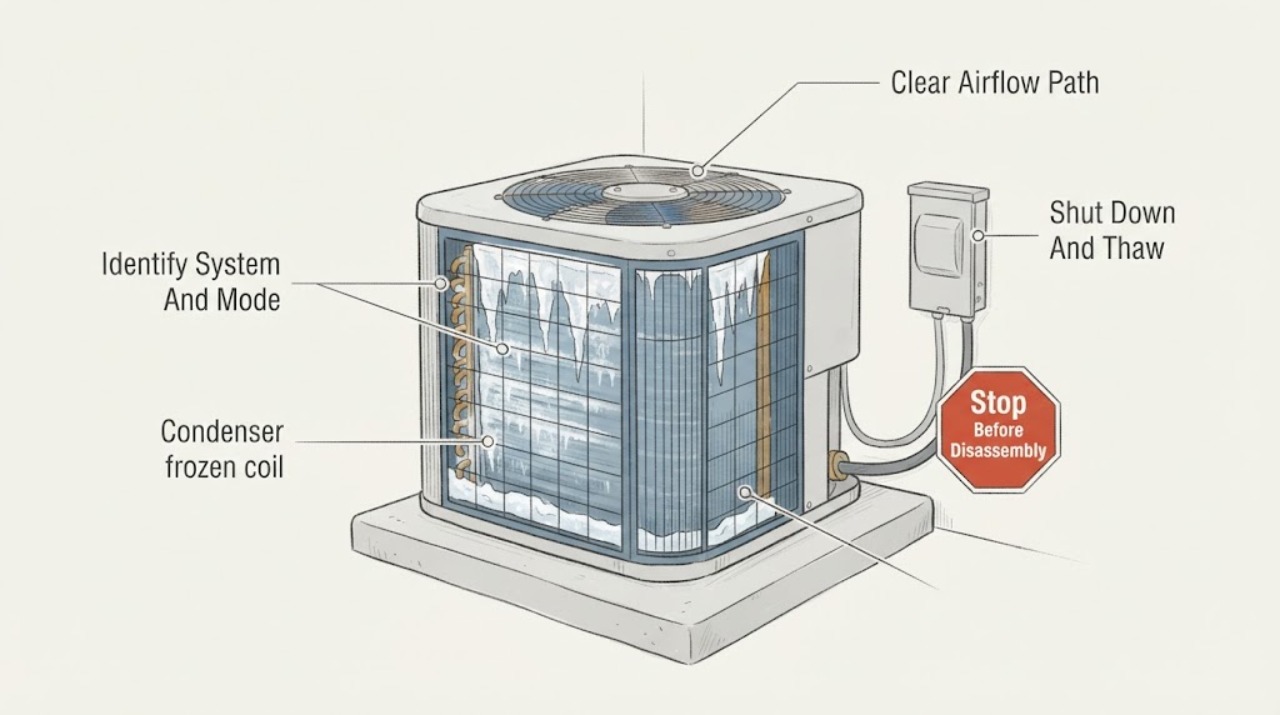
“Condenser frozen coil” can describe two different situations: in a standard split air conditioner, the frozen coil is usually the indoor evaporator, while the outdoor condenser releases heat; in a heat pump running in heating mode, light frost on the outdoor coil can be normal during an automatic defrost cycle. Identify the system and operating mode, note whether ice is on the indoor coil, outdoor coil, or connecting refrigerant tubing, turn cooling off if the indoor coil or tubing is iced, and let ice thaw naturally without chipping or heating it. Persistent or thick outdoor ice, repeated refreezing, weak airflow, water from thawing, or any suspected refrigerant, electrical, fan, compressor, or defrost fault requires qualified HVAC service.
Work through in order
Diagnostic checks
Use only checks that match the exact appliance or system and its official guide.
-
Check 1
Read the thermostat mode and identify whether the outdoor equipment is a conventional air conditioner or a heat pump from the exterior label or owner documentation. Note whether the ice appeared while the system was cooling or heating.
Expected result: The system is a standard air conditioner in cooling mode, a heat pump in heating mode, a heat pump in cooling mode, or the system type or mode is uncertain.
Next step: Use the matching branch and do not change modes repeatedly to test the ice. If the system type is uncertain, keep the equipment at the safe normal setting and have a technician identify it.
Stop if: Stop for smoke, burning odor, exposed wiring, a tripped breaker, refrigerant hiss, severe vibration, or any need to open the equipment cabinet.
Why this matters
Why: A standard split AC normally has its evaporator indoors and condenser outdoors; a heat pump can frost its outdoor coil during heating and use defrost. The same outdoor ice observation has different meanings depending on mode.
-
Check 2
From safe, stable positions, look without touching at the indoor unit area, visible refrigerant tubing, outdoor coil, and outdoor fan area. Compare the supply airflow and cooling or heating performance with normal operation; do not remove panels or reach through the grille.
Expected result: Ice is on the indoor coil or tubing, on the outdoor coil, on the outdoor unit during heat-pump heating, or only a small frost patch that clears; airflow is weak, normal, or absent.
Next step: Record the location and mode, then shut off the cooling call if the indoor coil or tubing is iced. Do not run the system to see whether the ice grows or clears.
Stop if: Stop for active water near electrical equipment, an inaccessible or unstable unit, a damaged coil or fan, or any need to touch ice, tubing, or moving parts.
Why this matters
Why: Indoor-coil or tubing ice with weak airflow supports a frozen evaporator path; outdoor ice in heat-pump heating may be a defrost event; persistent outdoor ice, cooling-mode ice, or abnormal airflow suggests a fault that cannot be diagnosed from location alone.
-
Check 3
If the indoor evaporator, visible refrigerant tubing, or a cooling system is iced, set the thermostat to stop cooling and leave the equipment off long enough for the ice to melt naturally. Protect the floor from thaw water only if this can be done without approaching electrical parts or opening the unit.
Expected result: Ice melts and airflow or water returns to normal, water overflows or reaches electrical parts, or ice remains or returns after a complete natural thaw.
Next step: Replace only an accessible filter if it is visibly loaded and the equipment instructions identify it as user-serviceable; otherwise keep the system off and arrange HVAC diagnosis. Never chip ice or use an external heat source.
Stop if: Stop for active water near electrical equipment, a frozen filter or coil cabinet, a damaged drain pan, a refrigerant smell or hiss, or any need to open the indoor unit.
Why this matters
Why: Thawing removes the immediate airflow obstruction but does not identify the cause; remaining or recurring ice points toward airflow restriction, refrigerant, coil, thermostat, blower, or another system fault.
-
Check 4
After the ice has cleared and with the system off, inspect only the accessible air filter, supply and return grilles, and the outside of the outdoor unit for obvious leaves, grass, or other blockage. Do not wash an iced coil, bend fins, remove panels, or reach near the fan.
Expected result: The filter is visibly clogged, return or supply airflow is blocked, outdoor clearance is obstructed, or the accessible airflow path is clear while freezing recurs.
Next step: Correct only an obvious external obstruction and replace a user-serviceable filter with the exact type and orientation specified by the equipment instructions. If ice returns or airflow remains weak, stop operation and call an HVAC professional.
Stop if: Stop for ice still present, water near electrical equipment, a blocked or damaged fan, a filter that cannot be removed safely, or any need to clean the coil or open a cabinet.
Why this matters
Why: Restricted airflow can contribute to evaporator freezing; a clear external path does not rule out a dirty internal coil, low refrigerant, blower issue, thermostat issue, defrost fault, or other cause.
-
Check 5
If the equipment is a heat pump operating in heating mode and the outdoor coil has only light frost, observe from a safe distance whether its normal automatic defrost clears the frost without intervention. Do not force a defrost cycle or approach the fan, compressor, wiring, or refrigerant lines.
Expected result: Frost clears and the system resumes heating, a brief steam cloud or fan pause occurs, or ice grows, remains, or returns repeatedly.
Next step: If the frost clears normally, continue monitoring without changing settings. If it persists, grows, or the home is not heating, turn the system off if directed by the manual and arrange qualified heat-pump service.
Stop if: Stop for thick ice blocking airflow, a continuously running or failing outdoor fan, unusual electrical noise, exposed wiring, water freezing around the unit, or any need to touch the coil or controls.
Why this matters
Why: Periodic frost and a short defrost event can be normal for a heat pump; ice that does not clear or repeated prolonged defrost can indicate low refrigerant, a defrost control or sensor fault, airflow or drainage trouble, or another system problem.
-
Check 6
Record the equipment type and mode, ice location and thickness, whether it clears, airflow strength, thermostat setting, filter condition, water from thawing, outdoor fan behavior, recent service, and any error display. Photograph only from a safe distance and do not remove panels for a model label.
Expected result: The record distinguishes indoor evaporator freezing, outdoor heat-pump defrost frost, persistent outdoor ice, and related airflow or performance symptoms.
Next step: Arrange qualified HVAC service for recurrent or persistent ice, weak or absent airflow, water, cooling or heating loss, or any suspected refrigerant, electrical, fan, compressor, or defrost fault. Keep the system off when a stop condition is present.
Stop if: Do not continue when diagnosis requires refrigerant gauges, electrical testing, capacitor or fan access, coil cleaning inside the cabinet, refrigerant recovery or charging, or bypassing a control.
Why this matters
Why: Mode, location, timing, and recurrence help a technician test airflow, refrigerant, coil cleanliness, fan, thermostat, drainage, defrost controls, and the condenser without guessing from the phrase “frozen condenser.”
Use your observations
Decision map
Find the observation that best matches what you see, then follow the next safe action.
-
PATH 01Next step
What you see
A conventional air conditioner is in cooling mode and ice is on the indoor coil, indoor cabinet, or connecting refrigerant tubing.
Do this next
Turn cooling off, let the ice thaw naturally, check only the accessible filter and grilles, and arrange HVAC service if the cause is not an obvious filter restriction or if freezing returns. Do not chip the ice or handle refrigerant.
-
PATH 02Next step
What you see
A heat pump is heating and light frost appears on the outdoor coil but clears during its normal defrost cycle.
Do this next
Leave the defrost controls alone and monitor the cycle from a safe distance. A brief steam cloud, fan pause, or sound change can occur while the outdoor coil is being cleared.
-
PATH 03Next step
What you see
A heat-pump outdoor coil remains iced, becomes covered, or refreezes instead of clearing.
Do this next
Stop experimenting with modes and arrange qualified HVAC service for defrost control, sensor, airflow, drainage, fan, and refrigerant diagnosis. Do not chip, scrape, heat, or wash the ice.
-
PATH 04Next step
What you see
Ice or frost appears on the outdoor unit or refrigerant tubing while a conventional AC or heat pump is cooling.
Do this next
Turn cooling off and let the system thaw naturally. Check only the accessible filter and airflow path; persistent ice or inadequate cooling needs professional refrigerant, airflow, coil, and outdoor-unit diagnosis.
-
PATH 05Next step
What you see
Freezing occurs with weak airflow and a visibly loaded filter or blocked return or supply path.
Do this next
Correct only the external obstruction or replace a user-serviceable filter as the equipment instructions specify, then monitor without restarting an iced system. If airflow stays weak or ice returns, call an HVAC professional.
-
PATH 06Next step
What you see
Thaw water reaches electrical equipment, the fan or wiring is damaged, a breaker trips, or the system has severe vibration, noise, or an error condition.
Do this next
Leave the equipment off if it can be done safely from the normal control, keep clear, and arrange qualified HVAC or electrical assessment. Do not open the cabinet or reset protection repeatedly.
Helpful context
Understand the symptom
The word condenser may be hiding the actual coil
In a typical split air conditioner, the outdoor unit contains the condenser coil, compressor, and fan, while the indoor unit contains the evaporator coil. A frozen coil symptom is therefore often an indoor evaporator or the refrigerant tubing connected to it, even when the visible ice is near the outdoor unit. A heat pump is different: its outdoor coil can frost during heating and then clear in defrost mode. Start by identifying whether the equipment is an air conditioner or heat pump and whether the thermostat is calling for cooling or heating.
Ice is a stop signal, not a cleaning target
Ice with weak airflow, inadequate cooling, water below the indoor unit, or frost on refrigerant lines can result from restricted airflow, a dirty filter or coil, low refrigerant, or another system fault. Turn the cooling call off when the indoor coil or connected tubing is frozen and let it thaw naturally. Do not chip ice, apply a hair dryer or space heater, open the coil cabinet, add refrigerant, or keep restarting the system while it is iced.
When outdoor frost can be normal—and when it is not
If the equipment is a heat pump in heating mode, periodic light frost may be cleared by its built-in defrost cycle; a brief change in sound, a stopped outdoor fan, or a cloud of steam can occur while the coil thaws. Frost that keeps growing, covers the unit, does not clear, or appears during cooling is not a normal homeowner adjustment. Do not force a defrost cycle or work on the reversing valve, fan, controls, or refrigerant circuit; arrange HVAC service.
Only after diagnosis
Potential parts
- air filter
Consider this category only when the filter is visibly loaded or damaged, the location is user-serviceable, and the equipment instructions specify a replacement filter.
Confirm exact dimensions, filter type, airflow direction, and equipment instructions; a new filter does not prove that low refrigerant, a dirty coil, blower fault, or defrost fault is absent. - heat-pump defrost sensor or control
Consider this category only after a qualified technician confirms persistent outdoor ice is caused by a failed defrost sensor or control.
Confirm the exact heat-pump model, control sequence, sensor type, wiring, and commissioning requirements; frost that clears normally does not justify replacing a control. - evaporator or condenser coil
Consider this category only after professional testing confirms a damaged or leaking coil rather than airflow restriction, thermostat, fan, defrost, or refrigerant-charge issue.
Confirm exact system model, coil configuration, refrigerant circuit, metering device, dimensions, and required evacuation and charging procedures before any replacement.
When checks do not resolve it
Need a professional?
Ice remains, grows, or returns after a complete natural thaw., The outdoor coil is heavily iced, a heat-pump defrost cycle does not clear it, or ice appears during cooling., Airflow is weak or absent, cooling or heating is inadequate, or thaw water is recurring., The suspected cause is low refrigerant, a leak, dirty internal coil, fan, compressor, thermostat, reversing valve, defrost control, or electrical component., Diagnosis would require opening a cabinet, using refrigerant gauges, testing live electrical parts, or removing ice from the coil.
Common questions
FAQ
Can a condenser coil freeze?
The phrase is ambiguous. In a standard split AC, the indoor evaporator is the coil normally associated with freezing, while the outdoor condenser releases heat. A heat pump can frost its outdoor coil in heating mode during normal operation, but thick, persistent, recurring, or cooling-mode ice needs professional diagnosis.
What should I do if ice is on my AC lines or outdoor unit?
Turn the cooling call off and let the system thaw naturally. Check only the accessible filter and airflow path after it is safe, and do not chip, heat, wash, or handle the ice or refrigerant lines. If the ice returns or cooling remains poor, arrange HVAC service.
Is frost on a heat-pump outdoor coil normal?
Light periodic frost can be normal when a heat pump is heating, because the outdoor coil periodically enters defrost. A brief fan pause, sound change, or steam cloud can occur. Frost that grows, stays, or repeatedly fails to clear indicates a problem that needs HVAC service.
Can a dirty filter cause a frozen coil?
Yes. A clogged filter or blocked return can restrict airflow and contribute to an indoor evaporator freezing, but low refrigerant, a dirty coil, thermostat, blower, and other faults can look similar. Replace only an identified user-serviceable filter and call a professional if freezing recurs.
Can I remove ice from the coil myself?
Do not chip, scrape, or heat the ice. Turn off the cooling call and allow natural thawing, protect against thaw water only from a safe position, and arrange HVAC service when the cause is not an obvious external airflow restriction or when the ice returns.
Read the exact guide
Official sources
- Troubleshoot an Air ConditionerCarrier Residential · AC frozen evaporator symptoms, causes, and service boundary
- Coils Troubleshooting GuideTrane · Coil ice, airflow, and external-observation guidance
- What Is the Heat Pump Defrost Cycle?Trane · Normal heat-pump outdoor frost and defrost behavior
- How to Troubleshoot Your Heat Pump: Tips and Tricks to Keep Your HVAC Systems Running SmoothlyTrane · Heat-pump outdoor-coil frost, defrost, and unusual-operation boundary
- Understanding Your AC Condenser UnitCarrier Residential · AC condenser, outdoor unit, and indoor evaporator roles
- Help! My AC Evaporator Coil Is FrozenTrane · Frozen evaporator response and homeowner-safe checks
Community feedback
Share a repair observation
Share a plain-text repair observation. Accepted observations are published automatically; this page may take a moment to update.