
On this page
Start here
Quick answer
Turn cooling off at the thermostat and let any ice melt naturally; do not chip it, pour hot water on it, or keep running the system with a frozen coil. First establish which coil is actually iced: the condenser is normally the outdoor heat-rejecting coil, while the evaporator is normally the indoor cold coil and is the one commonly associated with frost in cooling mode. Once the unit is safe and dry, check the return-air filter and visible airflow without opening equipment. Replace a restricted filter only with the exact size and type specified for the system. If ice returns, airflow remains weak, water leaks, the filter is clean, or the ice is on the outdoor coil, arrange qualified HVAC service for airflow, fan, refrigerant, controls, and operating-mode diagnosis.
Before you begin
Safety first
- This article permits only thermostat shutdown, natural defrost, ordinary filter access, room-level airflow checks, and safe external observation. A qualified HVAC technician must handle panels, coils, fans, motors, capacitors, refrigerant, electrical diagnosis, drains inside equipment, and sealed-system work.
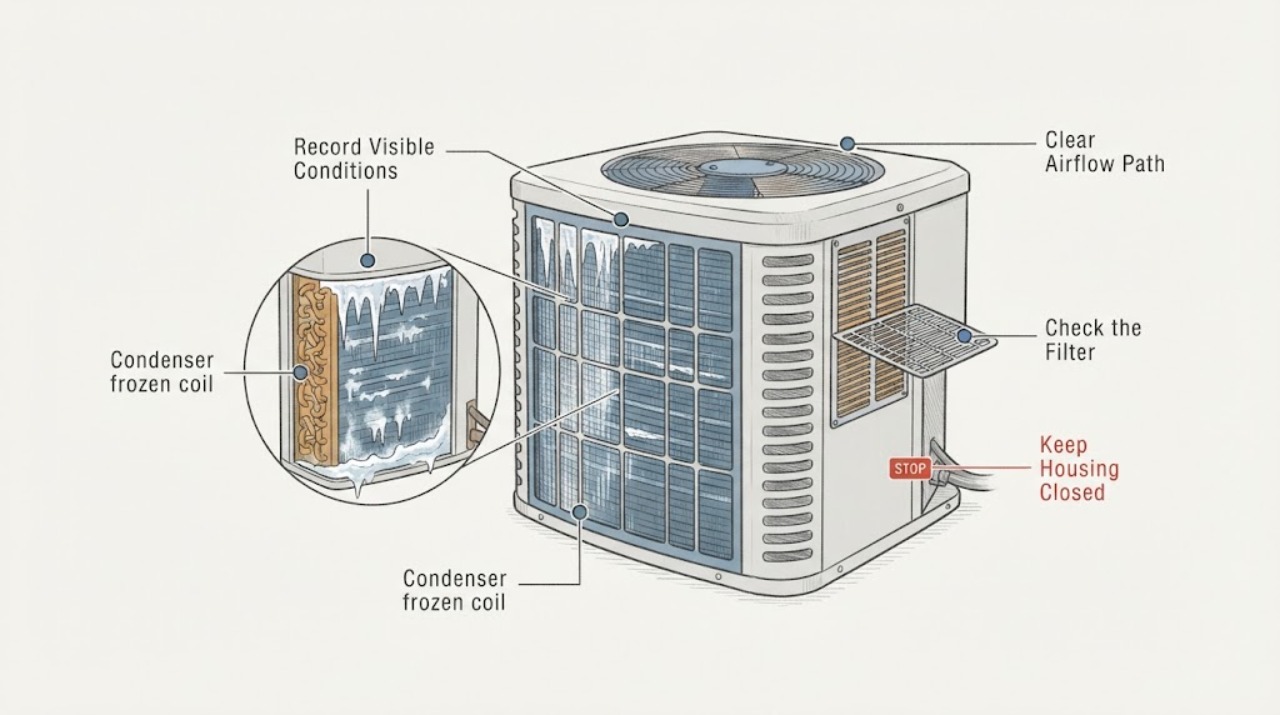
Work through in order
Diagnostic checks
Use only checks that match the exact appliance or system and its official guide.
-
Check 1
Set the thermostat out of cooling or turn cooling off, leave the indoor fan setting as the system instructions allow, and observe the coil area only from ordinary safe access; do not open panels or touch the ice.
Expected result: Record whether ice is on the indoor air-handler coil or line area, on the outdoor coil, or only on a pipe; note whether the unit is a cooling system or a heat pump, whether the outdoor fan runs, and whether water begins collecting as ice melts.
Next step: Keep cooling off and allow natural defrost; give the technician the exact ice location, operating mode, weather, fan response, and water-drain observation.
Stop if: Stop immediately for smoke, burning smell, arcing, an exposed wire, uncontrolled water near electrical equipment, a damaged coil, or a fan that is accessible and unsafe.
Why this matters
Why: Ice inside at the cold coil is consistent with an evaporator-frost problem, even if the user called it a condenser. Ice outside changes the diagnostic path and may relate to operating mode, outdoor conditions, fan or airflow behavior, or a refrigeration fault.
-
Check 2
After switching the system off and only from the normal filter access, remove or slide out the air filter without opening the air handler; compare its label, size, airflow arrow, and visible loading with the unit instructions.
Expected result: Classify the filter as clean and correctly installed, visibly loaded, wet, collapsed, the wrong size, installed backward, or impossible to remove without tools or panel access.
Next step: Replace only a clearly restricted filter with the exact approved size and type, restore the airflow direction, and do not restart cooling while ice remains; request HVAC diagnosis if the filter is wet, damaged, inaccessible, or the problem returns.
Stop if: Do not run the system without its required filter, stack filters, force a filter into place, wash a disposable filter, or reach into a blower or energized cabinet.
Why this matters
Why: A loaded, wet, collapsed, or incorrect filter can restrict return airflow and help an indoor evaporator freeze. A clean, correctly installed filter makes a filter-only explanation less likely and does not explain outdoor-coil ice by itself.
-
Check 3
With the system off, walk the occupied rooms and check that return grilles and supply registers are open and not blocked by furniture, drapes, stored items, or a closed door; do not alter ductwork.
Expected result: Record whether airflow is weak at several supplies, weak only in one room, normal after defrost, or absent; note whether the return grille is obstructed or the filter is being pulled tightly against its frame.
Next step: Remove only ordinary room-level obstructions, keep cooling off until the coil is clear, and arrange HVAC service for weak airflow, a noisy or non-running blower, or recurring frost.
Stop if: Do not remove duct covers, reach into a blower, bypass a door switch, or keep operating the system when airflow is absent or water reaches electrical equipment.
Why this matters
Why: Weak or absent airflow across several outlets supports an airflow-side fault involving the filter, return, blower, coil, or duct path. Normal airflow with recurring ice points beyond a simple register obstruction and needs professional testing.
-
Check 4
Keep the cooling call off and allow the ice to melt at room temperature; place a safe container or absorbent material below a reachable drain area only if it cannot contact electrical equipment, and do not accelerate melting.
Expected result: Record whether ice clears completely, the indoor fan can move air afterward, water drains normally, or ice remains after a reasonable defrost period.
Next step: Leave cooling off if ice remains or water cannot drain safely; provide the technician the defrost result and any wet area. Do not restart simply to see whether a partially frozen coil improves.
Stop if: Never chip ice, pour hot water, use a flame or heat gun, bend fins, move panels, or place water containers where a spill could reach electrical parts.
Why this matters
Why: A complete natural defrost permits a later controlled observation, but it does not identify the cause. Persistent ice, repeated refreezing, a blocked drain, or a water leak indicates that the system needs HVAC assessment.
-
Check 5
After the coil is fully clear and the area is dry, read the thermostat mode and fan setting, verify the filter is installed, and compare the displayed call for cooling with the equipment's normal response; do not repeatedly cycle the system.
Expected result: Record whether cooling is requested, the indoor blower responds, the outdoor unit responds, and the ice returns during a single normal observation; for a heat pump, record whether the system is in heating or cooling mode.
Next step: Stop the cooling call and schedule HVAC service for recurring ice, missing fan response, unexpected mode behavior, or any need to test controls, wiring, motors, capacitors, or refrigeration pressures.
Stop if: Do not open the thermostat, disconnect wiring, reset a breaker repeatedly, or run the system if it trips protection, smells hot, sparks, or produces uncontrolled water.
Why this matters
Why: A mismatch between the thermostat call and fan or outdoor response points toward controls, power, or a motor issue rather than the filter. Ice that returns after correct airflow and one normal cycle indicates a fault that requires professional diagnosis.
-
Check 6
With the outdoor unit off, inspect from a safe distance for leaves, grass, snow, or other debris around the cabinet and for visibly bent fins; do not remove the top, open the electrical section, or touch the fan.
Expected result: Record whether the outdoor coil is clear, visibly blocked, bent, iced, or inaccessible; note whether the unit is in a heating mode that could change outdoor-coil behavior.
Next step: Keep vegetation and loose debris away from the unit only from safe external access, leave an iced or damaged unit off, and request HVAC service for coil, fan, refrigerant, or mode diagnosis.
Stop if: Do not hose an iced unit, use a pressure washer, straighten fins with a tool, remove panels, hand-turn a fan, or enter the electrical compartment.
Why this matters
Why: Debris can reduce outdoor heat transfer, but it does not establish that the condenser is frozen or authorize internal cleaning. Outdoor ice, bent fins, a non-running fan, or an unclear heat-pump mode requires professional assessment.
-
Check 7
Before requesting service, collect the equipment nameplate and thermostat model information from dry ordinary access, plus photos of the ice location, filter, visible drain water, and outdoor unit without removing covers.
Expected result: Record system type, whether the ice was indoor or outdoor, filter condition and replacement date if known, airflow symptom, operating mode, weather, water leak, and whether the ice returned after natural defrost.
Next step: Give the record to a qualified HVAC technician and request checks of airflow, blower and outdoor fan operation, coil condition, controls, drain, and refrigerant circuit as applicable to the system.
Stop if: Do not measure refrigerant, attach gauges, open the sealed circuit, test a capacitor, probe wiring, or remove an electrical or coil panel.
Why this matters
Why: This separates a possible filter and airflow restriction from an evaporator, condenser, fan, control, drain, or refrigeration-system issue and prevents a technician from assuming that “condenser frozen” identifies the iced component.
Use your observations
Decision map
Find the observation that best matches what you see, then follow the next safe action.
-
PATH 01Safety boundary
What you see
Ice is on the indoor coil or nearby suction line during cooling operation.
Do this next
Keep cooling off, let the coil defrost naturally, check the filter and room-level airflow only, and arrange HVAC diagnosis if the ice returns or airflow is weak.
Why this path and its safety boundary
Why it matters: The reported condenser identity is likely reversed; an indoor evaporator freeze is more consistent with restricted airflow, coil fouling, low refrigerant, blower trouble, or a control problem.
Safety stop: Do not chip the ice, heat the coil, open the air handler, or recharge refrigerant yourself.
-
PATH 02Safety boundary
What you see
Ice is visibly on the outdoor condenser coil or cabinet.
Do this next
Leave the system off, record mode and weather from a safe position, and request qualified HVAC service; do not hose, heat, or dismantle the outdoor unit.
Why this path and its safety boundary
Why it matters: The outdoor coil condition is not explained by a filter alone. System type, operating mode, outdoor temperature, fan operation, airflow, controls, and refrigeration condition must be established.
Safety stop: Stop for a stalled fan, damaged cabinet, electrical smell, arcing, exposed wiring, or any need to open the electrical compartment.
-
PATH 03Safety boundary
What you see
The filter is visibly loaded, wet, collapsed, backward, or the wrong size, and airflow is weak.
Do this next
Replace it only with the exact approved filter from ordinary access, allow full natural defrost, and monitor one normal cycle only after the coil is clear; call HVAC service if ice returns.
Why this path and its safety boundary
Why it matters: A filter-related airflow restriction may be contributing to indoor evaporator frost, but it does not prove that the filter is the only fault.
Safety stop: Do not run without the required filter, stack filters, force a filter, or restart while ice remains.
-
PATH 04Safety boundary
What you see
The filter is clean and correctly installed, airflow is still weak or ice returns after natural defrost.
Do this next
Keep cooling off and provide the technician the ice location, filter record, airflow result, operating mode, and defrost history.
Why this path and its safety boundary
Why it matters: A blower, duct, coil, drain, control, outdoor fan, or refrigerant issue remains possible; changing filters repeatedly will not diagnose it.
Safety stop: Do not open panels, test motors or capacitors, measure refrigerant, or keep resetting the system.
-
PATH 05Safety boundary
What you see
The coil fully defrosts, the filter and room-level airflow are correct, and no ice returns during one normal observation.
Do this next
Continue normal filter care and record any renewed frost, weak airflow, water leak, unusual sound, or mode change; schedule service if any returns.
Why this path and its safety boundary
Why it matters: A temporary airflow restriction is possible, but the observation does not prove the system is repaired or rule out an intermittent fault.
Safety stop: Stop the system for renewed ice, poor airflow, water near electrical parts, smoke, burning smell, or repeated protection trips.
-
PATH 06Safety boundary
What you see
Meltwater appears below the indoor unit, does not drain normally, or reaches a floor or electrical area.
Do this next
Keep cooling off, protect the area only from a dry safe position, and request HVAC service for the pan, drain, coil, and equipment installation.
Why this path and its safety boundary
Why it matters: Defrost water can expose a drain or pan issue and creates a separate water-damage or shock risk.
Safety stop: Do not pour cleaner into the drain, open the air handler, mop around energized equipment, or restart cooling over standing water.
-
PATH 07Safety boundary
What you see
There is smoke, burning smell, arcing, exposed wiring, a hot disconnect, repeated breaker trips, an oily residue, or an inaccessible sealed-system fault.
Do this next
Leave the system off and arrange appropriate HVAC or electrical service; use emergency safety services for active smoke or fire.
Why this path and its safety boundary
Why it matters: This is beyond a filter check and may involve electrical, motor, compressor, or refrigerant hazards.
Safety stop: Do not reset protection repeatedly, touch wiring, discharge a capacitor, attach gauges, open the sealed circuit, or operate the equipment to reproduce the fault.
Helpful context
Understand the symptom
Confirm whether the iced surface is the condenser or evaporator
In a split air conditioner, the indoor evaporator absorbs heat and humidity and the outdoor condenser releases heat outside. Trane's troubleshooting guidance identifies a frozen evaporator as a common cooling problem and recommends stopping the system, while its coil guidance describes frost on a coil as a reason for professional assessment. If the report says condenser but the ice is inside near the furnace or air handler, the component identity may have been reversed. If the outdoor coil is iced, record the operating mode and weather and do not assume a filter alone explains it.
Use the filter as a low-risk airflow check
A filter check is useful only from ordinary access. With the system off, compare the installed filter with the exact size, airflow direction, and replacement guidance for the unit. A visibly loaded filter can restrict air and contribute to indoor coil frost, but a clean filter does not clear the evaporator, diagnose refrigerant charge, or prove that the outdoor coil is safe to clean. Keep supply registers and return grilles open and unobstructed.
Defrost naturally and escalate recurring ice
Leave cooling off long enough for the ice to melt naturally and protect the area below the indoor unit from condensate. Do not scrape fins, chip ice, use a heat gun or flame, or pour hot water over the coil. Once the ice is gone, a technician may need to check airflow, the blower, the coil, refrigerant circuit, fan, controls, and drain. Trane and Department of Energy guidance both connect restricted airflow or coil fouling with evaporator freeze and equipment damage, so recurring ice is not a reason to keep resetting the system.
Safety boundary
Stop conditions
- Turn cooling off and allow ice to melt naturally; never chip ice, pour hot water, use a flame or heat gun, or run the system with a frozen coil.
- Do not open electrical or coil panels, touch wiring, hand-turn a fan, test or discharge a capacitor, measure refrigerant, or open the sealed refrigeration circuit.
- Stop for smoke, burning smell, arcing, exposed wiring, repeated protection trips, a hot disconnect, uncontrolled water, or water near electrical equipment.
- Do not assume a clean filter explains ice on an outdoor condenser, and do not assume the reported condenser identity is correct when the ice is inside at the evaporator.
- Arrange qualified HVAC service for recurring ice, weak or absent airflow, outdoor-coil ice, a stalled fan, drain water, oily residue, or any fault beyond ordinary filter and register checks.
Only after diagnosis
Potential parts
- HVAC air filter
Consider this category only when the existing filter is visibly restricted, wet, damaged, or the wrong size and the unit documentation specifies a replacement.
Confirm the exact system size, filter dimensions, airflow direction, type, and manufacturer guidance; do not stack filters or operate without the required filter. - evaporator or condenser coil service component
Consider a coil repair or replacement only after a qualified technician confirms the iced coil, damage, leak, fouling, or system mismatch and identifies the required service path.
Coil identity, system capacity, refrigerant, cabinet dimensions, and matched equipment must be confirmed by the manufacturer or qualified HVAC technician; do not select a coil from the symptom alone. - blower or condenser fan service component
Consider this category only when professional diagnosis confirms that a fan or blower fault is causing restricted airflow, outdoor-coil ice, or abnormal operation.
Confirm the exact motor, control, electrical rating, wheel or blade, and system model through qualified service; do not test or replace an energized motor or capacitor.
When checks do not resolve it
Need a professional?
Arrange qualified HVAC service when the ice is on the outdoor condenser, the filter is clean but the indoor evaporator freezes, airflow remains weak, ice returns after natural defrost, the fan does not respond normally, meltwater does not drain, or the system may have a coil, control, motor, compressor, or refrigerant fault. Keep the system off and provide the technician the exact iced-coil location, system type and mode, filter condition, airflow result, weather, water observation, and defrost history.
Safety scope: This article permits only thermostat shutdown, natural defrost, ordinary filter access, room-level airflow checks, and safe external observation. A qualified HVAC technician must handle panels, coils, fans, motors, capacitors, refrigerant, electrical diagnosis, drains inside equipment, and sealed-system work.
Common questions
FAQ
Can a condenser coil freeze in an air conditioner?
First verify the location and operating mode. In a standard split cooling system, the outdoor condenser releases heat while the indoor evaporator is the cold coil commonly associated with frost. Outdoor ice needs HVAC assessment of the system type, mode, fan, airflow, and refrigeration condition rather than a filter-only fix.
Can a dirty filter cause a frozen coil?
A restricted filter can reduce airflow and contribute to an indoor evaporator freezing, but it does not prove that the filter is the only cause and does not by itself explain outdoor-coil ice. Replace only the exact approved filter, let the coil defrost naturally, and arrange service if frost returns.
Should I run the fan to melt an iced coil?
Follow the equipment instructions and keep the cooling call off. The priority is natural defrost without chipping, heating, or pouring hot water on the coil. Protect the area from meltwater without placing anything near electrical equipment, and have HVAC service assess persistent or recurring ice.
What if the filter is clean but the coil keeps freezing?
Keep cooling off and stop replacing filters as a guess. Recurring ice can involve the blower, ducts, coil fouling, drain, controls, fan, operating mode, or refrigerant circuit. Provide the technician the ice location, airflow result, system mode, and defrost history; do not open panels or test sealed-system parts.
When is a frozen coil an emergency?
Stop the system for smoke, burning smell, arcing, exposed wiring, repeated protection trips, a hot disconnect, uncontrolled water, or water near electrical equipment. Leave the area if there is active smoke or fire and use the appropriate emergency safety service; otherwise arrange qualified HVAC service for the equipment fault.
Read the exact guide
Official sources
- AC Not Blowing Cold Air? Learn What to DoTrane · Trane residential central-air troubleshooting guidance used for general split-system distinctions; exact equipment instructions control a particular installation.
- Guidelines on Airflow and Refrigerant Charge Verification and DiagnosticsU.S. Department of Energy · DOE technical guidance for residential air-conditioner diagnostics; it is not a homeowner procedure for opening or testing equipment.
- Coil TroubleshootingTrane · Trane residential coil troubleshooting guidance; exact model and installation instructions govern the equipment.
- Air Conditioner Coil MaintenanceTrane · Trane residential coil-maintenance guidance used for general safety boundaries; equipment instructions and a qualified technician control service.
Community feedback
Share a repair observation
Share a plain-text repair observation. Accepted observations are published automatically; this page may take a moment to update.