
On this page
Start here
Quick answer
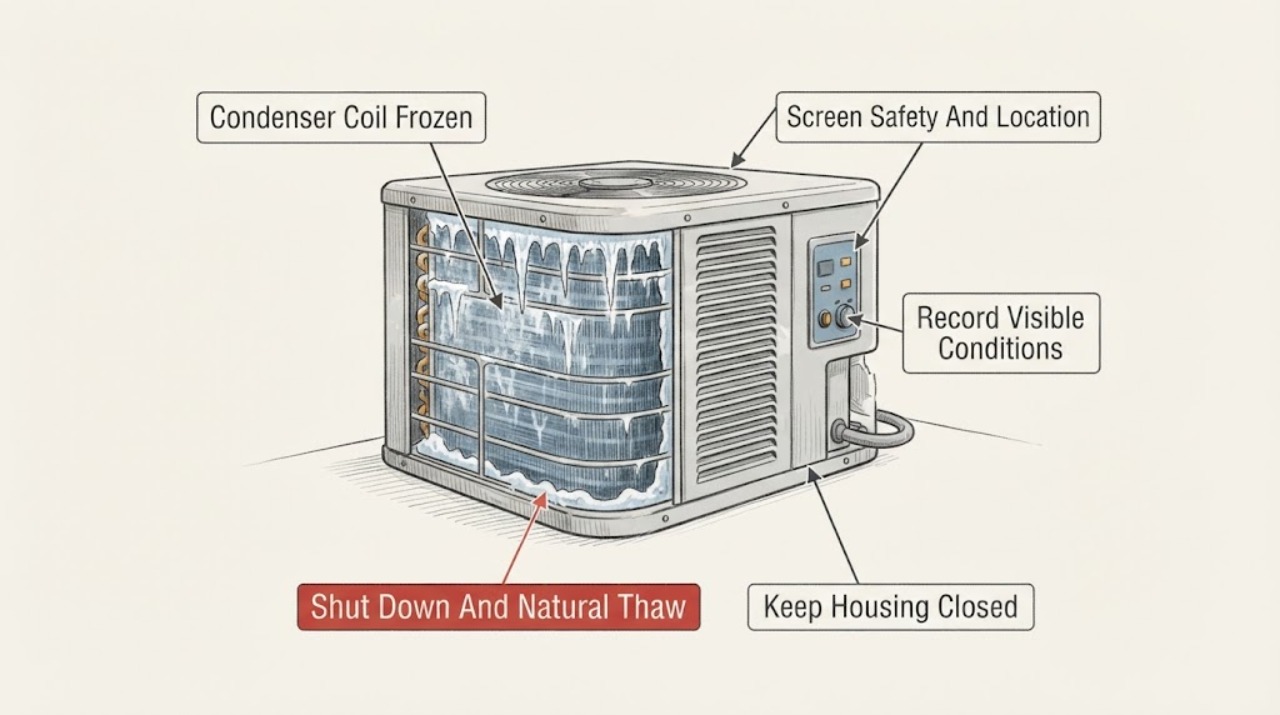
First confirm which coil is frozen. In a heat pump, the outdoor coil can frost during heating and should periodically defrost; a light, temporary frost can be normal, but thick ice that grows, blocks airflow, or does not clear is not. In cooling mode, ice seen at the outdoor condenser or copper tubing can instead reflect a system or refrigerant/airflow problem, and the indoor evaporator may be the coil that is actually frozen. Turn the thermostat off and allow ice to thaw naturally when the equipment instructions permit, while keeping the outdoor coil clear of leaves and snow from a safe distance. Never chip ice, pour hot or boiling water, use a torch or heat gun, hand-turn a fan, open a panel, or test refrigerant, electrical, high-pressure, or compressor parts. If ice returns, does not clear, the fan does not run, airflow is poor, water reaches electrical equipment, or any breaker trips, call a qualified HVAC technician.
Before you begin
Safety first
- This article permits only safe mode observation, thermostat OFF, natural thaw, visible filter/airflow and loose-debris checks, and non-contact recording. It does not authorize ice removal with tools or heat, cabinet opening, live electrical testing, fan or capacitor handling, refrigerant/high-pressure work, or safety bypasses.
Work through in order
Diagnostic checks
Use only checks that match the exact appliance or system and its official guide.
-
Check 1
From a dry, safe position, identify whether the ice is on the outdoor coil/cabinet, copper tubing, or an indoor air-handler area visible without opening it. Note the current mode, smoke, burning odor, sparks, hot equipment, water near electrical parts, exposed damage, and breaker status without touching equipment.
Expected result: There is light frost on an outdoor heat-pump coil with no hazard, thick/growing ice, indoor ice or thaw water, or a fire/electrical/water warning.
Next step: For smoke, fire, arcing, shock, or immediate danger, move away and call emergency responders. For water, hot equipment, or damaged electrical parts, keep clear and arrange urgent HVAC service; otherwise continue with identification only.
Stop if: Do not touch wet equipment, enter standing water, approach a moving fan, open a cabinet, or operate equipment with smoke, sparks, heat, or exposed damage.
Why this matters
Why: Location and mode separate possible normal heat-pump defrost frost from a frozen evaporator or abnormal condenser/defrost/refrigerant condition. Any hazard sign overrides routine thaw guidance.
-
Check 2
Record whether the system is in heating, cooling, or defrost, when the frost began, whether it is thin or a solid layer, whether the outdoor fan pauses as part of a documented defrost cycle, and whether the ice clears on its own. Do not force a defrost cycle or repeatedly call for operation.
Expected result: A light outdoor frost clears during the equipment's normal defrost behavior, or ice remains/grows, returns quickly, appears in cooling, or blocks the coil and fan.
Next step: If the ice clears normally, monitor and follow the exact manual. If it remains, grows, returns, or blocks airflow, shut the system down and call a qualified HVAC technician.
Stop if: Do not chip, scrape, melt with hot water or flame, hand-turn the fan, or restart repeatedly to see whether the ice worsens.
Why this matters
Why: Periodic heat-pump frost can be normal; persistent, growing, or mode-inconsistent ice indicates restricted airflow, water runoff, low refrigerant, fan/defrost control, or another fault requiring diagnosis.
-
Check 3
If there is no smoke, electrical damage, or unsafe water and the manual allows it, set the thermostat to OFF and let the coil thaw naturally. Keep the outdoor unit untouched and place no object against the coil; observe only from a safe distance for meltwater and changing ice.
Expected result: The ice gradually clears without intervention, or it does not clear, continues to grow, produces unusual water, or leaves the system unable to operate.
Next step: If the ice clears, do not immediately run repeated cycles; follow the manual and monitor. If it remains or returns, leave the system off and arrange HVAC service.
Stop if: Do not apply heat, boiling water, chemicals, a torch, a heat gun, a hair dryer near wet equipment, or any tool to the coil.
Why this matters
Why: Natural thaw removes ice without bending fins or damaging tubing, but thaw alone does not correct airflow, fan, defrost, or refrigerant causes. Unusual or persistent ice is not a user repair.
-
Check 4
With the system off, look from outside the unit for leaves, grass, snow, ice buildup, or other ordinary debris around the outdoor coil and for blocked return/supply airflow indoors. Clear only loose material that can be removed without touching the coil, fan, wiring, or cabinet; check the filter only where the exact manual identifies it as user-accessible.
Expected result: The outdoor coil and airflow path are clear, or debris/snow/filter loading is visibly restricting airflow.
Next step: Remove only safe loose obstructions and install the exact manual-specified filter if needed. Allow the system to thaw fully before one normal operation check; if ice or poor performance returns, call HVAC service.
Stop if: Do not brush or hose the coil, bend fins, remove panels, reach through the grille, scrape ice, or clean a coil while energized.
Why this matters
Why: Restricted outdoor or indoor airflow can reduce heat transfer and contribute to icing, but a clear exterior does not rule out a dirty internal coil, fan fault, defrost fault, or low refrigerant.
-
Check 5
From a safe distance after the unit is fully thawed, note whether the outdoor fan starts normally when the manual and weather conditions call for operation, whether airflow is present, and whether meltwater or condensate reaches an unsafe electrical area. Do not approach or hand-turn a fan.
Expected result: The fan runs with normal airflow, the fan is silent or not spinning, the coil refreezes, or water pools near equipment.
Next step: Leave the system off for a non-running fan, refreezing, or unsafe water and call HVAC service. Provide the timing and fan observation rather than testing the motor or electrical components.
Stop if: Do not touch fan blades, motor, capacitor, wiring, disconnect, refrigerant tubing, or pooled water near electrical equipment.
Why this matters
Why: No airflow can contribute to outdoor-coil icing and may indicate a fan motor, control, or electrical issue. Refreezing or unsafe water can indicate a deeper coil, drain, refrigerant, or protection problem.
-
Check 6
If ice is seen on indoor copper lines, the air-handler cabinet, or an indoor evaporator area rather than only the outdoor condenser coil, turn cooling OFF and record weak airflow, thaw water, dirty filter, and the mode. Do not open the air handler or inspect refrigerant connections.
Expected result: Only the outdoor coil has light heat-pump frost, or indoor/copper-line ice or thaw water is present during cooling.
Next step: Allow safe natural thaw with the system off and contact a qualified HVAC technician for recurring indoor ice, weak airflow, or water.
Stop if: Do not chip ice, add refrigerant, open tubing, remove coil panels, or restart a system while ice remains.
Why this matters
Why: Indoor or line ice commonly changes the path toward restricted airflow, evaporator, refrigerant, or compressor-protection diagnosis; it is not evidence that the outdoor condenser coil itself needs scraping.
-
Check 7
Give the technician the system type and model, coil location, heating/cooling mode, frost thickness and timing, defrost behavior, filter and airflow observations, outdoor fan response, weather or runoff, water/ice location, breaker status, and whether the ice returned after thaw.
Expected result: The ice cleared normally, remained or returned, appeared in cooling, followed a blocked coil/filter, occurred with a non-running fan, or involved indoor coil/line ice.
Next step: Keep the system off for persistent or returning ice and schedule qualified HVAC diagnosis. Ask the technician to check airflow, coil condition, fan/defrost controls, refrigerant charge and leaks, and compressor protection as applicable.
Stop if: Do not open cabinets, measure pressure or electricity, handle refrigerant, replace controls, or continue operation through persistent ice or warning signs.
Why this matters
Why: The pattern helps distinguish normal heat-pump defrost from airflow, fan, drain, defrost-control, refrigerant, compressor, or evaporator problems without unsafe testing.
Use your observations
Decision map
Find the observation that best matches what you see, then follow the next safe action.
-
PATH 01Safety boundary
What you see
Ice or meltwater is near electrical equipment, or there is smoke, fire, arcing, shock, burning odor, hot equipment, exposed damage, or a breaker trip.
Do this next
Move away and call emergency responders for fire, smoke, arcing, shock, or immediate danger; otherwise keep the system off and arrange urgent HVAC/electrical service once safe.
Why this path and its safety boundary
Why it matters: The frozen-coil symptom is accompanied by an electrical, fire, or water hazard.
Safety stop: Do not touch wet equipment, restore power, use water or heat, open a panel, or enter unsafe standing water.
-
PATH 02Safety boundary
What you see
A thin outdoor frost appears in heat mode and clears during the unit's normal defrost behavior without growing or blocking airflow.
Do this next
Monitor from a safe distance and follow the exact equipment manual. Arrange service if frost becomes thick, persistent, recurrent outside normal defrost, or affects comfort.
Why this path and its safety boundary
Why it matters: Periodic outdoor frost can be normal for a heat pump.
Safety stop: Do not scrape or heat the coil, hand-turn the fan, or force a defrost cycle.
-
PATH 03Safety boundary
What you see
Thick ice grows, does not clear, returns quickly, blocks the outdoor coil/fan, or appears in a mode where it is not expected.
Do this next
Turn the system off and let it thaw naturally if safe, then call a qualified HVAC technician for diagnosis.
Why this path and its safety boundary
Why it matters: Restricted airflow, runoff, a fan or defrost-control fault, low refrigerant, or another system problem may be present.
Safety stop: Do not chip ice, pour hot water, use flame/heat gun, open the cabinet, or test refrigerant/electrical parts.
-
PATH 04Safety boundary
What you see
Leaves, snow, grass, debris, or water runoff visibly obstructs the outdoor coil, or the outdoor fan is not operating after a safe thaw.
Do this next
Remove only loose safe debris away from the coil and fan, correct an obvious external runoff source without touching the equipment, and call HVAC service for fan or recurring icing.
Why this path and its safety boundary
Why it matters: Airflow restriction or runoff can promote outdoor-coil icing; a non-running fan may indicate a motor, control, or electrical fault.
Safety stop: Do not reach through the grille, bend fins, hose the coil, touch the motor/capacitor, or operate with a blocked/non-running fan.
-
PATH 05Safety boundary
What you see
Ice is on indoor tubing or the air-handler/evaporator area, or indoor thaw water and weak airflow accompany the report.
Do this next
Set cooling OFF, allow safe natural thaw, and call HVAC service for recurring ice, water, or weak airflow.
Why this path and its safety boundary
Why it matters: This points toward an evaporator, airflow, filter, blower, or refrigerant issue rather than a simple outdoor condenser surface problem.
Safety stop: Do not open the air handler, scrape ice, add refrigerant, or restart while ice remains.
-
PATH 06Safety boundary
What you see
The coil refreezes after airflow is clear, defrost does not complete, cooling/heating performance is poor, or the issue is accompanied by compressor/fan or control symptoms.
Do this next
Leave the system off as appropriate and schedule qualified HVAC diagnosis of the coil, airflow, controls, fan, refrigerant, and compressor.
Why this path and its safety boundary
Why it matters: Low refrigerant, a leak, defrost control/sensor, compressor, fan motor, or another high-pressure/electrical fault remains possible.
Safety stop: Do not measure pressures, open refrigerant lines, replace a capacitor or control, bypass safeties, or perform live electrical work.
Helpful context
Understand the symptom
Confirm what is actually frozen
The phrase condenser coil is often used for the outdoor coil, but a heat pump reverses its refrigeration roles between heating and cooling. In heating mode, frost on the outdoor coil may be part of normal operation and should clear in defrost. In cooling mode, ice near the outdoor unit or copper tubing can be a clue to an indoor evaporator, airflow, refrigerant, or condensing-unit problem rather than a coil that can be repaired by scraping. Record the mode and location before choosing a next step.
Thaw without damaging the coil
If the system is safe and the manual supports a user shutdown, set the thermostat to OFF and allow the ice to melt naturally. Keep people, pets, and objects away from the outdoor fan and coil. Do not chip ice, use hot water, apply flame or a heat gun, bend fins, or hand-turn a fan. Water from thawing ice can reach electrical equipment, so keep the system off and call HVAC service if the area becomes wet or the ice does not clear.
Persistent ice belongs to HVAC service
Persistent or rapidly returning ice can involve a dirty filter or restricted airflow, a blocked outdoor coil, fan or defrost failure, low refrigerant, a sensor, compressor, or another control problem. Refrigerant charge, coil pressures, fan motors, capacitors, compressors, and electrical controls are not homeowner tests. A technician can identify whether the outdoor condenser, indoor evaporator, defrost system, airflow, or refrigerant circuit is at fault.
Safety boundary
Stop conditions
- Stop immediately and move away for smoke, fire, arcing, shock, burning odor, hot equipment, exposed damage, violent vibration, or a breaker trip; use emergency responders for immediate danger.
- For meltwater or standing water near electrical equipment, keep the system off and do not enter unsafe water or restore power to wet equipment.
- Do not chip or scrape ice, pour hot or boiling water, use a torch, heat gun, hair dryer, or chemical, hand-turn a fan, bend fins, open a cabinet, or touch wiring, capacitors, compressors, or refrigerant lines.
- Do not restart repeatedly through persistent ice, blocked airflow, a non-running fan, or a returning fault. Refrigerant, high-pressure, electrical, compressor, fan, and defrost-control diagnosis requires qualified HVAC service.
When checks do not resolve it
Need a professional?
Call a qualified HVAC technician when thick or growing ice does not clear, returns after a safe natural thaw, appears during cooling, the outdoor fan does not run, indoor airflow is weak, water is present, or the cause is unclear. Use emergency responders for smoke, fire, arcing, shock, or immediate danger.
Safety scope: This article permits only safe mode observation, thermostat OFF, natural thaw, visible filter/airflow and loose-debris checks, and non-contact recording. It does not authorize ice removal with tools or heat, cabinet opening, live electrical testing, fan or capacitor handling, refrigerant/high-pressure work, or safety bypasses.
Common questions
FAQ
Is frost on an outdoor condenser coil normal?
A thin, temporary frost can be normal on a heat-pump outdoor coil during heating and should clear during defrost. Thick ice that grows, blocks airflow, remains, or returns is not a normal condition to scrape; turn the system off and call HVAC service.
Should I pour hot water on a frozen condenser coil?
No. Allow safe natural thaw with the thermostat OFF when the manual permits, and never use hot or boiling water, flame, a heat gun, or tools. Heat and water can damage the coil or create electrical risk.
Could the frozen coil actually be the indoor evaporator?
Yes. Ice on indoor tubing, the air-handler area, or thaw water during cooling points toward an evaporator, airflow, filter, blower, or refrigerant issue. Turn cooling OFF, let it thaw naturally, and have HVAC service diagnose the cause.
What causes thick ice on an outdoor heat-pump coil?
Possible causes include restricted airflow, water runoff freezing on the coil, a fan or defrost-control fault, or low refrigerant. A technician must determine which condition applies; do not open the unit or test refrigerant or electrical parts.
Read the exact guide
Official sources
- Troubleshoot an Air Conditioner: 6 Steps to Fix an AC Not WorkingCarrier · Manufacturer split-system guidance used to distinguish indoor evaporator icing from outdoor condensing-unit faults; exact system manual controls.
- Heat Pump Troubleshooting Guide | Common Heat Pump Problems & FixesCarrier · Manufacturer heat-pump guidance applied to outdoor coil icing; exact model behavior and qualified service control.
- AC Fan Not Working? Reasons Why It Stopped SpinningTrane · Manufacturer fan guidance used for non-contact symptom separation; exact unit and manual control.
- Coil Troubleshooting - TraneTrane · Manufacturer coil guidance used to separate indoor coil freezing and safe thaw boundaries; exact equipment controls.
- Heat Pump Troubleshooting: Diagnosing Common IssuesTrane · Manufacturer heat-pump guidance used to distinguish normal outdoor frost from a persistent freeze; exact equipment manual controls.
- Maintenance ChecklistENERGY STAR · Government energy-efficiency guidance used for filter and professional maintenance boundaries; exact equipment instructions control.
Community feedback
Share a repair observation
Share a plain-text repair observation. Accepted observations are published automatically; this page may take a moment to update.