
On this page
Start here
Quick answer
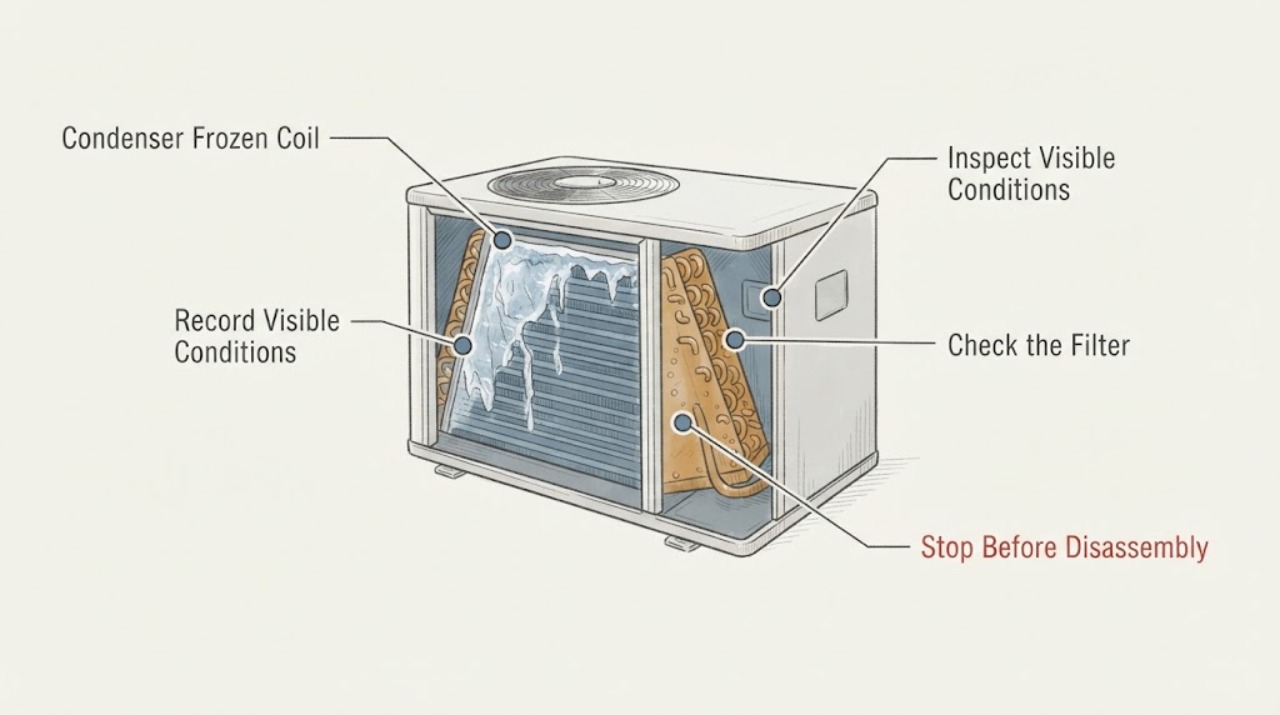
A frozen coil is usually an indoor evaporator-coil or connected refrigerant-line problem, not proof that the outdoor condenser coil itself is frozen. From a safe position, switch cooling off, note whether ice is on the indoor cabinet or copper line and whether the outdoor condenser fan is running, and check only an accessible air filter, open registers, and visible water. Do not chip ice, pour hot water, open either cabinet, touch wiring, test or handle refrigerant, or try to diagnose the coil electrically. Restricted airflow, a dirty coil, a failed blower, low refrigerant, or an outdoor condenser problem can all reduce cooling and create frost. Leave cooling off while ice melts naturally and call an HVAC professional if ice is present, returns, water threatens the equipment, the outdoor unit is silent or abnormal, or any electrical or burning warning appears.
Work through in order
Diagnostic checks
Use only checks that match the exact appliance or system and its official guide.
-
Check 1
From a dry, safe position, switch the thermostat from COOL to OFF and record whether the indoor blower is set to AUTO or ON. Do not open the air handler or reach toward a fan.
Expected result: Record whether cooling stops, whether air continues only because the fan is set to ON, and whether the thermostat still calls for cooling or shows an error.
Next step: Leave COOL off while ice melts. If the thermostat will not stop cooling, the blower behaves abnormally, or the control is blank or damaged, stop and request HVAC service.
Why this matters
Why: Turning cooling off removes the ongoing freeze load; fan-only airflow may help natural thawing if the equipment is dry and otherwise safe, but it does not diagnose a refrigerant, blower, or electrical fault.
-
Check 2
Without removing panels, look at the indoor air-handler or furnace area and the nearby floor, then look only at any visible copper refrigerant tubing from a safe position.
Expected result: Record whether frost or solid ice is on the indoor cabinet or tubing, whether airflow is weak, and whether thaw water is collecting in a pan or on the floor.
Next step: Keep cooling off, protect the area from water without touching wiring, and call HVAC if ice is extensive, water is escaping, or the coil is not safely accessible.
Why this matters
Why: Indoor cabinet or connected-line ice points toward a frozen evaporator path; weak airflow supports an airflow restriction but does not rule out low refrigerant or a failed blower. Water is expected during thaw only if it stays contained and away from electrical equipment.
-
Check 3
After cooling is off, inspect only the filter and visible supply and return registers that are designed for homeowner access; use the model manual for the filter location and direction.
Expected result: Record a visibly loaded filter, blocked return, closed register, or unusually weak airflow at several open registers. Do not remove an indoor coil cover or brush the coil.
Next step: Replace a dirty filter only with the correct type and fit, clear movable obstructions, and allow a natural thaw. If airflow remains weak or ice returns, leave cooling off and schedule HVAC diagnosis.
Why this matters
Why: A dirty filter or blocked airflow can reduce heat crossing the evaporator and contribute to freezing. A clean filter and open registers do not prove the coil, blower, or refrigerant circuit is healthy.
-
Check 4
From outside the equipment enclosure, observe the outdoor condenser without removing its grille or service panel. Note whether the fan runs when there is a legitimate cooling call, whether the cabinet is visibly obstructed, and where any frost appears.
Expected result: Record fan running or silent, normal airflow or no airflow, unusual humming/clicking, visible debris around the cabinet, and frost on outdoor tubing or the cabinet. Do not touch the fan, grille, wiring, capacitor, or refrigerant lines.
Next step: Turn cooling off and give the observations to an HVAC professional. Do not remove debris that requires opening the enclosure or working near moving or electrical parts.
Why this matters
Why: A silent outdoor unit, abnormal sound, or frost on outdoor tubing can accompany a condensing-unit, fan, compressor, airflow, or refrigerant problem. The outdoor coil and the indoor evaporator coil have different roles, so outdoor frost alone does not identify a failed condenser coil.
-
Check 5
Let the ice thaw naturally with cooling OFF; if the thermostat and equipment are dry, use only the fan setting when the model instructions permit it. Check from a safe position for contained condensate and wait until visible ice is gone before considering any restart.
Expected result: Record whether thaw water stays in the pan or drains normally, whether all visible ice disappears, and whether airflow returns after the filter is correctly installed.
Next step: Do not chip ice, pour hot water, use a hair dryer or heater, or force a restart. If the unit is dry and the filter and registers are normal, follow only the exact model manual for a single cautious test; stop immediately if frost returns or cooling remains poor.
Why this matters
Why: Natural thaw can clear the immediate ice but cannot identify the root cause. Persistent water, incomplete thaw, weak airflow, or a quick return of frost suggests a drain, airflow, mechanical, or refrigerant issue needing service.
-
Check 6
If the system has a visible breaker or disconnect handle, observe its position without opening a panel, touching exposed equipment, or repeatedly resetting it. Note any recent trip, outage, storm, or maintenance event.
Expected result: Record ON/OFF or an abnormal handle position and whether another breaker, fuse, or safety switch appears affected. Do not reset a breaker that trips again, feels hot, or is associated with odor, smoke, buzzing, water, or arcing.
Next step: If there is no hazard and the equipment instructions clearly allow one normal reset, make at most one attempt; otherwise leave it off and call HVAC or an electrician as appropriate.
Why this matters
Why: Loss of power can stop the blower or outdoor condenser and mimic a frozen-coil problem, while a repeat trip points to an electrical fault. A handle position cannot prove that the high-voltage equipment or capacitor is safe.
-
Check 7
Prepare a concise service report instead of testing the coil or refrigerant circuit: record the exact location of ice, indoor and outdoor airflow, thermostat setting, filter condition, water location, sound pattern, and whether the symptom returns after thawing.
Expected result: Include whether the issue is indoor evaporator-area ice, outdoor tubing/cabinet frost, a silent condenser, weak airflow, repeated freezing, or no ice but inadequate cooling.
Next step: Keep cooling off when ice or abnormal operation is present and arrange qualified HVAC service. Do not buy or install a coil, capacitor, fan motor, or refrigerant based only on the frost location.
Why this matters
Why: The pattern helps the professional separate airflow restriction, condensate handling, outdoor condenser/fan or compressor behavior, and refrigerant or control diagnosis without unsafe homeowner measurements.
Use your observations
Decision map
Find the observation that best matches what you see, then follow the next safe action.
-
PATH 01Safety boundary
What you see
Do this next
Treat this as a likely frozen evaporator path: turn COOL off, allow a natural thaw, check only the accessible filter and registers, and arrange HVAC service if the ice is extensive, water escapes, airflow is weak, or the ice returns.
Why this path and its safety boundary
Safety stop: Use the outdoor frost, no-ice poor-cooling, or safety branch rather than assuming the evaporator is clear.
-
PATH 02Safety boundary
What you see
Do this next
Leave cooling off and call HVAC; an outdoor condenser, fan, compressor, control, airflow, or refrigerant issue may be involved and the enclosure must not be opened by the homeowner.
Why this path and its safety boundary
Safety stop: Continue only with safe filter, register, thermostat, water, and timing observations; do not interpret a running fan as proof that the system is healthy.
-
PATH 03Safety boundary
What you see
Do this next
Replace the filter with the model-appropriate type, clear movable obstructions, keep COOL off until thawed, and have HVAC investigate if cooling is still weak or ice returns.
Why this path and its safety boundary
Safety stop: Do not open the coil cabinet or infer low refrigerant from the absence of a dirty filter; request professional diagnosis for persistent freezing.
-
PATH 04Safety boundary
What you see
Do this next
Keep cooling off, keep people away from wet electrical equipment, and arrange prompt HVAC service; do not touch wiring, drain components inside the cabinet, or energized equipment.
Why this path and its safety boundary
Safety stop: Continue passive observation while the ice thaws, but escalate if water appears later or the drain does not contain it.
-
PATH 05Safety boundary
What you see
Do this next
Stop immediately, do not reset or restart, keep clear, and use the appropriate emergency or licensed electrical/HVAC service path from a safe location.
Why this path and its safety boundary
Safety stop: Keep troubleshooting limited to the safe observations above; a frozen coil still requires cooling to remain off until thawed and the cause is understood.
Helpful context
Understand the symptom
First identify which coil is actually freezing
The word condenser is often used for the outdoor cabinet, but the coil that normally freezes in a cooling system is the indoor evaporator coil or the refrigerant tubing connected to it. Carrier describes the evaporator as the indoor heat-absorbing coil and the condenser as the outdoor heat-releasing coil. A homeowner may safely record where frost is visible without opening a cabinet: on an indoor air-handler cabinet or nearby copper line, on the outdoor tubing or cabinet, or nowhere because the ice has already melted into a pan or floor puddle. That location changes the next service question, but it does not make electrical or refrigerant work safe to perform at home.
Why the system can freeze while the room gets warmer
The evaporator needs warm indoor air moving across it. A clogged filter, blocked return or supply register, dirty coil, weak blower, low refrigerant, or another mechanical fault can reduce heat transfer and allow the coil surface to fall below freezing. The outdoor condenser also matters: a dirty or non-running outdoor fan or compressor prevents heat from leaving the system. These possibilities can look alike from the thermostat, so use the observations below to give an HVAC professional a useful pattern instead of guessing that the coil or a particular part is bad.
Safety boundary
Stop conditions
- Stop immediately for smoke, visible sparks or arcing, burning odor, a hot or melted panel or disconnect, exposed wiring, severe vibration, a repeated breaker trip, or water contacting electrical equipment.
- Stop ordinary operation when ice is visible or airflow is blocked by ice. Do not keep running the compressor to see whether the system recovers.
- Do not chip, scrape, puncture, or heat ice; do not pour hot water or use a hair dryer, heater, or other direct heat source to thaw a coil.
- Do not open indoor or outdoor panels, touch a capacitor, fan, terminals, coil, or refrigerant tubing, measure live voltage or refrigerant pressure, discharge a capacitor, bypass a control, or add or release refrigerant.
When checks do not resolve it
Need a professional?
Call a qualified HVAC professional for any visible coil or tubing ice, repeated freezing after a correct filter change and natural thaw, weak or absent airflow, an outdoor condenser that is silent or abnormal, suspected low refrigerant, a leaking condensate path, or any problem that cannot be resolved by safe thermostat and filter observations. Use an electrician for a hot, damaged, arcing, or repeatedly tripping electrical supply; do not ask the HVAC visit to substitute for unsafe electrical work.
Common questions
FAQ
Is a frozen outdoor condenser coil the same as a frozen evaporator coil?
No. In a typical split system the evaporator is indoors and absorbs heat, while the condenser is outdoors and releases heat. Frost on indoor equipment or its connected tubing points to the evaporator path; outdoor tubing or cabinet frost needs professional evaluation and does not prove that the outdoor condenser coil itself is the cause.
What should I do first when I see ice on an AC coil?
Switch COOL to OFF, keep people away from thaw water near electrical equipment, and let the ice melt naturally. You may inspect an accessible filter and open registers if the area is dry and safe, but do not chip the ice, use direct heat, open a cabinet, or continue running the compressor.
Can a dirty filter cause a coil to freeze?
Restricted airflow from a dirty filter or blocked registers can contribute to evaporator freezing. Replace only an accessible filter with the correct model-approved type and clear movable obstructions; if airflow is still weak or ice returns, the blower, coil, refrigerant, or another fault needs HVAC diagnosis.
Can I test the coil, capacitor, or refrigerant myself after the system is turned off?
No. Turning the thermostat or breaker off does not make internal electrical parts, capacitors, wiring, coils, or refrigerant circuits suitable for homeowner testing. Do not open panels, discharge a capacitor, measure live voltage or pressure, or add refrigerant; provide the visible symptom pattern to a qualified HVAC professional.
Read the exact guide
Official sources
- What Is an AC Evaporator Coil & What Does It Do?Carrier · Carrier explanation of evaporator location and heat and moisture transfer, and the distinction between evaporator and condenser coils.
- Maintenance ChecklistENERGY STAR · Government-backed maintenance guidance on filters, condensate drains, electrical connections, coils, refrigerant checks, and airflow service boundaries.
- Will Frozen AC Fix Itself? A Guide To Frozen AC CoilsCarrier · Carrier guidance on frozen-coil causes, turning cooling off, natural thawing, airflow checks, and avoiding direct heat or continued operation.
- Troubleshooting an AC Not WorkingCarrier · Carrier guidance on thermostat and filter checks, electrical boundaries, frozen evaporator indicators, outdoor condensing-unit symptoms, and professional escalation.
Community feedback
Share a repair observation
Share a plain-text repair observation. Accepted observations are published automatically; this page may take a moment to update.