
On this page
Start here
Quick answer
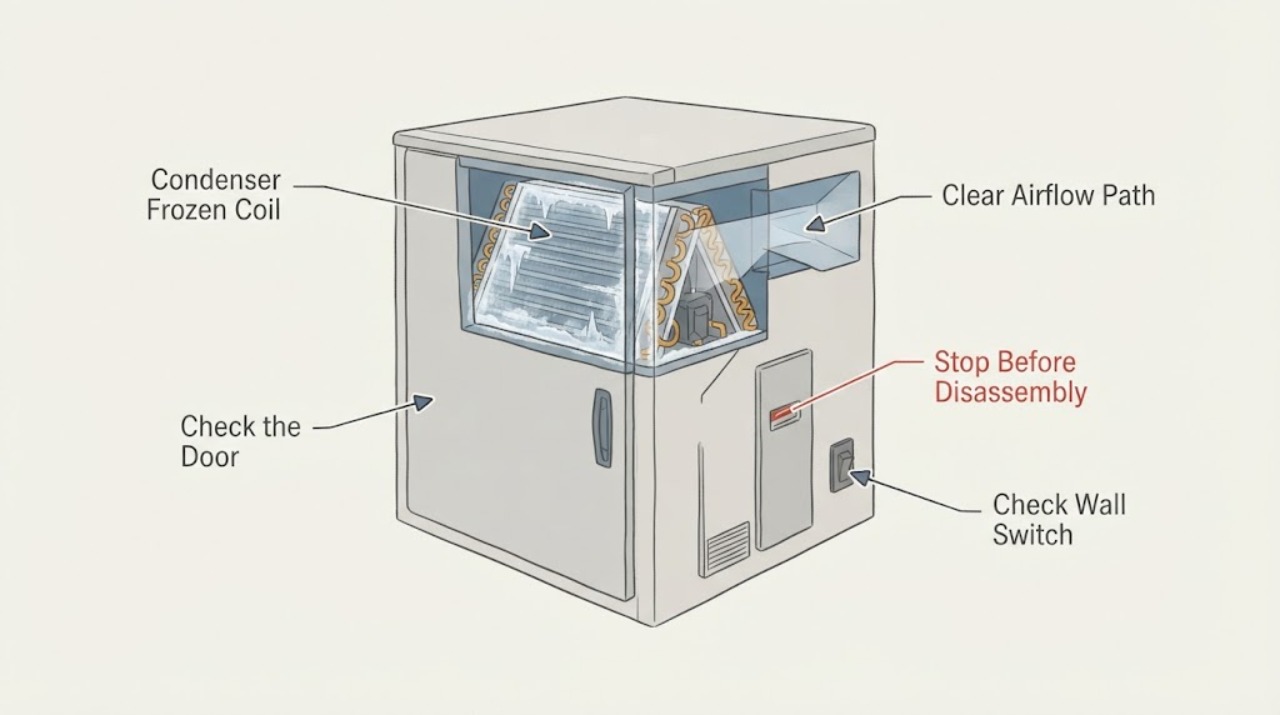
A coil that appears frozen near the outdoor condenser is often the indoor evaporator coil or the refrigerant line connected to it, not the outdoor condenser coil itself. Turn cooling off at the thermostat and let visible ice thaw naturally; do not chip it, pour hot water on it, or keep running the compressor against the ice. From a safe external position, check the air filter, return and supply airflow, visible condensate, and whether the ice returns after thawing. A dirty filter or restricted airflow can freeze an evaporator, but low refrigerant, a blower or coil fault, and control problems require HVAC service. Do not open panels, touch wiring, handle refrigerant, or use a tool on the coil.
Work through in order
Diagnostic checks
Use only checks that match the exact appliance or system and its official guide.
-
Check 1
From a safe distance, identify where the ice is visible: the outdoor condenser coil, the larger insulated refrigerant line near the outdoor unit, the indoor air-handler cabinet, or a supply area. Note whether the system is a split, packaged, or another design without removing any cover.
Expected result: Ice on the indoor coil or the connected suction line supports an evaporator-freeze branch. Frost on an outdoor surface can have another explanation, while a dirty outdoor condenser without ice is an airflow or heat-rejection observation rather than proof of a frozen evaporator.
Next step: Turn cooling off at the thermostat for visible icing and continue only with safe external checks. Arrange HVAC service when the location is unclear or the system design cannot be identified.
Why this matters
Why: Location prevents the outdoor condenser label from sending the diagnosis toward the wrong coil.
-
Check 2
At the thermostat, switch cooling to Off and leave the setpoint unchanged while the ice thaws naturally. Watch the floor, drain pan area, and nearby ceiling or wall from outside the equipment for water; do not scrape, pick, heat, or wash the ice.
Expected result: Ice gradually disappearing with cooling off supports a freeze that needs a cause check. Rapid water accumulation, a full pan, a blocked visible drain outlet, or a wet ceiling or wall indicates a condensate risk. Ice that does not thaw or returns quickly needs professional diagnosis.
Next step: Keep cooling off for an overflow, active leak, or recurring ice and call HVAC service. Do not restore cooling just to see whether the coil refreezes.
Why this matters
Why: Natural thawing protects the coil and reveals whether condensate can drain without turning an icing problem into water damage.
-
Check 3
With cooling off and the cabinet closed, inspect the accessible return filter and the return grille. Note a filter that is visibly loaded, collapsed, wet, or installed contrary to its airflow arrow, and check that return and supply registers are not blocked by furniture or coverings.
Expected result: A dirty filter or blocked return can reduce airflow across the evaporator and contribute to freezing. A wet filter suggests condensate or another leak. A clean filter and clear registers with repeated icing shifts attention to the blower, coil, thermostat, refrigerant, or control path.
Next step: Replace or clean the filter only when the system instructions allow it and the area is dry, then restore the access door and wait for complete thawing before any authorized retest. Recurring ice or weak airflow needs HVAC service.
Why this matters
Why: The filter and airflow path are the appropriate low-risk checks for the assigned filter component, but they do not prove that the coil or refrigerant circuit is sound.
-
Check 4
After thawing, observe airflow at several supply registers and the return grille with the equipment panels closed. Compare the air movement with the normal pattern and note whether the indoor blower starts, stalls, makes severe noise, or leaves some rooms without airflow.
Expected result: Weak airflow at all registers supports a return, filter, blower, coil, or control restriction. One weak register suggests a local register or duct issue. Normal airflow followed by recurring ice points away from a simple filter blockage and toward a cooling-system or control diagnosis.
Next step: Leave the system off for severe noise, no blower operation, repeat icing, or a wet cabinet and call HVAC service. Do not open the air handler to inspect the coil.
Why this matters
Why: Airflow behavior distinguishes an evaporator-starvation problem from a broader refrigeration or thermostat problem without touching the blower or coil.
-
Check 5
From outside the outdoor unit, observe whether its fan and compressor appear to run after the system is fully thawed and a normal cooling call is made, only if the area is dry and free of hazard signs. Note frost returning on the line, unusual noise, smoke, odor, or a breaker interruption; do not touch the fan, line, disconnect, or cabinet.
Expected result: An outdoor unit that does not start can indicate a power, control, or equipment fault. A running system that quickly refreezes may have restricted airflow, low refrigerant, a coil problem, or a control issue. Smoke, odor, a repeat trip, or abnormal line icing is a stop condition.
Next step: Turn cooling off for returning ice or any hazard and arrange HVAC service. Do not add refrigerant, open a disconnect, or remove a service panel.
Why this matters
Why: A safe external sequence helps the technician separate a no-start event from a running-but-freezing event, but it cannot diagnose refrigerant charge or high-voltage components.
-
Check 6
Prepare a service handoff with the ice location, system type, thermostat state, thawing time, filter and airflow condition, condensate or water observations, outdoor-unit response, frost-return timing, recent maintenance, and any noise, odor, or breaker event.
Expected result: This record distinguishes an indoor evaporator freeze caused by airflow from a condensate issue, thermostat or control fault, blower problem, dirty coil, low refrigerant, or an outdoor-unit no-start condition.
Next step: Give the record to an HVAC professional and keep panels, coils, refrigerant lines, and electrical controls untouched. Request professional diagnosis if icing returns or the cause is not resolved by the allowed filter check.
Why this matters
Why: The assigned condenser wording can conceal an indoor evaporator problem, so the exact location and sequence matter more than the label.
Use your observations
Decision map
Find the observation that best matches what you see, then follow the next safe action.
-
PATH 01Next step
What you see
Ice is on the indoor evaporator cabinet or the larger insulated line near the outdoor condenser.
Do this next
Arrange qualified service and follow the exact model guidance.
Why this path and its safety boundary
Why it matters: Turn cooling off and allow natural thawing. Check only the accessible filter, return, registers, and condensate area; recurring ice needs HVAC diagnosis of airflow, coil, controls, and refrigerant.
-
PATH 02Next step
What you see
The outdoor condenser coil looks dirty but there is no visible ice on the indoor coil or connected line.
Do this next
Arrange qualified service and follow the exact model guidance.
Why this path and its safety boundary
Why it matters: Treat this as a heat-rejection or maintenance observation, not proof of an evaporator freeze. Keep service panels closed and arrange HVAC maintenance if cooling is poor or the unit overheats.
-
PATH 03Next step
What you see
The accessible filter is dirty or collapsed and airflow is weak, with no water or electrical hazard.
Do this next
Arrange qualified service and follow the exact model guidance.
Why this path and its safety boundary
Why it matters: Replace or clean the filter only as the exact system instructions allow, restore the access door, and wait for complete thawing. If airflow or cooling remains poor or ice returns, call HVAC service.
-
PATH 04Next step
What you see
Airflow is normal after thawing but the coil or line freezes again.
Do this next
Arrange qualified service and follow the exact model guidance.
Why this path and its safety boundary
Why it matters: A filter-only explanation is not sufficient. Leave cooling off and arrange professional diagnosis of the coil, thermostat, controls, blower, and refrigerant circuit.
-
PATH 05Next step
What you see
Water accumulates during thawing, the pan overflows, or a ceiling or wall becomes wet.
Do this next
Arrange qualified service and follow the exact model guidance.
Why this path and its safety boundary
Why it matters: Keep cooling off and obtain prompt HVAC service for the condensate path and any water damage. Do not open the cabinet or run the system to evaporate the water.
-
PATH 06Next step
What you see
There is smoke, burning odor, sparking, a repeat breaker trip, exposed wiring, severe blower noise, or a hot electrical area.
Do this next
Arrange qualified service and follow the exact model guidance.
Why this path and its safety boundary
Why it matters: Stop immediately. If it can be done without touching damaged equipment or entering water, isolate power from a safe, clearly labeled control; otherwise leave the area and obtain emergency or qualified HVAC and electrical help. Do not reset and retest.
Helpful context
Understand the symptom
The term “condenser frozen coil” can describe ice seen at the outdoor unit, but in a split system the coil that normally freezes is usually the indoor evaporator or the refrigerant line between the indoor and outdoor sections. The outdoor condenser coil rejects heat and can be dirty without being the source of the ice. Identify the location before choosing a check.
A frozen evaporator is a system stop condition. Turn cooling off at the thermostat and allow natural thawing; do not chip ice, pour hot water, use a heat gun, or keep lowering the setpoint. Water released during thawing can overflow a pan or damage a ceiling.
Airflow checks can be limited to the filter, return grille, registers, and visible drainage. The coil cabinet, blower, electrical controls, refrigerant lines, and condenser service panels are not safe homeowner test points.
Safety boundary
Stop conditions
- Stop immediately for smoke, burning odor, sparking, exposed wiring, a repeat breaker trip, a hot electrical area, an overflowing pan, active water damage, or a blower with severe noise.
- Do not chip, pick, scrape, or melt ice; pour hot water on a coil; use a heat gun; open service panels; touch wiring, fans, capacitors, refrigerant lines, or disconnects; or add refrigerant.
- Leave cooling off when ice returns after thawing, airflow is weak, the filter is wet, the drain overflows, the outdoor unit will not start, or the exact coil location is uncertain.
Only after diagnosis
Potential parts
- HVAC air filter
Consider this only when the accessible filter is dirty, collapsed, wet from a leak, or due for replacement under the system instructions and airflow improves after the correct service.
Match the equipment's specified dimensions, orientation, and filter type; a new filter does not resolve recurring ice, low airflow, or condensate faults. - evaporator coil
Consider this only after a qualified technician confirms the indoor coil is dirty, damaged, leaking, or otherwise responsible for recurring freezing.
Confirm the exact equipment model, coil configuration, refrigerant design, and professional installation requirements; do not select a coil from the outdoor condenser label alone.
Common questions
FAQ
Is the condenser coil the part that freezes?
In a typical split system, visible ice near the outdoor condenser is often on the connected refrigerant line while the indoor evaporator is freezing. Identify the location without opening panels, turn cooling off, and arrange HVAC service for recurring ice.
Can a dirty filter cause a frozen coil?
Yes. A loaded filter or blocked return can reduce airflow over the evaporator and contribute to freezing. Replace or clean the filter only as the system instructions allow; recurring ice needs professional diagnosis.
How should I thaw a frozen air-conditioning coil?
Turn cooling off at the thermostat and allow the ice to thaw naturally. Do not chip it, pour hot water on it, use a heat gun, or keep running the system. Watch for condensate overflow and call HVAC service if the ice returns.
Why is water leaking after the coil thaws?
Meltwater can exceed a restricted or backed-up condensate path, or the pan may be damaged. Keep cooling off for an overflow or wet ceiling and arrange prompt HVAC service; do not open the coil cabinet.
Read the exact guide
Official sources
- Maintenance ChecklistENERGY STAR · Central HVAC filters, condensate drains, evaporator and condenser coils, blower airflow, controls, and professional refrigerant maintenance
- Energy Saver 101: Everything You Need to Know About Home CoolingU.S. Department of Energy · Evaporator, condenser, blower, filter, thermostat, drainage, refrigerant, and professional cooling-system boundaries
- Coil Troubleshooting GuideTrane · Indoor evaporator freeze location, natural thawing, filter and airflow causes, leakage observation, and professional coil or refrigerant service
Community feedback
Share a repair observation
Share a plain-text repair observation. Accepted observations are published automatically; this page may take a moment to update.