
On this page
Start here
Quick answer
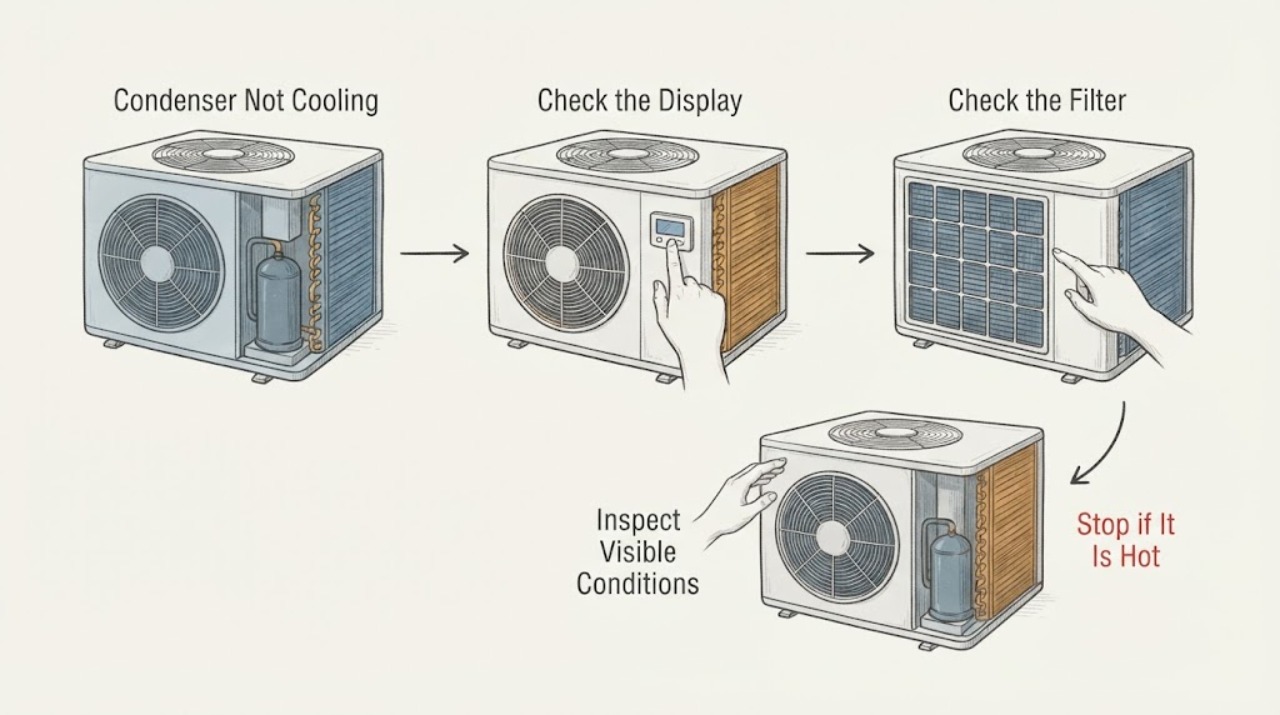
A condenser that is not cooling usually means the outdoor unit is not rejecting heat, or that an indoor airflow, thermostat, frozen-coil, electrical, refrigerant, compressor, or fan problem is preventing the split system from cooling. First confirm that the thermostat is calling for cooling and that indoor air is moving, then inspect the filter and the outdoor cabinet from a safe distance for blockage, ice, unusual noise, or no operation. Do not open the condenser cabinet, touch the compressor, capacitor, wiring, or refrigerant circuit. Turn cooling off if ice, burning odor, repeated electrical trips, severe noise, or overheating is present, and arrange HVAC service when the simple checks do not restore cooling.
Work through in order
Diagnostic checks
Use only checks that match the exact appliance or system and its official guide.
-
Check 1
At the thermostat, select the documented cooling mode, set a reasonable temporary cooling call below the room temperature, and note whether the display responds without opening any equipment.
Expected result: The display should show a cooling call or equivalent response. A blank display, a schedule override, a heat or fan-only mode, or a call that never reaches the system is a different starting point from an outdoor condenser that runs but does not cool.
Next step: Correct only the visible mode, schedule, fan, or temperature setting that the user understands; then allow one normal call. If the display remains blank or the system does not respond, arrange HVAC or electrical service instead of opening controls.
Stop if: Stop if the thermostat, wall, or nearby equipment is wet, scorched, sparking, unusually hot, or giving a burning odor.
Why this matters
Why: If the thermostat is not calling for cooling, the outdoor condenser may be waiting normally. If it calls and indoor air still stays warm, continue to airflow and outdoor observations rather than assuming the compressor is defective.
-
Check 2
With the system operating only if there is no hazard, check several supply registers and the return path for a normal stream of air, then inspect the accessible filter without reaching into the blower or coil cabinet.
Expected result: Normal airflow with warm air points toward outdoor heat rejection, refrigerant, or compressor-side trouble. Weak or absent airflow, a visibly loaded filter, or air that changes when the filter is removed for inspection points toward an indoor airflow restriction or air-handler issue.
Next step: Replace a disposable filter only with the size and orientation specified for the system, or clean a reusable filter according to its instructions. Do not remove cabinet panels or continue cooling if ice is present; call HVAC if airflow stays weak.
Stop if: Stop if the filter area is wet near electrical equipment, the blower makes scraping or electrical noise, the supply air smells burned, or ice is visible on tubing or coils.
Why this matters
Why: The outdoor condenser cannot compensate for a severely restricted indoor air path. Continued cooling with a frozen or poorly supplied indoor coil can stress the system and mask the condenser symptom.
-
Check 3
From a dry, stable position and without touching the cabinet, look at the outdoor unit while a cooling call is active: note whether the fan turns, whether air is discharged, whether the cabinet has clear space, and whether leaves, grass, plastic, or other debris are visibly pressed against the coil surface.
Expected result: A running fan with warm indoor air and an obstructed coil suggests poor heat rejection. A silent unit, a fan that does not turn, rapid cycling, or a strong electrical or mechanical sound suggests an electrical or mechanical fault. Do not infer that a quiet fan is safe to repair.
Next step: Remove only loose vegetation or objects that are outside the cabinet and can be lifted away without tools, water, contact, or bending fins. If the unit remains off, cycles abnormally, or sounds wrong, turn cooling off and arrange HVAC service.
Stop if: Stop immediately for humming with no normal operation, grinding, repeated clicking, smoke, arcing, a burning smell, a hot cabinet, or a breaker that has opened.
Why this matters
Why: The condenser coil, compressor, and fan work as a system. Visible debris can explain restricted outdoor airflow, but the absence of debris does not clear the compressor, capacitor, controls, refrigerant, or coil.
-
Check 4
Look from outside the equipment for ice or frost on exposed refrigerant tubing, the outdoor coil, or nearby surfaces, and check for unusual water near the indoor air handler without touching wet electrical equipment.
Expected result: Ice, weak airflow, poor cooling, or excess indoor condensate can accompany a frozen indoor coil or a refrigerant or airflow problem. No ice does not prove that refrigerant charge, the compressor, or the condenser coil is correct.
Next step: Turn the cooling call off and leave the system off when ice is present, then arrange HVAC diagnosis after recording where the ice and water appeared. Do not chip ice, heat tubing, add refrigerant, or restart repeatedly to see whether it clears.
Stop if: Stop for active water near wiring or equipment, a ceiling or wall leak, extensive ice, a chemical odor, or any need to touch tubing or open a cabinet.
Why this matters
Why: A frozen coil can worsen damage if the system keeps running. Refrigerant diagnosis and coil access are professional tasks; the observation is useful for routing service, not for identifying a part to replace.
-
Check 5
If the unit has no visible hazard, record the symptom pattern without reproducing a fault: outdoor unit never starts, fan runs but air stays warm, unit runs continuously, short-cycles, or stops after a sound or temperature change.
Expected result: No start points toward control, power, or outdoor-unit failure; fan operation with poor cooling points toward heat transfer, airflow, refrigerant, or compressor-side diagnosis; long or rapid cycles point toward capacity, airflow, coil, refrigerant, or control concerns.
Next step: Save the thermostat setting, indoor airflow impression, outdoor fan status, visible ice or debris, and when the problem began. Give those observations to an HVAC professional and keep the system off when a stop condition is present.
Stop if: Stop and do not reproduce the symptom if the system trips protection, emits smoke or a burning odor, becomes unusually hot, leaks water, or makes a violent or metallic noise.
Why this matters
Why: The pattern narrows the technician’s first checks but cannot identify a capacitor, compressor, fan motor, coil, or refrigerant fault from outside. A symptom record is safer than repeated resets or tests.
-
Check 6
Prepare a service handoff with the equipment type and model label photographed from a safe, dry position, thermostat behavior, filter status, indoor airflow, outdoor fan response, ice or water location, sound pattern, and any breaker or error indication.
Expected result: A complete timeline and symptom set lets the HVAC professional distinguish a dirty coil or airflow issue from a control, fan, compressor, electrical, or refrigerant investigation without asking the homeowner to open the cabinet.
Next step: Request HVAC service for a condenser that remains ineffective, will not start, short-cycles, runs continuously, has ice, or has unusual fan/compressor behavior. Keep the system off until the visit when any hazard is present.
Stop if: Stop all troubleshooting if reaching the label or outdoor unit would require climbing, entering water, moving an unstable object, touching wiring, or removing a panel.
Why this matters
Why: If basic settings, filter, and exterior clearance do not restore cooling, the remaining likely checks involve instruments or access reserved for a qualified technician.
Use your observations
Decision map
Find the observation that best matches what you see, then follow the next safe action.
-
PATH 01Next step
What you see
The thermostat does not call for cooling, the display is blank, or indoor airflow is absent.
Do this next
Correct only a clearly understood visible setting or replace the filter according to its instructions. If the display, indoor unit, or power remains abnormal, call HVAC or a qualified electrician without opening equipment.
Why this path and its safety boundary
Why it matters: Treat the first issue as a control, power, or air-handler path rather than assuming the condenser coil is defective.
-
PATH 02Next step
What you see
The thermostat calls, indoor airflow is normal, and the outdoor fan runs but the home remains warm.
Do this next
Leave the cabinet closed, keep cooling off if it runs continuously or shows ice or overheating, and have HVAC test the system. Do not handle refrigerant or electrical parts.
Why this path and its safety boundary
Why it matters: A blocked condenser coil, refrigerant issue, compressor problem, or another outdoor-unit fault remains possible even when the fan turns.
-
PATH 03Next step
What you see
The outdoor unit is silent, the fan does not turn, it starts and stops rapidly, or it makes a harsh electrical or mechanical sound.
Do this next
Do not repeatedly reset or restart it. Keep clear of the cabinet and arrange HVAC service; use emergency help for smoke, fire, arcing, or an immediately dangerous electrical condition.
Why this path and its safety boundary
Why it matters: The symptom is consistent with a power, control, fan, capacitor, compressor, or protection fault that cannot be safely isolated by exterior observation.
-
PATH 04Next step
What you see
Ice appears on tubing or coils, airflow is weak, or water is accumulating near the indoor unit.
Do this next
Turn cooling off, avoid chipping or heating the ice, keep away from wet electrical equipment, and arrange professional diagnosis.
Why this path and its safety boundary
Why it matters: A frozen coil or airflow/refrigerant problem may be stressing the system and can damage the compressor if operation continues.
-
PATH 05Next step
What you see
Only loose debris outside the cabinet is present, with no ice, water, unusual odor, abnormal noise, or electrical symptom.
Do this next
Lift away loose objects without tools or contact with the unit, allow normal clearance, and make one controlled cooling observation. If cooling remains poor, call HVAC rather than washing, brushing, or opening the coil.
Why this path and its safety boundary
Why it matters: Restricted outdoor airflow may be contributing to poor heat rejection, but clearing debris does not prove the coil or compressor is healthy.
Helpful context
Understand the symptom
What ‘condenser not cooling’ means
In a typical split system, the outdoor condensing unit contains the condenser coil, compressor, fan, and controls. The indoor evaporator absorbs heat and the outdoor side releases it. A warm house does not prove that the coil alone is faulty: the thermostat, filter, indoor blower, refrigerant circuit, and outdoor electrical parts all affect the same result. Treat the cabinet as an observation point, not as a user-serviceable repair area.
Start with the least risky observations
Use the thermostat display, the supply-air feel, the filter condition, and the outdoor unit’s visible behavior to separate a control or airflow problem from an outdoor-unit failure. Take a photo of any ice, water, debris, label, or display message for the technician. Do not keep forcing a system to run while it is iced, overheating, making a harsh noise, or repeatedly losing power.
Why the compressor and condenser coil matter
The compressor moves refrigerant and the condenser coil transfers heat into outdoor air. Dirt or blocked clearance can reduce heat rejection, while a failed fan, compressor, capacitor, electrical control, or refrigerant circuit can stop normal cooling. Those components can retain hazardous energy or require specialized instruments, so the homeowner checks below remain visual and control-side only.
When the outdoor unit is not the only suspect
Weak indoor airflow, a dirty filter, a frozen indoor coil, or a thermostat that is not actually calling for cooling can make a healthy condenser appear ineffective. A condenser that runs continuously, cycles rapidly, or never starts after a cooling call needs professional diagnosis if the filter, settings, and safe exterior clearance checks do not explain it.
Safety boundary
Stop conditions
- Stop and keep the system off for smoke, fire, arcing, burning odor, a hot cabinet, or repeated electrical trips.
- Stop for ice on tubing or coils, severe or metallic noise, uncontrolled cycling, or a compressor or fan that appears to be straining.
- Stop around wet electrical equipment, standing water, damaged wiring, or a leak that could reach the air handler or disconnect.
- Do not open the condenser cabinet, remove panels, touch wiring, test voltage, handle a capacitor, touch the compressor, open the refrigerant circuit, or add refrigerant.
- Do not climb, enter an unsafe area, use tools or water on the cabinet, chip ice, or repeatedly restart a system that shows a hazard.
When checks do not resolve it
Need a professional?
Call an HVAC professional when the condenser remains ineffective after the thermostat, filter, airflow, and safe exterior observations; when the outdoor unit will not start, short-cycles, runs continuously, or has ice; or whenever diagnosis could involve the compressor, capacitor, fan motor, controls, refrigerant, or a concealed coil. Use emergency services for smoke, fire, arcing, or an immediately dangerous electrical condition.
Common questions
FAQ
Does a condenser make cold air by itself?
No. In a split system, the outdoor condenser rejects heat while the indoor coil and blower handle indoor air. A warm house can therefore involve the thermostat, filter, indoor airflow, outdoor coil, refrigerant circuit, compressor, fan, or controls.
What can I safely check when the outdoor condenser is not cooling?
Check the thermostat's cooling call, indoor airflow, accessible filter, and visible loose debris around the outdoor cabinet from a dry stable position. Do not open the cabinet, touch wiring or the compressor, handle a capacitor, or work on refrigerant.
Should I keep running the system if I see ice?
No. Turn cooling off when ice is visible and arrange HVAC diagnosis. Ice can accompany restricted airflow or a refrigerant problem, and continued operation can stress the compressor; do not chip or heat the ice.
When is a condenser problem a professional repair?
Call HVAC when the unit does not start, the fan does not turn, cooling remains poor after basic checks, the system short-cycles or runs continuously, ice appears, or diagnosis may involve a capacitor, compressor, fan motor, controls, electrical supply, coil access, or refrigerant.
Read the exact guide
Official sources
- HomeCooling101U.S. Department of Energy · General residential air-conditioning education.
- Troubleshoot an Air Conditioner: 6 Steps to Fix an AC Not WorkingCarrier · Carrier's general residential air-conditioner troubleshooting guidance.
- Troubleshoot an Air Conditioner | AC TroubleshootingCarrier · Carrier's general split-system air-conditioner troubleshooting guidance.
- Maintenance ChecklistENERGY STAR · General central air-conditioning maintenance guidance.
Community feedback
Share a repair observation
Share a plain-text repair observation. Accepted observations are published automatically; this page may take a moment to update.