
On this page
Start here
Quick answer
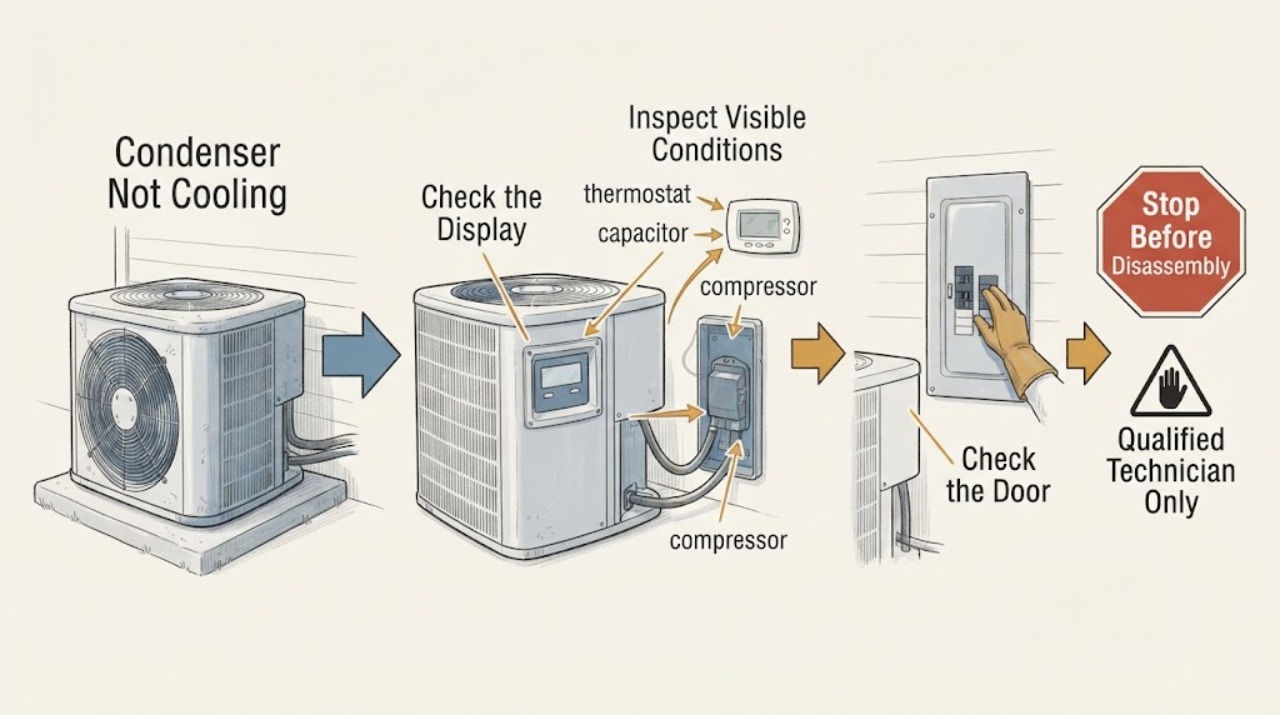
A condenser that is not cooling may have no valid thermostat demand, no power to the outdoor unit, blocked outdoor airflow, a failed capacitor or fan, a compressor fault, or low refrigerant. First confirm the thermostat is calling for cooling and observe whether the outdoor condenser starts, but do not open the cabinet. Look for visible debris, ice, oil-like residue, unusual noise, a stopped fan, or an unusually hot cabinet from a safe distance. A capacitor can retain a dangerous charge even after power is removed, and compressor, refrigerant, and electrical diagnosis belong to a qualified HVAC professional. If the breaker trips, you smell burning, see smoke or arcing, find damaged wiring, or the unit is hot or iced, leave it off and call for service.
Work through in order
Diagnostic checks
Use only checks that match the exact appliance or system and its official guide.
-
Check 1
At the thermostat, confirm the mode is Cool, the setpoint is below the room temperature, and the display is active. Note any delay, error message, schedule override, or indoor fan response without opening the thermostat or equipment.
Expected result: A wrong mode, satisfied setpoint, schedule, blank display, or communication symptom can prevent a cooling demand. A valid cooling call with no outdoor response shifts attention to power, controls, or the outdoor unit.
Next step: Record the thermostat state. If the call is valid but the condenser remains inactive, leave electrical and control diagnosis to HVAC service rather than repeatedly changing settings.
Why this matters
Why: The condenser cannot respond to a cooling cycle that the thermostat has not actually requested.
-
Check 2
From a safe distance, observe the outdoor condenser when a valid cooling call is present: note whether the fan runs, whether the cabinet is silent, whether it hums or cycles, and whether air leaving the top feels unusually hot. Do not touch the cabinet or reach through the grille.
Expected result: A silent cabinet suggests a demand, power, control, or component path. A fan that runs but does not cool keeps the compressor, refrigerant, coil, and airflow paths in scope. Humming, intermittent starting, unusual noise, or excessive heat raises capacitor, motor, or compressor concern.
Next step: Keep the unit off for humming, repeated cycling, unusual noise, or excessive heat and call HVAC service. Do not open the panel or attempt to start the fan.
Why this matters
Why: The outdoor fan and compressor are separate functions inside the condensing unit, so their visible or audible response narrows the branch without identifying a replaceable part.
-
Check 3
Inspect the outdoor unit from outside the cabinet for leaves, grass, snow, blocked discharge space, bent fins, ice, oil-like residue, water damage, or a damaged fan blade. Do not remove the grille or clean internal coil surfaces.
Expected result: Debris or restricted clearance can reduce condenser airflow and heat transfer. Ice, oily residue, bent fins, or physical damage points to a condition that should not be tested by continued operation.
Next step: Keep the unit off when ice, residue, damage, or severe blockage is present and arrange HVAC service. Only report or remove loose debris that is safely outside the cabinet and does not require touching the unit.
Why this matters
Why: Outdoor airflow and visible condition can explain poor heat rejection, but they cannot safely confirm a sealed-system or electrical failure.
-
Check 4
From a dry standing position, observe the home's electrical panel and any normal external disconnect indication for an obvious off or tripped state. Do not open the disconnect, remove fuses, touch conductors, or repeatedly reset a breaker.
Expected result: An obvious power interruption can explain a silent condenser. A breaker that trips again, a disconnect that is hot or damaged, or an unknown panel state indicates an electrical fault rather than a reset opportunity.
Next step: If a reset is considered at all, follow the exact equipment instructions and do not retry after an immediate or repeated trip. Leave the system off and call a qualified HVAC or electrical professional for persistent interruption.
Why this matters
Why: Power must be present for the thermostat signal, capacitor, fan, and compressor to operate, but live electrical diagnosis is not a homeowner check.
-
Check 5
Check indoor supply airflow and the accessible air filter while the system is off. Note whether airflow was normal, weak, or absent, and whether the filter is visibly loaded; do not open the air handler or touch the blower, capacitor, or wiring.
Expected result: Weak or absent indoor airflow can make the system appear not to cool and may contribute to coil icing. Normal airflow with a valid call and poor cooling keeps the outdoor coil, compressor, refrigerant, thermostat, and controls in scope.
Next step: Replace an obviously dirty accessible filter only when the exact equipment instructions allow it, then leave the system off if cooling remains poor, airflow is absent, or ice is present. Arrange HVAC service for recurrence.
Why this matters
Why: A condenser symptom can be secondary to an indoor airflow problem, and the outdoor cabinet alone cannot rule that out.
-
Check 6
Prepare a service note without opening or restarting the condenser: record thermostat mode and demand, outdoor fan response, sound, cabinet heat, visible ice or residue, airflow, filter condition, breaker behavior, cooling duration, and whether the problem is constant or intermittent.
Expected result: No outdoor response suggests demand, power, or control; fan-only or humming response suggests motor, capacitor, or compressor paths; normal operation with poor cooling suggests airflow, coil, refrigerant, or compressor performance; repeated trips require electrical service.
Next step: Give the record to a qualified HVAC technician. Ask for thermostat/control, airflow, outdoor fan, compressor, coil, and refrigerant evaluation as supported by the observations; do not authorize a part based only on a guess.
Why this matters
Why: The pattern is more useful than naming a capacitor or compressor from a symptom alone.
Use your observations
Decision map
Find the observation that best matches what you see, then follow the next safe action.
-
PATH 01Safety boundary
What you see
The thermostat is not calling for cooling, is in the wrong mode, is satisfied, has a blank display, or shows a schedule or communication issue.
Do this next
Correct only the visible user setting if the exact model instructions support it; if the display or communication remains abnormal, call HVAC service.
Why this path and its safety boundary
Why it matters: The condenser may be operating normally because it has no valid cooling request, or the control path cannot send one.
Safety stop: Do not bypass thermostat controls or open the thermostat or equipment wiring.
-
PATH 02Safety boundary
What you see
A valid cooling call is present but the outdoor condenser is silent and the indoor fan may still run.
Do this next
Observe only normal external power indications and leave the unit off for a persistent no-start; call a qualified HVAC professional.
Why this path and its safety boundary
Why it matters: Power, disconnect, control, capacitor, contactor, compressor, or a protective lockout may be preventing the condensing unit from starting.
Safety stop: Do not open the cabinet, test or replace the capacitor, bridge controls, or repeatedly reset a breaker.
-
PATH 03Safety boundary
What you see
The outdoor fan hums, starts slowly, cycles abnormally, does not spin, or the cabinet becomes unusually hot.
Do this next
Turn the system off and arrange HVAC service. Report the sound, fan response, and cabinet temperature without touching the unit.
Why this path and its safety boundary
Why it matters: A condenser fan motor, capacitor, control, or compressor problem may be involved; a capacitor can remain hazardous after power is removed.
Safety stop: Do not spin the blade, open the service cover, discharge a capacitor, or attempt motor or compressor work.
-
PATH 04Safety boundary
What you see
The outdoor unit has blocked airflow, heavy debris, visible ice, bent fins, physical damage, or oil-like residue.
Do this next
Leave the system off and arrange HVAC service. Report the obstruction or visible condition from outside the cabinet.
Why this path and its safety boundary
Why it matters: Heat rejection, coil condition, airflow, or refrigerant trouble may be preventing cooling; visible ice is a stop signal, not a cleaning challenge.
Safety stop: Do not chip ice, pour hot water on the coil, remove panels, touch refrigerant tubing, or continue running the unit.
-
PATH 05Safety boundary
What you see
The thermostat demand is valid, the condenser appears to run, indoor airflow is normal, but the home remains warm or the unit runs unusually long.
Do this next
Leave the system off if it is overheating, icing, noisy, or short cycling and call HVAC service for measurements and sealed-system diagnosis.
Why this path and its safety boundary
Why it matters: A dirty coil, low refrigerant, compressor performance issue, metering/control fault, or system sizing/duct condition remains possible.
Safety stop: Do not add refrigerant, connect gauges, open the sealed circuit, or keep running a unit that is iced or abnormally hot.
-
PATH 06Safety boundary
What you see
A breaker trips repeatedly, there is burning odor, smoke, arcing, damaged wiring, a hot disconnect, water in the equipment, or exposed conductors.
Do this next
Move away, keep others away, do not restore power, and seek qualified HVAC or electrical help from a safe location; use emergency services for fire or active arcing.
Why this path and its safety boundary
Why it matters: This is an electrical or fire-risk boundary and is not a condenser troubleshooting reset path.
Safety stop: Do not touch the unit, pull fuses, open panels, use water, or attempt another reset.
Helpful context
Understand the symptom
“Condenser not cooling” can mean the outdoor unit is not starting, the outdoor coil cannot reject heat, or the indoor system is running without delivering cool air. The condenser is the outdoor assembly; the indoor evaporator absorbs heat. Start by recording the thermostat demand and the outdoor unit's visible response rather than guessing whether the capacitor or compressor failed.
Keep all cabinet and electrical checks professional. Capacitors can retain charge, and the outdoor disconnect does not turn a component into a safe homeowner repair. Do not remove the service panel, touch wiring, bridge a contactor, or spin a fan blade by hand.
Ice, oil-like residue, persistent poor cooling, or recurring short cycles can indicate an airflow, refrigerant, coil, control, or compressor issue. Shut the system down when those warning signs appear and give the technician a symptom record instead of repeatedly restarting the unit.
Safety boundary
Stop conditions
- Stop operating the condenser when ice, a stopped or damaged fan, unusual noise, an unusually hot cabinet, poor cooling with repeated cycling, or water or physical damage is visible.
- Do not open the cabinet or disconnect, touch wiring, test or discharge a capacitor, bridge a contactor, measure live voltage, spin a fan blade, connect refrigerant gauges, add refrigerant, or open the sealed system.
- For smoke, burning odor, arcing, a hot or melted disconnect, exposed conductors, repeated breaker trips, or water near energized equipment, move away and seek emergency or qualified electrical/HVAC help from a safe location.
Only after diagnosis
Potential parts
- run capacitor
Consider this only if a qualified technician confirms that the capacitor is the cause of a fan or compressor starting or running fault.
Capacitor ratings and system configuration are specific, and the component can retain a dangerous charge; do not select, discharge, or replace it as a homeowner. - condenser fan motor
Consider this only when professional diagnosis confirms the outdoor fan motor is failed or outside its specified operating condition.
Motor type, voltage, speed, mounting, and system requirements must be verified by a qualified technician. - compressor
Consider this only after a qualified technician confirms a compressor fault and has evaluated electrical, airflow, refrigerant, and system alternatives.
Compressor work involves high voltage and a sealed refrigerant system; model, refrigerant, and system compatibility must be professionally verified.
Common questions
FAQ
Why is my condenser not cooling?
Check for a valid thermostat demand and observe the outdoor unit from a safe distance. No start, poor airflow, ice, unusual noise, overheating, low refrigerant, capacitor, compressor, or control issues can all be involved.
Can a bad capacitor stop a condenser from cooling?
Yes. A capacitor can prevent a fan motor or compressor from starting or running correctly, but it remains electrically hazardous after power is removed. Have a qualified HVAC technician diagnose it.
What if the thermostat is calling but the outdoor unit is silent?
Record the thermostat state and leave the condenser off. Power, disconnect, controls, capacitor, compressor, or a protective lockout may be involved; do not open the cabinet or repeatedly reset a breaker.
Can I keep running a condenser that has ice?
No. Turn off the affected call and arrange service. Ice can indicate airflow, refrigerant, coil, control, or heat-pump conditions, and continuing to run a frozen system can cause damage.
Read the exact guide
Official sources
- What is an AC Condenser Unit?Carrier · Outdoor condenser purpose and components, condenser airflow, visible failure signs, blocked coils, electrical components, refrigerant, and compressor distinction
- What is an AC Compressor?Carrier · Compressor role, poor-cooling and overheating symptoms, breaker trips, capacitor/thermostat relationship, and sealed-system professional boundary
- AC Fan Not Working? Reasons Why It Stopped SpinningTrane · Separate indoor blower and outdoor condenser fan roles, fan/capacitor safety, and professional motor diagnosis
- Troubleshoot an Air ConditionerCarrier · Filter and thermostat checks, frozen coil indicators, condensing-unit symptoms, compressor/fan/capacitor boundaries, electrical safety, and professional diagnosis
- AC Unit Not Turning On: Reasons Why And What To DoCarrier · Thermostat demand, power and disconnect observations, capacitor/compressor relationship, filter symptoms, and professional escalation
Community feedback
Share a repair observation
Share a plain-text repair observation. Accepted observations are published automatically; this page may take a moment to update.