
On this page
Start here
Quick answer
If the outdoor condenser starts and stops repeatedly before the home reaches the thermostat setting, the air conditioner is short cycling rather than completing a normal cooling cycle. Check only the thermostat settings and placement, the accessible indoor filter and return airflow, and the outdoor unit's visible airflow path from a safe position. Record whether there is ice, weak airflow, an unusual noise, a tripped breaker, or a burning odor. A dirty filter or thermostat problem may be observable, but low refrigerant, a failing capacitor, compressor or fan motor, control fault, and an oversized system require qualified HVAC diagnosis. Do not open the condenser panel, test live wiring, handle refrigerant, touch a capacitor, or keep resetting a tripped breaker.
Before you begin
Safety first
- This article is for safe observation and triage. A qualified HVAC professional determines whether the cause is airflow, thermostat/control, refrigerant, electrical, compressor or fan equipment, or system sizing, and performs all panel access, live electrical testing, refrigerant work, and part-selection checks.
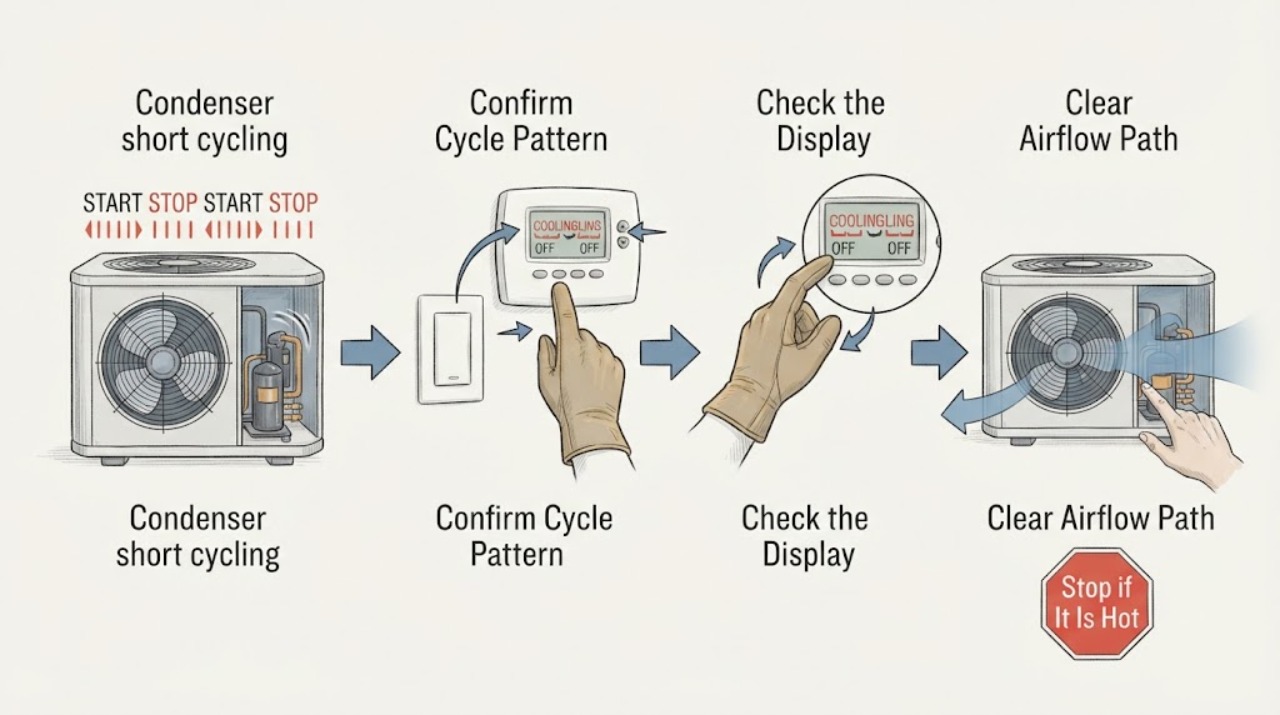
Work through in order
Diagnostic checks
Use only checks that match the exact appliance or system and its official guide.
-
Check 1
From a safe indoor and outdoor vantage point, observe one cooling call while noting when the thermostat calls for cooling, when the indoor blower runs, and when the outdoor condenser starts and stops; do not approach moving parts or remove any cover.
Expected result: Record whether the condenser stops before the thermostat reaches its setting, whether the indoor blower continues alone, whether the system restarts repeatedly, and whether the issue occurs only during a mild period or also during sustained heat.
Next step: Write down the sequence, thermostat reading, indoor comfort, and weather conditions for the HVAC technician; continue only with the low-risk checks below if there is no urgent stop condition.
Stop if: Stop observing and turn cooling off at the thermostat if there is smoke, a burning odor, exposed or damaged wiring, loud mechanical distress, fluid spraying, or an electrical smell.
Why this matters
Why: A condenser that repeatedly stops before the setpoint supports a short-cycling report. A blower-only interval may be a fan setting or control sequence, while a condenser that never starts is a different no-operation symptom. The observation cannot identify a failed electrical component.
-
Check 2
At the thermostat, verify that the mode is cooling, the fan behavior is intentional, the displayed setting was not changed by a schedule, and the thermostat is not in direct sun or immediately beside a supply register or heat-producing appliance; do not remove the thermostat or touch its wiring.
Expected result: The mode, schedule, or fan setting is wrong; the display is blank or inconsistent; the thermostat is exposed to a local heat source; or the settings and location appear correct.
Next step: Correct only the visible mode, schedule, or fan setting according to the thermostat instructions, then observe one complete call. If the display remains unreliable or short cycling continues, arrange HVAC diagnosis.
Stop if: Do not jumper terminals, remove the thermostat face, alter wiring, or use repeated power cycling as a test.
Why this matters
Why: A wrong setting or a badly placed sensor can create an apparent early stop or repeated call. A correct setting and sensible location do not rule out a failed thermostat, wiring, sizing, or equipment fault.
-
Check 3
With the system off at the thermostat, inspect the user-accessible indoor air filter and return grilles using the installed equipment instructions; replace a disposable filter only with the same specified size and type, and do not open the blower cabinet.
Expected result: The filter is visibly loaded, collapsed, wet, or installed backward; the return grille is blocked; the filter and return path look clear; or the filter is inaccessible or its specification is unknown.
Next step: Restore the correct filter and clear only movable items that block the return grille, then make one observation of cooling performance. If the pattern persists, airflow is weak, or ice is present, stop cooling and request professional service.
Stop if: Do not operate without the specified filter, force a filter into place, open the air handler, or use a filter change to justify touching electrical or refrigerant components.
Why this matters
Why: A loaded filter or blocked return can reduce airflow and is a plausible contributor to short periods, weak cooling, or ice. A clear filter does not clear the condenser, refrigerant, control, or sizing causes. A wet filter or inaccessible filter needs more than guesswork.
-
Check 4
From a stable position outside the equipment enclosure, visually inspect whether leaves, stored items, vegetation, snow, or another object blocks the condenser's air path; do not touch the grille, fan, coil, disconnect, wiring, or service panel.
Expected result: The air path is visibly obstructed; the coil appears heavily soiled; airflow looks clear; the fan is not turning when cooling is called; or the condition cannot be judged safely.
Next step: Remove only loose objects that are clearly away from the unit and can be moved without entering the equipment space; otherwise photograph the condition and have a qualified HVAC professional inspect and clean or repair it.
Stop if: Do not hose the coil, bend fins, remove the grille, reach through openings, touch the fan, or open the electrical compartment, even if the thermostat is off.
Why this matters
Why: A visible obstruction or heavily soiled outdoor coil can reduce heat rejection, but appearance alone cannot distinguish dirt from a refrigerant, fan, capacitor, compressor, or control fault. A stopped fan or inaccessible condition is a service finding, not a DIY repair invitation.
-
Check 5
From a safe distance, record visible frost or ice on the outdoor unit or copper tubing, weak or warm supply air, unusual humming or grinding, water where it is not normally expected, a breaker trip, or any burning smell; do not remove ice or reset a breaker repeatedly.
Expected result: There is ice or weak airflow, a repeated breaker trip, an abnormal sound, a burning smell or smoke, or none of these signs.
Next step: For ice or weak airflow, turn cooling off and arrange service; for a repeated trip, smoke, burning smell, or damaged wiring, leave the affected circuit off if it is already safely off and contact a qualified HVAC or electrical professional. Provide the observation record rather than testing inside the unit.
Stop if: Do not chip ice, add refrigerant, measure pressure, inspect a capacitor, handle wiring, or restart equipment that trips or smells hot.
Why this matters
Why: Carrier lists ice, inadequate cooling, short cycling, and condensing-unit faults among conditions that need professional troubleshooting; ice can accompany airflow or refrigerant problems. A breaker that trips again or any smoke/odor raises an immediate electrical or equipment-safety concern.
-
Check 6
Compare the symptom with the system's history: note whether short cycling began immediately after installation or replacement, follows a thermostat change, appears only in one zone, or started after maintenance or airflow changes; use records and observations rather than opening equipment.
Expected result: The system has short cycled since installation, began after a control or duct change, occurs only in certain conditions, or has no clear trigger.
Next step: Give the technician the installation or maintenance date, thermostat settings, filter history, cycle observations, and comfort symptoms so they can test the system and determine the repair scope.
Stop if: Do not select a replacement condenser, compressor, capacitor, fan motor, or thermostat solely from this history.
Why this matters
Why: A pattern present from commissioning can support an HVAC sizing or control review, while a new pattern after a change can focus the service visit on that change. Neither pattern proves oversizing or a specific failed part.
Use your observations
Decision map
Find the observation that best matches what you see, then follow the next safe action.
-
PATH 01Safety boundary
What you see
The thermostat mode, schedule, fan setting, or placement is clearly inconsistent with the intended cooling call.
Do this next
Correct only the visible setting or remove the local placement issue as allowed by the thermostat instructions, then observe one call. If the pattern remains, request HVAC diagnosis.
Why this path and its safety boundary
Safety stop: Do not open the thermostat or change its wiring.
-
PATH 02Safety boundary
What you see
The accessible filter is loaded or the return grille is visibly blocked, and there is no urgent odor, smoke, electrical, or ice condition.
Do this next
Restore the specified filter and unobstructed return airflow, then observe whether the short cycling stops. Escalate if airflow remains weak, ice appears, or cycling continues.
Why this path and its safety boundary
Safety stop: Do not operate without the proper filter or enter the air-handler cabinet.
-
PATH 03Safety boundary
What you see
Frost or ice is visible, cooling is inadequate, or tubing appears iced after the safe observation.
Do this next
Turn cooling off at the thermostat and arrange qualified HVAC service to assess airflow and refrigerant-related causes; do not remove the ice or add refrigerant.
Why this path and its safety boundary
Safety stop: No refrigerant recovery, charging, pressure testing, or coil disassembly is a homeowner step.
-
PATH 04Safety boundary
What you see
The outdoor fan does not run, the unit hums or grinds, the coil is heavily soiled, or the condenser still short cycles after safe settings and filter checks.
Do this next
Stop further testing and schedule a qualified HVAC inspection of the condenser, controls, airflow, refrigerant circuit, and system sizing.
Why this path and its safety boundary
Safety stop: Do not open the panel or choose a capacitor, motor, compressor, or condenser replacement from the symptom alone.
-
PATH 05Safety boundary
What you see
The breaker trips again, smoke or a burning odor is present, wiring is visibly damaged, or the equipment makes severe abnormal noise.
Do this next
Stop using the air conditioner. Keep clear of the equipment and contact a qualified HVAC or electrical professional; if there is active smoke or fire, use the appropriate emergency response for the property.
Why this path and its safety boundary
Safety stop: Do not reset the breaker repeatedly, touch the unit, or attempt live electrical diagnosis.
-
PATH 06Safety boundary
What you see
The home reaches the thermostat setting unusually quickly and the short cycling has existed since installation, while the filter and visible airflow path are normal.
Do this next
Request a professional load, equipment-sizing, and control review. An oversized system is a possible explanation, but the technician must verify it before any replacement decision.
Why this path and its safety boundary
Safety stop: Do not change refrigerant charge, thermostat differential, or equipment size as a self-test.
-
PATH 07Safety boundary
What you see
The thermostat and accessible filter look correct, no obstruction is visible, and the condenser continues to start and stop early without an obvious urgent sign.
Do this next
Arrange a normal-priority HVAC diagnostic visit and provide the cycle log, comfort symptoms, filter information, and installation or maintenance history.
Why this path and its safety boundary
Safety stop: Do not keep running repeated restart tests or disassemble the condenser while waiting.
Helpful context
Understand the symptom
First confirm that the pattern is actually short cycling
Short cycling means the cooling system turns off before completing a cooling cycle and then restarts frequently. Trane notes that this can leave the home cold and clammy, cool unevenly, increase energy use, and add start-up wear. A brief delay between starts can be a control feature, but repeated starts that do not let the home settle are the useful symptom here. Watch the thermostat and outdoor unit together so a normal indoor fan-only period is not mistaken for a condenser failure.
Use safe observations to narrow the cause
A thermostat exposed to direct sunlight or a supply register can sense the wrong temperature, while a dirty filter or blocked return can reduce airflow. A system that reaches the set temperature unusually quickly from the day it was installed can point toward sizing or control evaluation rather than a dirty coil. Carrier identifies ice, low refrigerant, a dirty condensing unit, and faults in the compressor, condenser fan motor, or run capacitor as conditions that need professional attention. These clues are for describing the fault, not for choosing a part or opening the equipment.
Know when the outdoor condenser is no longer a homeowner check
The outdoor condensing unit contains the outdoor coil, compressor, condenser fan, and electronic controls. Carrier specifically warns against troubleshooting refrigerant or electrical issues yourself and recommends professional help when a filter change does not solve the problem, when the coil is frozen, or when the condensing unit is faulty. If the breaker trips again, there is smoke or a burning smell, a fan does not run, or refrigerant tubing is iced, stop using the system and arrange qualified service rather than repeatedly restarting it.
Only after diagnosis
Potential parts
- air filter
Consider this only when the accessible filter is visibly loaded, damaged, or due for replacement according to the equipment instructions; a new filter will not correct a condenser, refrigerant, control, or sizing fault.
Confirm the exact size and filter specification from the existing filter, equipment documentation, or an HVAC professional before installing. - thermostat
Consider this only after professional testing shows the thermostat or its sensing/control behavior is the cause; a display or placement symptom alone does not establish compatibility or failure.
A qualified installer must confirm the system type, wiring, controls, and manufacturer requirements before replacement. - condenser fan motor or run capacitor
Consider either component only when a qualified technician's testing identifies a matching condenser fault; humming, rapid cycling, or a stopped fan is not enough to select a part.
Confirm the exact equipment model, electrical specifications, and approved replacement through qualified service; do not handle the capacitor or wiring yourself.
When checks do not resolve it
Need a professional?
Arrange qualified HVAC service when short cycling continues after the safe thermostat, filter, and visual airflow checks; when cooling is inadequate; when the pattern began after installation; or when the condenser fan, compressor, controls, refrigerant circuit, or system sizing may be involved. Treat smoke, a burning odor, repeated breaker trips, exposed wiring, severe mechanical noise, or active equipment damage as an immediate stop condition and keep the equipment off.
Safety scope: This article is for safe observation and triage. A qualified HVAC professional determines whether the cause is airflow, thermostat/control, refrigerant, electrical, compressor or fan equipment, or system sizing, and performs all panel access, live electrical testing, refrigerant work, and part-selection checks.
Have this ready
- Cycle sequence showing thermostat call, condenser starts and stops, and whether the indoor blower continues
- Thermostat mode, schedule, placement, displayed temperature, and comfort symptoms
- Filter condition, return-air obstruction, outdoor airflow observations, and any ice or visible debris
- Breaker-trip, odor, smoke, noise, water, and fan-operation observations
- Installation, replacement, maintenance, thermostat-change, and symptom-start history
Common questions
FAQ
Is a condenser that starts and stops every few minutes always bad?
Repeated starts before the home reaches the thermostat setting are a short-cycling symptom, not proof of one failed part. Check settings, the accessible filter, and visible airflow safely, then arrange HVAC diagnosis if the pattern persists or any ice, weak airflow, odor, noise, or breaker trip appears.
Can a dirty filter make the outdoor condenser short cycle?
A loaded filter or blocked return can reduce airflow and may contribute to short periods or ice. Replace only an accessible filter with the specified type, make one observation, and call for service if cycling continues, airflow is weak, or ice is present.
Should I replace the condenser capacitor when it short cycles?
No. A capacitor is inside an electrical compartment and the symptom does not identify it. Do not open the panel or touch wiring; a qualified technician must test the condenser and select any compatible part.
What should I do if the condenser is iced?
Turn cooling off at the thermostat and arrange qualified HVAC service. Ice can accompany airflow or refrigerant problems, so do not chip it off, add refrigerant, or open the unit to investigate.
Can an oversized air conditioner cause short cycling?
Yes, an oversized system can reach the thermostat setting too quickly and stop before completing a cycle, especially when the pattern has existed since installation. Treat sizing as a professional load and equipment review, not a reason to choose a replacement from symptoms alone.
Read the exact guide
Official sources
- Troubleshooting an AC Not WorkingCarrier · Supports safe checks of thermostat, filter, outdoor unit, ice, breaker symptoms, and escalation for refrigerant, electrical, condenser fan, compressor, and capacitor issues.
- AC Short CyclingTrane · Supports the definition and comfort effects of short cycling, thermostat-location clues, oversized-system clue, filter maintenance, and professional diagnosis.
Community feedback
Share a repair observation
Share a plain-text repair observation. Accepted observations are published automatically; this page may take a moment to update.