
On this page
Start here
Quick answer
Some Daikin heat-pump sounds are part of normal operation: a steady compressor hum, outdoor fan airflow, a brief whoosh when refrigerant flow changes, clicks at start or stop, and temporary increases during an outdoor defrost cycle. A new or worsening metallic scrape, harsh rattle, electrical buzz, repeated knocking, burning smell, smoke, water leak, or noise accompanied by poor heating is not a sound to diagnose by opening the unit. First identify whether the sound is indoors or outdoors and whether it follows startup, shutdown, heating, cooling, or defrost. With power off, remove only loose leaves, snow, or other external obstructions that the owner's instructions allow you to remove; keep hands away from the fan and fins. If the sound remains abnormal, an indoor or outdoor unit vibrates, a breaker trips, an error lamp flashes, or there is an odor or leak, stop operation and arrange qualified Daikin service.
Before you begin
Safety first
- This article supports sound classification, safe observation, filter care, and removal of loose external obstructions only when the manual allows it. Electrical, refrigerant, compressor, fan, mount, concealed duct, and internal cleaning work belongs to qualified service.
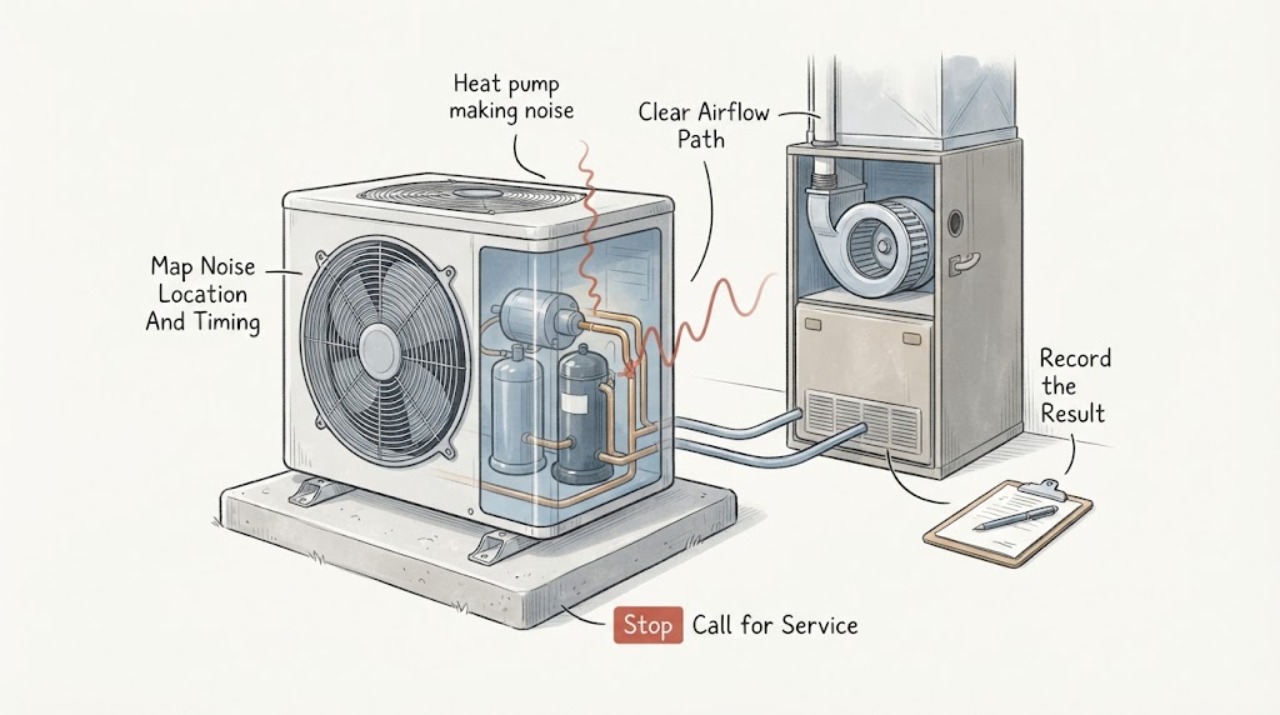
Work through in order
Diagnostic checks
Use only checks that match the exact appliance or system and its official guide.
-
Check 1
From a safe distance, identify whether the noise comes from the indoor unit, outdoor unit, duct or grille, or the surrounding structure. Note whether it begins at startup, changes at shutdown, occurs only in heating or cooling, follows fan-speed changes, or appears during an outdoor defrost period.
Expected result: Classify the sound as a steady hum or airflow, brief click or whoosh, water-flow sound during heating interruption, intermittent rattle or vibration, metallic scrape or knock, electrical buzz, or a sound whose source cannot be localized.
Next step: Record a short audio or video from a safe position, the mode and weather, and any heating or cooling change. Continue only with the external checks that match the sound; stop for odor, smoke, water, or unsafe access.
Stop if: Do not lean into the fan guard, touch the outdoor unit while it is running, or open an indoor or outdoor panel to locate the sound.
Why this matters
Why: A brief mode-linked whoosh, click, or defrost water sound can be normal operation. A persistent scrape, knock, rattle, or buzz is more consistent with an obstruction, loose exterior part, fan or motor issue, installation vibration, or electrical fault, but the sound does not identify which part.
-
Check 2
After using the controller to stop the heat pump and disconnecting power according to the model instructions, inspect the outside of the outdoor unit and nearby air path for leaves, snow, weeds, packaging, a loose grille or cover, or an object contacting the cabinet. Inspect indoor supply and return grilles for an obvious external blockage without removing panels.
Expected result: Record whether an object is visibly contacting or restricting an air inlet or outlet, the cabinet or grille is loose, the unit is surrounded by accumulated debris, or the air path is clear.
Next step: Remove only loose, reachable debris as the owner's instructions permit, restore the required clearance, and test once. Request service if the sound remains, the grille or cabinet is loose, or anything is contacting the fan area.
Stop if: Do not reach through the fan guard, bend coil fins, spray water into the unit, remove covers, or pull on refrigerant or electrical lines.
Why this matters
Why: A loose external object or blocked air path can create airflow noise or vibration and should be corrected only when it can be removed without reaching moving or sharp components. A clear path with persistent noise points toward an internal fan, compressor, mount, duct, or electrical issue.
-
Check 3
If the sound is indoors or changes with airflow, check the air filters and visible supply or return openings using the model's ordinary maintenance procedure. Confirm that furniture or other objects are not blocking the external airflow path and that the filter is installed correctly after cleaning and drying.
Expected result: Observe whether a filter is dirty, missing, mis-seated, or noisy when air moves; whether a grille or duct whistles; whether airflow is weak or uneven; or whether the filter and visible openings are clean and unobstructed.
Next step: Clean or reinstall the filter only as the manual allows, then retest once. Arrange qualified service for persistent indoor noise, weak airflow, duct access, water, or any need to clean inside the unit.
Stop if: Do not operate without a required filter, spray cleaner into the air handler, remove the blower cover, or touch the fan or electrical parts.
Why this matters
Why: A dirty or mis-seated filter or a blocked grille can raise airflow noise and reduce performance. Whistling, rattling, or uneven airflow with clean filters may indicate leaking or poorly sealed ductwork or an internal blower issue, not permission to open the air handler.
-
Check 4
When the heat pump is in heating mode, observe from a safe distance whether the noise coincides with a temporary pause in warm air, outdoor frost melting, water or steam at the outdoor unit, and a return to normal operation after the defrost period. Do not interrupt or force a defrost cycle.
Expected result: Classify the event as a brief whoosh or water sound during defrost with normal recovery, a noise that continues outside the defrost event, heavy ice that does not clear, or a defrost event accompanied by an error indication or poor heating.
Next step: Allow a normal defrost event to complete once, then document the duration and recovery. Request service if it does not recover, repeats abnormally, leaves heavy ice, or the noise is not limited to the event.
Stop if: Do not scrape coil ice, pour water over the outdoor unit, disable defrost, or operate with the fan blocked by ice.
Why this matters
Why: Daikin says heating can stop temporarily while the outdoor unit melts accumulated frost and that water or steam can be discharged. A persistent or worsening sound, ice that remains, repeated failed recovery, or an error indication makes a fan, airflow, defrost, refrigerant, or control problem more likely than normal defrost noise.
-
Check 5
With the system off, visually inspect whether the outdoor cabinet, stand, pad, nearby line cover, or wall support appears loose or is touching another surface. From a distance during operation, note whether the sound is transmitted into a wall, floor, ceiling, or duct rather than only coming through the air.
Expected result: Record a loose-looking cover or support, a cabinet that visibly shakes, contact with a wall or line cover, a new resonance after installation or severe weather, or no visible vibration source.
Next step: Keep the area clear and show the support, contact point, and recording to the installer or qualified Daikin technician. Do not alter the support, refrigerant lines, or anti-vibration hardware yourself.
Stop if: Do not climb, lift the unit, remove panels, tighten refrigerant-line fittings, or place improvised pads under a running outdoor unit.
Why this matters
Why: A loose cover, contact point, or installation vibration can amplify a normal fan or compressor sound. A visibly shaking cabinet or unknown vibration source can also indicate a rotating-component or mount problem and cannot be cleared safely by tightening random fasteners.
-
Check 6
Check the controller or indoor display for a flashing operation lamp or error code, and note whether the noise occurs with a burning smell, smoke, water leakage, repeated breaker operation, loss of heating or cooling, or a fan that does not run normally. Do this without opening the unit or resetting a breaker repeatedly.
Expected result: Record normal operation with no warning, an error or flashing lamp, a safety symptom, repeated power interruption, water leak, or a serious performance change accompanying the noise.
Next step: Stop operation and disconnect power only as the model instructions direct for an abnormal or hazardous condition. Give the technician the model, error code, mode, noise recording, weather, and checks already performed.
Stop if: Do not operate with smoke or burning odor, do not reset a tripping breaker, do not touch live wiring or refrigerant components, and do not keep testing a leaking or unsafe unit.
Why this matters
Why: A normal sound without other symptoms can be monitored. An error indication, abnormal noise, burning smell, smoke, water leakage, or repeated power protection means the system needs service; the combination is more important than trying to identify a part by sound.
Use your observations
Decision map
Find the observation that best matches what you see, then follow the next safe action.
-
PATH 01Safety boundary
What you see
The sound is a steady low hum or airflow, or a brief click or whoosh that occurs at startup, shutdown, mode change, or a normal defrost event; heating or cooling returns and there is no odor, leak, error, or visible damage.
Do this next
Record the normal pattern and keep the air path clear. Ask a technician to assess it if it becomes louder, persistent, disruptive, or changes character.
Why this path and its safety boundary
Why it matters: Normal compressor, fan, refrigerant-flow, or defrost operation is more likely than a failed part. Sound level can still be affected by the installation and surrounding surfaces.
Safety stop: Do not open the unit or replace a component solely because a normal operating sound is audible.
-
PATH 02Safety boundary
What you see
Noise changes with airflow and a dirty or mis-seated filter, blocked grille, leaf, snow, weed, or other external obstruction is found; there is no water, odor, error, or unsafe access issue.
Do this next
Clean or reinstall the filter and remove only loose reachable debris as the manual allows, then test once. Have service inspect persistent whistle, rattle, weak airflow, or fan contact.
Why this path and its safety boundary
Why it matters: Airflow restriction or an external installation condition is more likely than a compressor fault, although a persistent noise after correction needs further diagnosis.
Safety stop: Do not spray water into the unit, reach through the fan guard, bend fins, or remove panels to clean internal components.
-
PATH 03Safety boundary
What you see
A new rattle, scrape, knock, or strong vibration comes from the outdoor unit and persists outside a defrost event, especially if the cabinet, grille, support, or fan area visibly shakes.
Do this next
Stop the heat pump and request qualified inspection of the fan, motor, mounts, cabinet, and installation. Provide the recording and note whether the sound follows fan speed or outdoor temperature.
Why this path and its safety boundary
Why it matters: A loose cover, contact point, mounting or installation vibration, fan obstruction, or rotating-component problem is more likely than normal airflow noise. The exact fault cannot be identified safely by sound alone.
Safety stop: Do not touch or restrain the fan, remove the guard, tighten random hardware, lift the unit, or place material under the cabinet.
-
PATH 04Safety boundary
What you see
Noise is from the indoor unit or ductwork and is a persistent buzz, rattle, whistle, or uneven airflow after the filter and visible grilles are clean and unobstructed.
Do this next
Stop operation if the sound is abnormal or worsening and arrange qualified service; do not remove the air-handler cover or apply internal cleaner.
Why this path and its safety boundary
Why it matters: An internal blower, flap, loose panel, duct leak, or electrical component is more likely than a dirty filter. Daikin's troubleshooting guidance says abnormal indoor noise should lead to stopping operation and contacting the place of purchase.
Safety stop: Stop immediately for burning smell, smoke, water leak, live-electrical concern, or a flashing error lamp.
-
PATH 05Safety boundary
What you see
Any unusual noise occurs with burning odor, smoke, water leakage, repeated breaker operation, error indication, heavy outdoor icing, loss of heating or cooling, or a fan that stops unexpectedly.
Do this next
Stop operation, disconnect power only as the manual directs, keep clear of the unit, and contact qualified Daikin service. Preserve the error code and recording instead of resetting repeatedly.
Why this path and its safety boundary
Why it matters: This is not a normal-noise identification problem. An electrical, refrigerant, fan, drain, defrost, or control fault may be present, and continued operation can create damage or safety risk.
Safety stop: Do not restart to see whether the sound returns, reset a tripping breaker, open panels, touch wiring, or work on refrigerant or compressor components.
Helpful context
Understand the symptom
Separate normal heat-pump sounds from a fault
A heat pump moves refrigerant and air, so it will not be silent. Daikin describes a steady compressor hum, airflow from the outdoor fan, refrigerant whoosh, and brief clicks at startup or shutdown as normal operating sounds in its noise guidance. A change that occurs only when heating begins, stops, or enters defrost can therefore have a different meaning from a metallic scrape that continues throughout the cycle. Note the sound's character, location, duration, and relation to the operating mode before deciding that a part has failed.
Use the outdoor unit's symptoms, not a guessed part name
Leaves, snow, a blocked air path, a loose exterior cover, or a mounting surface can change airflow and vibration. Daikin instructs owners to keep the outdoor unit free of accumulated leaves and other debris and to use a location that can withstand the equipment's weight and suppress sound and vibration. An external visual check is reasonable after power is off, but the cabinet, fan guard, refrigerant lines, electrical compartment, and compressor are not homeowner access points.
Noise with heat loss or a safety symptom changes the next step
A temporary whoosh or water sound during outdoor defrost can be normal, and Daikin's troubleshooting guide says heating may stop for roughly three to ten minutes while frost melts. That explanation does not cover a burning smell, smoke, repeated breaker operation, water leaking from the indoor unit, or persistent abnormal noise. Those combinations require the heat pump to be stopped and evaluated, because sound alone cannot establish whether the cause is a fan, compressor, electrical component, refrigerant circuit, drain, or installation problem.
Safety boundary
Stop conditions
- Do not open indoor or outdoor panels, touch live wiring, disconnect refrigerant lines, or work on the compressor, fan motor, or controls as a homeowner noise check.
- Do not reach through a fan guard, touch aluminum fins, scrape coil ice, pour water into the unit, or use a heat source to change a defrost event.
- Do not reset a tripping breaker repeatedly or continue operation with smoke, burning odor, water leakage, damaged wiring, or a flashing error indication.
- Do not climb, lift the outdoor unit, alter mounts or refrigerant lines, tighten random fasteners, or place improvised vibration pads under the cabinet.
- Stop and arrange qualified service for a new metallic scrape, harsh rattle, knock, electrical buzz, persistent abnormal indoor noise, heavy icing, poor heating or cooling, or noise that returns after an approved external check.
Only after diagnosis
Potential parts
- outdoor fan or fan-motor assembly
Consider this category only if qualified diagnosis confirms a damaged fan blade, motor, bearing, or related rotating component after ruling out ordinary airflow obstruction and installation vibration.
Confirm the exact Daikin model, unit position, motor and blade specifications, electrical requirements, and manufacturer's fit information; do not order from a sound description alone. - anti-vibration mount or installation hardware
Consider this category only if the installer or technician confirms that a failed or unsuitable support or vibration-control component is transmitting a new cabinet or structure-borne noise.
Confirm the exact unit weight, mounting arrangement, surface, and manufacturer's installation requirements; never place improvised material under a running outdoor unit. - air filter
Consider this category only if the exact model uses a replaceable filter and the installed filter is damaged, missing, or cannot be cleaned according to the manual and is contributing to airflow noise or reduced performance.
Confirm the exact Daikin model, filter dimensions, orientation, and manufacturer's instructions; do not operate without a required filter.
When checks do not resolve it
Need a professional?
Arrange qualified Daikin service when an unusual noise persists after the safe external filter and obstruction checks, a cabinet or fan visibly vibrates, an indoor unit or duct whistles or rattles, the sound is accompanied by poor heating or cooling, outdoor ice does not clear, a flashing lamp or error appears, water leaks, a breaker trips, or there is any burning odor or smoke. Provide the exact model, indoor/outdoor location, sound recording, mode and timing, weather, error indication, and observations of airflow, ice, vibration, and performance.
Safety scope: This article supports sound classification, safe observation, filter care, and removal of loose external obstructions only when the manual allows it. Electrical, refrigerant, compressor, fan, mount, concealed duct, and internal cleaning work belongs to qualified service.
Common questions
FAQ
Is a humming or whooshing sound normal for a Daikin heat pump?
Often, yes. Fans, compressors, and refrigerant movement create sound, and Daikin identifies steady hum, airflow, brief refrigerant whoosh, and startup or shutdown clicks as possible normal sounds. A new metallic scrape, harsh rattle, persistent buzz, or sound with poor performance needs service.
Why does my heat pump get louder during defrost?
When heating, the outdoor unit may defrost accumulated frost, temporarily changing fan and compressor sound and producing water or steam. Daikin says a short heating interruption with water-flow sound can be normal defrost. Heavy ice that remains, failed recovery, or an error indication is not a normal-noise conclusion.
What can I safely check when the outdoor unit rattles?
Stop the unit and disconnect power as the manual directs, then inspect only the exterior for loose leaves, snow, a contacting object, or an obviously loose cover or support. Do not reach through the fan guard, remove panels, bend fins, lift the unit, or tighten random hardware.
Can a dirty filter make a Daikin heat pump noisy?
A dirty or incorrectly installed filter can restrict or disturb indoor airflow and may contribute to noise or poor performance. Clean or reinstall it only by the exact model procedure. Persistent whistle, rattle, weak airflow, water, or internal noise belongs to qualified service.
When should I turn off a noisy heat pump?
Stop it for a new or worsening abnormal noise, burning odor, smoke, water leak, repeated breaker operation, flashing error indication, heavy ice, fan blockage, or loss of heating or cooling. Disconnect power only as the manual directs and arrange qualified Daikin service rather than repeatedly restarting it.
Read the exact guide
Official sources
- OPERATION MANUALDaikin · Official Daikin Comfort operation manual for a multi-position air-handler heat-pump system; exact model manuals control a particular installation.
- Quiet HVAC SystemsDaikin Comfort · Official Daikin Comfort general HVAC guidance; it does not diagnose a particular heat-pump sound or set a universal noise limit.
- Troubleshooting | Air Conditioning and RefrigerationDaikin · Official Daikin global troubleshooting guidance; operating modes, controls, and service procedures vary by product and region.
- Air source heat pump noise: how quiet are modern systems?Daikin · Official Daikin consumer guidance for air-source heat pumps; actual sound and acceptable levels vary by model, installation, and environment.
Community feedback
Share a repair observation
Share a plain-text repair observation. Accepted observations are published automatically; this page may take a moment to update.