
On this page
Start here
Quick answer
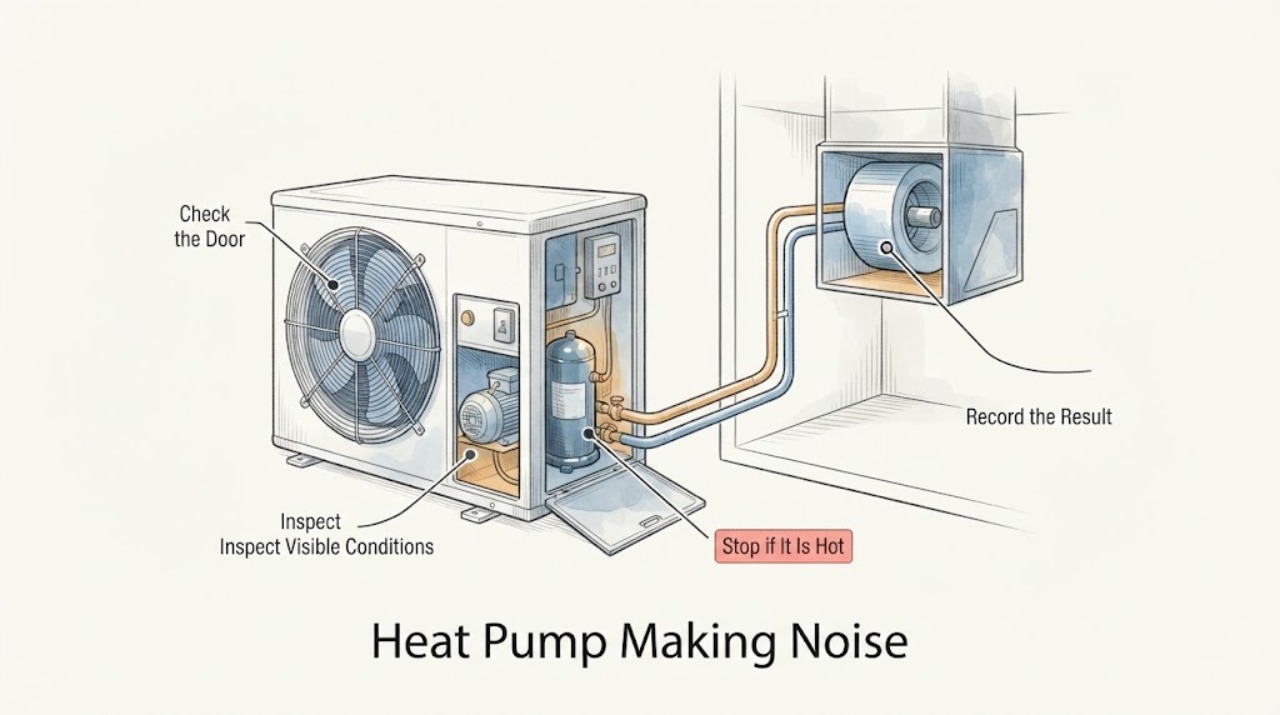
A heat pump can make brief operating sounds during startup, shutdown, refrigerant movement, or a defrost cycle, so the useful clues are the sound type, location, duration, and whether it is new or accompanied by poor heating/cooling. If the outdoor unit is clear but the noise is banging, grinding, rattling, screeching, prolonged buzzing, loud humming outside a normal defrost event, or hissing with performance changes, turn the system off if safe and arrange qualified HVAC service. A gentle whoosh during reversing-valve operation or a temporary hum while the outdoor fan stops in defrost can be normal for some systems. Do not remove panels, touch the capacitor, add refrigerant, straighten fan parts, or keep running a unit with smoke, a burning electrical smell, refrigerant hissing, severe vibration, ice that is not clearing, or repeated electrical trips.
Work through in order
Diagnostic checks
Use only checks that match the exact appliance or system and its official guide.
-
Check 1
From a safe position, identify whether the sound comes from the outdoor unit, indoor air handler, ductwork, or refrigerant-line area. Note whether it is a whoosh, hum, rattle, bang, grind, screech, buzz, or hiss; do not touch the cabinet, fan, lines, or electrical parts.
Expected result: The sound is outdoors, indoors, at the line set, or transmitted through the structure, and it is brief, repeating, or continuous.
Next step: Record a short audio or video from a safe distance and continue only with timing and performance observations. For grinding, screeching, severe rattling, continuous hissing, or a new loud sound, turn the system off if safe and arrange HVAC service.
Stop if: Stop immediately for smoke, burning electrical smell, gas-like odor, refrigerant hissing with performance loss, exposed wiring, moving parts, or a noise loud enough to suggest imminent mechanical damage.
Why this matters
Why: Location narrows the likely subsystem but does not confirm a failed part. Outdoor noises can involve the fan, motor, compressor, reversing valve, or cabinet; indoor noises can involve the blower or airflow path; hissing near refrigerant lines can signal a refrigerant concern.
-
Check 2
Compare the sound's timing with a normal heating or cooling call: startup, shutdown, a heating/cooling change, and a possible defrost period. Observe from outside the unit whether the fan pauses during a short defrost-related sound; do not extend the test or override the thermostat to force a cycle.
Expected result: A gentle whoosh occurs during mode change, a short hum occurs while the outdoor fan stops in defrost, the sound is present throughout operation, or the sound is much louder or longer than usual.
Next step: Monitor a brief familiar cycle sound only if heating/cooling remains normal. For a prolonged or changed sound, stop operating the unit if safe and arrange qualified service rather than trying to suppress the noise.
Stop if: Stop for a fan that does not resume after the expected cycle, rapidly increasing noise, severe vibration, ice that is growing or not clearing, or any electrical or refrigerant warning sign.
Why this matters
Why: Brief cycle-linked sounds can be normal for the system. A persistent, excessive, or newly changed sound outside the expected event makes a motor, compressor, reversing valve, electrical, or refrigerant issue more likely.
-
Check 3
With the system off and only from outside the cabinet, verify that the outdoor coil and fan opening are clear of obvious leaves, snow, and ice, and check that nearby panels or covers are not visibly loose. Do not remove a panel, reach through the grille, chip ice, or straighten a fan blade.
Expected result: The visible area is clear, a panel vibrates, ice is present but clearing normally, ice is accumulating, or the fan appears damaged or obstructed behind the guard.
Next step: Remove only a loose external item that is clearly safe and not attached to the unit. For persistent ice, fan damage, panel vibration that returns, or a clear cabinet with continued abnormal noise, arrange HVAC service.
Stop if: Stop for any need to enter the cabinet, touch the fan or coil, chip ice, use a hose while energized, or continue operation with severe vibration or a damaged guard.
Why this matters
Why: A clear exterior makes an internal or mechanical/electrical cause more likely. A loose panel can transmit vibration, but ice that grows or does not clear can indicate airflow, refrigerant, fan, or defrost trouble; a guarded fan must not be handled.
-
Check 4
Check the thermostat mode and the indoor air filter from its normal accessible location, and note whether the unit still heats or cools, airflow is weak, or the system runs constantly. Do not open the air handler or remove electrical covers to chase a noise.
Expected result: The mode is wrong, the filter is clogged, airflow or heating/cooling is reduced, the system runs continuously, or performance is normal despite the noise.
Next step: Correct only an obvious thermostat setting or replace a dirty accessible filter according to the unit manual. If noise or performance problems remain, stop self-diagnosis and schedule a qualified inspection.
Stop if: Stop for smoke, burning smell, electrical odor, repeated breaker trips, a frozen coil that is not clearing, or any need to access the blower, capacitor, wiring, or refrigerant circuit.
Why this matters
Why: A setting or airflow restriction can change operating behavior, but a clear filter and normal performance do not make a new loud noise harmless. Noise plus poor performance keeps frozen coil, refrigerant, compressor, reversing-valve, or blower issues in view.
-
Check 5
Document the sound, location, timing, outdoor temperature/season, heating or cooling mode, fan behavior, visible ice, airflow, and any error indication without opening the unit. If safe, turn the system off at the thermostat; use the disconnect or breaker only according to the owner manual and only when no electrical hazard is present.
Expected result: The noise stops when the system is off, returns immediately on restart, occurs only in defrost or mode change, or continues with abnormal odor, vibration, ice, or poor performance.
Next step: Leave the system off for a persistent abnormal or hazardous noise and arrange qualified HVAC service. Provide the technician the recording, timing, mode, visible conditions, filter status, and performance change.
Stop if: Stop for smoke, burning electrical odor, refrigerant leak suspicion, severe vibration, a fan that fails to run, repeated electrical trips, or any request to measure live voltage or handle refrigerant.
Why this matters
Why: A repeatable system-linked noise supports a heat-pump diagnosis, but the pattern alone cannot distinguish motor, compressor, reversing valve, refrigerant, control, or cabinet causes. Hazard signs raise the urgency and make continued operation unsafe.
Use your observations
Decision map
Find the observation that best matches what you see, then follow the next safe action.
-
PATH 01Safety boundary
What you see
Is the sound brief and tied to startup, shutdown, reversing-valve change, or defrost, with normal heating/cooling and no hazard sign?
Do this next
Treat it as a potentially normal operating sound for that system and monitor whether its timing, loudness, or duration changes; do not disassemble anything.
Why this path and its safety boundary
Why it matters: Timing and associated performance are more informative than the absence of visible debris alone.
Safety stop: Treat a continuous, prolonged, newly louder, or performance-linked sound as abnormal and arrange qualified HVAC service.
-
PATH 02Next step
What you see
Is the sound a rattle, bang, grind, screech, prolonged buzz, or severe vibration even though the outdoor unit looks clear?
Do this next
Turn the system off if safe and schedule HVAC service. Do not remove the grille, reach toward moving parts, or tighten internal hardware.
Why this path and its safety boundary
Why it matters: These patterns make a loose cabinet component, fan/motor, compressor, electrical component, or other internal fault more likely than a simple visible obstruction.
-
PATH 03Next step
What you see
Is there hissing near refrigerant lines, ice that is not clearing, weak heating/cooling, poor airflow, or a system that runs constantly along with the noise?
Do this next
Stop the system if safe and arrange qualified HVAC diagnosis. Do not chip ice, add refrigerant, or open the sealed circuit.
Why this path and its safety boundary
Why it matters: The combined pattern makes refrigerant, coil, fan, defrost, compressor, reversing-valve, or indoor-air-handler trouble more likely and is not a safe homeowner repair.
-
PATH 04Next step
What you see
Is there a burning electrical odor, smoke, repeated breaker trip, exposed wiring, or noise that continues or worsens immediately after restart?
Do this next
Leave the system off and keep clear of the equipment. Contact emergency services for an immediate fire/electrical hazard and arrange licensed HVAC service for the equipment fault.
Why this path and its safety boundary
Why it matters: The condition may involve an electrical or mechanical safety fault; continued operation can cause damage or injury.
Helpful context
Understand the symptom
No visible debris does not make every noise harmless
Leaves and snow are only one possible cause of heat-pump trouble. A clear outdoor cabinet can still have a fan, motor, compressor, reversing valve, control, refrigerant, or mounting problem. Trane lists banging, screeching, rattling, buzzing, grinding, and gurgling as unusual sounds that should be evaluated by an HVAC professional. Carrier similarly treats excessively loud or constant reversing-valve noise as a reason for service.
Timing separates a cycle sound from a new fault
Record whether the sound occurs only at startup or shutdown, during a change between heating and cooling, during defrost, or continuously while the unit runs. Trane notes that heat pumps can hum while the outdoor fan is stopped during defrost, and Carrier describes a gentle whoosh from the reversing valve as typically normal. The same sound outside those events, or a change from the unit's established pattern, deserves service rather than a guessed part replacement.
Sound plus performance is the decision point
A noise accompanied by weak airflow, poor heating or cooling, ice that does not clear, repeated cycling, a sudden bill increase, or a system that will not switch modes is more concerning than a short familiar operating sound. Carrier identifies frozen coils, low refrigerant, reversing-valve problems, compressor issues, and indoor-air-handler faults as conditions requiring professional diagnosis. Do not infer low refrigerant or a compressor failure from sound alone.
Safety boundary
Stop conditions
- Stop the heat pump and keep clear for smoke, burning electrical odor, exposed wiring, severe vibration, repeated breaker trips, refrigerant hissing with performance loss, or a loud mechanical noise that worsens; use emergency guidance for immediate hazards.
- Do not remove panels, touch capacitors or wiring, reach through the fan guard, chip ice, straighten blades, add refrigerant, or open the sealed circuit.
- Do not force a reversing valve, bypass a safety control, or repeatedly restart a unit that produces a new or prolonged abnormal sound.
- Stop after the area is visibly clear but the noise persists, returns immediately, or is accompanied by reduced heating/cooling, airflow changes, ice, odor, or a fan that does not resume.
Common questions
FAQ
Is a humming sound from a heat pump normal?
It can be during a normal defrost cycle when the outdoor fan is stopped, and a gentle whoosh can occur while the reversing valve changes mode. A hum that is new, excessively loud, constant, or accompanied by poor performance needs HVAC diagnosis.
Why is my heat pump rattling when nothing is blocking it?
A clear exterior does not rule out a loose cabinet part, fan or motor, compressor, severe vibration, or another internal fault. Turn the system off if safe and arrange service rather than removing the grille or reaching toward the fan.
What does hissing from a heat pump mean?
Hissing near refrigerant lines with performance loss can indicate a refrigerant concern, while hissing under an outdoor unit's normal sound can also point to compressor or electrical issues. Shut the system off if safe and call an HVAC professional; do not handle refrigerant.
Can a heat pump be noisy during defrost?
Some defrost-related sounds are normal: Trane describes a heat pump humming while the outdoor fan is stopped as it temporarily reverses operation to thaw the coil. The sound should return to the unit's normal pattern; a prolonged or unusually loud noise, growing ice, or poor heating needs service.
When should I turn off a noisy heat pump?
Turn it off if safe for grinding, screeching, banging, severe or increasing vibration, prolonged abnormal noise, burning electrical odor, smoke, refrigerant hissing with performance loss, repeated electrical trips, or ice that is not clearing. Keep clear for an immediate fire or electrical hazard and arrange qualified HVAC help.
Read the exact guide
Official sources
- Is This Normal? HVAC Smells and Sounds, ExplainedTrane · Trane explanation of normal versus changed HVAC sounds, heat-pump defrost hum, outdoor-unit vibration/noise patterns, hissing, and safety warnings
- Heat Pump Repair: Troubleshooting & Professional SolutionsCarrier Residential · Carrier heat-pump repair guidance on professional diagnostic testing and urgent symptoms such as loud screeching or burning electrical odors
- Heat Pump Troubleshooting: Diagnosing Common IssuesTrane · Trane heat-pump guidance identifying unusual noise types, professional service boundary, and related frozen/electrical concerns
- Heat Pump Troubleshooting | Heat Pump ProblemsCarrier · Carrier heat-pump guidance on normal reversing-valve whoosh, abnormal constant noise, outdoor obstruction/ice, fan and air-handler faults, and professional diagnosis
Community feedback
Share a repair observation
Share a plain-text repair observation. Accepted observations are published automatically; this page may take a moment to update.