
On this page
Start here
Quick answer
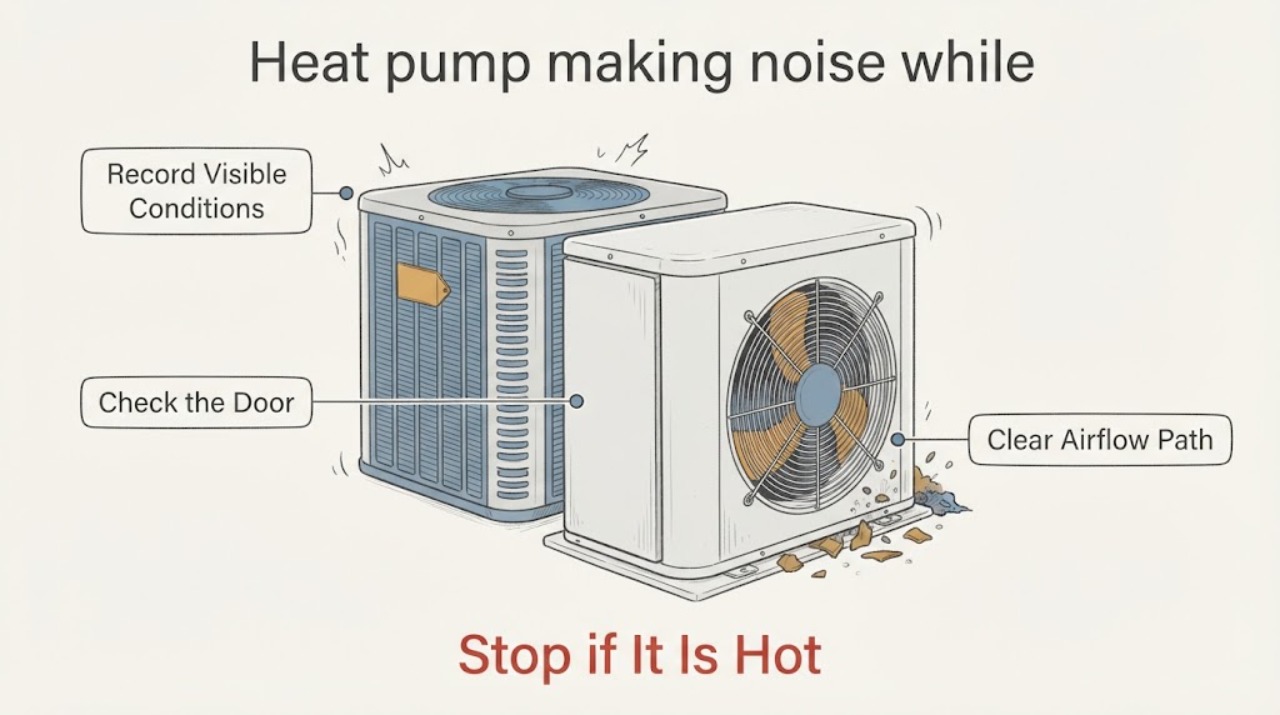
Some outdoor heat-pump sounds are part of normal operation: a brief whoosh or hum during a defrost cycle, a short startup or shutdown sound, and a temporary change while the reversing valve shifts. A new, loud, prolonged, or metallic bang, screech, grind, rattle, buzz, or hissing sound is not something to diagnose by opening the unit. From a safe distance, note the sound, when it occurs, whether the outdoor fan is turning, whether the indoor registers deliver air, and whether heating or cooling changed. Clear only leaves, snow, or other loose debris around the outdoor unit without reaching through the grille. If the noise is abnormal, persists outside defrost, comes with ice that does not clear, weak airflow, smoke, burning smell, refrigerant-like hissing, repeated breaker trips, or poor heating and cooling, turn the system off and arrange qualified HVAC service. Do not touch the capacitor, wiring, refrigerant lines, fan blade, or compressor.
Before you begin
Safety first
- This article supports listening from a safe distance, checking thermostat and indoor airflow, clearing loose outdoor debris, and observing a normal defrost transition without touching the unit. It does not authorize cabinet access, electrical or capacitor testing, fan or compressor work, refrigerant service, ice removal with tools or heat, or control bypass.
Work through in order
Diagnostic checks
Use only checks that match the exact appliance or system and its official guide.
-
Check 1
From a safe position away from the outdoor grille, listen for one normal operating sequence and record the sound in plain words. Note whether it happens at startup, shutdown, during steady running, when the thermostat changes mode, or during a suspected defrost cycle; do not move close to a fan or remove a panel to hear better.
Expected result: Record a brief whoosh or hum with the fan stopped, a startup click or short rumble, a new bang, screech, rattle, buzz, grind, gurgle, or hissing sound, and whether the sound settles or continues. Note the outdoor temperature only as context and whether heat or cooling delivery changed.
Next step: Use the normal-defrost or abnormal-noise branch. Keep a short recording if it can be made from a safe location and provide the timing to the technician.
Stop if: Turn the system off and stop observing if there is smoke, burning odor, exposed wiring, refrigerant-like hissing, a violent vibration, or a noise suggesting the fan is striking something.
Why this matters
Why: A short sound tied to defrost or refrigerant-flow reversal can be normal. A new, loud, prolonged, or metallic noise outside that transition makes a fan, motor, compressor, capacitor, contactor, mounting, refrigerant, or other system issue more likely.
-
Check 2
With the system off at the thermostat, inspect the area around the outdoor unit from outside the grille. Remove only loose leaves, snow, branches, or stored items that can be lifted without reaching through the grille; keep the coil, fan discharge, and service access unobstructed as the manufacturer's installation guidance requires.
Expected result: Note whether debris touches the cabinet or fan guard, snow blocks the intake or discharge, the unit is visibly leaning or vibrating on its base, or the coil is coated in ice that does not clear during normal operation.
Next step: Restore operation only after loose debris is clear and no hazard is present, then observe one cycle from a safe distance. Arrange service if noise or ice persists.
Stop if: Do not open the cabinet, push objects through the grille, chip ice, bend fins, spray water into the unit, or place hands near a fan that may start automatically.
Why this matters
Why: Loose debris or blocked airflow can cause vibration, reduced heat transfer, and longer or noisier operation. A leaning cabinet, persistent ice, or a noise that remains after the area is clear points to a mechanical, airflow, defrost, refrigerant, or installation issue rather than a simple obstruction.
-
Check 3
Check the thermostat mode and setpoint, then feel a few indoor registers and confirm that the return path and filter are not visibly blocked or overdue under the owner's instructions. Do this without changing wiring, opening the air handler, or repeatedly forcing the heat pump to run.
Expected result: Note whether the indoor fan runs, registers deliver air, airflow is weak, the unit runs constantly, the room temperature is not responding, or the abnormal outdoor sound appears with a loss of heating or cooling.
Next step: Correct only an obvious thermostat setting or a visibly blocked filter or register as the manual allows, then observe once. Arrange HVAC service if airflow or comfort remains abnormal.
Stop if: Do not remove the air-handler panel, test a capacitor or wiring, bypass a safety, or keep running the system when smoke, burning odor, or a breaker trip is present.
Why this matters
Why: An outdoor unit can run while the indoor air handler fails to activate, leaving little or no register airflow. Weak airflow or poor comfort alongside noise raises concern for an indoor blower, filter, coil, refrigerant, defrost, or control issue; a noise with normal comfort still needs service if it is new or prolonged.
-
Check 4
If the sound occurs in heating mode during cold or humid weather, observe from a distance whether the outdoor coil has light frost, whether the outdoor fan stops briefly, whether vapor or meltwater appears, and whether the system returns to its prior sound and airflow afterward. Do not touch or scrape the coil.
Expected result: Record a brief cycle with fan stopped and frost clearing, versus ice that keeps growing, a fan that never resumes, or noise that remains loud after the transition. Note whether indoor heat returns normally.
Next step: Allow a normal defrost transition to finish without interference. If ice remains, the noise persists, or comfort falls, turn the system off and arrange qualified HVAC service.
Stop if: Do not chip ice, pour hot water on the coil, disable defrost, cover the outdoor unit, or continue operation when the fan is striking ice or the coil is fully blocked.
Why this matters
Why: A brief hum, fan pause, and vapor or meltwater can accompany normal defrost. Ice that does not clear, persistent loud noise, or loss of heat points to a defrost-control, fan, refrigerant, airflow, or other system fault.
-
Check 5
Turn the heat pump off and arrange qualified HVAC service when the outdoor noise is new, loud, prolonged, or abnormal; when the outdoor fan, compressor, or reversing transition behaves unusually; or when noise accompanies ice, poor comfort, smoke, odor, hissing, vibration, or repeated breaker trips.
Expected result: Give the technician the sound description or recording, timing, mode, outdoor fan behavior, frost or ice pattern, indoor airflow, thermostat response, debris check, and any safe display or breaker information.
Next step: Leave power off when the noise is severe or accompanied by a hazard, and have the technician inspect and test the outdoor and indoor units, electrical components, refrigerant circuit, defrost function, and mounting before operation resumes.
Stop if: Do not open panels, test live electrical parts, touch a capacitor, add refrigerant, straighten a fan, or bypass a control to make the heat pump run quietly.
Why this matters
Why: A professional must distinguish normal defrost or valve sounds from fan, motor, compressor, capacitor, contactor, refrigerant, control, mounting, or airflow faults. The noise alone cannot select a replacement part or justify opening the unit.
Use your observations
Decision map
Find the observation that best matches what you see, then follow the next safe action.
-
PATH 01Safety boundary
What you see
The noise is a brief hum or whoosh during heating, the outdoor fan pauses, frost or vapor appears and clears, and the unit returns to normal heating afterward.
Do this next
Let the transition finish without touching the unit and continue monitoring. Arrange service if the sound becomes louder, prolonged, or no longer clears the frost.
Why this path and its safety boundary
Why it matters: Normal defrost or refrigerant-flow reversal is more likely than a failed component.
Safety stop: Do not interfere with the fan, coil, reversing valve, or defrost controls.
-
PATH 02Safety boundary
What you see
The outdoor unit makes a new bang, grind, screech, rattle, buzz, or high-pitched sound during steady operation, especially with vibration or a fan that appears to strike something.
Do this next
Turn the system off and arrange HVAC service; provide the exact timing and sound description without opening the cabinet.
Why this path and its safety boundary
Why it matters: A moving component, mount, fan motor, capacitor, contactor, compressor, or other mechanical or electrical fault is more likely than normal operation.
Safety stop: Do not reach through the guard, tighten internal hardware, test electrical parts, or restart repeatedly to reproduce the noise.
-
PATH 03Safety boundary
What you see
The outdoor coil remains heavily iced, the noise continues after a suspected defrost cycle, the outdoor fan does not resume, or heating and cooling or indoor airflow is poor.
Do this next
Turn the heat pump off and arrange qualified service. Do not chip ice or add refrigerant; report whether a normal defrost ever clears the coil.
Why this path and its safety boundary
Why it matters: A defrost-control, fan, refrigerant, airflow, indoor air-handler, or other system fault is more likely; the unit may be unable to transfer heat safely.
Safety stop: Do not pour hot water on the coil, block the unit, bypass defrost, or continue operation with a fully frozen coil or non-running fan.
-
PATH 04Safety boundary
What you see
Noise is accompanied by smoke, burning electrical odor, exposed wiring, refrigerant-like hissing, repeated breaker trips, violent vibration, or visible damage.
Do this next
Leave the system off, keep people away from the unit, and arrange urgent qualified HVAC service. Follow local emergency guidance if there is fire, smoke, or another immediate hazard.
Why this path and its safety boundary
Why it matters: A potentially hazardous electrical, refrigerant, compressor, motor, or mechanical condition is present and is not a homeowner sound-adjustment task.
Safety stop: Do not touch the unit, operate a disconnect or breaker in an unsafe area, open panels, or attempt a reset to see whether the sound disappears.
Helpful context
Understand the symptom
First decide whether the sound matches a normal heat-pump transition
An outdoor heat pump can change sound during startup, shutdown, refrigerant-flow reversal, or a defrost cycle. During defrost, the outdoor fan may stop while the system hums, and frost can melt. That sound should settle when the cycle ends. A sound that is new, loud, metallic, continuous, or accompanied by poor comfort is a symptom of a fault, not a normal operating signature.
Use the noise and the system response together
A rattle with vibration suggests movement or a loose component; a scrape or grind raises concern about the fan or another moving part; a buzz or hum can involve electrical or motor components unless it is the brief defrost behavior described by the manufacturer. Hissing near refrigerant lines, smoke, burning odor, repeated breaker trips, or a fan that cannot run changes the response to an immediate stop.
Only perform outdoor checks that do not require opening the unit
Keep the coil and fan discharge clear of leaves, snow, and stored objects, and check that indoor registers and the return path are unobstructed. Do not remove panels, touch electrical parts, chip ice from the coil, add refrigerant, or try to quiet a vibration by bending the cabinet. Those tasks require HVAC equipment, model information, and professional testing.
Safety boundary
Stop conditions
- Do not open the outdoor cabinet, touch capacitors, wiring, contactors, fan motors, compressors, or refrigerant lines.
- Do not chip ice, pour hot water on a coil, add refrigerant, bend the fan, bypass defrost controls, or repeatedly restart a noisy heat pump.
- Stop immediately for smoke, burning odor, exposed wiring, refrigerant-like hissing, violent vibration, repeated breaker trips, or a fan striking ice or debris.
- Keep the outdoor unit clear only by removing loose debris from outside the grille; do not reach into the fan area or remove panels.
- Arrange qualified HVAC service when a new or prolonged abnormal noise persists, ice does not clear, indoor airflow or comfort falls, or the noise returns after a safe obstruction check.
Only after diagnosis
Potential parts
- heat-pump outdoor fan motor or fan assembly
Consider this category only after qualified testing confirms that a fan motor, blade, or assembly is the source of the abnormal sound or airflow loss.
Confirm the complete unit model, motor specifications, blade dimensions, controls, and service instructions; replacement requires qualified HVAC service. - heat-pump capacitor or contactor
Consider this category only when a qualified technician identifies an electrical starting, running, or switching fault consistent with the noise and measured system behavior.
Electrical ratings and fit are model-specific; do not select or handle a capacitor or contactor from the sound alone. - heat-pump defrost control or sensor
Consider this category only when ice persists or abnormal defrost behavior is confirmed and qualified diagnosis identifies the control or sensor as failed.
Confirm the exact heat-pump model and control architecture; do not bypass or substitute safety and defrost components without approved documentation.
When checks do not resolve it
Need a professional?
Arrange qualified HVAC service for any new, loud, prolonged, or mechanical outdoor-unit noise, especially banging, grinding, screeching, rattling, buzzing, high-pitched sounds, or constant reversing-valve noise. Call urgently for smoke, burning odor, hissing near refrigerant lines, exposed wiring, repeated breaker trips, violent vibration, a fan that will not run, ice that does not clear, or loss of heating and cooling. A brief defrost hum or whoosh can be normal only when it settles and the system resumes normal operation.
Safety scope: This article supports listening from a safe distance, checking thermostat and indoor airflow, clearing loose outdoor debris, and observing a normal defrost transition without touching the unit. It does not authorize cabinet access, electrical or capacitor testing, fan or compressor work, refrigerant service, ice removal with tools or heat, or control bypass.
Common questions
FAQ
Is it normal for a heat pump outdoor unit to hum loudly?
A brief hum while the outdoor fan is stopped can occur during defrost, and a short startup or shutdown sound can be normal for some systems. A hum that is new, loud, prolonged, or present outside a defrost transition can involve a motor, capacitor, contactor, compressor, or another fault. Turn it off and arrange service if it does not settle.
Why does my heat pump make a whooshing sound outside?
A gentle whoosh can occur when the reversing valve changes refrigerant direction, including during a defrost transition. It should be brief and the system should return to normal heating or cooling. An excessively loud or constant whoosh, especially with poor comfort or ice, needs qualified HVAC diagnosis.
What does a rattling or grinding outdoor heat-pump noise mean?
Rattling or grinding is not a normal sound to fix by reaching into the unit. Vibration, a fan or motor, compressor, loose mounting, debris, or another internal component may be involved. Turn the system off if the noise is new or persistent, and do not remove panels or touch the fan.
Can ice on the outdoor heat-pump unit cause noise?
Light periodic frost can be normal and should clear during defrost. Ice that keeps growing can restrict airflow, make the fan strike ice, and indicate a defrost, fan, refrigerant, or airflow fault. Do not chip or heat the coil; turn the system off and arrange service if the ice does not clear.
What should I check before calling about a noisy heat pump?
Record when the sound occurs and whether it settles, check the thermostat mode and indoor register airflow, and remove only loose leaves, snow, or stored objects from around the outdoor unit without opening it. If the noise is new, loud, prolonged, or accompanied by smoke, odor, hissing, repeated breaker trips, ice, or poor comfort, leave it off and call a qualified HVAC professional.
Read the exact guide
Official sources
- Heat Pump Troubleshooting: Diagnosing Common IssuesTrane · Trane residential heat-pump troubleshooting; system design and defrost behavior vary by model.
- Is This Normal? HVAC Smells and Sounds, ExplainedTrane · Trane residential HVAC guidance; exact sounds and component access vary by model.
- Heat Pump Troubleshooting Guide: Is Your Heat Pump Not Working?Carrier · Carrier residential heat-pump guidance; Canadian product guidance and model-specific procedures can differ.
Community feedback
Share a repair observation
Share a plain-text repair observation. Accepted observations are published automatically; this page may take a moment to update.