
On this page
Start here
Quick answer
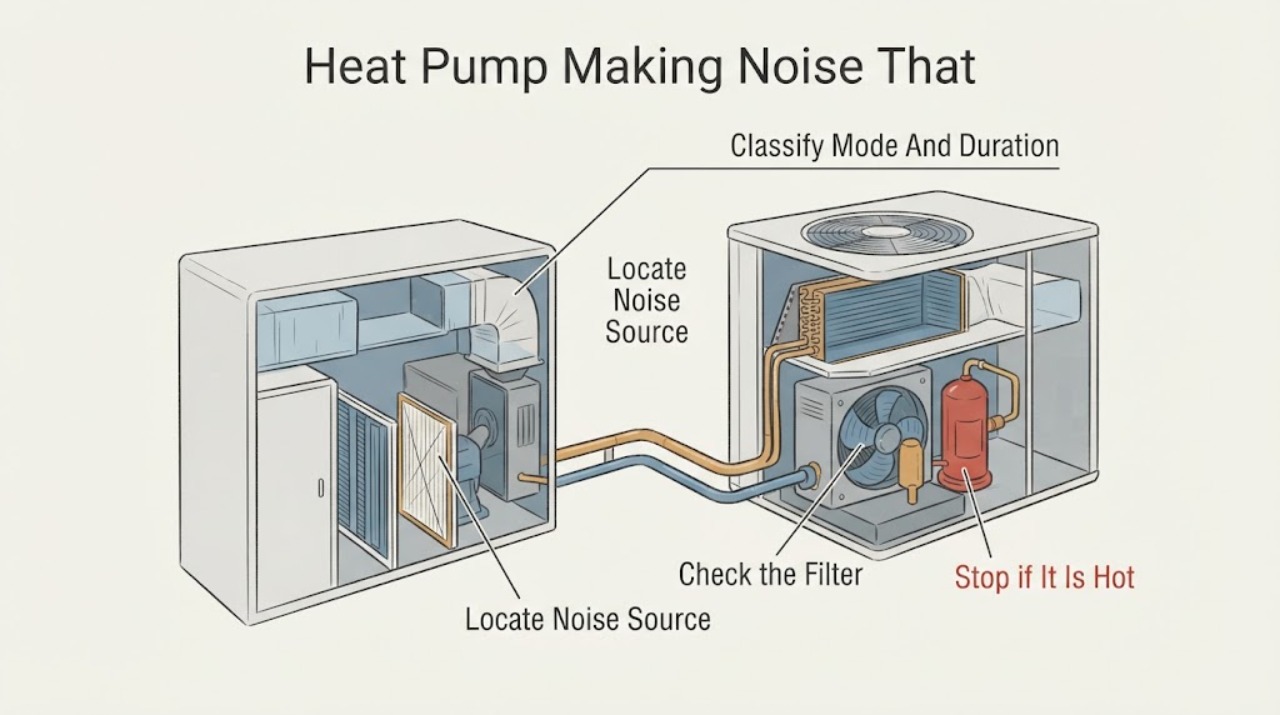
A heat pump can sound different in heating and cooling because the reversing valve changes refrigerant direction and the fans, compressor, and coil pressures operate differently. A brief whoosh or low hiss during startup, shutdown, a mode change, or a normal defrost cycle can be expected, but a new loud, grinding, rattling, high-pitched, or constant sound is not identified by mode alone. Note the exact sound, where it comes from, whether it occurs only during a mode change or throughout heating or cooling, and whether airflow or comfort also changes. Check only the thermostat mode, accessible filter, and visible outdoor airflow path with the equipment off as directed by its manual. Do not remove panels, touch refrigerant or electrical parts, chip ice, or force a reversing valve. Turn the system off and arrange qualified HVAC service for a loud or worsening noise, loss of heating or cooling, repeated short cycling, ice that does not clear, burning odor, damaged wiring, or any sound accompanied by a safety concern.
Work through in order
Diagnostic checks
Use only checks that match the exact appliance or system and its official guide.
-
Check 1
From a safe location, record whether the noise occurs only when changing from Heat to Cool or Cool to Heat, during the first seconds of a call, during the entire heating cycle, during the entire cooling cycle, or during an apparent defrost event; do not switch modes repeatedly to provoke it.
Expected result: The sound is brief at a mode transition, brief at startup or shutdown, present only in heating, present only in cooling, or continuous in both modes.
Next step: Keep a written or safe audio record and proceed to location and sound-type checks. Stop using the unit and arrange HVAC service if the noise is loud, worsening, continuous, or accompanied by poor heating or cooling.
Stop if: Do not repeatedly cycle the thermostat, stand near exposed moving parts, or continue a test if there is a burning odor, electrical smell, smoke, gas odor, or risk of contact with the equipment.
Why this matters
Why: A brief whoosh or low hiss at a transition can fit refrigerant direction change or normal operating control. A sound that continues through one mode points more toward a fan, blower, compressor, airflow, cabinet, or duct issue; a sound in both modes makes a common mechanical or installation issue more likely than a mode-specific valve event.
-
Check 2
Without opening equipment, identify whether the sound is loudest at the outdoor unit, indoor air handler, supply or return duct, or a wall; note whether airflow from the registers changes when the sound appears.
Expected result: The noise is outdoors near the fan or compressor, indoors near the blower, at a register or duct, or its location cannot be isolated safely.
Next step: Record the location and whether airflow changes, then use the result to choose the service description. Do not remove grilles, panels, or covers to listen closer.
Stop if: Keep clear of the outdoor fan and electrical enclosure. Do not put hands, tools, or a phone through a grille or reach into an air handler.
Why this matters
Why: An outdoor location keeps fan, compressor, coil, reversing-valve, defrost, and cabinet causes in focus. An indoor location keeps blower, filter, coil, cabinet, or duct causes in focus. A register or wall vibration can transmit a normal operating sound or a loose component, but location alone cannot identify the failed part.
-
Check 3
Check the thermostat display and accessible settings, confirm the intended Heat or Cool mode rather than an unintended automatic changeover, and with the system off inspect or replace the accessible air filter only as the equipment manual specifies.
Expected result: The thermostat is in an unintended mode, the fan is set to run continuously, the filter is visibly dirty or blocked, or settings and filter are normal.
Next step: Correct only an obvious setting or filter issue and observe one normal cycle. If the noise remains, worsens, or occurs with poor comfort, leave deeper diagnosis to an HVAC professional.
Stop if: Do not remove equipment panels, change wiring, reset a repeatedly tripping breaker, operate without a filter, or use a filter that does not match the manual.
Why this matters
Why: An unintended mode or continuous fan can make a normal fan sound appear mode-related. A restricted filter can increase airflow noise and system strain. Normal settings and a clean filter leave the outdoor unit, blower, controls, cabinet, and refrigerant circuit as unresolved possibilities.
-
Check 4
With the heat pump off and the fan stopped, inspect from outside for leaves, snow, ice buildup, branches, or other visible blockage around the outdoor coil and discharge path; remove only loose debris that is clearly reachable without tools and follow the unit manual.
Expected result: The outdoor airflow path is clear, loose debris is present, the coil is coated with ice, the fan or cabinet appears damaged, or the area cannot be checked safely.
Next step: Remove only loose external debris without bending the coil or fan, then monitor one normal cycle. Do not chip ice or pour water on the unit; arrange service if ice persists, the noise is abnormal, or performance is reduced.
Stop if: Do not enter unsafe areas, climb, disassemble the outdoor unit, touch wiring, bend coil fins, chip ice, or run the system with a damaged fan or exposed electrical hazard.
Why this matters
Why: Restricted outdoor airflow can increase operating noise and reduce heating or cooling performance. A small amount of frost can occur in heating, but heavy ice, a fan that does not operate as expected, damaged cabinet parts, or a blocked coil can indicate a defrost, airflow, fan, or refrigerant problem that a visual check cannot repair.
-
Check 5
If the noise occurs only during cold-weather heating, note from a safe distance whether the outdoor fan stops, the system briefly changes behavior, steam or water appears as ice clears, and normal heating returns afterward; do not manually start or interrupt defrost.
Expected result: The sound is brief and the system resumes normal heating, the sound is loud or prolonged, ice remains, heating does not return, or the event cannot be identified as defrost.
Next step: Document the timing and outdoor conditions. Leave the system off and arrange qualified HVAC service if the noise is excessive, defrost does not complete, the unit remains iced, or the home loses heat.
Stop if: Do not force a mode change, chip ice, pour hot water on the coil, bypass a defrost control, or work inside the outdoor cabinet.
Why this matters
Why: A short mode-related hum or whoosh with a stopped fan can fit a normal defrost sequence. A prolonged or violent sound, persistent ice, repeated abnormal defrost, or failure to return to heating points toward a defrost control, fan, coil, refrigerant, compressor, or reversing-valve problem and is not cleared by waiting indefinitely.
-
Check 6
Prepare the model and serial label, thermostat mode, sound description, location, duration, outdoor temperature or weather, airflow or comfort change, filter condition, ice or debris observations, and a safe recording made from outside the equipment area.
Expected result: The sound is repeatable in one mode, tied only to transitions or defrost, present in both modes, or paired with reduced heating, cooling, airflow, ice, repeated cycling, or a warning odor.
Next step: Give the record to a qualified HVAC technician and request diagnosis of the complete operating sequence rather than ordering a part from the noise description alone.
Stop if: Do not open the cabinet, test capacitors or voltage, handle refrigerant, bypass controls, or continue operating equipment that is unsafe or making a damaging noise.
Why this matters
Why: A mode-and-duration record helps a technician separate a normal refrigerant or defrost transition from an abnormal fan, blower, compressor, reversing-valve, airflow, control, or cabinet condition. A paired performance or safety symptom raises the priority of service.
Use your observations
Decision map
Find the observation that best matches what you see, then follow the next safe action.
-
PATH 01Next step
What you see
The sound is a brief whoosh or low hiss only at startup, shutdown, a heating-to-cooling change, or a normal defrost transition, and comfort returns normally.
Do this next
Record the duration and monitor without repeatedly switching modes. Arrange service if the sound becomes loud, lasts longer, recurs with poor performance, or no longer resembles the usual transition.
Why this path and its safety boundary
Why it matters: Refrigerant stopping or changing direction, reversing-valve operation, and defrost behavior are more likely than a continuously failing mechanical part.
-
PATH 02Next step
What you see
The noise occurs only during cold-weather heating, the outdoor fan stops briefly, and normal heating resumes after the event.
Do this next
Keep the area clear and record the event. Call HVAC service if the event is prolonged or unusually loud, ice remains, the unit fails to return to heating, or comfort declines.
Why this path and its safety boundary
Why it matters: A normal defrost cycle is more likely; heat pumps can temporarily reverse operation to melt frost on the outdoor coil.
-
PATH 03Next step
What you see
The sound is loud, grinding, scraping, rattling, high-pitched, or constant in heating or cooling, especially near the outdoor unit or indoor blower.
Do this next
Turn the system off if the sound is severe or accompanied by vibration, reduced airflow, burning odor, or poor performance, and arrange qualified HVAC diagnosis.
Why this path and its safety boundary
Why it matters: A fan, motor, compressor, loose cabinet, blower, airflow restriction, or reversing-valve issue is more likely than a harmless mode transition; the sound pattern does not identify the component.
-
PATH 04Next step
What you see
The mode-dependent noise occurs with heavy outdoor ice, blocked airflow, weak airflow, short cycling, loss of heating or cooling, or failure to switch modes.
Do this next
Do not chip ice or open the unit. Leave it off and call a qualified HVAC technician, providing the model and the documented sound and performance pattern.
Why this path and its safety boundary
Why it matters: An airflow, defrost, refrigerant, fan, control, compressor, or reversing-valve fault becomes more likely, and continued operation may worsen the condition.
-
PATH 05Next step
What you see
The sound is strongest at the indoor air handler, filter, register, or duct and changes with fan operation or airflow, while the outdoor unit appears normal.
Do this next
Check only the accessible filter and thermostat fan setting. If the noise remains or airflow is abnormal, arrange HVAC service rather than opening the blower cabinet.
Why this path and its safety boundary
Why it matters: Filter restriction, blower or cabinet vibration, louver movement, or duct expansion and transmission is more likely than an outdoor reversing-valve fault, but an airflow check may still be needed.
Helpful context
Understand the symptom
Mode-related sounds can be normal, but the sound pattern matters
Heating and cooling use the same heat pump in opposite refrigerant directions. A short whoosh or low hiss at a mode change can be refrigerant stopping or changing direction, and a defrost event can temporarily reverse the cycle and stop the outdoor fan. That does not make every mode-dependent noise normal: a sound that is newly loud, continuous, grinding, scraping, rattling, or accompanied by poor comfort needs service diagnosis.
Separate the mode transition from the operating sound
Write down whether the noise lasts only a few seconds while switching, appears only in heating, appears only in cooling, or continues for the full call. Also note whether it is indoors at the air handler or registers, outdoors at the compressor and fan, or transmitted through a wall or duct. These distinctions help a technician consider the reversing valve, defrost operation, fan or blower, compressor, airflow, cabinet, and ductwork without guessing at a part.
Keep homeowner checks outside the cabinet
The safe homeowner checks are limited to settings, an accessible filter, and visible clearance around the outdoor unit. Do not remove service panels, measure live voltage, open the refrigerant circuit, bend fan blades, chip ice, or bypass controls. Refrigerant, electrical, compressor, reversing-valve, and defrost diagnosis belongs to a qualified HVAC professional.
Safety boundary
Stop conditions
- Stop the unit and seek qualified HVAC service for a loud, grinding, scraping, rattling, high-pitched, or constant noise; heavy or persistent ice; damaged fan or wiring; repeated short cycling; failure to heat, cool, defrost, or change modes; burning or electrical odor; smoke; or a breaker that trips again. Leave immediately and contact emergency help or the utility as appropriate for smoke, fire, or another immediate hazard. Do not remove panels, touch live electrical parts, handle refrigerant, chip ice, force a reversing valve, bypass a control, or continue repeated mode tests.
Only after diagnosis
Potential parts
- reversing valve or reversing-valve coil
Consider this only if a qualified technician confirms abnormal mode switching or excessive valve noise rather than a normal brief refrigerant transition.
Confirm the complete indoor and outdoor unit model and the manufacturer's service information before any part is selected. - outdoor fan motor or fan assembly
Consider this only if professional testing links the mode-dependent noise, vibration, or airflow loss to the outdoor fan or motor.
Do not infer fit from appearance; the technician must confirm the unit model, electrical specification, and manufacturer-approved component. - indoor blower motor or blower wheel
Consider this only when the sound is located at the indoor air handler and professional inspection confirms a blower or motor defect.
Verify the air-handler model and approved replacement specification before ordering or installing anything.
When checks do not resolve it
Need a professional?
Call a qualified HVAC technician when the noise is new, worsening, mode-specific but abnormal, present through a full cycle, or accompanied by reduced airflow, poor comfort, ice, vibration, leaks, repeated cycling, or failure to switch modes. A brief familiar transition sound with normal performance can be documented and monitored, but it should still be evaluated if its pattern changes.
Have this ready
- Provide the model and serial information, mode and duration, sound location and description, weather, airflow or comfort change, filter and outdoor clearance observations, and a safe recording.
Common questions
FAQ
Is it normal for a heat pump to sound different in heating and cooling?
Yes, a brief whoosh, hiss, or hum can occur because the reversing valve changes refrigerant direction and because defrost changes the heating operation. A new loud, grinding, rattling, high-pitched, or constant sound is not established as normal by the mode alone and needs service if it persists.
Why does my heat pump hum only in heating mode?
In cold weather, a brief heating-only hum can occur during defrost while the outdoor fan is stopped and the system temporarily reverses operation to thaw the coil. If the hum is loud, continuous, prolonged, or paired with ice or poor heat, turn the unit off and call an HVAC technician.
What does a whooshing noise during a mode change mean?
A gentle, short whoosh can be refrigerant stopping or changing direction through the reversing valve. Carrier describes that as typically normal, but excessive or constant reversing-valve noise should be investigated by a qualified technician.
Can a dirty filter make a heat pump sound louder in one mode?
A restricted filter can change airflow and make indoor airflow noise or system strain more noticeable, but it does not prove that the filter is the cause of a mode-dependent sound. Inspect or replace an accessible filter according to the equipment instructions, then arrange service if the sound or comfort problem remains.
Should I chip ice off a noisy heat-pump outdoor unit?
No. Do not chip ice or reach into the outdoor unit. A little frost can occur during heating, but heavy ice, a failed defrost event, or reduced performance can involve airflow, fan, defrost, refrigerant, or control problems and should be assessed by a qualified HVAC professional.
When should I turn off a noisy heat pump?
Turn it off and arrange service for a loud or worsening noise, grinding, scraping, severe vibration, persistent ice, poor heating or cooling, repeated short cycling, failure to switch modes, burning or electrical odor, smoke, or damaged wiring. Leave immediately and seek emergency help for fire or another immediate hazard.
Read the exact guide
Official sources
- Heat Pump TroubleshootingCarrier · Manufacturer guidance on reversing-valve whooshing, excessive or constant valve noise, outdoor airflow, ice, defrost, and professional diagnosis.
- Is This Normal? HVAC Smells and Sounds, ExplainedTrane · Manufacturer guidance on normal and abnormal HVAC sounds, including heat-pump humming during defrost.
- Ductless Heating & CoolingENERGY STAR · Government-backed energy-efficiency guidance applicable to ductless heat pumps and general heat-pump outdoor clearance, explicit mode selection, and filter checks.
- What Is a Heat Pump, and How Does It Work?Carrier · Manufacturer explanation of the reversing valve, refrigerant flow, outdoor and indoor coils, and the different heating and cooling operating directions.
- Maintenance ChecklistENERGY STAR · Government-backed maintenance guidance for thermostat controls, electrical connections, airflow, condensate, coils, blower components, and accessible filters.
Community feedback
Share a repair observation
Share a plain-text repair observation. Accepted observations are published automatically; this page may take a moment to update.