
On this page
Start here
Quick answer
A Goodman heat pump can make normal hums, airflow sounds, clicks, or temporary defrost sounds, but a new or worsening rattle, roar, screech, grinding, loud buzz, hissing, or vibration needs attention. First note whether the sound comes from the outdoor unit, indoor air handler, duct/register, or refrigerant-line area and whether it occurs at startup, shutdown, heating, cooling, or defrost. From a safe position, check that the outdoor unit is not covered or blocked by leaves, snow, debris, or a nearby object, that accessible indoor registers and the filter are not obstructed, and that nothing is visibly loose or rubbing. Goodman explains that sound changes can reflect debris, loose parts, bearings, motor components, fan imbalance, coils, filters, piping, or the compressor, while it recommends licensed professional inspection for system concerns. A brief increase in heat-pump noise during defrost can be normal, but it should settle; loud or persistent hissing may indicate refrigerant or compressor trouble. Shut the system off and arrange qualified HVAC service for grinding, severe vibration, electrical or burning odor, refrigerant-like hissing, an outdoor fan that binds, ice that does not clear, or any noise that starts suddenly and affects heating or cooling. Do not open panels, touch the fan or compressor, tighten live electrical parts, add refrigerant, or lubricate components by guesswork.
Before you begin
Safety first
- Homeowner checks should remain limited to sound location and timing, safe external debris and clearance observations, model-correct filter and register checks, and defrost or performance documentation. A qualified technician should inspect the fan, blower, compressor and electrical components, refrigerant lines, controls, defrost system, airflow, drain paths, and mounting.
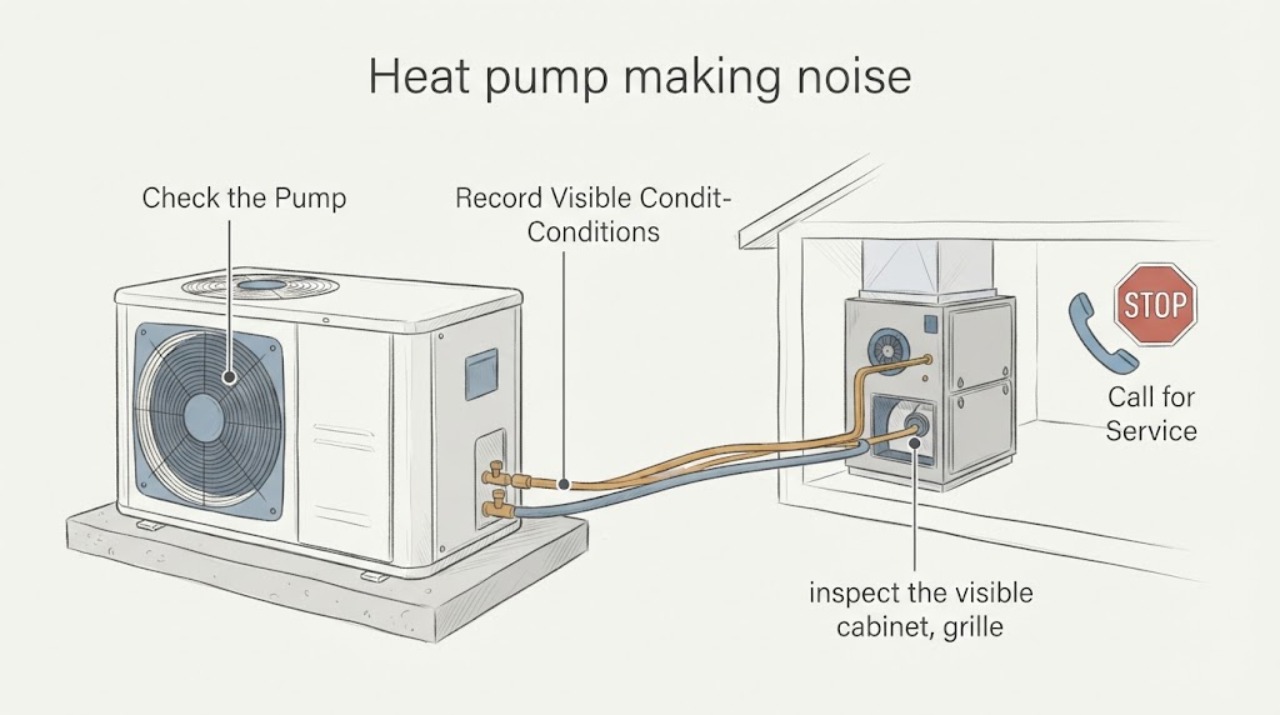
Work through in order
Diagnostic checks
Use only checks that match the exact appliance or system and its official guide.
-
Check 1
Turn the heat pump off from the thermostat and disconnect power only from a safe position if there is smoke, burning or electrical odor, sparks, severe vibration, grinding, a hot or discolored disconnect, refrigerant-like hissing, or visible damage; do not approach moving parts.
Expected result: The sound is a mild familiar operating hum with no hazard sign, or it is sudden, severe, worsening, or accompanied by odor, heat, smoke, sparks, leak, or damage.
Next step: For smoke, fire, or electrical danger, leave the area and use emergency help. For severe or leak-like noise, keep the system off and arrange qualified HVAC service. Otherwise continue with cool, external checks only.
Why this matters
Why: A normal operating sound can be observed safely, but a new severe mechanical, electrical, or refrigerant symptom can cause injury or equipment damage if the unit keeps running.
-
Check 2
From safe positions, identify whether the sound comes from the outdoor cabinet, indoor air handler, duct or register, refrigerant-line area, or a nearby object; record whether it occurs at startup, shutdown, during heating, cooling, defrost, or continuously.
Expected result: The sound is localized outdoors, indoors, at a register, at a line, or it travels through the structure; it is brief, mode-specific, or persistent.
Next step: Make one safe recording from a distance and stop for a new loud, grinding, hissing, or persistent sound. Do not remove covers or place a hand on the cabinet, lines, fan, or compressor.
Why this matters
Why: Location and timing distinguish airflow and duct resonance from fan, compressor, defrost, blower, electrical, or refrigerant concerns. Sound transmission can make the apparent location misleading.
-
Check 3
With the outdoor unit off, inspect the visible cabinet, grille, pad, and surrounding area for leaves, snow, ice, a loose-looking panel, a displaced object, or anything rubbing the cabinet; do not reach through the grille or remove a guard.
Expected result: Debris, snow, heavy ice, an external object, or visible vibration damage is present, or the outdoor unit appears clear and stable.
Next step: Clear only loose debris from a safe, powered-off position and keep the heat pump uncovered. Arrange service for heavy ice, damage, a loose panel, persistent noise, or anything that requires guard or panel removal.
Why this matters
Why: Debris, restricted air, an object, or cabinet vibration can create rattling or roaring without proving an internal component has failed. A clear stable exterior keeps fan, compressor, electrical, and refrigerant causes in consideration.
-
Check 4
Check the indoor filter, return grilles, and supply registers with the system off; replace a loaded filter only with the exact model-approved type and make sure furniture or drapes are not blocking airflow.
Expected result: The filter is dirty or restrictive, returns or supplies are blocked, noise changes at registers, or airflow and filter condition appear normal.
Next step: Correct only an obvious filter or grille obstruction. If noise persists, airflow is weak, or heating/cooling performance changes, keep the system off as needed and arrange HVAC inspection.
Why this matters
Why: Airflow restriction can alter pressure and blower noise and can reduce comfort. Normal indoor airflow does not rule out an outdoor fan, compressor, refrigerant, or electrical fault.
-
Check 5
If the system is in heating mode and frost is visible, observe from a safe distance whether a normal defrost event clears light frost and the outdoor fan resumes; do not chip ice, use heat or flame, pour water, or force a mode change.
Expected result: Light frost clears and operation returns to its prior sound, or ice is heavy, remains, returns quickly, the fan does not resume, or comfort deteriorates.
Next step: Arrange qualified HVAC service for heavy ice, a failed defrost recovery, persistent noise, or poor heating. Do not operate through severe icing or open the outdoor cabinet.
Why this matters
Why: A temporary defrost sound and light frost can be normal. Heavy or persistent ice can restrict airflow and indicate a defrost, refrigerant, airflow, sensor, or control problem.
-
Check 6
Compare the noise with the selected mode and thermostat call without repeatedly cycling the system; note whether the heat pump still heats or cools, the indoor blower runs, and any display or control alert appears.
Expected result: The sound occurs only at startup or shutdown, during defrost, in one mode, with reduced comfort, with an alert, or regardless of mode and call.
Next step: Save the alert and timing, then stop for persistent loud noise, hissing, grinding, or performance loss. Arrange service for internal fan, compressor, electrical, refrigerant, control, or duct diagnosis.
Why this matters
Why: A mode-specific or defrost-linked sound may be an operating transition, while a new sound with reduced comfort or an alert points toward a system fault. Repeated cycling cannot identify the component safely.
-
Check 7
Gather the exact Goodman model, indoor and outdoor unit locations, sound description and recording, mode and timing, frost or debris findings, filter and register condition, thermostat or fault alert, weather, recent maintenance, and heating or cooling performance.
Expected result: The sound is new, worsening, difficult to localize, persistent after external checks, associated with ice or an odor, or accompanied by reduced comfort.
Next step: Give the record to a qualified HVAC technician and request inspection of airflow, fan and blower, compressor and electrical components, refrigerant lines, controls, drain paths, defrost operation, and mounting as applicable.
Why this matters
Why: This pattern keeps fan, blower, compressor, capacitor, controls, refrigerant lines, defrost, airflow, duct, and mounting causes in consideration. No single noise description proves which part needs replacement.
Use your observations
Decision map
Find the observation that best matches what you see, then follow the next safe action.
-
PATH 01Next step
What you see
The sound is a brief, familiar hum or click at startup or shutdown, the system performs normally, and no vibration, odor, ice, or alert appears.
Do this next
Record the normal pattern and monitor without repeated testing. Arrange service if the sound becomes louder, persists, changes character, or affects comfort.
Why this path and its safety boundary
Why it matters: A normal operating transition is more likely than a failing component, but the baseline matters and a change should be monitored.
-
PATH 02Next step
What you see
The outdoor unit rattles or roars and visible debris, snow, ice, an object, or a loose-looking external panel is present.
Do this next
Turn the system off, clear only safe loose debris, keep the unit uncovered, and arrange service if the noise or vibration remains or a guard/panel is involved.
Why this path and its safety boundary
Why it matters: An external airflow or vibration source is more likely than an internal compressor fault, although the noise may have caused or exposed damage.
-
PATH 03Next step
What you see
The sound appears during defrost with light frost, then settles and heating returns normally.
Do this next
Do not interrupt or force defrost. Arrange service if ice becomes heavy, the fan fails to resume, the sound continues outside defrost, or heating performance declines.
Why this path and its safety boundary
Why it matters: A normal defrost transition is more likely than a persistent mechanical fault.
-
PATH 04Next step
What you see
A new hum, screech, grinding, hissing, or severe vibration persists outside a normal transition or occurs with reduced heating/cooling.
Do this next
Shut the system off and arrange qualified HVAC service. Do not touch moving or energized parts, open panels, add refrigerant, or lubricate components by guesswork.
Why this path and its safety boundary
Why it matters: Fan, blower, compressor, capacitor, refrigerant, electrical, mounting, or control trouble is more likely than normal operation.
-
PATH 05Next step
What you see
The noise is accompanied by smoke, burning or electrical odor, sparks, a hot disconnect, refrigerant-like hissing or leak, fan binding, severe vibration, or ice that blocks operation.
Do this next
Leave the area for smoke or fire, disconnect only from a safe position, keep the system off, and arrange qualified HVAC or electrical service; use emergency help for active fire.
Why this path and its safety boundary
Why it matters: An electrical, refrigerant, mechanical, or equipment-damage hazard outweighs ordinary sound troubleshooting.
Helpful context
Understand the symptom
Locate the sound before naming a part
A noise can travel through refrigerant lines, ductwork, registers, framing, or the cabinet. Listen from safe positions at the outdoor unit, indoor air handler, and nearest registers; do not put hands through grilles or remove panels. The location, timing, mode, and effect on comfort are more useful than calling every noise a compressor problem.
Some heat-pump sounds are part of normal operation
A heat pump may hum as the compressor runs, click as controls change state, and make a temporary change in sound during defrost. Goodman says light frost can trigger automatic defrost, and Trane notes the outdoor fan may stop while the heat pump reverses operation to melt ice. A new, loud, persistent, or worsening sound outside that pattern is not something to normalize.
External debris and vibration are safe first checks
Leaves, snow, ice, a loose grille, a displaced object, or a panel that visibly rattles can make the outdoor unit noisy. The unit should not be covered in winter, because Goodman says it needs outdoor air through its vents. Clear only loose debris from a powered-off, safe exterior; do not reach near the fan or remove guards.
Indoor airflow can change noise too
A clogged filter, blocked return, closed register, restrictive duct, or blower issue can change pressure and make sounds echo through the duct system. Goodman says filters, supply vents, and airflow should be considered during maintenance. Replace a model-correct filter only when the system is off and leave blower, electrical, and refrigerant work to a technician.
Frost and mode change the meaning of a hum
Light frost in heating mode can be normal when a defrost control clears it. Heavy ice, ice that returns quickly, a fan that does not resume, or poor heating indicates a service condition. Do not chip ice, pour water on the unit, use a flame, or force the system into a mode to reproduce the sound.
Refrigerant and electrical boundaries are firm
Hissing near refrigerant lines or a sudden outdoor roar can involve a leak, compressor, capacitor, contactor, or fan motor. These systems contain energized components and pressurized refrigerant. Turn the system off for persistent or hazardous noise and provide the sound timing and location to qualified HVAC service.
Safety boundary
Stop conditions
- Shut the heat pump off for grinding, screeching, severe vibration, persistent hissing, smoke, burning or electrical odor, sparks, a hot or discolored disconnect, visible refrigerant leak, or a fan that binds; use emergency help for active fire.
- Do not open the outdoor or indoor cabinet, reach through fan guards or registers, touch energized wiring, tighten electrical terminals, add refrigerant, chip ice, use flame or hot water, or lubricate internal parts.
- Do not cover the outdoor heat pump, block its vents, force a defrost or mode change, run through heavy ice, or repeatedly cycle the system to reproduce an abnormal sound.
- Arrange qualified HVAC service when a new or worsening noise persists after safe external checks, appears with reduced heating or cooling, returns after defrost, or cannot be localized to a safe external cause.
Only after diagnosis
Potential parts
- heat-pump outdoor fan or fan motor
Consider only when a qualified technician confirms a worn, obstructed, unbalanced, or failed fan or motor after debris and airflow causes are evaluated; noise alone is not proof.
Match the exact Goodman model, motor, blade, rotation, connector, controls, and airflow requirements; guard and electrical access are service work. - heat-pump compressor or start component
Consider only after professional testing confirms compressor, capacitor, contactor, or start-circuit trouble; startup hum or roar can also be a normal transition or mounting vibration.
Match the exact outdoor-unit model and electrical specifications; do not test live terminals or replace a pressurized-system component by guesswork. - heat-pump defrost control or sensor
Consider only when heavy or recurring ice and failed defrost operation are confirmed by a technician; light frost and a brief defrost sound can be normal.
Match the exact Goodman model, sensor arrangement, board, wiring, and approved defrost procedure; do not force or bypass defrost controls. - heat-pump air filter or airflow component
Consider filter replacement only for a loaded or damaged filter and other airflow parts only after testing confirms a blower or duct restriction; a noisy outdoor unit may have another cause.
Match the exact system, filter dimensions, airflow direction, blower configuration, and owner instructions; do not substitute a restrictive filter without approval.
When checks do not resolve it
Need a professional?
Safety scope: Homeowner checks should remain limited to sound location and timing, safe external debris and clearance observations, model-correct filter and register checks, and defrost or performance documentation. A qualified technician should inspect the fan, blower, compressor and electrical components, refrigerant lines, controls, defrost system, airflow, drain paths, and mounting.
Common questions
FAQ
Is a humming noise from a Goodman heat pump always a problem?
No. A steady operating hum or a brief defrost-related change can be normal. A new, louder, persistent, rattling, grinding, hissing, or vibration-related hum—especially with poor comfort—needs qualified HVAC inspection.
Why does my heat pump get louder during defrost?
During defrost, the system changes operation to melt light outdoor frost, and the outdoor fan may stop temporarily. The sound should settle and normal heating should return; heavy ice or noise that persists outside defrost requires service.
Can leaves or snow make a Goodman heat pump noisy?
Yes. Debris, snow, ice, a blocked cabinet, or an object near the fan can change airflow and create rattling or roaring. Turn the system off and clear only loose, safely reachable debris; do not remove guards or operate through heavy ice.
Should I replace the capacitor or compressor because the heat pump is loud?
No. Similar sounds can come from a fan, blower, mounting, airflow, control, refrigerant, or normal mode transition. A qualified technician should identify the source and test the component before any replacement.
Read the exact guide
Official sources
- Is This Normal? HVAC Smells and Sounds, ExplainedTrane · Trane distinguishes temporary defrost humming from persistent abnormal noise and advises shutting down and arranging repair for loud, hissing, mechanical, or electrical symptoms.
- Why Does my Neighbor's Air Conditioner Sound Loud?Goodman · Goodman explains normal cycling sounds, sound changes and potential mechanical or airflow causes, and lists professional maintenance checks relevant to a heat-pump outdoor and indoor system.
- Heat pump common questions and answersGoodman · Goodman explains that heat pumps need outdoor airflow, can develop light frost and automatic defrost, and should receive professional attention for heavy ice or comfort problems.
Community feedback
Share a repair observation
Share a plain-text repair observation. Accepted observations are published automatically; this page may take a moment to update.